


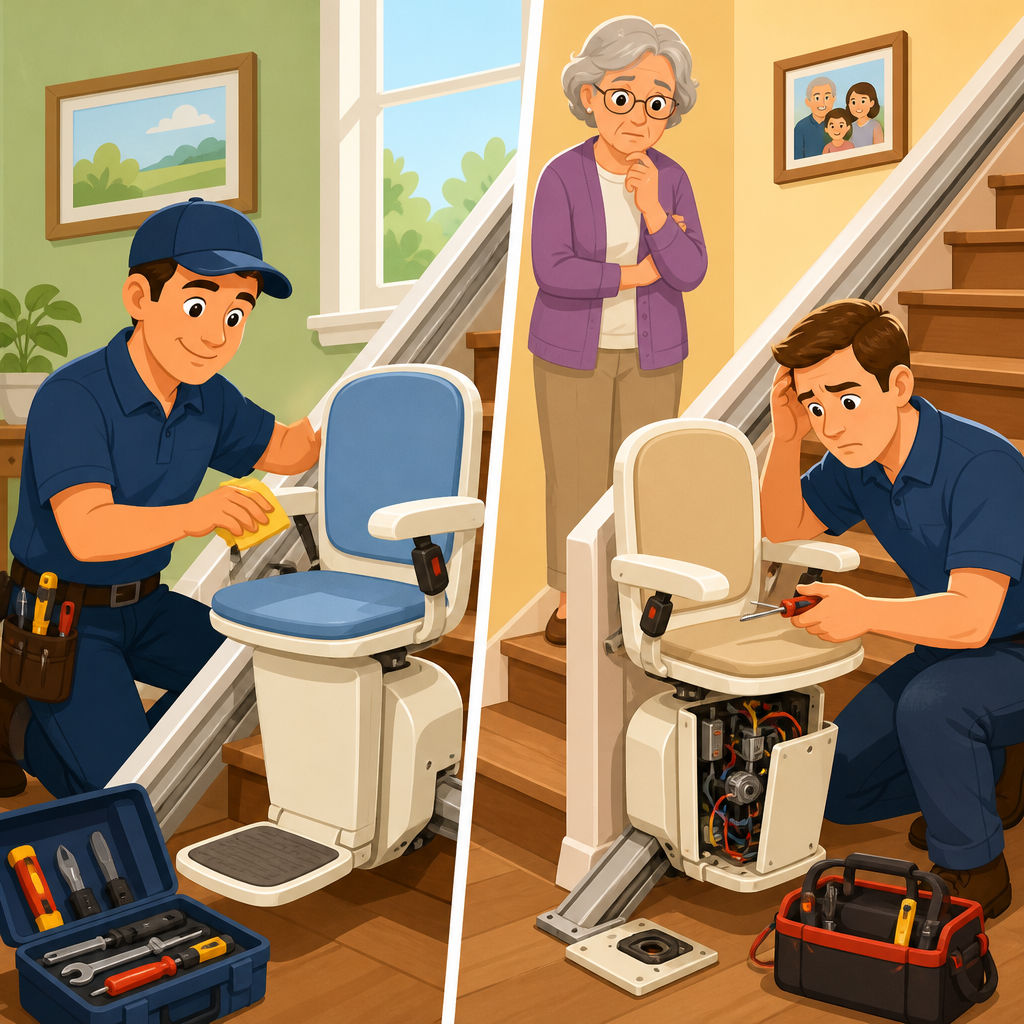
Homeowners often ask whether an annual stair lift service is the same thing as calling for a repair visit, and the short answer is no: one is preventive maintenance scheduled to keep the lift safe and reliable, while the other is corrective work performed after a fault, breakdown, or visible change in performance. Understanding that difference matters because stair lifts are mobility devices, not ordinary household appliances. They carry people on a rail system, rely on batteries, charging contacts, safety edges, seat interlocks, and drive components, and must operate predictably every time. In my experience working around residential accessibility equipment, confusion usually starts when a lift still runs but begins to hesitate, beep, stop midway, or drain batteries faster than normal. Many owners assume that if the lift is moving, it can wait until something fails. That assumption often turns a low-cost annual inspection into an urgent repair with higher parts, labor, and downtime.
An annual stair lift service is a planned inspection and tune-up performed on a working unit. A repair visit addresses a specific defect such as a charging fault, worn batteries, rail obstruction, seat swivel interlock issue, faulty call/send control, or gearbox problem. Both visits may include testing and adjustments, but their purpose, scope, and urgency differ. This distinction is important for safety, budgeting, warranty compliance, and long-term equipment life. It also matters for family caregivers, occupational therapists, and adult children managing a parent’s home, because preventive service helps identify wear before it affects transfers on the staircase. This hub article explains annual inspections in detail, shows what happens during service versus repair, and gives practical guidance on when to schedule each type of visit.
What an annual stair lift service includes
An annual stair lift service is a preventive maintenance appointment designed to confirm that the stair lift is operating within manufacturer expectations and that safety systems are functioning correctly. On most modern units from Bruno, Stannah, Handicare, Acorn, Harmar, or Access BDD, the technician begins with a functional check: seat up and down positions, arm operation, footrest security, swivel lock engagement, call/send stations, remote controls, travel speed, start-stop smoothness, final limit operation, and parking behavior on charging points. If the model has diagnostic codes, those are reviewed before any adjustments are made. The goal is to find small changes that indicate wear, contamination, or misalignment before a stoppage occurs.
During service, the technician typically inspects the rail for debris, verifies rack or track condition, checks carriage rollers or guidance surfaces, examines wiring looms for abrasion, confirms battery voltage and charger output, and tests safety edges on the footrest and carriage. On a hinged rail system, hinge movement and lower obstruction protection are also checked. A proper annual inspection usually includes cleaning charging contacts, removing lint and pet hair from vulnerable areas, tightening accessible fasteners to specification, and applying only the lubricants approved by the manufacturer. That last point matters. Many stair lifts use geared or sealed systems that can be damaged by over-lubrication or the wrong spray product. A generic “oil everything” approach is poor practice and often creates more problems than it solves.
Another key element of annual service is documentation. A competent company records model and serial number, battery readings, charger status, observed wear, parts approaching end of life, and any recommendations. If the lift is under warranty or a service contract, those notes can support future claims. Annual service is not just a box-ticking exercise. It is the routine checkpoint that confirms the lift remains fit for daily use.
What happens during a repair visit
A repair visit is different because it starts with a symptom, not a schedule. The customer reports that the lift is beeping, not charging, stopping at random, moving only in one direction, refusing to start, or displaying a fault code. The technician’s first task is diagnosis. That means reproducing the problem, checking power supply, reading onboard diagnostics where available, isolating whether the issue is mechanical, electrical, or user-interface related, and then identifying the failed component or condition causing the fault. The repair process may require replacement parts, additional labor time, or a return visit if uncommon components are not stocked on the van.
Typical repair causes include battery failure after years of cycling, charger malfunction, dirty or misaligned charging strips, worn seat switch contacts, damaged wiring, failed printed circuit boards, broken remotes, or an obstruction sensor that remains triggered. In homes with pets, dust, hair, and carpet fibers can interfere with moving parts or charging surfaces. In coastal properties, corrosion at contacts is more common. In homes with inconsistent power, surge events sometimes affect chargers or control boards. Unlike annual service, a repair visit is reactive. The lift has already shown a fault or failed to operate normally.
Repair visits also carry more uncertainty. Some faults are obvious, such as a dead charger with no output. Others are intermittent and take time to trace, especially on older lifts where multiple worn components contribute to the same symptom. A unit that stops midway, for example, may have weak batteries, a charging issue, increased mechanical drag, or a safety edge intermittently opening circuit continuity. That is why repair pricing can vary more than routine annual service. Diagnosis is skilled work, and the fix may range from cleaning contacts to replacing major components.
Annual inspections versus repairs: the practical differences
The easiest way to understand the difference is to compare purpose, timing, and outcome. Annual stair lift service is planned preventive care for a lift that is still operating. A repair visit is unscheduled corrective action for a lift that is not operating properly. Service reduces the chance of breakdowns; repairs restore function after a problem appears. Service budgets are usually predictable; repair costs depend on the fault, parts availability, and the age of the lift. Service protects reliability; repairs recover reliability after it has been lost.
| Aspect | Annual Stair Lift Service | Repair Visit |
|---|---|---|
| Primary purpose | Prevent problems and verify safe operation | Diagnose and fix a fault or breakdown |
| When it happens | On a regular schedule, usually every 12 months | When symptoms, errors, or failure occur |
| Lift condition at start | Usually working normally | Partly working, unreliable, or not working at all |
| Typical tasks | Inspection, testing, cleaning, adjustment, battery and charger checks | Fault finding, part replacement, reset, wiring repair, component testing |
| Cost pattern | More predictable | Variable depending on diagnosis and parts |
| Main benefit | Lower risk of interruption and earlier detection of wear | Restored operation after a problem affects use |
There is overlap, of course. During annual service, a technician may discover a worn part that should be replaced, which turns preventive maintenance into a small repair. Likewise, during a repair visit, a conscientious technician may perform additional safety checks once the fault is corrected. Still, the core distinction remains clear: maintenance preserves condition, while repair addresses failure.
Why annual inspections matter for safety and reliability
Stair lifts are built with multiple safety layers, but every layer depends on proper condition and adjustment. The seat swivel lock must engage fully so users can dismount onto the landing rather than the stairs. The footrest and carriage safety edges must stop the lift if they strike an obstacle. Charging circuits must keep batteries healthy because most stair lifts use battery power for travel even when plugged into household electricity. If batteries deteriorate unnoticed, the lift may slow, beep, or stop during a power outage when it is needed most. Annual inspections matter because they test those safety functions under controlled conditions rather than waiting for a real-life failure.
Reliability is just as important as safety. For many users, the stair lift is the only practical route between floors. A breakdown can interrupt medication access, bathroom use, sleeping arrangements, and caregiver routines. In one common scenario, an owner ignores minor beeping for weeks because the lift still runs. By the time a technician is called, the batteries have deep-cycled repeatedly due to poor charging contact. What could have been a simple contact clean and alignment check during annual service becomes a battery replacement job. Preventive visits reduce that cascade because they identify reduced charger output, dirty contacts, and declining battery performance earlier.
Annual inspections also help with older units. Parts support varies by manufacturer and model age. When a lift is ten or more years old, a service visit can flag whether batteries, rollers, hinge assemblies, or electronic components are nearing end of life. That gives families time to plan instead of facing an emergency replacement after a sudden failure.
Common issues found during annual stair lift service
Most annual visits do not reveal dramatic faults. They reveal small, predictable forms of wear. Battery capacity loss is among the most common findings, especially on lifts used several times a day or parked off the charge point. Sealed lead-acid batteries often need replacement every few years, though life depends heavily on use patterns and charging consistency. Dirty charging strips and oxidized contacts are also routine findings, particularly where cleaning products leave residue or the rail is exposed to humidity. Even slight contamination can interrupt charging enough to shorten battery life.
Technicians also often find loose seat or arm fasteners, footrest sag, remote control issues, rail debris, or hinge misalignment on folding rail systems. On some lifts, carriage rollers and guide surfaces show wear that does not yet stop operation but changes travel smoothness. Safety edges may test correctly but feel sticky because of dirt buildup. Wiring near moving joints can develop abrasion over time. None of these issues necessarily means the lift is unsafe at that moment, but each is a reason annual service has value. The point is not simply to react to failure. It is to catch deterioration while correction is inexpensive and straightforward.
User habits come into play as well. A technician may find that the lift is regularly parked away from the charging point, overloaded with bags, or used with the footrest striking stored items near the staircase. Annual inspections create an opportunity for retraining. Simple behavior changes can prevent repeat callouts and extend equipment life.
When a repair visit is necessary instead of routine service
Some symptoms mean you should stop thinking in terms of annual inspection and schedule a repair visit promptly. These include the stair lift not moving, stopping repeatedly for no clear reason, failing to charge, making unusual grinding noises, showing a persistent diagnostic code, or refusing to lock the seat in travel position. If the armrests, seat, or footrest feel loose enough to affect transfer stability, that also warrants repair attention. Likewise, any burning smell, visible cable damage, impact damage to the rail, or repeated tripping of a power supply should be treated as a fault condition, not a maintenance reminder.
A useful rule is this: if the stair lift’s basic function or safety behavior has changed, book a repair visit. Annual service is not an appropriate substitute for troubleshooting an active fault. Continuing to use a malfunctioning lift can worsen the damage. For example, a carriage that drags because of roller wear can place extra load on the drive system and batteries. A charging problem can deplete batteries to the point where the lift strands a user on one floor. A seat interlock issue can create a dangerous transfer situation at the top landing. Quick diagnosis limits secondary damage and reduces downtime.
That said, not every issue is mechanical. Sometimes the repair is user education: restoring a tripped outlet, repositioning the seat, lowering the armrest fully, or clearing an obstruction from the footrest safety edge. A good technician distinguishes between true component failure and operating conditions that mimic failure.
How service contracts, warranties, and age affect the decision
Whether you choose annual service, on-demand repair, or a full maintenance agreement often depends on warranty status and the lift’s age. New stair lifts commonly include a manufacturer warranty on major components, but labor coverage may be shorter than parts coverage. Many service providers offer plans that include one annual inspection plus discounted or included callouts. For heavy users or households where the lift is essential every day, those plans can make sense because they create predictable maintenance records and simplify response when a fault occurs.
For out-of-warranty lifts, annual inspections become more important, not less. Older batteries, chargers, hinges, and electronic boards are more likely to drift out of tolerance. A yearly service cannot prevent every failure, but it improves the odds of catching weak points early. If the model is aging out of support, use the annual inspection to ask direct questions: Are replacement batteries standard? Are boards still available? Is the rail condition good? Would upcoming repairs approach the cost of replacement? Those questions help families make rational decisions instead of reacting under pressure.
Cost should be considered over the life of the equipment, not just per visit. Skipping a modest annual service may feel economical until emergency callout fees, battery replacement, rush parts, or temporary caregiving arrangements erase the savings. The better comparison is not service cost versus zero cost. It is planned maintenance cost versus the financial and practical impact of avoidable downtime.
How to prepare for an annual inspection and choose a qualified provider
To get full value from annual stair lift service, prepare a short history before the technician arrives. Note any beeps, slower travel, changes in battery performance during outages, intermittent stops, or problems with remotes. Clear the staircase and landings so hinge sections, charge points, and rail ends are accessible. If multiple people use the lift, mention differences in experience, because an issue that appears user-specific can reveal an adjustment problem. Keep your manual available if possible, along with prior service records. Those details help the technician identify patterns rather than treating the visit as a one-time snapshot.
Provider choice matters. Use a company familiar with your brand and model, ask whether technicians carry manufacturer-approved batteries and common parts, and confirm that the visit includes safety testing, charger and battery checks, cleaning of contacts, and written documentation. Reputable companies should explain what they inspected, what they adjusted, and which items may need attention before the next annual inspection. They should also be honest about limits. If a discontinued board is becoming hard to source, you need to hear that clearly. Good maintenance advice is specific, not generic.
The bottom line is simple. Annual stair lift service and repair visits are related, but they are not the same. Service is scheduled preventive care that checks operation, safety systems, batteries, charging, alignment, and wear before a failure disrupts the household. A repair visit is targeted fault finding and corrective work after performance changes or breakdown occur. Treat annual inspections as the maintenance foundation for your stair lift, especially within a broader maintenance, troubleshooting, and safety plan. That approach improves reliability, protects users, and usually lowers long-term ownership costs. If your lift has not been inspected in the last twelve months, schedule an annual service now and address any active fault as a repair, not a wait-and-see issue.
Frequently Asked Questions
1. Is an annual stair lift service the same as a repair visit?
No. An annual stair lift service and a repair visit serve two different purposes. An annual service is preventive maintenance that is scheduled in advance to help keep the stair lift operating safely, smoothly, and reliably. During that visit, a technician typically inspects the lift’s major components, checks the batteries and charging system, tests safety features, looks for wear, makes adjustments, and confirms the unit is performing as it should. The goal is to identify small issues before they become larger, more disruptive problems.
A repair visit, by contrast, is corrective work. It usually happens after the stair lift develops a fault, stops working, starts making unusual noises, shows an error code, moves inconsistently, or has a visible change in performance. In that case, the technician’s job is to diagnose a specific problem and restore proper operation. While some inspection may happen during a repair call, the visit is focused on fixing a malfunction rather than performing routine upkeep. In short, annual service is proactive; repair is reactive.
2. What is typically included in an annual stair lift service?
An annual stair lift service usually includes a full operational and safety check of the equipment. Although the exact checklist can vary by manufacturer and model, a proper service often covers inspection of the rail, carriage, seat, footrest, controls, charging points, batteries, swivel function, seat belt, safety edges, and start-stop performance. The technician may clean key areas, check for loose fittings, confirm the unit charges correctly at the designated points, and test how the lift travels along the rail under normal operating conditions.
The visit may also include evaluating signs of wear that a homeowner might not easily notice, such as reduced battery efficiency, alignment issues, minor mechanical resistance, or early problems with switches and sensors. These checks matter because stair lifts are mobility devices that people depend on every day, often multiple times per day. A lift can still appear to be working while underlying wear is gradually increasing the risk of stoppages or erratic behavior. Regular service helps catch those warning signs early and supports long-term reliability, user confidence, and safety.
3. When should I schedule a repair visit instead of waiting for my next service appointment?
You should schedule a repair visit whenever the stair lift shows signs that something is wrong, especially if performance has changed suddenly or noticeably. Common reasons to call for a repair include the lift stopping mid-travel, failing to charge, beeping unexpectedly, displaying a fault code, moving more slowly than usual, hesitating on the rail, making grinding or clicking noises, or failing to respond consistently to the controls. Damage to the seat, footrest, rail, armrests, or safety features also warrants prompt attention.
It is generally not a good idea to wait for the next routine service if the lift is behaving abnormally. Because the stair lift is used to carry a person up and down the stairs, even small changes in operation should be taken seriously. Continuing to use a lift that is clearly malfunctioning may increase the chance of a complete breakdown or create avoidable safety concerns. If the unit is still operating but something seems off, it is wise to stop guessing and have a qualified technician assess it. Quick action often prevents a minor repair from turning into a more expensive or inconvenient one.
4. If I have regular annual servicing, can that prevent all stair lift repairs?
No. Annual servicing can reduce the likelihood of unexpected problems, but it cannot eliminate the need for repairs altogether. Preventive maintenance is designed to improve reliability, extend the life of components, and identify wear before it causes a failure. That said, stair lifts still contain electrical, mechanical, and battery-driven systems that can develop faults over time. Normal usage, age, environmental conditions, power interruptions, accidental damage, and simple component fatigue can all lead to problems that require repair even on a well-maintained unit.
Think of annual service as a way to lower risk rather than guarantee zero breakdowns. It is one of the best steps a homeowner can take to protect the lift’s performance, but it is not a substitute for repairs when something actually fails. In many cases, routine servicing helps reduce emergency callouts because technicians can spot weakening batteries, charging issues, or worn parts early. However, if a new fault develops between service appointments, a dedicated repair visit is still the right response.
5. Why does the difference between service and repair matter for homeowners?
The distinction matters because it shapes how homeowners care for a device that directly affects daily mobility, independence, and safety. If someone assumes that a repair visit and a service visit are interchangeable, they may delay essential maintenance until something goes wrong. That approach can increase the chance of inconvenience, unexpected downtime, and potentially avoidable wear. A stair lift is not just another household machine; it is equipment that supports access to different levels of the home, often for people who rely on it every day.
Understanding the difference also helps homeowners make better decisions about scheduling, budgeting, and long-term ownership. Annual servicing is part of a preventive care plan, while repair visits address specific faults that need correction. When both are used appropriately, the result is a safer and more dependable lift. Homeowners are better prepared to recognize warning signs, respond quickly when performance changes, and keep the equipment in proper working condition year after year. That combination of routine maintenance and timely repairs is the best way to support reliability and peace of mind.