


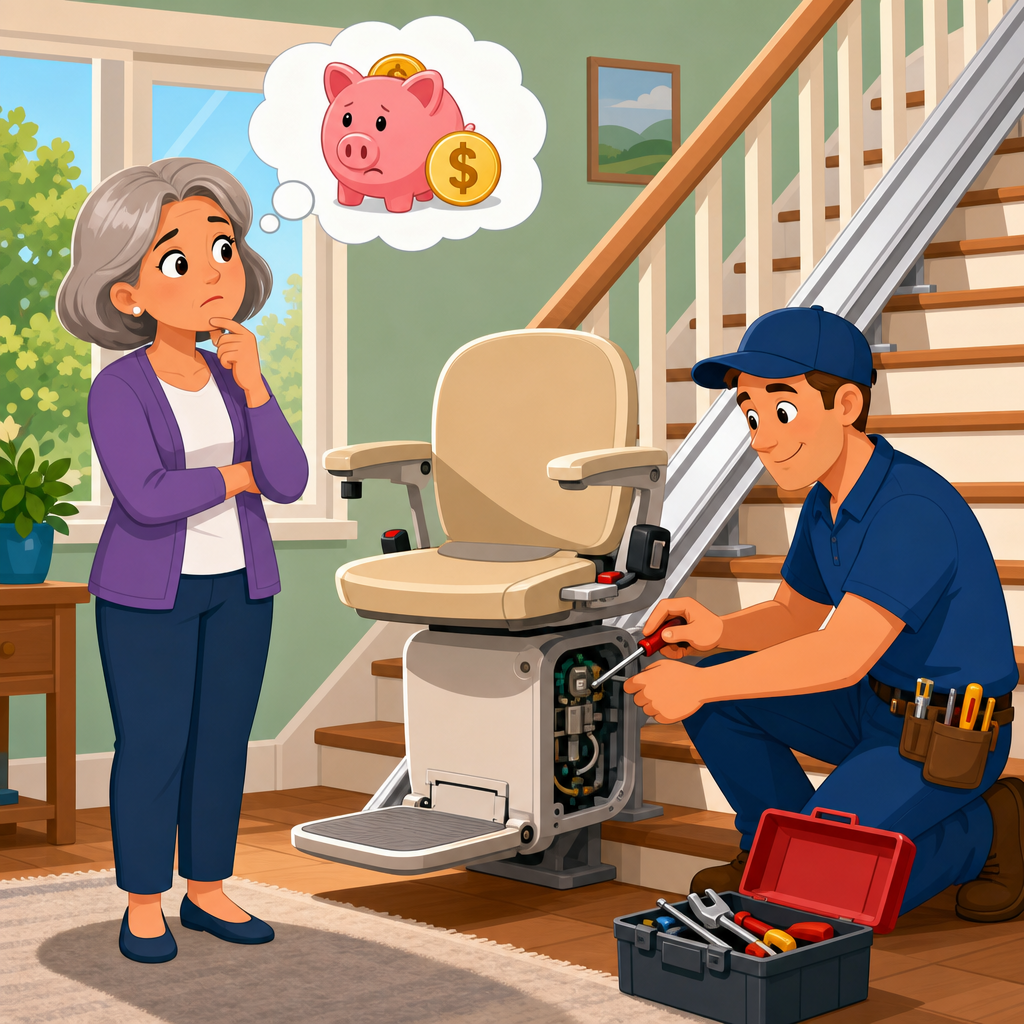
Chair lifts are not always expensive to repair, but the true answer depends on the type of lift, the age of the unit, the brand, the part that failed, and how well the equipment has been maintained over time. In the field, I have seen a simple battery replacement cost far less than homeowners expect, while a failed carriage board or geared drive assembly can turn one service call into a major expense. For anyone comparing mobility solutions, the better question is not only “Are chair lifts expensive to repair?” but “What does chair lift ownership cost over time?”
A chair lift, also called a stair lift, is a motorized seat that travels along a rail mounted to a staircase. Most modern residential systems use rechargeable batteries, a call/send control, safety sensors, a footrest, a swivel seat, and a drive system that moves the chair up and down the stairs. Repair costs can range from modest to significant because these systems combine electronics, mechanical parts, batteries, and installation-specific components. Straight stair lifts are usually cheaper to service than curved stair lifts because their rails, carriage systems, and replacement parts are simpler and more standardized.
This topic matters because the upfront purchase price is only part of the financial picture. Homeowners, caregivers, and older adults often focus on installation quotes, then get surprised later by maintenance plans, battery changes, service visits, and eventual part replacement. Cost of ownership over time includes purchase, installation, warranty coverage, annual maintenance, emergency repairs, electricity use, removal, and resale value. Understanding those categories helps buyers budget accurately, compare brands fairly, and decide whether buying new, buying used, renting, or financing is the smartest path.
In practical terms, chair lift repair costs are best viewed as part of a long-life equipment decision. A well-chosen lift from a reputable manufacturer can run reliably for years with predictable upkeep. A poorly matched or aging unit can create repeated service charges that erase any savings from a lower initial price. When people ask me whether chair lifts are expensive to repair, I tell them that occasional repairs are manageable, but deferred maintenance, discontinued models, and complex custom systems are what drive ownership costs up.
What determines chair lift repair cost
Five variables usually determine what a repair will cost: lift type, labor rates, replacement part availability, warranty status, and urgency. Straight stair lifts generally have lower repair costs because many parts are shared across common models and technicians can access rails and carriage assemblies quickly. Curved stair lifts often require model-specific components, custom rail alignment, and longer diagnostic time. Outdoor stair lifts add weather-related wear, which increases the chance of corrosion, sensor faults, and upholstery damage.
Labor is often the hidden factor. A service call may include a diagnostic fee, travel charge, minimum labor block, and then the part itself. In many markets, a single residential mobility equipment visit starts around the cost of a standard appliance service call and rises from there if the technician needs to return with special parts. Emergency or after-hours service costs more. If the lift is in a rural area, mileage can materially change the invoice. These are ordinary industry patterns, not exceptions.
Part availability matters just as much as labor. Current models from recognized brands such as Bruno, Harmar, Savaria, Stannah, and Acorn are usually easier to support than older discontinued units. Batteries, seat belts, limit switches, chargers, and remotes are common wear items. Main boards, drive motors, transmission components, and custom curved rail sections are more expensive and sometimes slower to source. Once a manufacturer stops supporting a model, repair economics change fast because technicians may need refurbished parts or salvage inventory.
Common repairs and what owners typically pay
Most chair lift repairs fall into a few predictable categories. Battery replacement is common because many residential lifts use sealed lead-acid batteries that typically last several years, depending on charge cycles, temperature, and whether the unit stays parked on its charging point. Charger replacement is also common if the lift stops holding charge or shows intermittent power faults. Safety edge sensors can fail or become misaligned. Call/send remotes, seat swivel interlocks, footrest switches, and wiring harnesses also generate service requests.
Mechanical failures are less common than battery or sensor issues, but they are the repairs owners remember because they cost more. A worn gear rack interface, motor failure, transmission issue, or carriage board fault can produce jerky movement, error codes, or total shutdown. Upholstery and cosmetic issues are usually minor unless the lift is outdoors. For outdoor units, water intrusion is the recurring enemy. I have seen lifts that looked mechanically fine but needed significant electrical work because the cover was not used consistently and moisture reached connectors and boards.
| Repair item | Typical cost range | Notes on ownership impact |
|---|---|---|
| Batteries | $100–$300 | Routine wear item; budget for periodic replacement |
| Charger or power supply | $150–$400 | Often mistaken for battery failure; affects reliability quickly |
| Remote, switch, or sensor | $100–$350 | Usually moderate repair if diagnosis is straightforward |
| Service call and labor | $150–$450 | Varies by region, travel, and emergency timing |
| Motor, board, or transmission repair | $500–$1,500+ | High-impact repair; can change replace-versus-repair decision |
| Curved lift specialty parts | $700–$2,000+ | Custom systems are the most expensive to keep in service |
These ranges reflect common residential scenarios, not guaranteed prices. The key ownership lesson is that small repairs are normal, while major component failures are infrequent but financially important. Over a ten-year period, many owners spend modestly if the lift is maintained, used properly, and backed by available parts. The expensive cases usually involve neglected systems, unsupported models, or custom curved lifts with aging electronics.
Cost of ownership over time: the full financial picture
To evaluate cost of ownership over time, separate one-time costs from recurring costs. One-time costs include purchase, installation, electrical preparation if needed, and in some homes carpentry or rail modifications. Recurring costs include annual service, batteries, occasional repairs, and eventual removal or replacement. Electricity use is usually minor because most lifts charge from a standard household outlet and draw meaningful power mainly during charging and operation. In real budgets, electricity is not what drives ownership cost.
Straight stair lifts commonly have the lowest lifetime cost because they cost less to buy, use standardized rails, and are easier to resell or recondition. Curved stair lifts often have the highest lifetime cost because the rail is custom built for a specific staircase with exact bends, parking angles, and overrun dimensions. That custom rail has value only in very limited circumstances, which reduces resale flexibility. If a curved lift has a major failure outside warranty, repair cost must be weighed against the age of the system and the practical difficulty of reusing the installation elsewhere.
Maintenance affects total cost more than many buyers expect. Annual inspections can catch charging problems, loose seat assemblies, rack debris, and switch wear before they become emergency breakdowns. The same principle applies in elevators, wheelchair lifts, and hospital beds: preventive service reduces downtime and lowers the chance of major failure. It does not eliminate repairs, but it usually shifts ownership from reactive spending to planned spending, which is easier on a household budget.
Another overlooked cost is downtime. If the lift is essential for a user who cannot safely manage stairs, an unexpected outage has real consequences. Families may need temporary caregiving help, rearranged sleeping space, or urgent service. Those indirect costs do not appear on a repair estimate, but they belong in any honest cost-of-ownership discussion. Reliability, parts support, and local service coverage often matter more than saving a few hundred dollars at purchase.
When repair is worth it and when replacement makes more sense
Repair is usually worth it when the lift is relatively new, the brand still supports the model, and the failed component is a normal wear item. Replacing batteries, a charger, a seat switch, or a remote is usually straightforward. Even a moderate repair can make sense if the rail and carriage are otherwise in good condition. If the lift meets the user’s needs and service history has been stable, keeping it running is often the lowest-cost choice.
Replacement becomes more attractive when repair costs stack up around an aging system. The break-even point is not a universal percentage, but once a lift needs expensive electronics or drivetrain work and also shows signs of broader wear, owners should compare the repair estimate with the value of a newer lift carrying fresh warranty coverage. This is especially true if the current unit is discontinued. Spending heavily on unsupported equipment can create a cycle of repeat service calls and uncertain parts sourcing.
For curved lifts, replacement decisions require extra care because the custom rail is such a large share of total system cost. If the rail remains usable and the manufacturer can support the carriage platform, repair may still be sensible. If the rail or key control components are obsolete, replacement can become the only practical long-term answer. In homes where mobility needs have changed, owners may also use that replacement moment to compare stair lifts with home elevators, vertical platform lifts, or first-floor bedroom conversion.
How to reduce repair expense before you buy
The cheapest repair is the one you prevent through better buying decisions. Start with a reputable dealer that provides local service, not just installation. Ask who performs warranty work, how fast emergency visits are scheduled, whether technicians stock common parts, and what brands they are factory trained to service. A strong dealer network lowers lifetime cost because it improves diagnosis, reduces downtime, and makes parts procurement more predictable.
Read warranty terms carefully. Many manufacturers separate coverage for major components, electronics, batteries, and labor. Lifetime coverage may apply only to the drivetrain or rail on select models, while batteries and service labor may be excluded after a shorter period. Buyers who miss these details often assume they have full protection when they do not. A realistic review of coverage is essential in any cost and financing conversation because warranty structure changes future out-of-pocket exposure.
Model selection also matters. Choose features that solve real mobility needs, but avoid unnecessary complexity. Powered swivel seats, folding rails, and heavy-duty capacity options can be valuable, yet every added mechanism is another component that may require adjustment or repair later. That does not mean buyers should choose the simplest model by default. It means the best value comes from matching the lift to the user, staircase, transfer ability, and daily routine with precision.
Finally, ask for a projected five-year and ten-year ownership estimate. Good dealers can outline expected battery cycles, maintenance recommendations, probable service intervals, and removal policies. That framework helps buyers compare cash purchase, rental, used equipment, and financing options on equal terms. It also turns the repair question into a fuller decision about value, safety, and long-term affordability.
Chair lift repairs are not automatically expensive, but ownership costs are real and should be planned, not guessed. Straight lifts usually deliver the lowest repair risk and the most predictable long-term spending. Curved and outdoor lifts cost more to own because they involve custom parts, more complex service, and greater exposure to environmental wear. Small repairs such as batteries, chargers, sensors, and remotes are common and manageable. Large repairs involving motors, control boards, or drive systems are less common but can be expensive enough to trigger a replace-versus-repair decision.
The smartest way to control cost of ownership over time is to buy the right lift from a brand with strong parts support, verify local service availability, understand warranty limits, and keep up with routine maintenance. That combination reduces breakdowns, protects mobility, and makes future expenses far more predictable. If you are comparing chair lifts under the broader cost and financing options category, build your decision around lifetime value, not just the installation quote. Review service terms, ask for long-range ownership estimates, and choose the option that will stay dependable when you need it most.
Frequently Asked Questions
Are chair lifts usually expensive to repair?
Not always. Chair lift repair costs can range from relatively minor to surprisingly high, depending on what actually failed. In many cases, the issue is something straightforward such as a weak battery, a faulty call/send control, a seat switch problem, or a simple adjustment that a trained technician can handle during a standard service visit. Those repairs are often far less expensive than homeowners fear. On the other hand, if the problem involves major internal components such as the carriage board, motor, transmission, geared drive assembly, or a damaged rail section, the cost can rise quickly because both parts and labor become more involved.
The biggest mistake is assuming every breakdown means the lift is nearing the end of its life. That is not necessarily true. A well-built stair lift or chair lift can often be restored with one targeted repair, especially if it has been maintained properly and the parts are still available. The better way to think about cost is not whether chair lifts are expensive to repair in general, but which repair is needed, how old the unit is, and whether the repair makes financial sense compared with replacement.
What factors have the biggest impact on chair lift repair cost?
Several factors determine whether a repair stays affordable or becomes a major expense. First is the type of lift. A straight stair lift is usually simpler and less expensive to service than a curved lift because curved systems are more customized and often use specialized parts. Platform lifts and other heavy-duty accessibility equipment can also cost more to repair because the mechanical systems are larger and more complex.
Age matters as well. Older lifts may require parts that are harder to source, especially if the manufacturer has discontinued a model. Brand is another important factor. Some manufacturers maintain strong parts support, while others become difficult to service over time. The specific failed part is often the biggest cost driver. Replacing batteries or footrest switches is very different from replacing a logic board, charger, motor, or drive system.
Maintenance history can also make a major difference. A lift that has been cleaned, adjusted, and inspected regularly tends to suffer fewer major failures. By contrast, a unit that has been left with weak batteries, dirty track surfaces, loose wiring, or ignored warning signs may develop larger mechanical or electrical issues. Finally, labor rates and service availability in your area can affect the final bill, especially if the technician must make multiple trips or order special components.
Which chair lift repairs are usually affordable, and which ones tend to be expensive?
The more affordable repairs typically involve wear items, basic electrical issues, or adjustments. Battery replacement is one of the most common examples, and it is often much cheaper than people expect. Other lower-cost repairs may include replacing remote controls, tightening or adjusting seat and footrest components, correcting charging contact issues, replacing limit switches, or resolving minor wiring faults. In some cases, what seems like a major breakdown turns out to be a power supply issue, a tripped safety sensor, or a charger problem.
More expensive repairs usually involve the core operating components of the lift. A failed carriage board, main control board, motor, transmission, geared drive assembly, or rail-related problem can significantly increase the total cost. These repairs often require more diagnostic time, higher-priced parts, and more labor to install and test. If a lift has multiple failing components at once, the bill can climb even higher. This is especially true on older or discontinued models where replacement parts are scarce, special-order only, or no longer manufactured.
In practical terms, the cost difference comes down to whether the technician is replacing a common service item or rebuilding a central system that powers and controls the lift. That is why two chair lift repair appointments can look completely different in price, even though both began with the same homeowner concern: “The lift stopped working.”
How can I tell whether it is better to repair a chair lift or replace it?
The decision usually comes down to age, reliability, parts availability, and the total value of the repair. If the chair lift is relatively modern, has been dependable, and only needs one identifiable repair, fixing it often makes good financial sense. This is especially true if the rail is in good condition and the issue is limited to batteries, charging, controls, or a single electrical component. Many lifts can continue serving safely for years after a properly completed repair.
Replacement becomes more attractive when the lift is older, parts are obsolete, breakdowns are becoming frequent, or the repair involves a major drivetrain or control system failure. If a large repair only restores a unit temporarily while other aging parts remain likely to fail, investing in a new lift may be the smarter long-term move. A newer unit can also offer improved safety features, quieter operation, better battery performance, and stronger manufacturer support.
A good rule of thumb is to ask a qualified technician for an honest cost-benefit evaluation. You want to know not only the price of today’s repair, but also the condition of the rest of the system, the likelihood of future repairs, and whether parts support will remain available. That wider view helps you avoid spending heavily on a lift that may soon need additional costly work.
What can homeowners do to keep chair lift repair costs as low as possible?
The best way to control repair costs is preventive care. Regular professional maintenance can catch small issues before they become expensive ones. During service, a technician can inspect the batteries, charging system, gear engagement, safety circuits, seat function, track condition, and wiring connections. Small adjustments and early replacement of worn components often cost much less than waiting for a full breakdown.
Homeowners can also help by using the lift correctly and paying attention to warning signs. If the lift starts moving more slowly, beeping unexpectedly, stopping intermittently, or failing to charge consistently, it is wise to schedule service early rather than continue operating it until something larger fails. Keeping the track clean, avoiding impact damage, and making sure the unit remains plugged in and charging as intended can also extend the life of the system.
Another smart step is choosing a reputable dealer or service company that works with your lift’s brand and can access the right parts. Prompt, qualified service reduces misdiagnosis and repeat visits. In the long run, the least expensive chair lift repair strategy is usually not delaying service, but staying ahead of problems while the fixes are still simple and affordable.