


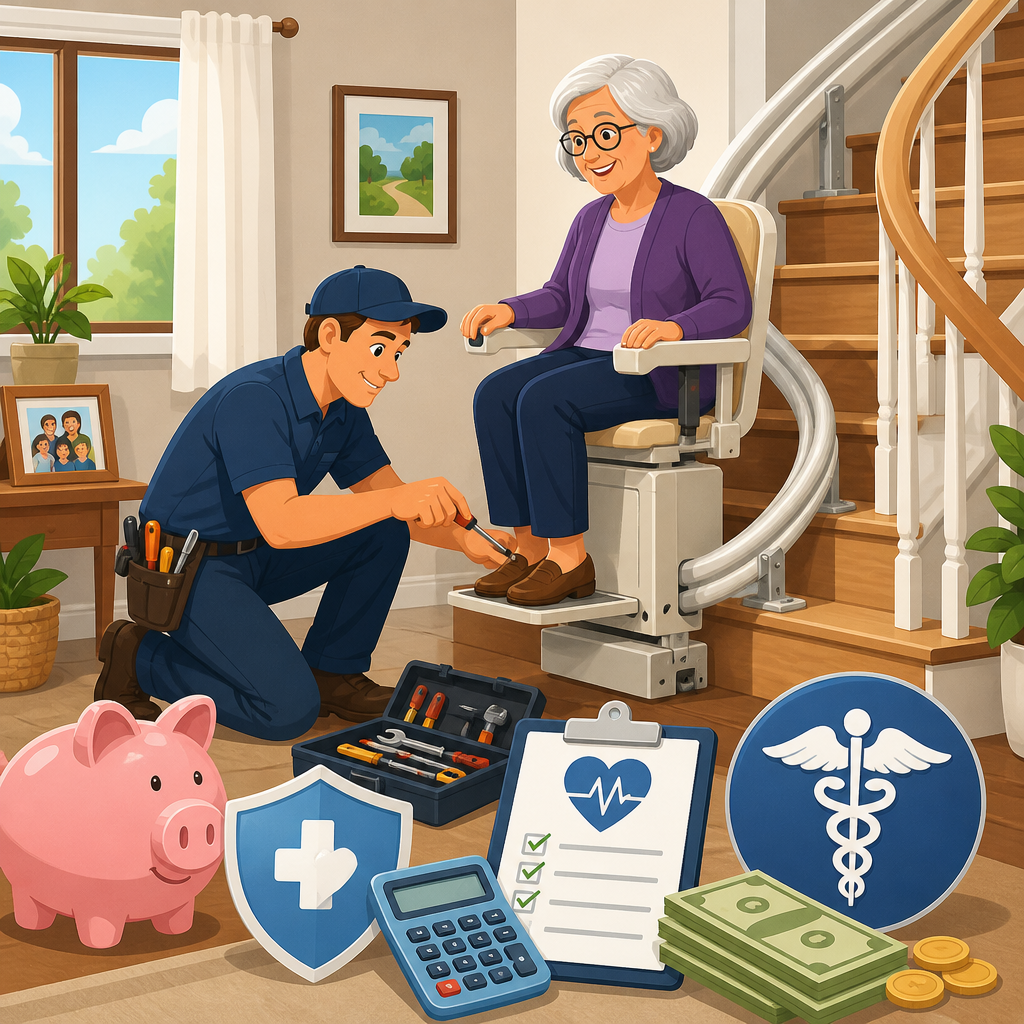
Are stair lift repairs and maintenance tax deductible medical expenses? In many cases, they can be, but the answer depends on why the stair lift was installed, how the expense is categorized, and which tax rules apply to your return. I have worked with families comparing stair lift quotes, documenting home accessibility costs, and coordinating records for tax preparers, and the pattern is consistent: taxpayers often miss legitimate medical deductions because they do not separate equipment costs from general home improvement spending.
A stair lift is a motorized chair or platform attached to a staircase that helps a person with limited mobility move safely between floors. Repairs usually mean fixing a broken component such as the rail, battery, motor, gearbox, footrest sensor, or call/send controls. Maintenance usually refers to preventive service, lubrication, safety checks, battery testing, and manufacturer-recommended inspections. Tax deductible medical expenses are qualified costs paid primarily to diagnose, treat, mitigate, or prevent disease, or to affect a body structure or function, subject to Internal Revenue Service rules and income thresholds.
This matters because stair lifts are expensive to own over time. Initial installation can cost several thousand dollars, and recurring service can add meaningful annual expense, especially for older units or lifts used many times each day. For older adults aging in place, and for households supporting a disabled family member, understanding whether repairs, maintenance, warranties, or removal costs qualify can reduce after-tax cost and improve budgeting decisions. As the hub for tax deductions and medical expenses within cost and financing options, this guide explains the federal rules, common gray areas, documentation standards, reimbursement interactions, and planning steps that determine whether stair lift expenses belong on Schedule A.
When stair lift repairs and maintenance qualify as medical expenses
The core tax rule is straightforward: a stair lift expense is generally deductible as a medical expense if it is primarily for medical care. Under IRS Publication 502, medical care includes equipment and home improvements needed for medical reasons. In practice, that means the taxpayer or dependent must have a diagnosed mobility limitation or related condition, and the stair lift must be installed to help address that limitation. If the original stair lift qualifies as a medical expense, then necessary repairs and maintenance directly tied to keeping that lift functional often qualify as well.
Examples usually include replacing a failed battery so the user can travel safely during a power outage, repairing a seat swivel lock that affects transfers, fixing obstruction sensors that stop unsafe movement, or servicing a rail alignment issue that prevents reliable operation. Annual maintenance may also qualify when it is recommended to preserve safe operation of a medically necessary lift. I advise clients to connect every invoice to the medical purpose of the equipment. A tax preparer is far more comfortable deducting “battery replacement for prescribed stair lift used by disabled spouse” than a receipt that simply says “home service call.”
The deduction is not unlimited. For federal income taxes in the United States, unreimbursed medical expenses are deductible only to the extent they exceed 7.5 percent of adjusted gross income, and only if the taxpayer itemizes deductions. That threshold means many households receive no immediate tax benefit even when the expense is medically valid. Still, high stair lift costs, combined with other medical bills such as premiums, hospital care, prescriptions, or long-term care services, can push a household above the threshold.
What the IRS looks at: medical necessity, capital improvement, and added home value
The most important concept is medical necessity. A stair lift installed for convenience, resale appeal, or general aging preferences without a documented medical reason is not treated the same as one installed for a person with severe arthritis, multiple sclerosis, Parkinson’s disease, a spinal cord injury, stroke aftereffects, or another condition affecting safe stair use. The IRS does not require a prescription in every situation, but a physician’s letter of medical necessity is one of the strongest pieces of support you can keep.
Home accessibility changes also raise the issue of capital improvements. Some medical home improvements are deductible only to the extent their cost exceeds any increase in the home’s value. That rule commonly applies to major structural changes such as adding an elevator, widening hallways, or constructing accessible bathrooms. Stair lifts are often treated more favorably because they are attached equipment with a specialized medical function and typically do not increase market value by much, especially if they are custom fitted to one staircase. Even so, taxpayers should not assume. If an improvement substantially boosts value, only the excess cost may count as a medical expense.
Repairs and maintenance create fewer valuation problems than first-time installation because service costs usually do not add value; they restore existing function. If a technician replaces worn rollers, recalibrates the carriage, or repairs the charging strip, the payment is usually easier to position as a direct medical equipment expense rather than a capital improvement. That distinction is why repair records deserve the same attention as installation invoices.
Which stair lift costs are commonly deductible and which are not
Not every invoice related to a stair lift belongs on a tax return. The best approach is to separate costs into clearly medical, potentially medical, and clearly personal categories. This prevents overclaiming and makes audits less risky.
| Expense type | Usually deductible? | Why it may or may not qualify |
|---|---|---|
| Initial stair lift purchase and installation | Often yes | Usually qualifies when medically necessary; may be reduced by any increase in home value for certain improvements |
| Battery replacement, motor repair, sensor repair, rail service | Usually yes | Directly maintains medically necessary equipment used for mobility |
| Annual maintenance or safety inspection | Often yes | Qualifies when tied to safe operation of a medically necessary lift |
| Extended warranty or service contract | Sometimes | Can be arguable if it functions like prepaid repair coverage for medical equipment; facts and billing detail matter |
| Cosmetic upholstery upgrades or custom finishes | Usually no | Personal preference costs are not medical care |
| Removal after no longer needed | Sometimes | May qualify if medically related or necessary to accommodate ongoing care; often fact specific |
| General electrical work unrelated to the lift | Usually no | Must be directly necessary for operating the medical equipment |
Used stair lifts deserve special mention. A preowned unit can still qualify if it is purchased and installed for medical reasons. The same is true for rental stair lifts, though rental periods and service charges should be documented carefully. Platform lifts and wheelchair lifts may also qualify under similar reasoning, but they can trigger larger home-value questions because they sometimes involve more substantial structural work.
Documentation that supports a deduction
Documentation is where valid deductions are won or lost. The strongest file includes a physician’s statement describing the diagnosis, mobility limitation, and medical need for the stair lift; the original sales contract; detailed invoices for repairs and maintenance; proof of payment; warranty terms; and notes showing whether any insurer, Medicaid waiver, veterans program, or state assistance fund reimbursed part of the cost. If the expense involved structural modification, keep contractor descriptions and any appraisal or comparable market evidence relevant to value increase.
Invoice detail matters more than most taxpayers realize. I recommend asking dealers and service companies to describe work precisely: “replace batteries on Bruno Elite stair lift used by patient with impaired ambulation” is far better than “service completed.” Named manufacturers such as Bruno, Harmar, Stannah, Access BDD, and Handicare all provide service documentation formats that can usually be supplemented with additional medical-purpose detail if requested at the time of billing.
Timing matters too. Medical expenses are generally deductible in the year paid, not necessarily the year the service was performed. If you finance the stair lift, only amounts actually paid during the tax year generally count, not the full contract balance. If a relative pays for a dependent’s stair lift expenses, dependency and support rules become important, and the person claiming the deduction should confirm eligibility with a qualified tax professional.
How reimbursements, HSAs, FSAs, and state rules affect tax treatment
An expense cannot be deducted twice. If Medicare Advantage, Medicaid, a state assistive technology program, a workers’ compensation claim, or a long-term care policy reimburses part of the stair lift repair, only the unreimbursed portion may be counted as a medical expense. Traditional Medicare generally does not cover stair lifts because they are commonly classified as home modifications rather than durable medical equipment under standard coverage rules, but some local programs, Medicaid waivers, or veterans benefits may help.
Health savings accounts and flexible spending accounts change the analysis. If you pay a qualifying stair lift expense with HSA or FSA funds, that payment is already receiving tax-favored treatment, so you cannot also claim the same amount as an itemized medical deduction. However, many households still benefit from using these accounts for repair or maintenance charges because the tax savings are immediate and do not depend on exceeding the 7.5 percent adjusted gross income threshold.
State tax treatment may differ from federal rules. Some states do not follow federal itemized deduction rules exactly, and some offer separate credits or deductions for accessibility modifications, elder care, or disability-related home improvements. This is one reason a stair lift tax strategy should not stop with the federal return. A state-specific review can uncover additional savings, especially in states with aging-in-place initiatives or disability access incentives.
Common scenarios taxpayers ask about
One common question is whether maintenance counts if the stair lift is old and no new prescription was written. Usually, yes, if the lift remains medically necessary and in active use by the person with the condition. Another frequent question is whether a spouse can claim repairs when the lift was originally installed years ago for the other spouse. Again, usually yes, if the spouse is a dependent or the couple files jointly and the expense is unreimbursed.
Families also ask about second homes. If the medically necessary stair lift is installed in a home the patient actually uses and the expense is primarily for medical care, the claim may still be supportable, but scrutiny rises sharply if the property is occasional-use or vacation oriented. The medical purpose must be genuine and well documented. For adult children paying a parent’s stair lift bill, the tax answer often turns on dependency status and whether the child provided more than half of the parent’s support.
Another gray area involves bundled invoices. Dealers sometimes package tune-ups, cosmetic parts, and nonessential upgrades together. Separate those charges before claiming anything. In an audit, blended invoices invite disallowance. I have seen taxpayers avoid problems simply by requesting revised invoices that break out labor, safety parts, optional accessories, and travel charges.
Practical tax planning for stair lift owners
The best tax planning starts before the repair happens. Ask the stair lift company for detailed service descriptions, keep the physician letter current, and save every payment record in one folder. If you expect major medical spending in a year, consider clustering elective but necessary stair lift work into the same tax year as other large unreimbursed medical costs. Batching expenses can make the 7.5 percent threshold easier to exceed.
It also helps to coordinate with the broader financial picture. A household deciding between repairing an aging lift and replacing it should compare not only safety and reliability, but also tax treatment, financing terms, warranty coverage, and possible assistance programs. Sometimes a replacement produces better long-term value because new units are safer, quieter, and more efficient, while generating a larger deductible medical expense in a year when the household is already itemizing.
Tax reporting should be conservative, organized, and consistent. Do not estimate. Do not include reimbursed costs. Do not assume that every home accessibility bill automatically qualifies. When facts are strong, stair lift repairs and maintenance are often defensible medical expenses. When facts are weak, aggressive claims are easy for an examiner to challenge.
The bottom line is that stair lift repairs and maintenance can be tax deductible medical expenses when they are primarily for medical care, properly documented, unreimbursed, and claimed under the normal medical deduction rules. Installation, service calls, battery replacement, safety repairs, and preventive maintenance often qualify if the lift is medically necessary for you, your spouse, or your dependent. The biggest limits are the 7.5 percent adjusted gross income threshold, the need to itemize, and the rule against deducting costs already paid through reimbursement or tax-advantaged accounts.
For households researching cost and financing options, this topic is larger than a single deduction. Tax treatment intersects with grants, veterans benefits, Medicaid waivers, HSA strategy, warranty choices, and the decision to repair or replace an older unit. That is why this article serves as the hub for tax deductions and medical expenses in the stair lift cost conversation: the deduction is valuable, but only when viewed as part of the full affordability picture.
If you are paying for stair lift service now, gather your invoices, request a medical-necessity note from the treating physician, and review the expenses with a tax professional who understands accessibility equipment. A careful review can turn overlooked repair bills into legitimate tax savings while keeping your records audit ready.
Frequently Asked Questions
Are stair lift repairs and maintenance tax deductible as medical expenses?
They can be, but only when the stair lift itself qualifies as a medical expense under IRS rules. In general, a stair lift installed primarily for medical care, mobility support, or to accommodate a diagnosed condition may be treated as a medically necessary home modification. If that threshold is met, related costs such as repairs, service calls, replacement parts, and maintenance may also be deductible as part of maintaining medical equipment used in the home. Common examples might include motor repairs, track adjustments, battery replacement, seat or safety sensor repairs, and annual service needed to keep the lift working safely for the person who relies on it.
The key issue is purpose. If the stair lift was added for convenience, aging-in-place without a documented medical need, or to improve general comfort, the IRS may not view the repair and upkeep costs as deductible medical expenses. If, however, the stair lift was recommended because someone in the home has a mobility impairment, neurological condition, arthritis, balance disorder, post-surgical limitation, or another qualifying medical issue, the tax treatment is often more favorable. Even then, the deduction is not automatic. Medical expenses generally must be itemized on Schedule A, and only the amount of total qualifying medical expenses that exceeds the applicable adjusted gross income threshold can be deducted. That means a valid expense can still produce little or no tax benefit if the taxpayer does not itemize or does not exceed the threshold.
Does it matter whether the stair lift was installed for medical necessity or general convenience?
Yes, this is one of the most important factors in determining deductibility. The IRS distinguishes between expenses incurred primarily for medical care and expenses that are personal, cosmetic, or merely helpful. A stair lift installed because a physician determined that the patient could not safely use stairs is far more likely to qualify than one added simply because climbing stairs had become inconvenient. Medical necessity does not mean the person must be completely unable to walk; it generally means the equipment is needed to diagnose, cure, mitigate, treat, or prevent a physical or mental condition, or to affect a structure or function of the body.
In practice, the stronger the documentation, the better. A doctor’s letter or prescription stating that the stair lift is necessary due to a diagnosed medical condition can be extremely helpful. Tax preparers also often want to see the installation invoice, proof of payment, and records showing the equipment was installed for the use of a specific patient in the home. Once the original installation qualifies, follow-up expenses for keeping the lift operational are easier to support. Without that medical link, repair and maintenance charges may look like ordinary household upkeep rather than deductible medical costs. That is why families are often advised to separate the medical justification from the general home-improvement narrative from the start.
Can you deduct both the cost of the stair lift and the ongoing maintenance, or only one of them?
Potentially both, but the rules can differ depending on the nature of the expense and whether the installation increased the value of the home. The cost of buying and installing a stair lift may qualify as a medical expense if it was done for medical reasons. In some situations, home improvements made for medical care are deductible only to the extent that the cost exceeds any increase in the home’s fair market value. However, certain accessibility modifications that do not materially add value in the traditional sense may be more fully deductible. Ongoing costs to operate, repair, and maintain medically necessary equipment are often treated more straightforwardly, especially when they are clearly tied to preserving the function of the equipment rather than improving the property itself.
For example, if a taxpayer installs a stair lift because of a mobility disability and later pays for service visits, replacement batteries, diagnostic work, or a new carriage component, those follow-up costs may be deductible as medical expenses if the original medical purpose remains the same. The practical issue is documentation and categorization. It is smart to keep installation invoices separate from repair bills, and repair bills separate from broader remodeling work such as painting, stair refinishing, or electrical upgrades unrelated to the lift’s operation. This clean separation helps your tax preparer evaluate which amounts may qualify, which might need a home-value analysis, and which are more likely to be treated as nondeductible personal or capital improvement expenses.
What records should you keep to support a deduction for stair lift repairs and maintenance?
You should keep enough documentation to prove four things: who needed the stair lift, why it was medically necessary, what was paid, and that the specific repair or maintenance expense relates directly to the stair lift. Ideally, that means retaining a physician’s note, prescription, or written recommendation; the original purchase and installation contract; itemized invoices for all repair and service work; receipts or canceled checks showing payment; warranty information; and any service agreements. If the bill includes both deductible and nondeductible work, ask the provider for a line-item invoice so the stair lift portion is clearly separated from other household services.
It is also helpful to maintain a simple tax file or spreadsheet listing each date of service, the vendor, the amount paid, and the medical reason the equipment is needed. Families often lose deductions because repair costs are buried inside a larger home invoice or paid from multiple accounts with no central record. If your tax preparer asks later whether a charge was for a stair lift motor replacement or a general staircase remodel, you want a clear answer backed by paperwork. Good records matter even more if the deduction is substantial or if the IRS questions whether the expense was truly medical in nature. Organized records do not guarantee a deduction, but they make it much easier to defend one that is otherwise valid.
Are there any limitations or situations where stair lift maintenance expenses would not be deductible?
Yes, several. First, if the stair lift was not installed primarily for medical care, repairs and maintenance are generally not deductible. Second, even if the expense qualifies medically, you usually receive a tax benefit only if you itemize deductions rather than claim the standard deduction. Third, medical expenses are subject to an adjusted gross income floor, so only the portion of total qualifying medical expenses above that threshold is deductible. This means a taxpayer can have legitimate stair lift repair expenses and still see no meaningful deduction if their total medical expenses are too low relative to income.
There are also classification issues to watch for. Costs that are really home improvements, aesthetic upgrades, or general property maintenance are usually not deductible just because they happen at the same time as stair lift work. For example, repainting the stairwell, replacing flooring for appearance reasons, or upgrading electrical systems for broader household use may not qualify. Reimbursements matter too. If insurance, a flexible spending arrangement, a health savings account, a veterans’ benefit, or another program reimbursed the expense, you generally cannot deduct the reimbursed amount. Finally, state tax rules may differ from federal treatment, so it is worth asking a tax professional how your specific return should handle accessibility expenses. The broad answer is that stair lift maintenance can be deductible, but only when the medical purpose, tax reporting method, and supporting records all align.