


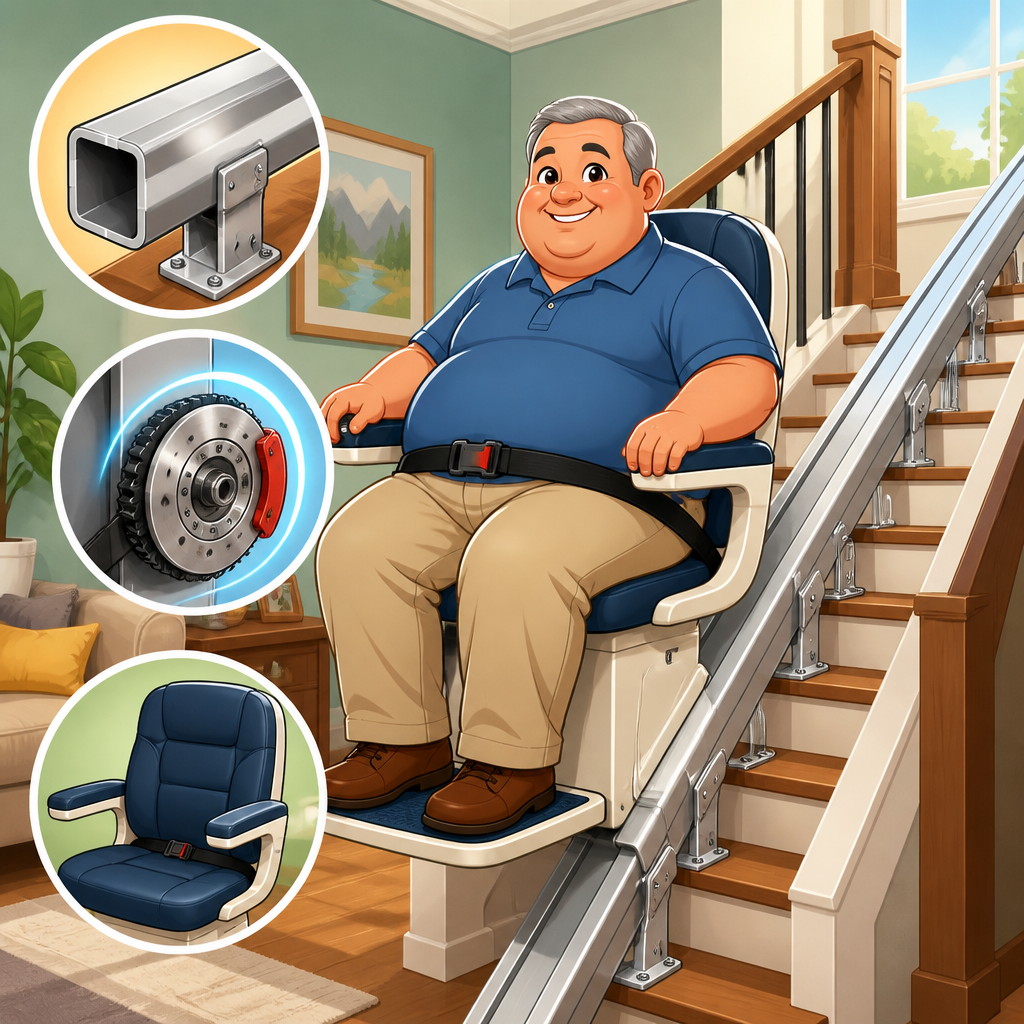
Bariatric stair lift safety depends on three engineering pillars: rail strength, braking performance, and seat design. When a lift is built for heavier users, every load path, moving part, and contact surface must perform under higher forces than a standard residential model. In the heavy-duty segment, that difference is not cosmetic. It determines whether the lift remains stable on the stairs, stops smoothly without rollback, and supports the rider with secure posture during travel.
A bariatric stair lift is a powered chair lift designed for users who exceed the weight range of typical stair lifts, which often top out around 300 to 350 pounds. Heavy-duty models commonly raise capacity into the 400 to 600 pound range, although exact limits vary by manufacturer, rail configuration, and staircase geometry. Safety in this category is not just about a higher posted capacity. It is about structural engineering, drivetrain tuning, seat dimensions, user transfer, and compliance with recognized codes and testing standards.
I have seen buyers focus almost entirely on weight capacity labels, then miss the more important question: how does the entire system behave at that load every day? Capacity means little without understanding rail deflection, attachment spacing, brake type, seat width, arm support, footrest clearance, and the user’s center of gravity. A bariatric stair lift must accommodate not only weight, but also body dimensions, limited mobility, balance deficits, and transfer needs. The safest product is the one that matches the person and the staircase as a complete system.
This article serves as a hub for heavy-duty lifts within the broader chair lift types and designs category. It explains what makes bariatric stair lift safety different, what to evaluate before purchase, and which technical features matter most in real homes. If you are comparing models, planning for future mobility changes, or advising a family member, start here. The goal is simple: understand how rail strength, braking, and seat design work together so you can judge safety beyond marketing claims.
Why Heavy-Duty Stair Lifts Require Different Engineering
Heavy-duty stair lifts are not simply standard units with wider seats. They operate under higher static and dynamic loads, and that affects the entire machine. Static load is the user’s body weight when seated. Dynamic load includes acceleration at startup, deceleration at stops, weight shifts during transfer, and small jolts created by track transitions or changes in stair pitch. Engineers account for these forces by increasing rail section strength, upgrading gearboxes and motors, specifying more robust brackets, and calibrating overspeed and braking systems for the rated capacity.
Stair geometry also matters more in bariatric applications. A narrow staircase may technically accept a wider chair, but still leave unsafe clearance for knees, elbows, or caregivers. On landings, a larger user may need a powered swivel seat or a folding rail to create a safer dismount zone. I always recommend measuring clear stair width, tread depth, headroom, and top and bottom landing space before discussing brands. Product selection should follow the staircase and the rider, not the other way around.
Another difference is usage pattern. Heavy-duty lifts are often purchased when walking is already difficult and endurance is limited. That means the lift may be used several times daily, with less margin for awkward transfers or abrupt motion. Smooth starts, controlled leveling, and solid arm support become practical safety features, not optional comforts. In my experience, the best installations are those that reduce anxiety before the first ride. Confidence improves compliance, and consistent use reduces the risk of stair falls.
Rail Strength: The Foundation of Bariatric Stair Lift Safety
The rail is the primary structural element of a stair lift. It supports the carriage, guides travel, and transfers load into the stair treads or, less commonly, wall-mounted supports. For bariatric stair lift safety, rail strength must be evaluated in terms of material, cross-sectional design, bracket spacing, anchoring method, and allowable deflection under load. A stronger rail reduces flex, vibration, and carriage movement, all of which affect ride stability and user confidence.
Most modern heavy-duty lifts use steel or high-strength aluminum rails. Steel offers excellent stiffness and fatigue resistance, which is why it remains common for high-capacity straight stair lifts. Aluminum can perform well if the profile is engineered correctly, but the rail must still limit deflection under full load. Excessive flex is not just uncomfortable. It can change how the drive system engages the rail, increase wear, and create a sensation of instability that makes transfers harder for larger users.
Bracket spacing is a major but often overlooked factor. The rail may be strong on paper, yet perform poorly if support brackets are too far apart or fixed to weak stair components. Installers should verify tread condition, fastener type, and the manufacturer’s spacing requirements. On older wooden stairs, I have seen projects require reinforcement because the staircase itself, not the lift, was the limiting factor. A safe heavy-duty installation depends on the structure beneath the rail as much as the rail itself.
Curved systems require even more scrutiny. Because the rail changes direction and may include custom bends, parking sections, or intermediate landings, force distribution becomes more complex. Weight capacity on a curved bariatric stair lift may differ from a straight model, and the user’s position relative to the curve can affect side loading. That is why custom surveying, digital measurement, and manufacturer-specific engineering review are essential for high-capacity curved lifts.
| Safety factor | What to check | Why it matters for heavy-duty lifts |
|---|---|---|
| Rail material | Steel or reinforced aluminum profile | Higher stiffness reduces flex and improves ride stability |
| Bracket spacing | Manufacturer-approved interval and fastening method | Poor spacing increases deflection and stress on stairs |
| Stair structure | Sound treads, secure anchoring points, no rot or cracks | The staircase must safely carry the transferred load |
| Load rating | Published capacity for the exact rail type and layout | Straight and curved systems may have different limits |
| Ride quality | Minimal sway, vibration, and carriage movement | Stable travel improves confidence and transfer safety |
Braking Systems: How Heavy-Duty Lifts Control Motion and Stop Safely
Braking is the second core safety pillar. In a stair lift, braking is not one single component. It is a layered system that typically includes the drive’s reduction gearing, an electromechanical service brake, and an overspeed or fail-safe brake designed to stop the carriage if travel exceeds safe limits. On battery-powered models, control systems also manage ramp-up and ramp-down speed to prevent jerky starts and stops. For heavier riders, these features must work together under greater momentum.
Most quality stair lifts use a transmission that is not freewheeling. Worm gear or similar reduction systems inherently resist reverse motion, which helps prevent uncontrolled descent. However, relying on gearing alone is not enough. A proper bariatric stair lift uses a spring-applied or normally engaged brake that defaults to a safe state if power is lost. This matters during battery faults, charger problems, or electrical interruptions. Fail-safe design is not optional on a high-capacity unit.
Overspeed governors or mechanical safeties are equally important. If a drive component were to fail, the carriage should not run away down the rail. Manufacturers use different mechanisms, but the principle is the same: detect abnormal speed and mechanically stop the lift. In product reviews and site assessments, I pay attention to how clearly the manufacturer explains this protection. Vague descriptions are a warning sign. Reputable companies document braking architecture, diagnostic alerts, and maintenance procedures.
Smooth braking is also a transfer safety issue. A stop that feels minor to a lighter, stronger user can shift a bariatric rider forward, especially if trunk control is limited. That is why acceleration curves, seat angle, armrest placement, and footrest stability all interact with braking. The best systems stop positively without abrupt pitch. If possible, request a demonstration with the actual user on a similar model. Lab specifications matter, but real-world feel often reveals the safer choice.
Seat Design: Support, Fit, and Transfer Safety
Seat design is where engineering meets the human body. A bariatric stair lift seat must distribute pressure, support posture, permit safe transfers, and maintain the rider’s center of mass within the system’s stability envelope. Width alone is not enough. The safest seat balances usable space with side support, armrest strength, seat height, swivel function, and restraint design. A seat that is too narrow causes compression and poor posture. A seat that is too wide may reduce lateral support and make the rider feel insecure.
Look first at seat width and depth relative to the user’s body dimensions. Many heavy-duty seats add reinforced pans, higher-density foam, and stronger hinge assemblies. Those upgrades matter because the seat base experiences concentrated loading during sit-to-stand transfers, which often create higher moment forces than seated travel itself. I prefer designs with rigid armrests that can bear downward force during transfers, provided the manufacturer specifically rates them for that use. Decorative arms are not transfer supports.
Swivel seats deserve careful evaluation. A manual or powered swivel at the top landing allows the user to dismount away from the open stairwell, reducing fall risk. For larger users with limited trunk rotation, powered swivel mechanisms can be significantly safer than manual release levers. Seat height also matters. If the chair sits too low, the user may struggle to stand. Too high, and foot support suffers, increasing pressure under the thighs and reducing stability.
Restraints should fit the user and be easy to operate. Most stair lifts use a lap belt, but some heavy-duty applications may benefit from upgraded belts or more accessible buckles. Footrests must provide full support and include obstruction sensors. If the feet are poorly supported, the user can slide forward, especially during braking. In practice, the safest bariatric seat is the one that allows a controlled sit, stable ride, and predictable stand-up at both landings.
Codes, Testing, and Installation Standards That Matter
Buyers should ask which standards the lift meets and who will install it. In North America, stair lifts are commonly evaluated to ASME A18.1 and applicable electrical safety requirements, while some products also align with accessibility and platform lift guidance in specific settings. Local code enforcement varies in private homes, but the underlying standards still matter because they shape design, testing, and installation practice. A serious supplier should be able to explain listing, testing, and service procedures in plain language.
Installation quality is inseparable from product safety. A well-designed heavy-duty stair lift can become unsafe if the rail is misaligned, brackets are improperly spaced, charge points are inconsistent, or seat settings are not adjusted to the rider. Professional installers should complete a site survey, verify structural conditions, test travel under load, and instruct the user on parking, swivel operation, belt use, and emergency procedures. I have found that the best companies schedule a follow-up visit after the first weeks of use, when small adjustments can greatly improve comfort and confidence.
Maintenance is the final layer. Batteries, charge contacts, seat swivels, footrest sensors, and brake components all require inspection. A bariatric lift should have a documented service interval and access to replacement parts. For a sub-pillar topic like heavy-duty lifts, this is the key takeaway: safety is not a single feature. It is a system built from correct product selection, proper installation, routine maintenance, and fit to the user’s body and home. If you are comparing heavy-duty lifts, use this hub as your starting checklist, then move to model-specific guides, rail layout articles, and maintenance resources before you buy.
Bariatric stair lift safety comes down to how well the entire system manages higher loads without sacrificing stability, control, or transfer support. Rail strength matters because the rail and its brackets carry the load and shape ride quality. Braking matters because heavier riders generate more momentum, making fail-safe stopping and smooth deceleration essential. Seat design matters because a larger user needs more than space; they need posture support, solid armrests, proper height, secure restraints, and a safe swivel at the landing.
For anyone researching heavy-duty lifts under the chair lift types and designs category, the central lesson is clear: do not judge a bariatric stair lift by capacity alone. Evaluate the rail profile, bracket installation, stair structure, brake architecture, seat dimensions, and transfer mechanics together. Ask for standards information, a real site survey, and a demonstration that reflects the intended user. When those elements align, a heavy-duty lift can provide dependable daily access and sharply reduce the risk of stair falls. Use this hub to guide your next comparison, then speak with a qualified stair lift professional about your staircase and mobility needs.
Frequently Asked Questions
What makes a bariatric stair lift rail different from a standard stair lift rail?
A bariatric stair lift rail is engineered to handle substantially higher loads without flexing, twisting, or losing alignment over time. That difference starts with the rail itself, which is typically built from heavier-gauge steel or similarly robust structural materials, but it also extends to the brackets, fasteners, carriage interface, and the way the rail transfers force into the staircase. In a standard model, the rail supports the rider and the moving drive system under everyday residential use. In a bariatric model, the same system must manage higher static and dynamic forces, including the added stress created during starts, stops, and changes in rider position.
Rail strength is not just about whether the lift can hold a published weight rating in a stationary test. It is about maintaining stability throughout real-world operation. A properly designed bariatric rail resists deflection so the carriage stays level, the seat remains secure, and the rider does not experience excessive sway. That matters for safety because even small amounts of rail movement can affect comfort, confidence, and the consistency of braking and drive engagement. The stronger and more rigid the rail system, the more predictable the ride tends to be.
Another key difference is the complete load path. On a heavy-duty lift, engineers pay close attention to how force travels from the rider into the seat, through the carriage, into the rail, and finally into the mounting points on the stairs. If any part of that chain is undersized, the system may be less stable even if the motor still moves the lift. That is why bariatric-rated equipment should always be evaluated as a complete assembly rather than as a stronger seat mounted onto a standard base. True heavy-duty safety comes from integrated engineering, not a cosmetic upgrade.
How does braking performance affect safety on a bariatric stair lift?
Braking performance is one of the most important safety features in any stair lift, and it becomes even more critical in bariatric applications because greater rider weight creates greater momentum and higher forces during stopping. A properly designed bariatric stair lift should start and stop in a controlled, predictable way without jerking, slipping, or rolling back on the rail. The braking system must do more than stop the lift at the top and bottom of the stairs. It must also help manage travel speed, hold position securely, and perform reliably if power is interrupted or if the lift encounters a fault.
In many stair lifts, braking is tied to the drive system and transmission, often with fail-safe features that automatically engage when needed. For bariatric use, those components must be sized and tested for the heavier duty cycle. The lift should be able to decelerate smoothly under maximum rated load, maintain traction or drive engagement without chatter, and remain stationary once stopped. A weak or poorly tuned braking system can lead to uncomfortable stops, extra wear on the rail and drive components, or in worst cases, rollback behavior that undermines rider safety and confidence.
Smooth braking also plays a major role in rider posture. If the lift stops abruptly, the rider’s body shifts forward or sideways, increasing pressure on the seat edges, armrests, and footrest. For users with limited balance, joint pain, or reduced core strength, that sudden movement can feel unsafe even if the lift technically remains within specification. Strong bariatric safety design means the braking system works together with the rail structure and seat geometry to create a steady ride from start to finish. When evaluating a lift, it is worth asking not only whether it has brakes, but how those brakes perform under full rated load and during repeated use.
Why is seat design such a major safety factor for bariatric stair lifts?
Seat design is a major safety factor because it is the primary point of contact between the rider and the machine. On a bariatric stair lift, the seat must do far more than provide a place to sit. It must support higher body weight evenly, promote a stable seated posture, reduce pressure points, and help prevent shifting during travel. A well-designed bariatric seat typically includes a wider and stronger frame, reinforced mounting points, durable padding, supportive armrests, and a geometry that allows the rider to sit deeply and securely rather than perched near the edge.
Good seat design also helps maintain the rider’s center of gravity in the correct position relative to the carriage and rail. That matters because stability is not just about total weight capacity; it is also about how that weight is positioned. If the seat is too narrow, too shallow, or not adequately supportive, the rider may lean, slide, or adjust constantly during motion. Those small shifts create changing forces that affect comfort and can place extra strain on the lift system. In contrast, a properly engineered bariatric seat keeps the rider aligned, supported, and less likely to reposition during travel.
Armrests, seat height, footrest placement, and swivel function also contribute to safety. Strong armrests can assist with transfers on and off the lift, while correct seat height helps the rider sit and stand with better control. The footrest should support the legs without forcing awkward posture, and the seat should swivel and lock securely for safe entry and exit at the landing. In bariatric applications, these details are especially important because transfers often involve greater force and less margin for instability. A safe seat is one that works as part of a complete support system, not just a larger version of a standard chair.
How can homeowners or buyers verify that a bariatric stair lift is truly built for heavy-duty safety?
The best way to verify heavy-duty safety is to look beyond the marketing language and ask specific technical and installation questions. A true bariatric stair lift should have a clearly stated weight capacity, and that rating should reflect the entire system, including rail, carriage, seat, and mounting hardware. Buyers should ask whether the rail and carriage were originally engineered for bariatric use or whether the product is a modified standard model. That distinction matters because a lift designed from the ground up for heavier users is generally more reliable and stable than one that relies on partial upgrades.
It is also important to ask about testing and standards compliance. Reputable manufacturers should be able to explain how the lift has been tested under load, how braking performance is validated, and what safety mechanisms are built into the drive and control systems. Questions about rail bracket spacing, stair attachment requirements, seat reinforcement, and emergency stop behavior are entirely appropriate. If a dealer cannot explain how the product manages higher forces throughout the load path, that is a warning sign.
Installation quality is another major part of verification. Even the strongest bariatric stair lift can perform poorly if it is installed on a staircase that has not been properly assessed for structure, clearance, and landing space. The installer should evaluate stair dimensions, user transfer needs, seat fit, and whether the home environment supports safe use. Buyers should also ask about maintenance intervals, battery backup, and replacement part availability, since heavy-duty lifts depend on consistent service to keep rail alignment, braking performance, and seat hardware in top condition. In short, true bariatric safety is confirmed through engineering transparency, proper site evaluation, and professional installation.
What are the biggest safety risks if rail strength, braking, or seat design are inadequate?
If any one of these three pillars is inadequate, the stair lift may still appear functional while delivering a much lower margin of safety. A weak rail can flex excessively, wear unevenly, or allow the carriage to travel with more movement than intended. That can create a sensation of wobble, increase stress on brackets and drive components, and reduce overall confidence for the rider. Over time, insufficient rail strength may also contribute to alignment issues that affect how smoothly the lift starts, travels, and stops.
Inadequate braking introduces a different set of risks. The most obvious concern is poor stopping control, including abrupt deceleration, inconsistent speed management, or rollback after the lift stops. These issues are especially serious for heavier users because the forces involved are greater, and any sudden movement can shift the rider’s posture quickly. Even if a complete failure never occurs, weak braking can make routine operation feel unstable and can accelerate wear on other parts of the system. Safety is not only about preventing rare emergencies; it is also about ensuring every trip feels controlled and repeatable.
Poor seat design creates risks at the human interface level. If the seat does not properly support the rider, the user may lean to one side, slide forward, struggle with transfers, or place too much force on the armrests when sitting down or standing up. Those problems increase the chance of awkward positioning, loss of balance, and discomfort during travel. In bariatric applications, discomfort often becomes a safety issue because the rider may compensate by shifting posture or gripping the lift in ways the system was not designed to support. When rail strength, braking, and seat design are all properly engineered together, the result is not just a lift that carries more weight, but a lift that carries that weight safely, smoothly, and with long-term reliability.