


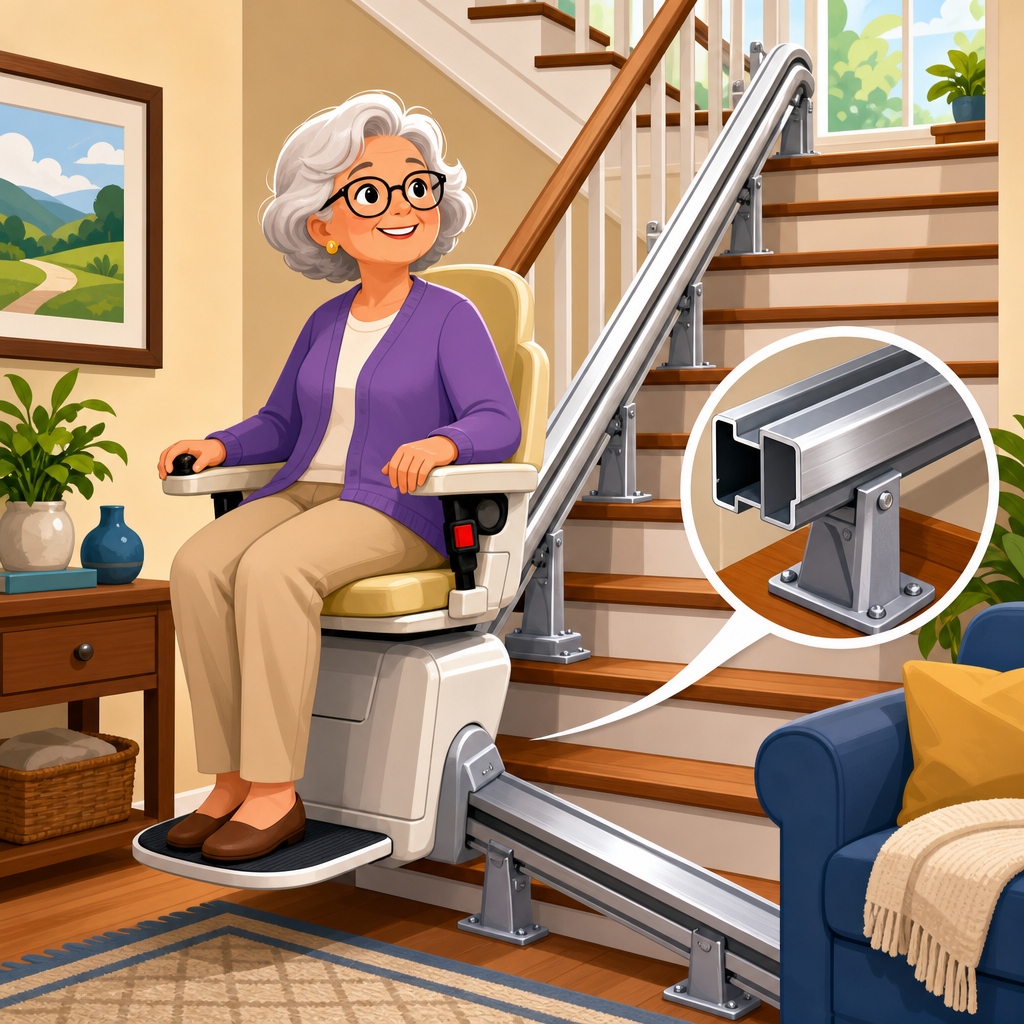
Heavy-duty stair lifts with reinforced rails are specialized mobility systems built to carry higher weight capacities, fit larger seat dimensions, and maintain stable travel on staircases that would challenge standard residential models. In practice, “heavy-duty” usually means a rated capacity of 350 to 600 pounds, while “reinforced rails” refers to track systems engineered with thicker materials, stronger brackets, wider mounting geometry, or dual-rail designs that reduce flex and improve ride quality under load. I have evaluated these systems in homes where a standard lift simply was not appropriate, and the difference is not cosmetic. It affects safety margins, seat comfort, transfer ease, battery performance, and long-term reliability.
This category matters because stair access is often the barrier that turns a manageable home into one that feels unusable. For larger adults, bariatric users, tall users with long femurs, or households needing a lift that can support different body types, a conventional stair lift can create pressure points, unstable seating, cramped arm spacing, and operational strain. Reinforced-rail models are designed to solve those issues with stronger chassis components, broader seats, higher backrests, heavier gear assemblies, and more substantial footrests. They also matter for caregivers and family decision-makers, because selecting the wrong lift can lead to premature wear, difficult transfers, and expensive replacement. As a hub page within chair lift types and designs, this guide explains what defines a heavy-duty lift, how reinforced rails work, which features truly matter, where these lifts fit best, and how to compare leading options with confidence.
What makes a stair lift heavy-duty
A heavy-duty stair lift is not just a standard chair with a higher sticker price. The best heavy-duty stair lifts with reinforced rails are built around higher load tolerances from the ground up. That starts with the carriage, transmission, motor output, and seat base. It continues through the rail brackets, charging system, swivel mechanism, footrest hinge points, and safety sensors. Most standard residential straight stair lifts are rated around 275 to 350 pounds. Heavy-duty models typically begin at 350 pounds and frequently reach 400, 450, 500, or 600 pounds, depending on the staircase geometry and manufacturer certification.
Seat dimensions are equally important. In field assessments, I have seen buyers focus on weight rating alone, then discover the user still feels squeezed by the arms or pushed too far forward by a shallow seat pan. A true heavy-duty lift usually provides a wider seat, stronger armrests, a deeper pan, and more generous distance between arms. Some models also increase the distance from the seat to the footrest, which is critical for taller riders. If the user’s knees sit too high or too close to the carriage, transfers become harder and pressure on the hips increases during travel.
Safety systems scale with capacity too. Reputable heavy-duty lifts use overspeed governors, final limit switches, obstruction sensors on the footrest and carriage, battery backup, and lockable call/send controls. Better units include smooth-start and smooth-stop programming to reduce jerk at launch, because abrupt motion feels more pronounced on a larger frame. Standards and code expectations vary by market, but established manufacturers design around recognized safety and testing protocols rather than improvising capacity claims.
How reinforced rails improve strength and ride quality
Reinforced rails are the structural backbone of heavy-duty performance. In a stair lift, the rail does more than guide movement. It manages load transfer into the stair treads, maintains gear alignment, and controls deflection along the run. Under a heavier rider, a lightly built rail can flex enough to affect comfort, noise, and component wear. Reinforced systems address that by using thicker extrusions, stronger rack interfaces, wider attachment points, and in some cases dual-rail construction. The result is a steadier ride and lower mechanical stress.
One common misunderstanding is that wall strength determines whether a heavy-duty lift can be installed. Most residential stair lifts mount to the stairs, not the wall. The installer assesses tread depth, bracket spacing, landing clearance, and the condition of the staircase itself. Reinforced rails often need more space than slimline models, especially when paired with larger seats. That is why measurement is critical. A lift can have an excellent weight rating and still be the wrong choice if it blocks the staircase for other users or leaves too little room for safe boarding at the top landing.
Curved installations add another layer. Heavy-duty curved stair lifts exist, but the engineering is more complex because the rail must maintain strength through bends, intermediate landings, and parking positions. In many homes, the best answer is not a curved unit but a straight run with a transfer point, or in some cases a vertical platform lift if the user remains in a wheelchair. Reinforced rails improve performance, but they do not eliminate the need to match the product to the staircase and transfer requirements.
Core features that separate the best models
The best heavy-duty lifts stand out in the details. First is seat ergonomics. Look for higher-density foam, a seat width that matches the user’s hip breadth, adjustable arm width if available, and a swivel seat that locks securely at the landing. Manual swivel is common; powered swivel can be valuable for users with limited trunk rotation, but it adds cost and service complexity. Second is drivetrain quality. Rack-and-pinion systems dominate the category because they are reliable and predictable under load. Better units pair them with soft-start controllers and sealed gearboxes that hold up over years of daily use.
Battery design is another differentiator. Most modern lifts use DC batteries charged at the rail ends or at charge points along the track. For heavy-duty use, battery reserve matters because higher loads draw more current, especially on longer runs. In practical terms, the user should still be able to complete several trips during a power outage. Seatbelt style also matters. Standard lap belts work well for many users, but retractable belts or larger buckle designs can improve ease of use for riders with limited hand dexterity or a larger abdomen.
Controls should be simple and positive. A large rocker switch or joystick on the armrest is easier to use than tiny buttons. Call/send stations should be wireless if possible, and parking options should keep the chair out of traffic at the top or bottom landing. For homes where multiple people share the lift, foldability matters too, but heavy-duty seats never fold as compactly as narrow standard models. That tradeoff is normal and should be planned for, not treated as a defect.
| Feature | Why it matters on heavy-duty lifts | What to verify before buying |
|---|---|---|
| Weight capacity | Determines safe operating limit and structural suitability | Ask whether the published rating changes on curved rails or long runs |
| Seat width and depth | Affects comfort, hip support, and transfer safety | Measure the user seated, with winter clothing if relevant |
| Rail design | Controls flex, noise, and long-term durability | Confirm bracket spacing and staircase clearance |
| Battery system | Supports operation during outages and repeated daily trips | Ask about typical trip count during power loss |
| Swivel and footrest | Improves landing exit and reduces twisting risk | Test whether the user can operate both comfortably |
Leading heavy-duty stair lift brands and product types
Several established manufacturers serve the heavy-duty category, although availability depends on country and dealer network. Harmar is widely known in North America for models such as the Pinnacle Heavy Duty, often cited around a 600-pound capacity on appropriate straight staircases. Bruno also has a strong reputation for robust engineering and dealer support, with products like the Elite line often specified when users need a sturdier seat and dependable ride quality. Stannah, Handicare, Savaria, and Access BDD each have strong positions in stair mobility, though their exact heavy-duty offerings and limits differ by market and staircase type.
The important point is not to shop by brand name alone. I have seen excellent installations from regional dealers using premium equipment, and poor outcomes from recognized brands installed without enough attention to fit, transfer space, or user posture. Ask which model is truly intended for higher capacities rather than a standard unit with optional upholstery. Request the rated capacity in writing, ask whether the published limit applies to the exact rail configuration proposed, and confirm parts availability. A high-capacity lift is a long-term mobility device, so local service support matters as much as brochure claims.
Product type also matters. Straight heavy-duty stair lifts generally offer the best value, fastest installation, and highest confidence in performance. Curved heavy-duty lifts are more custom and more expensive because each rail is manufactured to staircase measurements. Outdoor heavy-duty lifts exist as well, using weather-resistant covers, sealed electronics, and corrosion-resistant finishes, but true high-capacity outdoor options are less common. For users who cannot safely transfer to a chair, a vertical platform lift or incline platform lift may be a better heavy-duty solution than any seated stair lift.
Best use cases, limitations, and installation planning
Heavy-duty lifts are best for users who need more than a higher number on a spec sheet. They are especially valuable for bariatric users, broad-shouldered riders, very tall adults, and anyone whose comfort or transfer safety is compromised on a narrow seat. They are also useful in multigenerational homes where a single lift must accommodate different riders over time. In one installation review, a household initially considered a standard 350-pound model because the primary user weighed less than that limit. Once we measured hip width, knee angle, and the top landing transfer path, it became clear a heavy-duty seat and reinforced rail were the safer choice.
There are limitations. These lifts require more stair width and can reduce clear walking space when folded. They cost more than standard models, particularly if powered options or custom rail sections are added. Delivery can take longer for specialized configurations. Noise can also be slightly higher on some high-capacity units because the motor and drivetrain are doing more work, though premium systems remain quiet enough for most homes. For narrow staircases, the physically strongest lift is not always the best lift. Sometimes a compact standard model, a transfer aid, or a different mobility solution is more practical.
Installation planning should include staircase measurement, landing assessment, user transfer evaluation, and electrical considerations. Even though battery-powered lifts operate during outages, the charger still needs a reliable power source. Dealers should verify tread integrity, nose overhang, rail start position, and whether a hinged rail is needed to avoid blocking a doorway. Good installers also discuss maintenance intervals, battery replacement cycles, upholstery wear, and future changes in the user’s mobility. That planning is what turns a product purchase into a durable home-access solution.
How to choose the right heavy-duty lift for your home
Start with the user, not the staircase. Record body measurements, transfer habits, hand strength, balance, and whether a caregiver assists. Then evaluate the stairs: straight or curved layout, usable width, landings, door swings, and parking locations. Next, compare only models that are explicitly rated for the user’s needs with margin to spare. A lift should not be selected at the edge of its capacity. Ask for an in-home assessment, a written quote with the exact model name, warranty terms, and service response details. Test the seat if possible. Comfort problems are easy to miss in a showroom and impossible to ignore after installation.
The best heavy-duty stair lifts with reinforced rails combine structural strength, proper seat geometry, reliable controls, and local service backing. For a sub-pillar hub on heavy-duty lifts, the essential takeaway is simple: capacity alone does not define suitability. The right system must fit the rider, the staircase, and the realities of daily use. When those pieces align, a reinforced-rail lift restores safe home access, reduces caregiver strain, and extends the useful life of the home itself. If you are comparing heavy-duty stair lift options, begin with a professional measurement and a model-by-model review, then use that information to explore the specific lift types, rail designs, and brand comparisons linked throughout this topic cluster.
Frequently Asked Questions
What makes a stair lift “heavy-duty,” and how are reinforced rails different from standard rails?
A heavy-duty stair lift is designed specifically for users who need more support than a standard residential model can typically provide. In most cases, that means a higher weight capacity in the range of about 350 to 600 pounds, along with a larger seat, a sturdier footrest, a stronger transmission, and a more robust drive system. These lifts are engineered to maintain smooth, controlled movement even under greater loads, which is essential for both comfort and long-term reliability. They are not simply standard stair lifts with bigger seats; they are purpose-built systems intended to handle increased physical demands on every major component.
Reinforced rails are a major part of that upgraded design. Compared with standard rails, reinforced rail systems use thicker-gauge materials, stronger attachment brackets, wider mounting geometry, or in some cases dual-rail configurations. The goal is to reduce rail flex, improve stability, and keep the carriage traveling securely along the staircase. This matters because higher-capacity users place more stress on the track and mounting points during start-up, travel, and stopping. A reinforced rail helps distribute those forces more effectively, which can improve ride quality and contribute to a safer, steadier experience. In practical terms, if a homeowner is evaluating heavy-duty stair lifts, the rail system is just as important as the weight rating listed on the brochure.
Who should consider a heavy-duty stair lift with reinforced rails instead of a standard residential model?
These systems are a strong fit for people who need a higher weight capacity, a roomier seating platform, or greater overall stability during travel. That can include bariatric users, taller or broader individuals who feel cramped in standard stair lift seats, and households where multiple users may share the lift and require more adaptable support. They can also make sense when the staircase itself creates extra demands, such as longer runs, steeper inclines, or layouts where minimizing rail movement and maximizing ride confidence are especially important.
It is also worth considering a heavy-duty model when long-term durability is a priority. Some homeowners choose reinforced-rail systems not only because of current mobility needs, but because they want a lift with more structural margin, especially in homes where the lift may be used frequently throughout the day. A professional assessment is important here. An experienced stair lift dealer or installer will look at the user’s weight, body dimensions, transfer needs, stair width, landing space, and the structure of the staircase itself. That evaluation helps determine whether a heavy-duty unit is truly necessary or whether a standard lift can safely and comfortably do the job. The best decision is based on the full picture, not on weight capacity alone.
How much weight can heavy-duty stair lifts typically support, and does a higher capacity affect comfort or performance?
Most heavy-duty stair lifts are rated somewhere between 350 and 600 pounds, though exact capacities vary by manufacturer, model, rail design, and stair configuration. Straight stair lifts often have different capacity limits than curved models, and the same brand may offer multiple capacity levels depending on seat style and track system. It is important to understand that the published weight rating is a tested operating limit, not a target to exceed or “approximate.” For safety and warranty protection, users should select a model that comfortably meets their needs rather than one that barely matches them.
A higher capacity can actually improve comfort for many users because these lifts usually come with wider seats, stronger armrests, more supportive frames, and a more planted ride feel. Reinforced rails also help minimize flex and vibration, which can make travel feel smoother and more secure. That said, increased capacity can influence other aspects of installation and operation. Heavy-duty units may require more staircase clearance, more careful fit planning at the top and bottom landings, and in some cases different seat or folding dimensions than compact standard models. Performance should still be smooth and controlled when the unit is correctly matched to the user and professionally installed. The key is to balance capacity, ergonomics, and stairway fit rather than focusing on weight rating alone.
Can heavy-duty stair lifts with reinforced rails be installed on narrow, steep, or curved staircases?
In many cases, yes, but the answer depends heavily on the measurements and structural details of the staircase. Heavy-duty stair lifts can be installed on straight staircases, and many manufacturers also offer curved systems with reinforced rail options for stairs with turns, intermediate landings, or spiral-like transitions. However, these higher-capacity lifts generally need more physical space than compact standard units. A larger seat, wider carriage, and more robust rail design can affect how much open walking space remains on the stairs when the lift is parked or folded.
Narrow or steep staircases require especially careful planning. Installers will evaluate stair width, tread depth, headroom, landing clearance, folding dimensions, and the user’s ability to get on and off safely at each end of the rail. For curved staircases, the rail is custom fabricated, so precision measurements are critical. Reinforced rails can be a major advantage on challenging stair runs because they improve structural rigidity and ride stability, but they do not eliminate the need for adequate space and proper geometry. This is why an in-home assessment is essential. A qualified provider can determine whether a heavy-duty model will fit, whether modifications are needed, or whether an alternative accessibility solution would be safer and more practical.
What safety and installation factors matter most when choosing the best heavy-duty stair lift with reinforced rails?
The most important factors are proper weight capacity, a rail system engineered for the intended load, and professional installation by a company experienced with high-capacity mobility equipment. Buyers should look for features such as a secure seat belt, swivel seat with locking positions, obstruction sensors, smooth start-and-stop operation, reliable battery backup, and stable armrest and footrest design. For heavy-duty models, seat width and transfer support are especially important because the user must be able to board and exit without twisting awkwardly or feeling unstable. Reinforced rails should also be matched with strong brackets and a mounting plan appropriate for the staircase design.
Installation quality is every bit as important as the lift itself. Stair lifts are usually mounted to the stair treads rather than the wall, so installers need to confirm the staircase is structurally suitable and that bracket placement will support the system correctly. They should also verify parking positions, charging points, power requirements, and safe landing access at the top and bottom. Beyond installation, ask about maintenance intervals, service response times, warranty coverage, and whether the dealer stocks parts for the specific heavy-duty model being recommended. The best heavy-duty stair lift is not just the one with the highest number on a spec sheet; it is the one that fits the user properly, matches the staircase, delivers a stable ride through reinforced rail engineering, and is backed by competent installation and ongoing support.