


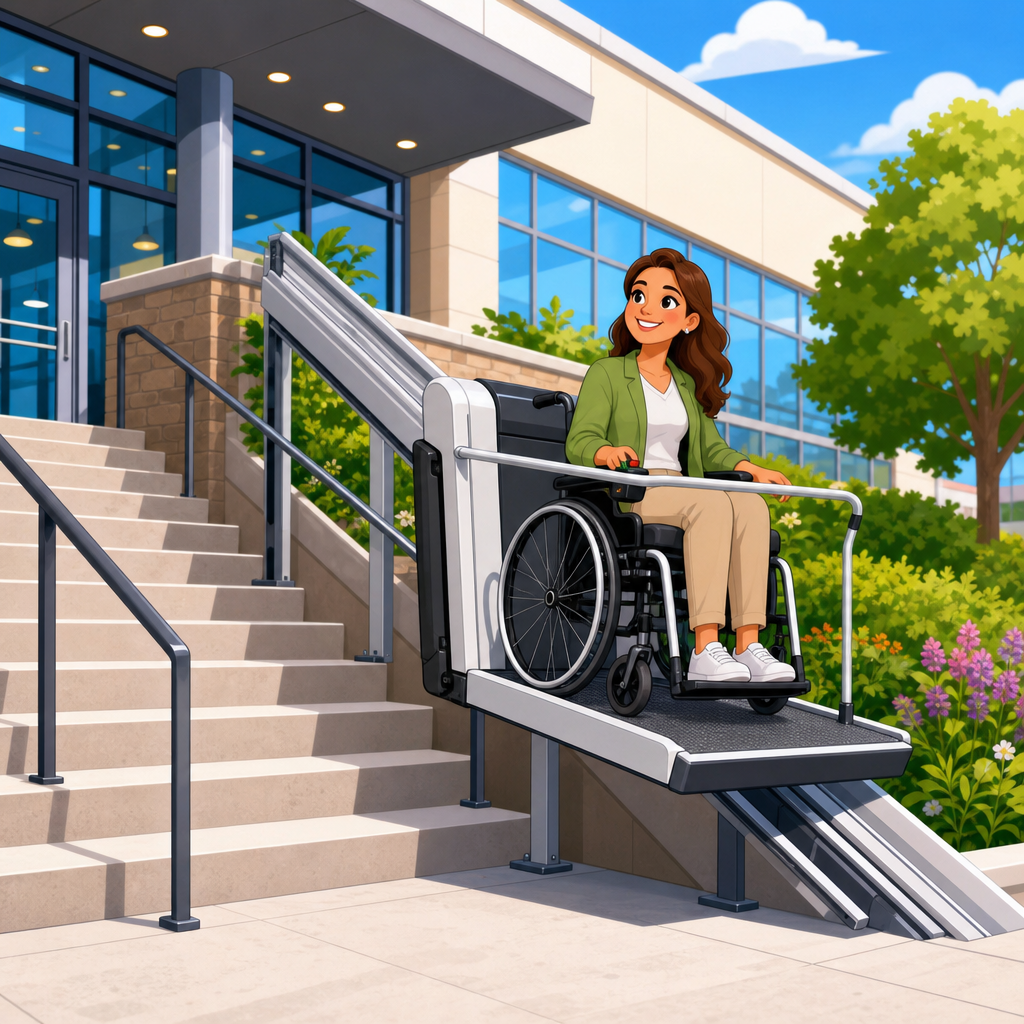
Best incline platform lifts for commercial use solve a specific accessibility problem: moving wheelchair users and passengers with limited mobility along an existing staircase when a full elevator or vertical platform lift is impractical. An incline platform lift travels on rails mounted beside the stairs, carries a wheelchair or standing passenger on a foldable platform, and preserves access in buildings where floor space, structural limits, or historic restrictions make other solutions difficult. In commercial settings, that includes schools, churches, offices, restaurants, transit stations, healthcare clinics, and multifamily public areas. Choosing the right system matters because building owners are balancing code compliance, passenger safety, stairway clear width, traffic flow, maintenance demands, and long-term operating cost, not just purchase price.
I have worked on accessibility equipment selections where the wrong lift looked economical at bid stage but became expensive once permitting, electrical upgrades, and ongoing service were included. That is why commercial buyers need a clear framework. Incline platform lifts are governed by accessibility and safety requirements, commonly including ADA design considerations for accessible routes, ASME A18.1 safety standards for platform lifts and stairway chairlifts, and local building and fire code provisions that can affect rail placement, landing gates, call stations, and emergency operation. The best commercial incline platform lift is therefore not a single brand or model for every property. It is the lift that fits the staircase geometry, duty cycle, user population, and inspection environment while remaining reliable for years of public use.
This hub article explains how to evaluate incline platform lifts, where they work best, what features separate residential-grade thinking from true commercial performance, and which manufacturers are most often considered in the market. It also points readers toward related topics within Chair Lift Types & Designs, including straight stair lifts, curved stair lifts, vertical platform lifts, and commercial wheelchair lift planning. If you are comparing systems for a renovation or new fit-out, start here before requesting drawings or proposals. A well-chosen incline platform lift protects accessibility, reduces project risk, and gives building users a dignified, independent way to move between levels.
What makes an incline platform lift suitable for commercial use
A commercial incline platform lift must do more than move up and down safely. It has to operate predictably in public conditions, tolerate heavier usage, and satisfy authorities having jurisdiction during plan review and inspection. The core difference between residential and commercial application is duty, control, and code scrutiny. In a private home, use may be only a few trips per day. In a school or worship facility, the lift may be called repeatedly during arrival, departure, and events. That changes what matters. Drive system durability, battery backup behavior, platform size, fold-up projection, diagnostic capability, and service access become essential buying criteria.
Commercial models typically include constant-pressure controls, obstruction sensors on platform edges, overspeed protection, final limit switches, emergency stop buttons, keyed operation where required, and power-fold or automatic ramp options to simplify use. They also need robust landing protection. Depending on the design, that can mean upper and lower landing gates, barrier arms, or integrated platform sidewalls that prevent roll-off during travel. Good systems are engineered so a wheelchair user can board, align, and ride with minimal assistance. In practice, that means clear visual controls, smooth starts and stops, and enough platform depth for common mobility devices, including many power chairs.
Another factor is stairway impact. The rail and parked platform reduce usable stair width, so the best incline platform lifts for commercial use are those that preserve code-required egress and day-to-day pedestrian circulation. I have seen excellent products rejected because the folded platform still projected too far into a narrow stair. Early field measurement is nonnegotiable. The stair angle, number of landings, door swings, handrail conflicts, and bottom clear floor area all affect viability long before product brochures matter.
Where incline platform lifts work best in commercial buildings
Incline platform lifts are ideal when a building needs an accessible route across one or a few level changes and the staircase is already the logical path of travel. Typical examples include a restaurant with dining on a mezzanine, a church with sanctuary access from an entry hall, a school stage, an office lobby with split levels, or a historic building where cutting a shaft would be disruptive or prohibited. In these settings, an incline platform lift often costs less and installs faster than an elevator, especially when structural work is limited.
They are also valuable in retrofit projects. Existing buildings frequently have architectural constraints that block a vertical lift footprint or machine room. Because an incline platform lift follows the stairs, it can use otherwise underutilized space. Curved systems can even navigate intermediate landings and changes in direction, though they are more expensive and require precise site surveying. In heritage properties, this can be the only acceptable way to provide wheelchair access without major alteration to significant fabric.
That said, incline platform lifts are not the right answer everywhere. If a building has high traffic, frequent unassisted public use, or multiple upper floors, an elevator or vertical platform lift may provide a better user experience and higher throughput. Public schools and transit environments, for example, may find that users queue at busy times if only one stairway lift serves the route. Weather exposure is another consideration. Outdoor-rated incline platform lifts exist, but corrosion resistance, drainage, and winter reliability must be reviewed carefully. Commercial buyers should think in terms of route capacity, not just physical fit.
Key evaluation criteria before choosing a model
When owners ask how to compare incline platform lifts, I recommend five filters: staircase compatibility, user accommodation, compliance pathway, durability, and service support. Staircase compatibility covers straight versus curved travel, rail mounting method, folded platform projection, landing space, and required electrical supply. User accommodation includes rated capacity, platform dimensions, attendant operation needs, and whether the lift can handle heavier power wheelchairs or scooters commonly seen in public facilities.
Compliance pathway is often underappreciated. Before selecting a brand, confirm how the product addresses ASME A18.1, local accessibility rules, fire alarm integration if required, and any stair egress limitations enforced by the building official or fire marshal. Some jurisdictions are stricter about gate interlocks, call/send controls, or emergency lowering. It is easier to choose a product with a strong commercial track record in your region than to educate inspectors on a lesser-known import.
Durability is where lifecycle cost becomes real. Ask about drive type, battery system, charger arrangement, exposure rating, finish options, and maintenance intervals. A lower upfront quote can lose value quickly if the unit needs frequent callouts or parts are slow to source. Service support may be the deciding factor. The best equipment still fails occasionally, and a commercial building cannot leave its accessible route unavailable for long. Evaluate who performs installation, who stocks critical parts, average response times, and whether remote diagnostics are available.
| Criterion | What to verify | Why it matters in commercial use |
|---|---|---|
| Stair geometry | Straight or curved run, width, landings, door conflicts | Determines whether the lift fits without compromising egress |
| Capacity and platform size | Rated load, usable deck dimensions, ramp configuration | Ensures common wheelchairs and power chairs can ride safely |
| Code acceptance | ASME A18.1 listing, local permit history, interlocks | Reduces redesign and inspection risk |
| Duty and reliability | Drive system, battery backup, controls, diagnostics | Supports frequent public operation with fewer shutdowns |
| Service network | Installer credentials, parts availability, maintenance plan | Minimizes downtime on an essential accessible route |
Straight versus curved incline platform lifts
Straight incline platform lifts serve a single uninterrupted staircase. They are simpler, faster to quote, and usually more economical than curved models. In many commercial renovations, a straight lift is the first option worth exploring because fabrication is standardized and installation is comparatively straightforward. If the stair connects two levels directly and there is enough landing space at both ends, a straight model can provide a dependable solution with lower lead times and easier future service.
Curved incline platform lifts are custom-built for stairs with turns, intermediate landings, or complex geometry. They solve access problems that would otherwise require major construction, but they demand meticulous measurement, often through digital survey methods or detailed templating. Curved rails increase cost materially, and replacement parts may be more model-specific. However, in older civic buildings, religious facilities, and split-level commercial interiors, a curved incline platform lift can be the only practical accessible route.
The tradeoff is not just price. Curved systems also require more planning around parking positions, travel speed through bends, and user waiting time. Buyers should ask how the platform stores at each landing, whether there is automatic folding, and how attendants or independent users will call the lift from different levels. On hub pages covering straight stair lifts and curved stair lifts, the emphasis is often seated travel; for wheelchair access, those same straight-versus-curved distinctions remain important, but platform size, rail loading, and landing protection become much more critical.
Leading brands and product lines commonly considered
The commercial market often includes Savaria, Garaventa, Bruno, Ascendor, Lehner, and regional suppliers with established dealer networks. Savaria’s Delta inclined platform lift is widely specified for straight stair applications and is known for commercial-grade controls, multiple platform sizes, and broad North American familiarity. Garaventa has a strong reputation in public accessibility projects, particularly where architects need proven code acceptance and custom configuration options. Bruno is better known in some markets for stairlifts and vertical platform lifts, but its commercial accessibility portfolio is still part of many comparative reviews depending on dealer coverage.
European manufacturers such as Ascendor and Lehner are also relevant, especially for architecturally sensitive projects or installations requiring compact folded profiles. In my experience, the best results come from comparing not just brochure features but actual support in your area. A theoretically excellent unit is a weak choice if the nearest qualified technician is hours away or if replacement sensors must ship internationally every time a fault occurs.
Rather than naming a universal winner, it is more accurate to rank these products by project fit. For a straightforward interior stair in a school annex, a mainstream straight model from a manufacturer with strong local service usually wins. For a landmark property with a turning stair and aesthetics under review, a custom curved system from an experienced specialty provider may be the best incline platform lift for commercial use. Ask each vendor for references in similar occupancies, not just general testimonials.
Installation, maintenance, and total cost of ownership
Commercial buyers should expect total project cost to include field verification, lift equipment, rails, electrical work, permits, delivery, installation, testing, inspection, and staff orientation. If gates, wall modifications, or fire alarm interface are needed, those costs should be identified early. Straight incline platform lifts are usually less expensive to purchase and install than curved systems, but the stair itself can drive cost if reinforcement, power relocation, or landing reconfiguration is required.
Maintenance is not optional. Because these lifts provide an accessible route, downtime has operational and legal consequences. Most manufacturers recommend scheduled preventive maintenance, and prudent owners keep service records, test safety devices routinely, and train staff on basic operation during outages. Battery-backed units still need healthy batteries; neglected battery replacement is a common cause of avoidable failures. Cleaning also matters. Dust, salt, and debris on rails or platform hinges can shorten component life, especially on exterior or semi-exterior stairs.
Total cost of ownership depends heavily on usage pattern and service quality. A more expensive model with better diagnostics, stronger local support, and proven parts availability often becomes the cheaper choice over ten years. That is especially true in healthcare, education, and assembly occupancies where an out-of-service lift creates immediate complaints and workarounds. When reviewing proposals, ask vendors for expected maintenance frequency, typical wear items, warranty scope, and estimated lead time for critical components. Those answers reveal more than the base quote.
How to choose the best incline platform lift for your property
Start with a site survey by a contractor or accessibility lift specialist who has commercial experience, not only residential sales background. Confirm stair dimensions, landings, user needs, and code constraints before discussing finishes. Next, define the route’s purpose. Is the lift serving occasional escorted access to a stage, or is it the primary public route to key spaces every day? The answer shapes capacity expectations, control layout, and whether an incline platform lift is appropriate at all.
Then compare at least three proposals on a normalized basis: exact scope, code assumptions, lead time, warranty, maintenance plan, and exclusions. Request photos or case studies of similar installations, and speak with facility managers who live with the equipment. If your broader accessibility plan also involves vertical circulation elsewhere, review related articles on vertical platform lifts and commercial wheelchair lifts to ensure you are not forcing a stair-based solution where another system would perform better.
The best incline platform lifts for commercial use are dependable, code-ready, easy to operate, and backed by responsive local service. They preserve access without requiring major reconstruction, which is why they remain such an important option within Chair Lift Types & Designs. If you are planning an accessibility upgrade, use this hub as your starting point, gather a qualified site assessment, and shortlist manufacturers with proven commercial installations in buildings like yours.
Frequently Asked Questions
What is an incline platform lift, and when is it the best choice for a commercial building?
An incline platform lift is a motorized accessibility device that travels along a rail system mounted beside an existing staircase. It is designed to carry a wheelchair user, scooter user, or in some models a standing passenger, from one level to another without requiring a full elevator shaft or the footprint of a vertical platform lift. In commercial settings, it is often one of the most practical ways to improve access when a building has limited space, structural constraints, or preservation requirements that make major construction difficult.
It is typically the best choice when a business, school, church, municipal building, medical office, or other public facility needs to provide access over a short rise of stairs but cannot reasonably install an elevator. This often applies in older buildings, split-level entrances, mezzanines, and historic properties where preserving the original structure matters. Because the lift folds up when not in use, it helps maintain stairway usability while still offering an accessible route for people with mobility limitations.
For many commercial properties, the value of an incline platform lift is that it solves a very specific problem efficiently. It allows accessibility upgrades without the expense, space demands, and construction complexity of creating a new shaft, pit, machine room, or large vertical lift enclosure. That makes it especially attractive for renovations and retrofit projects where every inch of floor space and every structural modification matters.
How do commercial incline platform lifts compare with elevators and vertical platform lifts?
Commercial incline platform lifts fill a unique niche between elevators and vertical platform lifts. An elevator is usually the best long-term solution for moving large numbers of passengers between multiple floors, but it requires significant construction, dedicated space, and a much larger budget. A vertical platform lift can be effective for short rises, but it still needs clear landing space and is not always practical where the only route is along an existing staircase. An incline platform lift, by contrast, uses the line of the stairs themselves, making it a strong option when preserving the current layout is important.
In terms of installation impact, incline platform lifts are often much less disruptive. The rails are mounted along the stairway, and the platform folds up when parked, which helps avoid consuming valuable square footage. This is a major advantage in commercial buildings with tight lobbies, narrow entries, or limited room for new construction. In historic buildings, that reduced structural intervention can also make code review and design approvals more manageable.
That said, incline platform lifts are not a direct replacement for elevators in every environment. They generally move one passenger or mobility device at a time, travel more slowly than elevators, and are best suited for shorter runs or moderate traffic situations. For a busy multi-story office, hotel, or hospital, an elevator is usually the more appropriate accessibility solution. But for many commercial properties with an isolated stair challenge, an incline platform lift offers a highly practical balance of access, cost control, and building preservation.
What features should you look for in the best incline platform lifts for commercial use?
The best commercial incline platform lifts combine safety, durability, ease of use, and code-appropriate design. First, look for a model specifically rated for commercial applications rather than residential use. Commercial lifts are built for heavier duty cycles, more frequent operation, and stricter performance expectations. Important basics include a sturdy rail system, dependable drive mechanism, non-slip platform surface, obstruction sensors, emergency stop controls, battery backup or emergency lowering capability, and safety arms or barriers that secure the passenger during travel.
Platform size and weight capacity are also critical. The lift should be able to accommodate common wheelchair dimensions and turning needs at the landings, and it should have enough capacity for both the mobility device and user without pushing the equipment to its limits. In public settings, fold-up design matters too. A compact folded profile helps preserve egress and keeps the staircase as open as possible when the lift is not in use.
You should also pay close attention to usability features such as constant-pressure controls, call/send stations, smooth starts and stops, and intuitive boarding design. In commercial environments, reliability and serviceability are just as important as the initial specifications. Choosing a lift from a reputable manufacturer with strong dealer support, available replacement parts, and qualified technicians can make a major difference over the life of the equipment. The best lift is not simply the one with the most features on paper; it is the one that fits the building, the traffic level, the stair configuration, and the long-term maintenance plan.
Are incline platform lifts safe and code-compliant for public or commercial spaces?
Yes, when properly selected, installed, and maintained, incline platform lifts can be safe and code-compliant for public and commercial use. These lifts are engineered with multiple safety systems intended to protect both the rider and other stair users. Common safety features include platform edge sensors that stop the lift if it encounters an obstruction, side barriers or arms that help prevent roll-off during travel, overspeed protection, key controls where required, emergency stop buttons, and backup systems to address power interruptions. The fold-up platform design also helps reduce interference with normal stair traffic when the unit is parked.
Code compliance, however, depends on more than just the lift itself. The installation must match the building conditions, local code requirements, and accessibility standards that apply in the jurisdiction. Stair width, landing clearance, folded platform projection, emergency egress, electrical requirements, and operational controls all need to be reviewed carefully. In many cases, compliance also involves coordination among the lift supplier, architect, contractor, and local building officials to ensure the entire system is appropriate for the intended public use.
Because commercial accessibility requirements can be complex, building owners should never assume that any lift model will automatically satisfy all obligations. The safest and smartest approach is to work with experienced professionals who understand commercial codes, accessibility regulations, and the realities of retrofit construction. A properly planned installation not only protects users but also reduces the risk of failed inspections, costly redesigns, and future liability concerns.
How much do commercial incline platform lifts cost, and what affects the final price?
The cost of a commercial incline platform lift can vary widely depending on the staircase layout, lift length, building conditions, and required customization. Straight staircases are generally less expensive to equip than curved or multi-landing stairways, because curved systems require custom rail fabrication and more complex engineering. In addition to the lift equipment itself, total project cost often includes site evaluation, design coordination, electrical work, permitting, delivery, installation, testing, and final inspection.
Several building-specific factors can influence pricing significantly. For example, narrow stairs, limited landing space, unusual structural conditions, or historic preservation requirements may require custom solutions or more labor-intensive installation. Weight capacity, platform dimensions, automatic folding features, upgraded controls, and weather-resistant options for semi-exterior applications can also add cost. If the project involves commercial code review, accessibility consultation, or coordination with other renovations, those planning expenses should be included in the budget as well.
It is also important to think beyond the purchase price. Long-term value includes maintenance requirements, service availability, warranty coverage, parts support, and expected lifespan under commercial use. A lower upfront quote is not always the better investment if it leads to more downtime or limited service support later. For most commercial buyers, the most accurate way to budget is to request a site-specific proposal from a qualified dealer or accessibility contractor who can assess the stairs, usage needs, and compliance considerations in detail.