


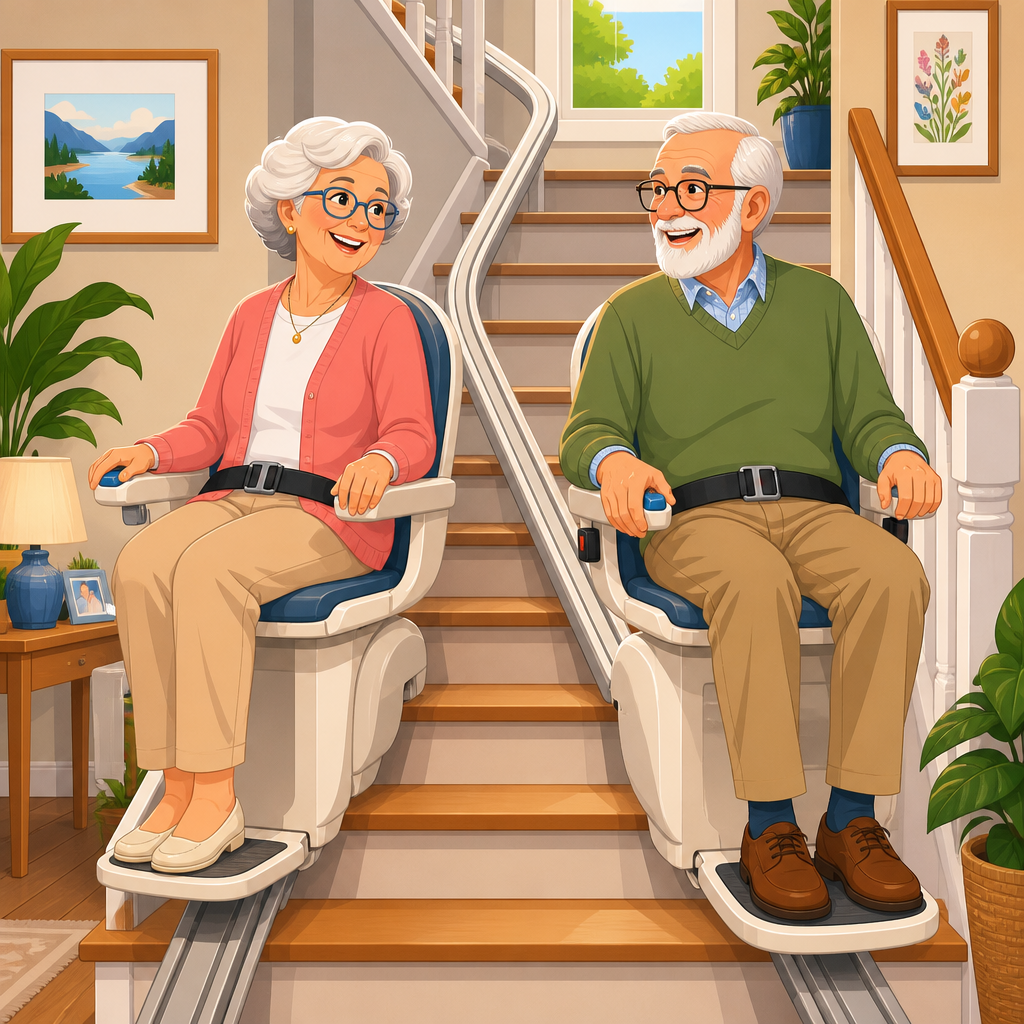
Choosing the best stair lifts for couples sharing the same staircase starts with one practical truth: the right system must serve two people with different bodies, routines, and mobility needs without turning the stairs into a daily negotiation. In the stair lift market, people often use stair lift and chair lift interchangeably, especially in guides for seniors, but the core product is the same: a motorized seat that travels along a rail fixed to the stairs. For couples, however, the buying decision is more complex than it is for a single user. You are not just matching a lift to a staircase. You are matching it to two sets of transfer abilities, two comfort preferences, two safety profiles, and one shared home layout.
I have worked with families comparing lifts for straight stairs, curved stairs, narrow landings, and split-level entries, and the same questions come up every time. Can one lift be adjusted quickly for both users? Is a heavy-duty model too bulky for a spouse who is smaller? Does a perch seat help one person while making the ride awkward for the other? Can two lifts run on the same staircase, or is that unsafe and impractical? These are the questions that separate a generic product roundup from a useful stair lift buying guide.
This hub article covers the best chair lifts for seniors through the lens that matters in real homes: shared use. It explains which lift types work best, what features matter most when two people rely on the same rail, how leading brands compare, and when a custom solution is worth the cost. It also helps you evaluate fit, installation, service, and long-term ownership so you can narrow options confidently before speaking with a dealer. If you are building a shortlist for a shared staircase, this guide gives you the framework.
What makes a stair lift good for two users
A stair lift for couples must do three jobs well. First, it has to fit the staircase physically. Second, it has to fit both users ergonomically. Third, it has to support reliable day-to-day use with minimal friction. If any one of those fails, the lift may still work on paper but disappoint in practice.
The first checkpoint is staircase type. Straight stair lifts run on a simple rail and are usually the most affordable option. Curved stair lifts are custom built to match turns, intermediate landings, or spiral transitions and cost significantly more. Outdoor stair lifts add weather-resistant materials, sealed controls, and UV-stable seats. For couples, rail design matters because shared use amplifies inconvenience. A rail overrun, powered swivel seat, or folding hinge that feels optional for one user can be essential when two people are boarding at different ends of the staircase.
The second checkpoint is seat and control flexibility. In homes I have assessed, the best shared-use models offer armrest controls that are easy to reach, call-send remotes at both landings, and seats that swivel securely with low hand force. Adjustable seat height, footrest position, and arm width matter because spouses often have different leg lengths, torso stability, or hip mobility. A model that fits one user perfectly but forces the other into a poor transfer angle is not the best stair lift for couples.
The third checkpoint is operating rhythm. Shared use works best when both riders can send the chair to the other floor easily, recognize the controls without confusion, and trust that battery backup will keep the unit moving during a power outage. Most quality lifts charge continuously or at designated charge points and use batteries to operate even when utility power is lost. That is not a luxury feature. For seniors, it is a safety requirement.
Best types of stair lifts for couples sharing one staircase
The best type depends on the physical needs of both riders. A standard seated stair lift is the right choice for most couples because it balances comfort, safety, and space efficiency. These lifts typically include a padded seat, seat belt, obstruction sensors, folding footrest, and swivel seat at the top landing. They are the baseline recommendation for couples who can sit and stand with moderate support.
Perch stair lifts are useful when one or both users have limited knee bend or find sitting painful. The rider leans against a small seat while standing or semi-standing. On paper, this can solve space problems on narrow stairs because perch lifts often project less into the walking path. In practice, they are not ideal for every couple. One spouse may appreciate the transfer angle while the other feels insecure without a full seated position. Perch models are best only when both users can tolerate the posture safely.
Heavy-duty stair lifts deserve careful attention in shared situations. These units support higher weight capacities, commonly 350 to 600 pounds depending on the brand and model, and usually include a wider seat and reinforced chassis. If one spouse needs the higher capacity, a heavy-duty model may be necessary. The tradeoff is footprint. Wider seats and rails can reduce clearance on already tight stairs. The best choice is often the smallest model that safely accommodates the larger user while still letting the smaller user sit with proper side support.
Some couples ask about installing two stair lifts on one staircase. In almost every case, that is the wrong solution. It increases obstruction, complicates servicing, and may not be feasible on straight or curved runs. A single well-fitted lift with call-send controls is usually safer, cheaper, and easier to manage.
| Lift type | Best for | Main advantage for couples | Main limitation |
|---|---|---|---|
| Standard seated | Most seniors with moderate mobility limits | Balanced comfort, simple controls, broad brand choice | May be tight on very narrow stairs |
| Perch | Users who struggle to bend knees fully | Helps with difficult sit-to-stand transfers | Not comfortable or secure for every rider |
| Heavy-duty | Higher-capacity users or taller riders | Safer fit for larger spouse, stronger frame | Takes more space and can feel oversized |
| Outdoor | Exterior porch or entry stairs | Lets both users access the home safely | Higher weather exposure and maintenance needs |
Features that matter most when two seniors share a chair lift
When two people use one stair lift daily, convenience features become core performance features. Start with call-send controls. Each user should be able to summon the chair from either landing without climbing stairs or waiting for help. Wireless remotes are common, but wall-mounted controls can be easier for users with vision or dexterity challenges. The best systems include intuitive buttons with clear directional logic.
Next, prioritize powered components where needed. A manual swivel seat is acceptable for many users, but if either spouse has arthritis, reduced grip strength, or trunk weakness, a powered swivel can materially improve safety at the upper landing. The same is true for powered footrests and powered rail hinges. These add cost, yet they remove repeated bending and lifting that often become pain points within months of installation.
Seat geometry matters more than brochures suggest. Look for a seat depth that supports the thighs without forcing the knees too high, armrests that provide a stable push-off point, and a footrest large enough for orthopedic shoes. If one spouse is petite and the other tall, ask the dealer to demonstrate transfer fit for both people, not just a showroom ride. I have seen buyers approve a unit after one smooth demo only to discover at home that the shorter spouse cannot plant both feet securely before sitting.
Safety features should be nonnegotiable. Standard expectations include a seat belt, overspeed governor, obstruction sensors on the footrest and carriage, battery backup, and lockable controls if grandchildren visit. Reputable manufacturers also design to recognized standards such as ASME A18.1 in North America, which covers platform lifts and stairway chairlifts. A dealer who cannot explain applicable codes, weight capacity, and charging method clearly is not the right partner.
Leading brands and models worth shortlisting
In the best chair lifts for seniors category, a few established brands consistently appear because they have broad dealer networks, parts availability, and proven product lines. Bruno is a frequent top choice in the United States, especially for reliability and solid build quality. Models such as the Bruno Elite for straight stairs and Bruno Elite Curved are well regarded for smooth travel, strong weight capacities, and comfortable seats. For couples, Bruno often works well because controls are straightforward and the seating feels stable for a wide range of body types.
Stannah is another major name with a strong reputation in custom curved installations. Its products typically offer refined ride quality, compact rail options, and good upholstery choices. In shared-use homes with complex stairs, Stannah often stands out because customization is deep and the finished fit can be cleaner than lower-cost alternatives. The downside is price. Curved systems from premium brands are rarely budget purchases.
Handicare is widely known for lineup breadth, including straight, curved, outdoor, and heavy-duty options. Some Handicare models include features such as powered hinge rails and slide-track designs that reduce rail intrusion near doorways. Those details can make a major difference when a shared staircase opens into a hall that both spouses use frequently.
Harmar remains a recognizable option, particularly for value-conscious buyers and for buyers seeking dealer availability in many regions. Savaria also deserves attention, especially where custom accessibility solutions are being considered alongside lifts, such as vertical platform lifts or future home modifications.
No brand is universally best. The right question is narrower: which manufacturer offers the safest, most serviceable model for both users on this specific staircase? For straight stairs, compare warranty terms, seat fit, ride smoothness, and local service response. For curved stairs, prioritize measuring accuracy, rail design, and installer experience over marketing claims.
How to match a lift to your staircase and your daily routine
Start with measurements, but do not stop there. Dealers should measure the full run length, stair width, landing clearance, nose-to-wall distance, and any obstructions such as radiators, handrails, or door swings. Narrow staircases often need a tighter folding profile or a parking position that keeps the chair out of the main path. In homes where one spouse still walks the stairs occasionally, this clearance question is critical.
Daily routine is just as important as dimensions. Ask where each person begins and ends the day, whether either uses a walker, cane, or oxygen tubing, and how often the chair must be parked away from the main landing. If one spouse wakes earlier, remote call-send operation needs to be simple enough to use half awake. If one user transfers more slowly, the top landing must provide enough space to swivel, stand, and steady before walking away.
Also consider future change. Many buyers shop only for current mobility, but couples often age at different rates. A lift that is barely adequate now may fail within two years if one spouse develops reduced balance, spinal stenosis, or shoulder weakness. Choosing a model with optional powered functions, stronger capacity, or better seat support can delay the need for replacement.
Costs, installation, and when custom solutions are worth it
Straight stair lifts commonly cost far less than curved units, but exact pricing varies by brand, dealer, powered options, and regional labor rates. In many markets, a straight lift may fall roughly in the low-thousands installed, while a curved lift can climb into the high-thousands or beyond because the rail is made to order. Outdoor and heavy-duty models add further cost. For couples, the temptation is to shop strictly on price because one lift feels like a shared household appliance. That approach backfires when the cheaper unit lacks the adjustments or powered features one spouse truly needs.
Installation quality matters as much as product quality. A good installer checks charging points, confirms seat leveling, tests obstruction sensors, and trains both users separately. That final step is often skipped, yet it is essential. Each spouse should practice calling the lift, boarding, fastening the belt, operating travel controls, swiveling safely, and folding the unit if applicable.
Custom solutions are worth the money when the staircase has turns, tight lower runouts, doorway conflicts, or unusual user needs. A slide track, folding hinge, or custom parking location can transform a frustrating setup into a seamless one. In shared-use homes, that convenience compounds every day.
Conclusion
The best stair lifts for couples sharing the same staircase are the ones that fit two people as carefully as they fit the stairs. For most households, that means a standard seated model from a reputable brand, equipped with easy call-send controls, dependable battery operation, and transfer-friendly seating. When one spouse has higher weight needs, painful knee flexion, or limited hand strength, heavy-duty frames, perch options, and powered features become more than upgrades. They become the difference between occasional use and confident daily use.
As a hub for best chair lifts for seniors, this guide should help you compare the main product types, understand where leading brands excel, and ask better questions during a home assessment. Focus on staircase fit, dual-user comfort, safety systems, service support, and realistic long-term needs. If you are narrowing your options now, schedule in-home quotes from experienced dealers and have both users test the same model before you decide.
Frequently Asked Questions
1. What should couples look for first when choosing a stair lift for a shared staircase?
The first priority is not the brand, the upholstery, or even the price—it is whether the lift can comfortably and safely serve two different people on the same staircase every day. For couples, that usually means comparing seat size, weight capacity, armrest spacing, footrest design, swivel options, and ease of use. One partner may need a higher seat, while the other may want a narrower profile for easier transfers. A good shared-use stair lift should feel stable and supportive for both riders, not ideal for one person and merely tolerable for the other.
It is also important to think about how the lift will fit into the couple’s routine. If both people use the stairs frequently, features such as call/send controls at each landing, a folding seat and footrest, and smooth start-and-stop operation become much more valuable. These details reduce friction in daily use and help prevent the staircase from becoming a source of frustration. In many homes, the best choice is the model that is easiest to live with repeatedly, not just the one with the most features on paper.
Another major consideration is the staircase itself. Straight staircases generally offer more affordable and faster-to-install options, while curved staircases require custom rail systems. Couples should also consider whether the staircase must remain easy for other household members to walk on while the lift is parked. A stair lift with a compact folded profile and parking options at the top or bottom landing can make a major difference in shared households.
Finally, couples should look ahead rather than buying only for current needs. If one partner’s mobility is likely to change, selecting a lift with higher capacity, easier transfer positioning, or better seated support may prevent the need for replacement later. In short, the best stair lift for couples is one that matches both users now, fits the home properly, and still makes sense as needs evolve.
2. Can one stair lift really work well for two people with different mobility needs?
Yes, in many cases one stair lift can work very well for two people, but only if the model is chosen with shared use in mind. The key is understanding that “different mobility needs” can mean several things: different body sizes, different balance abilities, different levels of hand strength, different transfer methods, or different comfort preferences. A stair lift that works beautifully for a person who can sit and stand independently may be much less suitable for someone who needs more support during transfers.
For that reason, couples should pay close attention to adjustability and usability. Features that often help include a generously sized seat, supportive armrests, a seat height that allows easier standing, a swivel seat at the landing, a secure seat belt, and simple controls that do not require strong grip or precise finger motion. Some lifts also offer powered swivel seats or powered footrests, which can be especially helpful if one or both users have limited flexibility, arthritis, or reduced leg strength.
That said, there are situations where one standard stair lift may not meet both people’s needs equally well. For example, if one partner requires a heavy-duty model with a larger seat and higher weight capacity, the other partner may find that larger seat less comfortable or feel less secure. Likewise, if one person needs a perch-style or standing stair lift and the other needs a traditional seated model, the buying decision becomes more specialized. In these cases, a professional in-home assessment is especially important.
The best way to decide is to have both users evaluated together, not separately. A reputable stair lift provider should observe how each person sits, transfers, and uses controls, then recommend a solution that balances comfort, safety, and practicality. For many couples, one well-chosen stair lift is entirely realistic—but it should be selected as a shared mobility tool, not simply as a generic device for “the household.”
3. Is it better for couples to buy a standard stair lift or a heavy-duty model?
That depends on the physical needs of both users, but couples should not assume that a heavy-duty model is automatically the better shared solution. Heavy-duty stair lifts are designed with higher weight capacities, wider seats, and sometimes reinforced components. These features can be extremely valuable if one or both users need the extra support, but they also require enough staircase width and may create a bulkier presence when folded. In a home where space is tight, that can affect walking clearance for everyone else using the stairs.
A standard stair lift is often the best choice when both users fall comfortably within the manufacturer’s recommended capacity and can use the seat safely and confidently. Many modern standard models already offer excellent stability, smooth performance, and practical comfort features. If both partners can transfer easily and do not need a larger seat base or expanded arm spacing, a standard lift may provide the best balance of function, footprint, and cost.
However, if either partner would be close to the upper weight limit of a standard model, or if one user would be noticeably cramped in the seat, moving up to a heavy-duty model is often the wiser long-term decision. The right fit matters for safety as much as comfort. A seat that is too small can make boarding more difficult, reduce confidence, and increase the risk of awkward transfers. Likewise, buying a model that only barely meets one partner’s needs leaves little room for future changes in health or mobility.
Couples should also remember that heavy-duty models may have additional installation requirements. Some need wider staircases, and some may not be suitable for certain layouts. The most reliable approach is to compare real measurements, not assumptions: body size, seat dimensions, staircase width, and landing space. The best model is the one that both users can operate safely and comfortably without compromising the function of the staircase itself.
4. Which features make the biggest difference when two people are sharing the same stair lift every day?
The features that matter most are the ones that reduce waiting, simplify operation, and make transfers safer for both users. Near the top of that list are call/send controls. These allow one partner to bring the lift to their floor without relying on the other person to return it manually. In shared daily use, this is one of the most practical features because it prevents the stair lift from becoming inconvenient when parked at the opposite landing.
A swivel seat is another major advantage, especially at the top landing. It allows the rider to turn away from the staircase before standing, which improves stability and reduces the feeling of stepping out toward the stairs. For couples with different levels of balance or confidence, a powered swivel seat can be even more useful because it removes some of the physical effort required. Powered footrests are also worth considering when bending down is difficult or painful.
Comfort and fit features also matter more in shared use than many buyers expect. A padded seat, supportive backrest, easy-to-reach controls, and foldable armrests and footrest can improve the experience for both riders while keeping the staircase less obstructed between uses. Smooth ride quality is especially important if either user has joint pain, back discomfort, or a sensitivity to jerky starts and stops. Battery backup is another valuable feature because it ensures the lift can still operate during a power outage.
Finally, couples should pay attention to parking and charging arrangements. Some stair lifts can be parked away from the main living view or at a location that leaves the hallway and staircase clearer. This can make a noticeable difference in homes where both appearance and space efficiency matter. In everyday life, the best features are not always the flashiest—they are the ones that quietly prevent minor inconveniences from turning into recurring problems.
5. How can couples make sure they are buying a stair lift that will still work well in the future?
The smartest way to future-proof a stair lift purchase is to think beyond today’s mobility level. Many couples begin shopping because one partner needs help now, but the best buying decision often accounts for the possibility that both people may rely on the lift more heavily over time. That means looking at capacity, seat support, transfer ease, safety features, warranty terms, and service availability—not just the initial purchase price.
One of the most important steps is choosing a model with enough performance margin. If a lift only barely suits one user’s size, strength, or balance needs, it may not remain practical if those needs increase. A more supportive seat, easier controls, powered options, or a higher weight capacity can extend the useful life of the system and reduce the chance of needing an upgrade later. For couples aging in place, this is often a more cost-effective strategy than buying the minimum acceptable option now.
Service and reliability are just as important as specifications. Couples should ask how quickly repairs are handled, whether maintenance plans are available, what the battery replacement schedule looks like, and whether parts are readily accessible for that model. A dependable stair lift is not simply one that installs well—it is one that remains supportable for years. If the lift becomes central to both partners’ daily movement through the home, downtime can create serious disruption.
It also helps to choose a provider that performs a thorough home assessment and asks detailed questions about both users. A strong recommendation should reflect staircase dimensions, transfer habits, hand strength, future health expectations, and household traffic patterns. When couples buy with those factors in mind, they are much more likely to end up with a stair lift that feels like a