


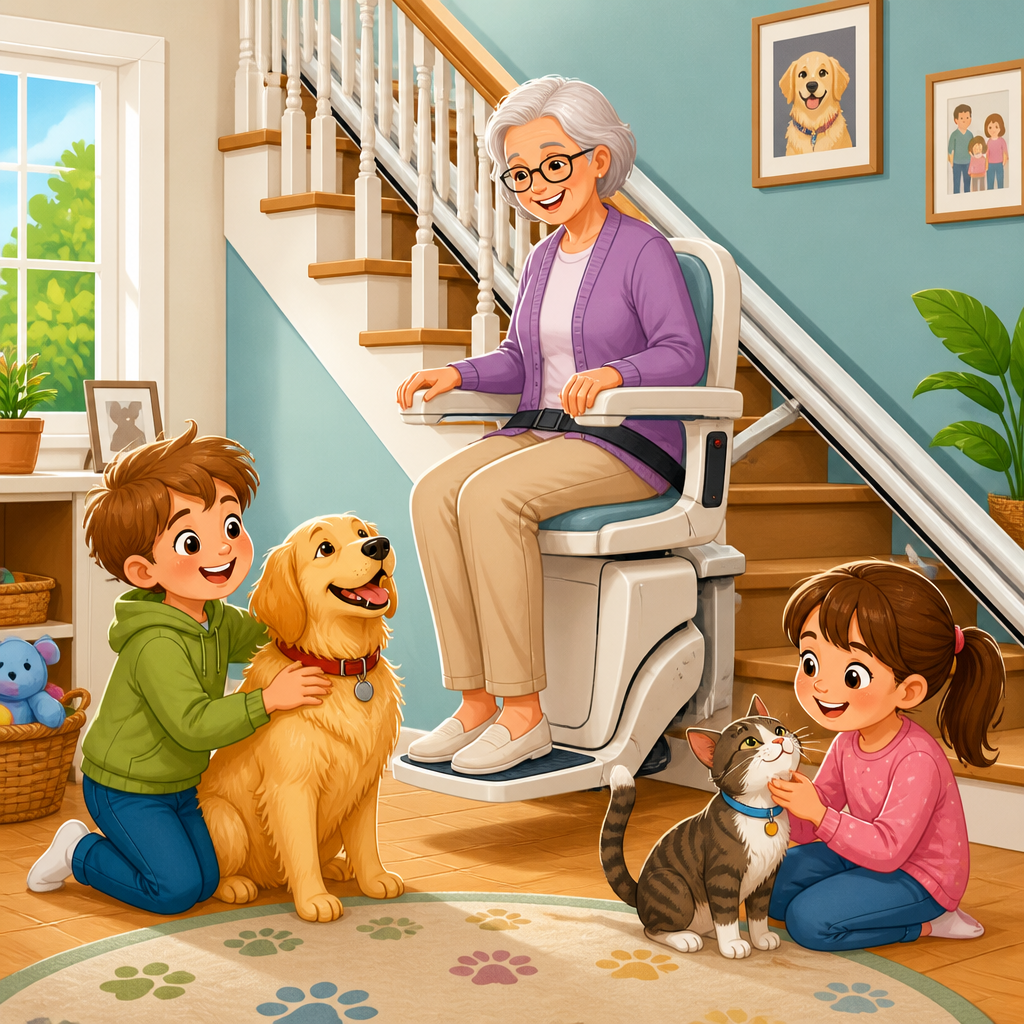
Choosing the best stair lifts for homes with pets and children requires more than comparing prices or upholstery colors. In family houses, a stair lift becomes part mobility device, part traffic-management system, and part safety feature. I have helped families evaluate installations in narrow townhouses, split-level suburban homes, and multigenerational properties where toddlers, teenagers, cats, and large dogs all shared the same staircase. The right model reduces fall risk for the rider without creating new hazards for everyone else.
A stair lift is a motorized chair that travels along a rail fixed to the staircase, carrying one seated user between levels. Key terms matter when comparing stair lifts. A straight stair lift fits a staircase without turns or landings. A curved stair lift follows bends, intermediate landings, or spiral-like geometry through a custom rail. A perch seat supports riders who have trouble bending their knees. A folding footrest, swivel seat, call-send control, and obstruction sensors are standard or optional safety features that become especially important in busy homes.
Why does the topic matter so much for families? Children move unpredictably, and pets often treat stairs as pathways, resting spots, or launch points. That changes the risk profile. A safe lift in a quiet two-adult household may be a poor fit in a home where a child leaves toys on steps or a dog sleeps on the landing. The best stair lifts for homes with pets and children combine compact design, reliable sensors, secure seating, intuitive controls, and durable construction that can handle constant daily use. This guide compares the most suitable lift types, ranks the features that matter most, and explains how to choose a system that works in real family life.
What Makes a Stair Lift Family Friendly
The best family-friendly stair lifts share six traits: a narrow folded profile, strong obstruction detection, simple controls, secure rider positioning, dependable battery backup, and easy maintenance. Folded width is crucial because children and pets still need walking space when the chair is parked. On many quality straight lifts, the seat, arms, and footrest fold up to reduce projection into the staircase. In practice, even a difference of a few inches can determine whether a narrow stair remains comfortable for others to use.
Obstruction sensors are equally important. Most modern lifts have sensors on the carriage and footrest that stop the unit if it contacts an object on the stairs. In family settings, that object may be a toy truck, a dropped backpack strap, or a cat sitting on a lower step. Sensors do not replace supervision, but they are a critical layer of protection. I advise families to test how quickly the lift stops during demonstrations and to ask exactly which edges are sensor protected.
Controls should be intuitive for the rider while remaining resistant to accidental activation by children. Many systems use constant-pressure rocker switches, meaning the chair moves only while the user keeps the control engaged. That is safer than a start-stop style for homes with young children who like pressing buttons. Call-send remotes are useful too, especially when one caregiver parks the chair away from the main traffic zone after use.
Seat belts, powered swivel seats, and stable footrests improve rider safety. A powered swivel can be very helpful at the top landing, where awkward twisting near an open staircase increases fall risk. Finally, battery operation matters. Most modern stair lifts charge from household power but run on batteries, allowing several trips during an outage. For households with elders, children, and pets, that resilience is not optional.
Best Stair Lift Types for Homes With Pets and Children
The safest type depends first on staircase shape and second on household behavior. Straight stair lifts are usually the best value and simplest option for homes with a single uninterrupted run of stairs. Because their rails are standardized rather than fully custom, installation is faster, often completed in a few hours. They also tend to have slimmer rail footprints and lower long-term service costs. For many family homes, a high-quality straight lift with strong sensors and a folding rail is the most practical choice.
Curved stair lifts are the right answer when the staircase has turns, pie-shaped steps, or intermediate landings. Families sometimes hesitate because curved systems cost significantly more, but forcing a poor-fit straight solution is not safe. A properly designed curved lift can park out of the main sightline, reducing the chance that children treat it like furniture or that pets congregate around it. Because the rail is custom built, exact measurement is essential; installers commonly use photo measurement systems or digital surveying to avoid clearance problems.
Standing or perch stair lifts can help users who cannot fully bend at the knees or hips. However, in homes with young children, I treat these as niche solutions because they generally leave less margin for rider instability than seated models. Outdoor stair lifts are another category, useful for porch entries or garage access, but weatherproofing alone does not make them ideal for family use. They still need covered controls, lockable operation, and maintenance against debris tracked in by pets.
For most households under this subtopic, the strongest recommendations fall into three practical design patterns: straight compact lifts for standard stairs, curved custom lifts for complex layouts, and heavy-duty seated lifts for larger users who still need family-safe operation. The ranking should always start with fit and safety, not brand loyalty.
Top Features to Prioritize When Comparing Models
When I compare stair lifts for clients with children and pets, I score features in a strict order. Safety sensors come first, then folded footprint, then seat stability and transfer safety, then usability and service support. Upholstery, color, and even speed matter less than these fundamentals. A stair lift that looks attractive but blocks the stairs or misses low obstacles is not the right product.
| Feature | Why It Matters in Family Homes | What to Look For |
|---|---|---|
| Obstruction sensors | Stops travel if toys, paws, or objects are in the way | Sensors on footrest and carriage edges |
| Folded width | Preserves stair access for children, pets, and caregivers | Compact chair, arms, and footrest when folded |
| Swivel seat | Helps the rider exit safely away from the staircase edge | Locking swivel, ideally powered for limited mobility |
| Call-send controls | Allows parking the chair away from active family zones | Simple wall or handheld controls with secure pairing |
| Battery backup | Keeps the lift working during power outages | Sealed batteries with easy service access |
| Service network | Reduces downtime in homes that rely on daily access | Local dealer, parts availability, clear warranty terms |
Noise level also deserves attention. Loud gear noise can startle pets and make children curious or anxious. Modern DC-drive stair lifts from established manufacturers are generally quieter than older designs, though no lift is silent. Ask for a live demonstration. If the family has a reactive dog, repeated short rides before full-time use can help desensitize the animal.
Another feature that is often overlooked is a hinged or folding rail at the bottom. In entry halls, the rail can otherwise extend into a doorway or walking path, creating a trip hazard for kids carrying backpacks or for pets darting through the space. A powered hinge costs more but can dramatically improve daily usability.
Best Brands and Models to Evaluate First
Among recognized manufacturers, Bruno, Stannah, Harmar, Handicare, and Access BDD are consistently on the shortlist. Exact model names and local availability vary by market, but their core reputations are well established. In the United States, Bruno straight lifts are frequently praised for build quality, smooth ride feel, and dependable service support through dealer networks. For families, Bruno models with compact folded dimensions and optional power footrest or folding rail are usually worth early consideration.
Stannah is widely respected for refined engineering, a stable ride, and thoughtful ergonomics. In homes with children, I like Stannah’s emphasis on easy controls and secure seating geometry. Their curved systems are especially strong contenders where landings and turns create awkward traffic flow. Harmar remains prominent because it covers multiple price points and offers both straight and curved products, including heavy-duty options. That breadth can help households compare practical tradeoffs without switching brands during the shopping process.
Handicare and Access BDD also deserve attention for compact designs and broad international experience. Access BDD, known for the HomeGlide line in many regions, often enters the conversation when stair width is tight. Handicare has long been a serious competitor in custom and straight lift segments, with dealer support that can be excellent depending on location. Because service quality is local, the best brand nationally is not always the best installer in your zip code.
If I were ranking starting points for a typical family home, I would first compare a premium straight lift from Bruno or Stannah, a value-oriented but established straight lift from Harmar or Access BDD, and a custom curved proposal from Stannah or Handicare if the staircase requires it. The winning choice usually comes down to measurements, safety options, and installer competence rather than brochure claims alone.
Installation, Maintenance, and Daily Use in Busy Households
Stair lifts are mounted to stair treads, not usually to the wall, which surprises many homeowners. A professional survey should confirm tread condition, staircase width, landing clearance, power proximity for charging, and any interference from radiators, trim, doors, or banisters. In homes with children, installers should also discuss parking points so the chair is not left where it invites climbing or blocks sightlines. I often recommend parking the lift at the top landing or at a less active level when practical.
Routine maintenance is straightforward but not optional. Families should keep the rail clean, avoid pet hair buildup around moving parts, and test safety features according to the manufacturer’s guidance. Many companies recommend annual service, while heavy-use households may benefit from more frequent checks. Batteries usually last several years but are consumable parts. If ride speed changes, beeping becomes frequent, or charging seems inconsistent, schedule service promptly rather than waiting for failure.
Daily operating rules make a measurable difference. Teach children that the stair lift is not a toy, establish a no-storage zone on steps, and train pets not to rest on landings where the chair travels. For dogs, a simple place command and consistent reinforcement often solve the problem. For cats, families may need physical deterrents such as preferred beds positioned away from the staircase. The safest stair lift is one supported by household routines.
How to Choose the Right Hub-and-Spoke Buying Path
As a hub article under chair lift types and designs, this page should guide readers toward more specific comparisons. Start with staircase shape: straight, curved, outdoor, or narrow. Next identify user needs: standard seated use, heavy-duty capacity, perch-style transfer, or powered swivel assistance. Then compare by family factors: pets, toddlers, multigenerational use, and available stair width. This sequence prevents the common mistake of shopping by price before confirming fit.
Buyers should request at least three in-home assessments, ask for written dimensions, verify weight capacity, and review warranty coverage on motor, gearbox, electronics, and batteries separately. Ask who performs service locally and what the average response time is for a nonworking lift. In my experience, that answer tells you more than a glossy brochure ever will. If the household includes active children and pets, insist on a live test of sensors, folding functions, seat swivel, and call-send controls before signing.
The best stair lifts for homes with pets and children are the models that protect the rider while preserving safe movement for everyone else. In most cases, that means a compact seated lift from an established brand, fitted precisely to the staircase, with strong obstruction sensing, battery backup, and a parking strategy that keeps the stairs clear. Straight lifts usually win on value and simplicity; curved lifts win when the staircase demands a custom answer; heavy-duty or perch options fill specialized needs only when measurements and mobility requirements support them.
The key takeaway is simple: evaluate stair lifts as part of the whole household environment, not as isolated medical devices. Measure carefully, compare trusted brands, prioritize family-safe features, and choose an installer with proven local service. If you are building out your research, use this hub as the starting point and move next to detailed comparisons for straight, curved, narrow, and heavy-duty models. A well-chosen stair lift can restore independence without compromising how a busy family home works.
Frequently Asked Questions
1. What features matter most when choosing a stair lift for a home with pets and children?
In homes with kids and animals, the best stair lift is the one that combines rider safety with day-to-day household practicality. The first features I recommend looking for are obstruction sensors, a swivel seat with a secure lock, a seat belt, a folding footrest, and reliable call/send controls. Obstruction sensors are especially important because they help stop the lift if a toy, pet, or other object is on the stairs or track. That added layer of protection can reduce the chance of accidents in busy households where someone may leave a stuffed animal, shoe, or pet bowl in the wrong place.
The seat design also matters more than many families expect. A swivel seat that locks firmly in place at the top landing allows the rider to get on and off facing away from the stairs, which is much safer when children are moving around nearby. Folding arms, seat, and footrest are useful because they keep more walking space open when the lift is parked. This can make a real difference in narrower staircases where everyone still needs to pass comfortably. If your home has younger children, look for controls that are simple for the rider but not so tempting or accessible that they turn into a toy. Some models also include key locks to prevent unsupervised use.
For pet owners, quiet operation and smooth starts and stops are often overlooked but very valuable. Sudden movement or loud mechanical noise can startle dogs and cats, especially at first. A stair lift with a gentle ride is easier for both the user and the animals sharing the home. Battery backup is another high-priority feature because it allows the lift to operate during a power outage, which is particularly important if the rider cannot safely manage the stairs without assistance. In short, the best family-friendly stair lift is not just comfortable for the user; it is designed to function safely in a lively, unpredictable household.
2. Are stair lifts safe to use around pets and young children?
Yes, modern stair lifts can be very safe in homes with pets and children, provided the right model is installed and the family follows a few common-sense rules. Today’s quality stair lifts are built with multiple safety systems, including seat belts, footrest sensors, carriage obstruction sensors, and secure armrests. These features are designed to protect the rider while also helping reduce the risk of the lift moving into an object, pet, or person on the stairs. That said, no mobility device should be treated as completely hands-off. In a busy home, good habits are just as important as good equipment.
One of the biggest concerns families have is whether a child or pet could be injured by the moving lift. This is why sensor systems matter so much. If the lift meets resistance from an item on the staircase or track, it should stop rather than continue moving. Even so, I always advise families to teach children that the stair lift is not a ride or play area. Pets should also be discouraged from sleeping on the stairs or gathering near the rail. Consistent routines help a lot here. For example, many households designate a resting spot for the dog away from the staircase and teach children to keep toys off the steps.
Another smart precaution is choosing a model with a key switch or lockable controls if there are very young children in the home. This prevents unsupervised activation. Families should also make sure everyone understands how the call/send buttons work so the lift can be moved to a parked position when not in use. With proper installation, regular servicing, and clear household rules, a stair lift can be used safely in a family home without turning the staircase into a hazard zone.
3. How do stair lifts affect staircase access in narrower or high-traffic family homes?
This is one of the most important practical questions, especially in townhouses, split-level homes, and older properties where staircases are already tight. A stair lift does take up space, but the degree to which it affects access depends on the staircase width, the rail design, and whether the chair folds compactly when not in use. In most cases, a properly selected and professionally installed stair lift still allows other family members to use the stairs safely. The key is choosing a model designed with space efficiency in mind.
For narrower staircases, I typically recommend paying close attention to the folded profile of the unit. When the seat, arms, and footrest are folded up, some models are much slimmer than others. That difference can have a major impact in a home where children are constantly going up and down the stairs and pets may follow close behind. A rail that hugs the wall closely can also help preserve usable walking width. In some homes, a hinged rail at the bottom is recommended so the track does not obstruct a doorway or create a trip point in a hallway.
Traffic flow matters just as much as raw measurements. A staircase used by one adult a few times a day creates very different demands than one used by school-age children, teenagers, and several pets. During planning, it is worth thinking about where the chair will park, whether people will naturally crowd at the landings, and how the rider will get on and off without blocking others. An experienced stair lift dealer should assess not only whether the lift fits technically, but also whether it works for the real movement patterns of the household. In family homes, the best installation is the one that feels safe and manageable for everyone, not just the person riding it.
4. What is the best way to train children and pets to live safely with a stair lift?
The safest homes are the ones where the stair lift becomes a normal, respected part of the routine rather than a novelty. For children, that starts with simple, consistent rules. Explain that the lift is a mobility aid, not a toy, and that they should never ride on it with the user unless the manufacturer specifically allows it, which most do not. They should also understand that they must keep toys, books, shoes, and backpacks off the stairs and away from the track. Younger children usually respond well to clear, repeated guidance, while older children benefit from being told why these rules matter for the rider’s safety and independence.
With pets, the goal is desensitization and habit-building. Many animals are cautious around new equipment at first, so introduce the stair lift gradually. Let the pet observe it while it is stationary, then while it moves, using praise and reassurance to keep the experience calm. Dogs can be taught a “place” command or encouraged to wait at a safe distance from the staircase when the lift is in use. Cats may need more time, especially if they like to sit on stairs or investigate moving objects. In either case, avoid forcing interactions. Calm repetition works better than correction.
It also helps to establish a few household routines around lift use. For example, before the stair lift moves, someone can quickly check the steps and landing for toys, leashes, sleeping pets, or laundry baskets. Keep the staircase well lit so everyone can see the rail and moving chair clearly. If the stair lift has a parking position away from the main traffic path, use it consistently. Families who take a little time to create these habits usually find that children and pets adapt quickly, and the lift simply becomes another ordinary part of home life.
5. Should families prioritize professional installation and maintenance more heavily in homes with pets and children?
Absolutely. Professional installation and ongoing maintenance are important in any home, but they become even more critical when the environment is active, crowded, and unpredictable. In a household with children and pets, the stair lift is likely to face more day-to-day wear, more potential obstructions, and more exposure to dirt, fur, and accidental bumps. A skilled installer will make sure the rail alignment, seat height, charging points, and safety features are set up correctly for both the rider and the layout of the home. That level of precision can make a significant difference in safe use over time.
During installation, the technician should do more than simply mount the lift. They should evaluate landing safety, folded clearance, track placement, and how the user gets on and off at both ends. In a family setting, I also like to see installers explain the controls, demonstrate the safety sensors, and answer practical questions about children, pets, and everyday traffic. This real-world guidance is often just as valuable as the equipment itself because it helps the household use the lift confidently from day one.
Maintenance matters because even the best stair lift is a mechanical device that needs periodic inspection. Pet hair, dust, and ordinary use can affect performance if the unit is neglected. Regular servicing helps ensure that batteries charge properly, sensors function as intended, and moving parts remain smooth and reliable. If the home includes large dogs that shed heavily, or if the staircase sees constant activity, sticking to the manufacturer’s maintenance schedule is especially wise. Families should also know who to call if the lift stops unexpectedly or begins making unusual noises. In short, if safety is the priority, professional setup and scheduled service are not optional extras; they are part of responsible stair lift ownership.