


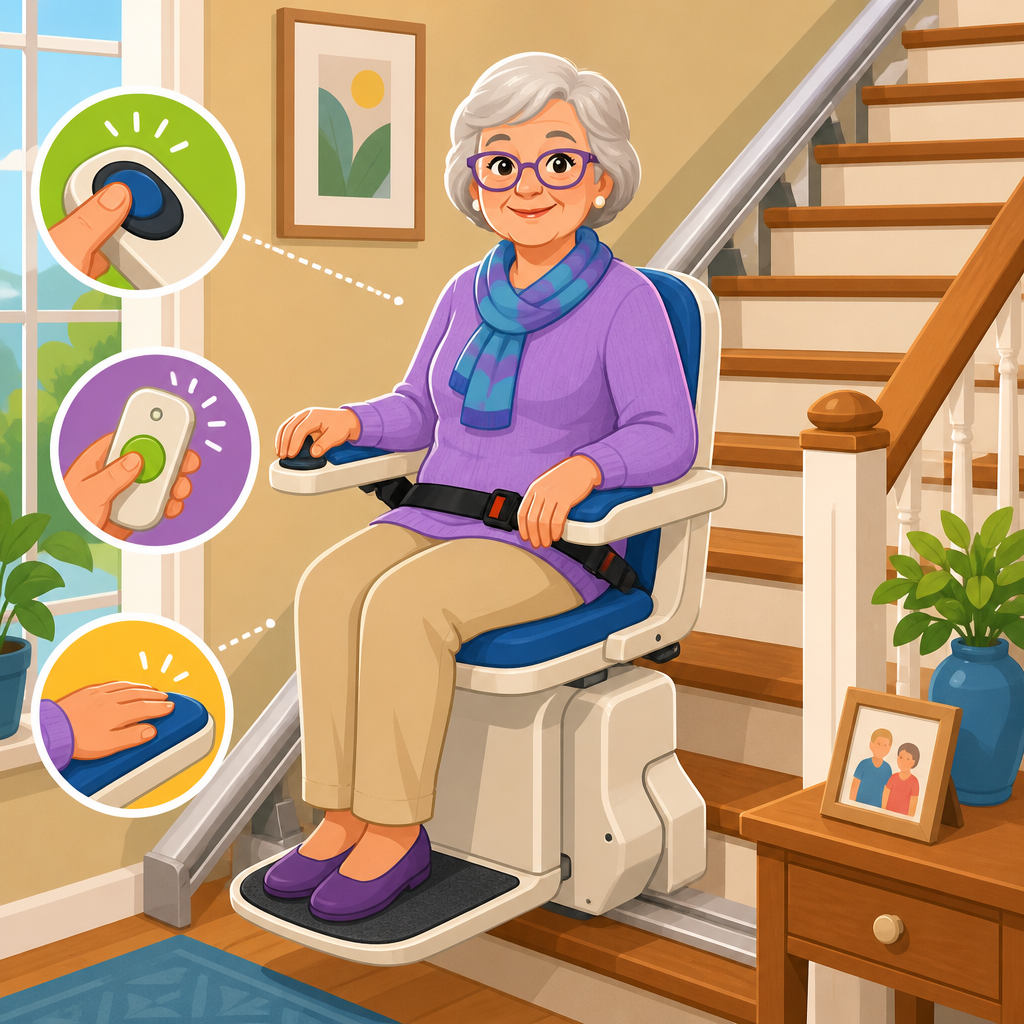
Choosing the best stair lifts for people with limited grip or hand dexterity starts with one practical question: can the user operate the lift safely every single time without painful twisting, pinching, or forceful hand movements? For many buyers, that answer determines whether a stair lift restores independence or becomes another difficult device to manage. In this guide to the best chair lifts for disabled users, I will break down the controls, seat designs, safety systems, and installation factors that matter most when hand strength is reduced by arthritis, stroke, neuropathy, Parkinson’s disease, multiple sclerosis, spinal cord injury, or age-related weakness.
A stair lift, sometimes called a chair lift for stairs, is a motorized seat that travels along a rail fixed to the staircase. The user sits down, secures a belt, and activates the unit using onboard controls or a remote. The challenge for people with limited grip is that many standard models assume the user can press small toggles, hold buttons steadily, swivel the seat with one hand, fold footrests manually, and manage a seat belt buckle without strain. In real home assessments, those details matter more than brochure claims.
This topic matters because hand function affects every step of the transfer process: calling the lift, sitting down, positioning feet, fastening the belt, starting movement, swiveling at the landing, and standing up. A safe lift for one person may be unusable for another with thumb arthritis or one-sided weakness. The best chair lifts for disabled users are not simply the fastest or least expensive models. They are the ones that reduce hand effort, support predictable transfers, and match the user’s diagnosis, body size, and staircase layout.
When comparing products, prioritize four criteria. First, low-force controls: large rocker switches, paddle controls, joystick-style operation, or easy-touch remotes are better than tiny recessed buttons. Second, powered features: power swivel seats and power footrests reduce the need to bend or pull. Third, transfer stability: armrests, seat height, perch options, and overrun rails should help the user get on and off with minimal hand strain. Fourth, service support: stair lifts are durable medical-adjacent devices, and reliable local installation and maintenance often matter as much as the brand itself.
What makes a stair lift easier to use with limited grip
The easiest stair lifts for people with poor hand dexterity share a few nonnegotiable design traits. Large, intuitive controls come first. In my experience reviewing demonstrations and installer specifications, the best systems use paddle or rocker controls that respond to palm pressure or the side of the hand, rather than requiring fingertip precision. Some users with severe arthritis do better with a light-touch joystick because it avoids sustained pressure. Others with tremor prefer a firmer rocker that reduces accidental activation. There is no universal best control; there is a best control for a given pattern of weakness.
Seat operation is the next deciding factor. Manual swivel levers are common, but they can be difficult for users with reduced finger flexion. A powered swivel seat at the top landing is one of the most valuable upgrades available because it turns the chair into the safe exit position automatically or with minimal input. Powered footrests are also important. Many buyers focus on ride comfort and overlook the fact that bending to fold a footplate can be harder than riding the stairs themselves.
Remote controls should also be judged by hand accessibility, not convenience alone. Call/send remotes let another household member move the lift, but they also allow the primary user to avoid reaching awkwardly if the chair is parked at the wrong end. Look for remotes with large buttons, high contrast labeling, and tactile feedback. Some premium systems pair better with wall-mounted call stations than loose handheld remotes, which can be dropped or misplaced by users with weak grip.
Finally, consider belt style and arm support. Standard lap belts with small tongues can frustrate users who have numb fingers. Upgraded retractable belts or automotive-style buckles are often easier. Sturdy armrests that remain stable during transfers help compensate for reduced grasp strength, especially when the user pushes with the forearm instead of the hand.
Best stair lift features to prioritize before comparing brands
If you are shopping broadly for the best chair lifts for disabled users, start with features instead of logos. Too many families narrow the field to a popular manufacturer before confirming whether the chair can actually be operated by the intended user. The most important features for limited grip include low-resistance controls, power swivel, power footrest, easy belt fastening, and obstruction sensors that stop the lift if an item is on the stairs.
Battery backup is essential, not optional. Modern stair lifts from established brands typically run on DC batteries that charge at points on the rail, allowing use during a power outage. For users with mobility impairment, being stranded on one floor is a genuine safety issue. Weight capacity matters too. Standard units often support around 300 to 350 pounds, while heavy-duty models may reach 400 to 600 pounds. Heavier users may also need a wider seat and more forgiving arm spacing to allow easier side transfers.
Rail design affects dexterity more than buyers expect. A hinge rail can prevent the track from blocking a doorway, but if the hinge is manual, it adds another hand task. Automatic hinge rails are preferable when hand function is limited. Track overruns, which extend the rail beyond the top or bottom step, improve transfer safety by moving the user away from the staircase edge before standing. For someone with poor balance and weak hands, that margin is critical.
| Feature | Why it matters for limited grip | Best fit |
|---|---|---|
| Large rocker or paddle control | Works with palm or side of hand | Arthritis, tremor, reduced pinch strength |
| Power swivel seat | Avoids twisting a manual lever | Stroke, one-handed users, severe hand pain |
| Power footrest | Eliminates bending and lifting by hand | Neuropathy, balance issues, back pain |
| Retractable seat belt | Easier than threading a small buckle | Numbness, weak fine motor control |
| Track overrun | Creates safer transfer zone | Most disabled users |
Leading stair lift brands and which users they suit best
Among recognized manufacturers, Bruno, Stannah, Handicare, Harmar, and Savaria are frequent contenders in North America and parts of Europe. Brand availability depends on dealer networks, and dealer quality often influences the ownership experience more than the logo on the chair. Still, each brand has strengths worth noting.
Bruno is widely respected for build quality, smooth ride performance, and straightforward controls. Models such as the Elan for straight stairs and Elite for higher capacities often appeal to users who want simple operation and dependable after-sales support. I have seen Bruno units recommended often for older adults with arthritis because the controls are easy to learn and the seats feel stable during transfers. Their heavy-duty options are also strong candidates for users who need more space and support.
Stannah is known for refined engineering and highly tailored installations, especially on curved staircases. The company’s seats and rail systems are often praised for fit and finish, and many installers rate the ride quality highly. For users with limited dexterity, the appeal is not just the seat but the ability to customize the installation around transfer needs, parking points, and landing safety. Stannah can be expensive, but for complex homes it is often justified.
Handicare offers a broad lineup, including straight and curved solutions, with some models emphasizing slim folded profiles. That can matter in shared stairways where other household members need clearance. Harmar is a practical option many dealers carry, with models that cover standard and heavy-duty requirements. Savaria is also established and often considered when buyers want a robust stair mobility solution from a company active in accessibility products more broadly.
No brand is perfect for every user. The right question is not “Which company is best?” but “Which model, with which options, installed by which local dealer, best matches this person’s hand function and transfer pattern?”
Best chair lifts for disabled users by condition and mobility pattern
Different disabilities create different control challenges. For arthritis, joint pain and reduced pinch strength usually make large palm-operated controls and powered features the top priority. A buyer with hand osteoarthritis may tolerate standing and sitting fairly well but struggle badly with small switches and belt buckles. In that case, a standard straight stair lift with a power swivel seat can outperform a more advanced model that still relies on fiddly manual parts.
For stroke survivors, one-sided weakness changes the evaluation. Controls need to be reachable and operable from the stronger side, and transfer direction matters. During assessments, installers should confirm whether the user leads with the stronger leg, whether one hand can stabilize on an armrest, and whether the seat should swivel toward a specific landing position. Powered swivel seats are especially valuable here because they reduce the need for bilateral hand coordination.
Users with Parkinson’s disease may have tremor, bradykinesia, and freezing episodes. They benefit from predictable controls with clear tactile feedback and enough time to settle before movement. Sudden or overly sensitive activation is not ideal. Users with peripheral neuropathy may have numb fingers and reduced awareness of button pressure, making larger controls and visible indicator lights useful. Those with multiple sclerosis may experience fluctuating fatigue, so minimizing manual tasks becomes more important over time.
For wheelchair users who can transfer independently or with limited help, seat height, armrest shape, and available overrun space deserve close analysis. In some cases, a stair lift is less suitable than a vertical platform lift or home elevator, especially if the user cannot perform a safe seated transfer. A good buying guide should say that plainly: the best chair lift for a disabled user is not always a chair lift.
Straight, curved, and heavy-duty models: choosing the right format
Straight stair lifts are installed on staircases without turns or intermediate landings. They are usually the fastest to install, the simplest to service, and the least expensive. For buyers with limited grip, straight lifts often provide the best value because the budget can go toward powered features instead of custom rail fabrication. If your staircase is straight, spending more on usability upgrades is usually smarter than paying for cosmetic extras.
Curved stair lifts are custom built for staircases with bends, landings, or spiral sections. They cost more because the rail is manufactured to the exact staircase geometry. The advantage is precise fit and safer travel on challenging layouts. For users with hand limitations, curved lifts may also solve transfer problems by parking the seat in a better position at the top or bottom landing. That customization can make the difference between a workable transfer and a risky one.
Heavy-duty stair lifts are designed for larger body sizes, higher capacities, and often wider seats. They can also be useful for users who need more room to shift weight during transfers or who use bulky braces. However, larger seats can create a tradeoff for users with short stature or limited trunk control, because reaching the armrests or controls may become harder. Always test the seating geometry, not just the weight rating.
Outdoor stair lifts deserve a brief mention for homes with entry steps. Weather-resistant seats, covers, sealed controls, and corrosion protection are standard on outdoor-rated units, but hand dexterity still matters. Wet conditions can make buckles and fold-down components more difficult to manage, so oversized controls and minimal manual folding are especially important outdoors.
Buying, installation, and long-term ownership considerations
Price varies widely. Straight stair lifts commonly start in the low thousands, while curved models can cost several times more. Added options such as power swivel, power footrest, automatic hinge rails, upgraded upholstery, and higher weight capacities increase the final quote. Used and rental stair lifts may reduce upfront cost, particularly for temporary recovery needs, but availability is limited for curved units because the rail is custom. If dexterity-friendly options are nonnegotiable, confirm they are included in any resale or rental package.
Professional installation is standard and should include measurement of staircase width, landing clearances, power supply location, and user transfer pattern. Ask the dealer to demonstrate every hand-related task before you buy: calling the chair, lowering the seat, fastening the belt, activating movement, swiveling at the top, and folding components afterward. If any step feels awkward during the demonstration, it will usually feel worse at home when fatigue and time pressure are involved.
Maintenance should not be overlooked. Batteries, charge points, seat swivels, and footrest mechanisms require periodic service. Choose a company with local technicians, reasonable response times, and access to parts. Ask about warranty terms for the motor, gearbox, rail, and electronics. Better yet, ask what happens when the lift stops mid-stair and what support is available after hours. That answer tells you more than marketing language ever will.
The best stair lifts for people with limited grip or hand dexterity are the ones that remove fine-motor barriers from daily use. Large easy-press controls, powered swivel seats, powered footrests, stable armrests, and safe transfer zones matter more than flashy upgrades. For anyone researching the best chair lifts for disabled users, the smart path is to match the lift to the person’s exact hand function, not to buy the most advertised model.
Start by arranging an in-home assessment with a reputable local dealer and insist on hands-on testing of every control. Compare straight, curved, and heavy-duty options based on transfer safety, not just price. If you make dexterity the center of the buying decision, a stair lift can become a reliable independence tool rather than a frustrating compromise. Use this guide as your hub, then move on to detailed model comparisons, condition-specific advice, and installation checklists before making the final purchase.
Frequently Asked Questions
What features make a stair lift easier to use for someone with limited grip or poor hand dexterity?
The best stair lifts for people with limited grip usually reduce or eliminate the need for tight grasping, finger pinching, or wrist twisting. The most helpful feature is simple, low-effort operation. Many users do better with large rocker switches, paddle-style controls, or soft-touch buttons that can be pressed with the side of the hand, palm, or even a closed fist instead of the fingertips. Some stair lifts also include remote call/send controls, which can be useful when the lift needs to be brought to the user without requiring them to navigate difficult stairs first.
Seat design also matters more than many buyers expect. A supportive seat with well-placed armrests can make transfers easier and reduce strain on the hands during sitting and standing. Swivel seats are especially important because they allow the user to get on and off facing the landing rather than twisting the body awkwardly. If the swivel function is manual, it should have an easy-to-operate lever that does not require a strong squeeze. Powered swivel and powered footrest options can be excellent upgrades for users who struggle with bending, reaching, or operating latches.
Safety and comfort features should be evaluated through the same lens: can the person use them consistently without discomfort or confusion? A seat belt should be secure but easy to fasten. Folding components should move smoothly and not require force. Controls should be clearly labeled and positioned where the user can reach them naturally. In short, the right stair lift is not just one that fits the staircase. It is one that matches the user’s hand strength, finger mobility, and daily routine so operation feels predictable and safe every time.
Are joystick or toggle controls better than standard stair lift buttons for users with arthritis or weak hands?
In many cases, yes, but it depends on the exact control style and the user’s range of motion. For people with arthritis, hand weakness, tremors, or reduced finger coordination, traditional small buttons can be frustrating because they often require precise fingertip pressure. Larger controls, such as paddle switches, joysticks, or broad toggles, are frequently easier because they demand less precision and can be activated with a larger part of the hand. That reduces stress on sore joints and makes the stair lift more practical for everyday use.
That said, not every joystick-style control is automatically better. Some are stiff, small, or mounted at an awkward angle. The goal is not simply to find a different control type, but to find one that requires minimal force and feels natural in the user’s hand. A well-designed toggle or rocker control often works very well because it allows straightforward forward-and-back movement without complicated hand positioning. For some users, this is easier than pressing and holding a button continuously with one finger.
The best approach is to test the control in person whenever possible. During a demonstration, the user should try operating the lift several times with the hand they are most likely to use every day. Pay attention to whether they can start, hold, and stop the ride comfortably without pain or hesitation. A control that seems minor in the showroom can become a major source of frustration at home if it requires repeated effort. Ease of use should always come before appearance or brand preference.
Can a stair lift still be safe and practical if the user cannot easily operate a seat belt, swivel lever, or folding footrest?
Yes, but only if those parts are chosen carefully and matched to the user’s physical abilities. Many stair lift buyers focus first on the rail and motor, but for users with limited dexterity, the small daily interactions are often what determine success. If fastening a seat belt is difficult, look for designs with simpler buckle mechanisms that do not require fine finger control. Some users do better with automotive-style buckles than with smaller or stiffer latches. The key is making sure the safety feature is easy enough that it will actually be used every trip.
Swivel seats and footrests deserve the same level of attention. A manual swivel seat can be safe and effective if the release lever is large, smooth, and easy to engage. But if the user has severe arthritis, one-sided weakness, or significant hand pain, a powered swivel seat may be a far better choice because it removes a difficult step during exit at the top landing. Likewise, a manual folding footrest may be manageable for some people, while others benefit from a powered footrest that moves with a button press and eliminates the need to bend down and use the hands at all.
Practical safety means the user can perform every necessary action reliably, not just under ideal conditions but every day when tired, stiff, or distracted. During an evaluation, ask the dealer to demonstrate all optional powered features and let the intended user try them personally. If one step in the process feels difficult now, it will likely feel even harder over time. The safest stair lift is the one the user can operate fully and confidently without needing risky workarounds.
How important is professional assessment and installation when choosing a stair lift for someone with reduced hand function?
Professional assessment is extremely important because the right stair lift for limited grip is not chosen by staircase measurements alone. A qualified stair lift provider should evaluate both the home and the user. That includes the staircase shape, available landing space, seat height needs, transfer technique, and control accessibility. For someone with reduced hand function, the assessment should also include how they grip, whether they can push or pull reliably, which hand is stronger, and whether pain, numbness, tremors, or joint stiffness affect operation.
Installation quality also has a direct impact on ease of use and safety. A properly installed stair lift should stop smoothly, align well with the landing, and place the chair in a position that supports safe transfers. If the seat is too low, too high, or too close to a wall, the user may end up using the hands in awkward ways just to get seated or stand up. An experienced installer can also recommend rail overruns, powered options, and parking locations that reduce strain and improve access.
Just as important, a reputable company should provide a clear demonstration after installation. The user should be shown how to operate the controls, lock the swivel seat if applicable, use the seat belt, and call or send the lift. Family members or caregivers should also understand the system. For buyers comparing the best chair lifts for disabled users, expert setup and training are not extra conveniences. They are part of what makes the equipment genuinely usable for a person with limited dexterity.
What should buyers ask before purchasing a stair lift for a person with limited grip strength or dexterity problems?
Buyers should ask highly specific, hands-on questions rather than relying on general claims that a model is “easy to use.” Start with the controls: How much force is needed to operate them? Can the user activate them with a palm, side of the hand, or weak fingers? Is the control continuous-pressure, and if so, will that be tiring? Then move to transfer features: Is the seat height appropriate? Does the seat swivel manually or automatically? How easy is the lever or button to use? Can the footrest be powered? These details are often what separate a suitable stair lift from one that becomes difficult after the first week.
It is also important to ask about maintenance, reliability, and support. A stair lift used by someone with dexterity challenges should work smoothly and predictably because any malfunction or stiffness in the controls may immediately make it harder to use. Ask how often the unit should be serviced, what kind of warranty is included, how quickly repair calls are handled, and whether replacement parts are readily available. If batteries are involved, find out what happens during a power outage and whether charging is automatic and dependable.
Finally, insist on a real demonstration with the intended user present. The best question of all is simple: Can this person use every essential function safely and comfortably on their own? If the answer is uncertain, keep looking or explore powered upgrades. A good dealer should welcome these questions and help match the equipment to the user’s physical abilities, not pressure the family into a one-size-fits-all model. When buying a stair lift for limited hand strength, usability is not a minor detail. It is the main decision point.