


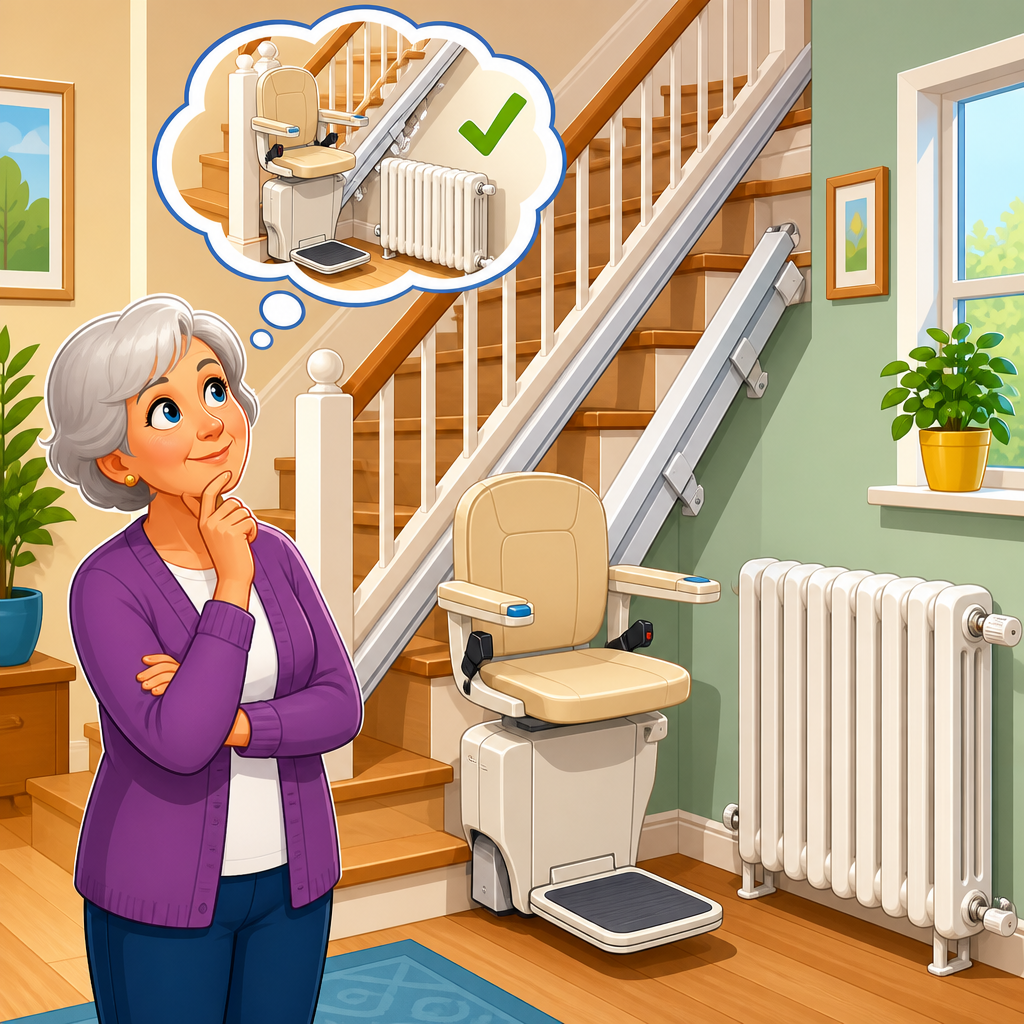
A stair lift can often be installed when there is a radiator near the stairs, but the answer depends on clearance, track position, heat output, pipe routing, and the exact lift model chosen. Homeowners usually ask this question after noticing that the stairway is already tight and worrying that a rail or chair will clash with the radiator, restrict access, or create a safety issue. In most cases, an experienced surveyor can design around the obstacle by selecting a rail profile that preserves walking space, repositioning parking points, or recommending a modest radiator alteration. The key is to treat the radiator as one part of a full stair lift assessment rather than assuming it automatically prevents installation.
That distinction matters because stair lifts are fitted to the staircase, not typically to the wall, and modern systems are more adaptable than many people expect. A radiator is a fixed heat emitter connected to a central heating system, usually projecting several inches from the wall or landing return. A stair lift consists of a rail, carriage, powered seat, call stations, charging points, and safety sensors. Installers assess rise, going, width, headroom, overrun needs, hinge options, and transfer space at the top and bottom. When a radiator sits near any of those critical zones, it becomes a design variable that may affect comfort, code compliance, and usability, but not necessarily feasibility.
I have seen this issue arise in older homes with narrow halls, in postwar houses where a panel radiator was added after the staircase was built, and in bungalows converted for aging in place. The same question comes up repeatedly: will the chair hit the radiator, will the user’s knees or elbows strike it, and does the heat damage the equipment? Those are the right questions. The practical answer is that installers measure not just the staircase but the user’s body position on the lift, the folded dimensions of the seat, and the path of the footrest. They also review whether the radiator reduces safe passing space for other household members using the stairs on foot.
For families planning a purchase, understanding the options in advance can save time and avoid expensive guesswork. This guide explains when a stair lift can be installed near a radiator, what surveyors look for, which lift types work best in tight spaces, when a radiator may need moving, and the most common homeowner questions about cost, disruption, safety, and maintenance. If you are comparing chair lift types and designs, this is the practical hub page to start with because radiator conflicts are rarely solved by one simple measurement; they are solved by matching the right equipment to the staircase and the user.
How installers decide whether a stair lift will fit near a radiator
The first step is a detailed home survey. Reputable stair lift companies measure the clear stair width, the projection of the radiator from the wall, the location of valves and exposed pipework, the landing dimensions, and the travel line the chair will follow. On a straight staircase, the rail usually sits close to one side of the treads on mounting feet fixed into the stairs. On a curved staircase, the rail can be tailored to sit tighter or wider at selected points, which sometimes helps avoid a radiator body but may affect the folded width elsewhere. The surveyor also checks user transfer space, because a lift that technically fits but leaves an awkward or unsafe mount and dismount point is not a good solution.
Clearance is the governing issue. Manufacturers publish minimum staircase widths, but those figures are only the starting point because obstacles alter usable space. For example, a staircase that measures 760 millimeters wide may be suitable for some compact straight lifts in an empty run, yet a radiator projecting 110 millimeters into the stair envelope near the bottom landing can make the access point much tighter. The rail may still fit, but the seated user’s knees could pass close to the radiator, or the folded footrest could interfere with a thermostatic radiator valve. That is why surveyors assess dynamic clearance, not just static width.
Heat itself is rarely the main problem. Standard domestic radiators operate at temperatures that nearby building finishes routinely tolerate, and stair lift components are designed for normal indoor environments. However, constant close exposure to heat can matter if a charger, hinge mechanism, call station, or plastic trim sits immediately adjacent to a high-output radiator. Installers therefore try to maintain sensible separation and avoid mounting charging points where repeated heat cycling could reduce component life. In practice, geometry and user comfort are more common concerns than heat damage.
Pipework can be more troublesome than the radiator panel. Floor-mounted pipes, valve tails, or decorative covers may sit exactly where a rail foot or hinged track needs to land. Older homes sometimes have microbore pipes tucked along skirting lines or crossing the base of a staircase. If those services block a bracket position, the installer may adjust footing locations, choose a different rail arrangement, or recommend a plumber reroute the pipes before fitting day. This is usually manageable, but it must be identified during the survey rather than discovered midway through installation.
Best stair lift designs for homes with radiators near the stairs
Different stair lift designs solve radiator conflicts in different ways. Straight stair lifts are usually the simplest and most economical option because the rail is linear and installation is fast, often completed within a few hours once the site is prepared. Many straight models have slimline seats, narrow folded profiles, and powered swivel or folding footrest options that help in restricted approaches. If the radiator is near the bottom step, a hinged rail can prevent the track from extending into a doorway or striking the radiator face when parked. This is a common solution in compact hallways.
Curved stair lifts offer more customization. Because the rail is fabricated to match the staircase precisely, it can sometimes be designed to hug the inner or outer edge strategically and reduce the likelihood of contact with a radiator at a turn or landing. In split-level homes or staircases with intermediate landings, that flexibility can make an installation possible when a standard straight rail cannot maintain adequate approach space. The tradeoff is price and lead time. Curved lifts cost more because the rail is bespoke, and any design adjustment around a radiator must still preserve smooth travel, safe charging positions, and comfortable boarding points.
Perch stair lifts may be useful when the user has difficulty bending their knees fully or when space is especially restricted. Rather than sitting fully, the user leans on a small seat in a near-standing posture. Because the user’s profile can be more compact, a perch model may help where a radiator narrows the path. It is not right for everyone, though. Perch lifts require better balance and are not suitable for all medical conditions, so they should be considered only after an individual assessment.
Outdoor-style robustness is not a substitute for indoor fit. Some homeowners assume a more rugged unit can simply tolerate being closer to a radiator. That misses the point. The right design decision is about folded width, seat-to-wall offset, footrest sweep, and overrun placement. Brands such as Stannah, Handicare, Acorn, Bruno, and Access BDD all offer models with differing seat dimensions and rail geometries, so comparing specification sheets matters. In my experience, two lifts that both claim to suit narrow stairs can feel very different once installed near a radiator because the user’s knees, elbows, and hand position vary by model.
Common solutions when the radiator is in the way
Most radiator conflicts are solved with one of a few practical adjustments. The installer may shift the rail slightly on the treads, specify a slim seat, add a hinge, change the parking position, or coordinate a small plumbing modification. Moving the radiator entirely is sometimes the cleanest answer, especially if it sits at the foot of the stairs where every millimeter counts. Relocation does add cost, but it can improve daily circulation for everyone, not just the stair lift user. In homes with oversized older radiators, replacing the unit with a more compact modern panel radiator can free space while maintaining heat output if the specification is calculated properly.
| Issue near the stairs | Typical fix | Main benefit | Key limitation |
|---|---|---|---|
| Radiator projects into boarding area | Move or replace radiator with slimmer model | Improves user access and walking space | Requires plumbing work and redecorating |
| Track would extend toward radiator at bottom | Install hinged rail | Keeps hallway or doorway clear when parked | Adds mechanical complexity and cost |
| User knees pass close to radiator | Choose compact seat or curved alignment | Improves seated clearance without major building work | Model choice may be limited by body size |
| Pipework blocks rail feet or hinge zone | Reroute exposed pipes | Allows proper fixing positions | Must be planned before installation day |
| Landing space is tight | Change parking point or overrun arrangement | Makes transfer safer at top or bottom | May alter where the chair rests for charging |
Homeowners should also ask whether the radiator location affects emergency use. If there is a power outage or fault, can the user still step on or off safely, and can other people pass on the stairs? Battery-powered stair lifts normally continue to operate for multiple trips during a mains outage, but safe transfer areas still matter. A radiator that leaves a cramped lower landing can become more problematic when someone is assisting the user. Surveyors should test not just machine movement but human movement around the machine.
Another underappreciated solution is changing where the chair parks. Many lifts can be parked at the top rather than the bottom, or vice versa, so the radiator-adjacent section is used only during travel, not as the regular boarding position. This can reduce visual clutter in the hallway and keep the warmest part of the staircase free of a stationary seat. If two users need access, call stations let the chair travel between levels without anyone manually folding and unfolding it each time.
Safety, building considerations, and what homeowners should ask
A stair lift near a radiator must still provide safe access, adequate stair usability, and secure installation. In the UK, stair lifts are commonly designed and fitted with reference to machinery and accessibility standards used by established manufacturers and installers, while in the US and Canada comparable product safety expectations are guided by codes, manufacturer instructions, and platform-specific standards. Homeowners do not need to become code experts, but they should expect the installer to explain why the proposed layout is safe, where the charging points will be, and how the chair behaves if it meets an obstruction. Safety edges and pressure sensors stop the lift when they detect contact, but relying on sensors to compensate for poor spacing is not good design.
Ask direct questions during the survey. What is the folded width of the seat and footrest at the radiator point? How much clearance will the user have when seated? Will heat affect batteries or chargers? Does the radiator valve create a snag point for clothing, hands, or the footrest? If the rail is hinged, what happens if the hinge area is obstructed? Can the user operate the swivel seat and seatbelt comfortably without reaching toward a hot radiator surface? These questions often reveal whether the surveyor is thinking through real daily use rather than just trying to place an order.
There are also household comfort issues. A stair lift can change airflow around a radiator and make dusting or bleeding the radiator slightly less convenient. Conversely, a radiator can warm the seat area, which some users appreciate in winter and others dislike. Neither point usually determines feasibility, but both affect satisfaction after installation. Good installers discuss how to preserve access for radiator maintenance, decorating, and cleaning.
If a property is listed, in a conservation area, or managed by a housing association, additional permissions may apply if radiator relocation involves visible building alterations or new pipe routes. Renters should get written approval before any plumbing changes. This is another reason a full plan matters: the lift company and plumber should coordinate so that permissions, measurements, and installation dates line up.
Cost, disruption, and the most frequent practical questions
Cost varies widely because the radiator itself is rarely the expensive part; the chosen workaround is. A straight stair lift is generally the lowest-cost category, while curved lifts and bespoke rail changes increase price substantially. Adding a hinged rail, powered footrest, heavy-duty seat, or custom parking arrangement can raise the total further. If the radiator must be moved, budget for plumbing labor, possible draining of the heating circuit, making good wall finishes, and redecorating. Even so, a small radiator alteration may be far cheaper than forcing a poor lift layout that reduces safety or comfort every day.
Installation disruption is usually modest. Many straight stair lifts are fitted in half a day, and a plumber can often relocate or replace a radiator in a separate short visit. Curved lifts take longer to manufacture but not necessarily much longer to fit once delivered. The essential point is sequencing: plumbing changes should be completed before the final stair lift measurement if they alter wall projection or landing space. Otherwise, the rail may be designed around conditions that no longer exist.
Homeowners also ask whether temporary removal of the radiator is enough. Sometimes it is, especially if the long-term plan is to use a slimmer replacement and the fitter only needs the space cleared. But never assume removal alone solves the issue. Pipe stubs, valves, and boxing can still intrude into the lift envelope. Another common question is whether a wall-mounted handrail can stay. Often yes, but if a radiator and handrail together squeeze the user’s path, one element may need adjusting.
The takeaway is simple: yes, a stair lift can often be installed when there is a radiator near the stairs, but only after a measured, model-specific assessment. The best outcomes come from surveyors who evaluate the staircase, the radiator, the user’s body position, and daily traffic patterns together. Straight lifts, curved lifts, slim seats, hinged rails, and selective radiator relocation all have roles, and the right choice depends on clearance and usability rather than guesswork. If you are planning a chair lift and have a radiator close to the staircase, book a detailed home survey, ask for exact clearances in writing, and compare at least two design options before committing.
Frequently Asked Questions
Can a stair lift be installed if there is a radiator next to the stairs?
Yes, in many cases a stair lift can still be installed when there is a radiator near the staircase. The key issue is not simply whether a radiator is present, but how much space is available between the stair edge, the wall, and the radiator itself. Stair lift rails are typically fixed to the stairs rather than the wall, which gives installers more flexibility than many homeowners expect. A nearby radiator does not automatically rule out a lift, but it does need to be carefully measured as part of the survey process.
An experienced stair lift surveyor will check the width of the staircase, the projection of the radiator into the stairway, and the likely travel path of both the rail and chair. They will also consider whether the lift user can get on and off safely at the top and bottom of the stairs without the radiator creating an obstruction. In some homes, a standard straight rail works perfectly well. In others, a hinged rail, a different seat style, or a more compact model may be recommended to preserve safe movement through the stairway.
In short, a radiator nearby is usually a design consideration rather than a deal-breaker. The final answer depends on clearance, track position, and the exact lift model chosen, which is why an in-home assessment is so important before any installation is approved.
How much space is needed between a stair lift and a radiator?
There is no single universal measurement that applies to every home because stair lifts vary by manufacturer, rail design, and chair dimensions. What matters most is the clear usable space after the rail is fitted and the chair is folded or in motion. The installer must make sure the lift can travel without hitting the radiator and that there is still adequate room for safe stair use, especially if other members of the household will continue walking up and down the stairs.
During a survey, professionals look at several specific measurements. These include the overall staircase width, how far the radiator sticks out from the wall, whether any valves or exposed pipework project even farther, and how much space the footrest and seat occupy when folded and unfolded. They also consider user comfort. A technically possible installation is not enough if the rider would feel cramped or struggle to sit, stand, or turn safely near the radiator.
Because of these variables, homeowners should avoid relying on rough estimates. A staircase that seems too narrow at first glance may still be suitable with the right rail profile, while a staircase that appears workable may need modifications if the radiator or pipework intrudes more than expected. Precise measurement is the only reliable way to confirm a safe fit.
Will the heat from the radiator affect the stair lift?
Under normal household conditions, a radiator does not usually produce enough heat to prevent a stair lift from being installed or operated safely. Stair lifts are designed for everyday indoor environments, and installers routinely encounter features such as radiators, skirting boards, and nearby fixtures. However, the radiator’s location and heat output still matter because the lift should not be positioned in a way that exposes key components to unnecessary heat or restricts ventilation around the equipment.
In practice, the surveyor will assess how close the rail, carriage, charging points, and any wiring would be to the radiator. They will also look at whether the lift passes directly in front of it or whether only part of the system comes near it at one point on the staircase. If the radiator is unusually large, runs very hot, or has an awkward shape, the installer may recommend a different rail position or a different lift model to maintain sensible separation.
For most homes, the bigger concern is not heat damage but physical clearance and safe operation. Even so, a professional installer will factor in both issues. If there is any doubt, they can advise whether minor adjustments, such as relocating the radiator, changing the valves, or selecting a slimmer lift option, would create a better long-term result.
Can the stair lift rail be positioned to avoid the radiator and keep the stairs usable?
Often, yes. One of the main advantages of a professional stair lift survey is that the system can be planned around obstacles rather than treated as a one-size-fits-all product. Because the rail is normally mounted to the stair treads, not the wall, there is often flexibility in how it sits on the staircase. Installers can sometimes use a rail profile that preserves walkway space, reduces projection, and avoids direct conflict with the radiator.
Depending on the staircase and the lift brand, solutions may include a compact rail, a tighter seat design, a powered hinge or manual hinged rail at the lower end, or a model with a smaller folded footprint. On curved staircases, a custom rail can sometimes be shaped to improve clearance around features such as radiators, windowsills, or doorways. The aim is to make sure the lift works safely for the user while still allowing practical day-to-day access for everyone else in the home.
That said, the best layout depends on the exact property. A radiator beside the bottom few steps may create different challenges than one halfway up the stairs or near the top landing. The location affects boarding space, parking position, and walking clearance. A surveyor will balance all of these factors and recommend the arrangement that offers the safest and most convenient overall use.
What happens if the radiator or its pipework is in the way of the installation?
If the radiator or pipework interferes with the stair lift, there are usually several possible solutions. In some cases, the lift can be installed with no changes to the heating system by choosing a different rail position or a more compact stair lift model. In other cases, small alterations may be recommended, such as replacing bulky radiator valves, adjusting exposed pipe runs, or moving the radiator slightly to improve clearance. These changes are often less extensive than homeowners fear.
The decision depends on what exactly is causing the conflict. Sometimes the radiator body itself is not the main issue, but the valves or pipes extend farther into the stair space than expected. In other situations, the radiator may affect the user’s ability to sit down or get off the lift safely at a landing. A good surveyor will identify whether the obstacle affects travel, parking, access, or all three. From there, they can explain which changes are optional and which are necessary for safe installation.
If any building or plumbing work is needed, it should be coordinated before the stair lift is fitted so that the final installation meets both safety and usability requirements. The most important point is that a radiator near the stairs does not automatically end the discussion. It simply means the installation needs to be planned carefully, with attention to clearance, pipe routing, and the most suitable lift design for the home.