


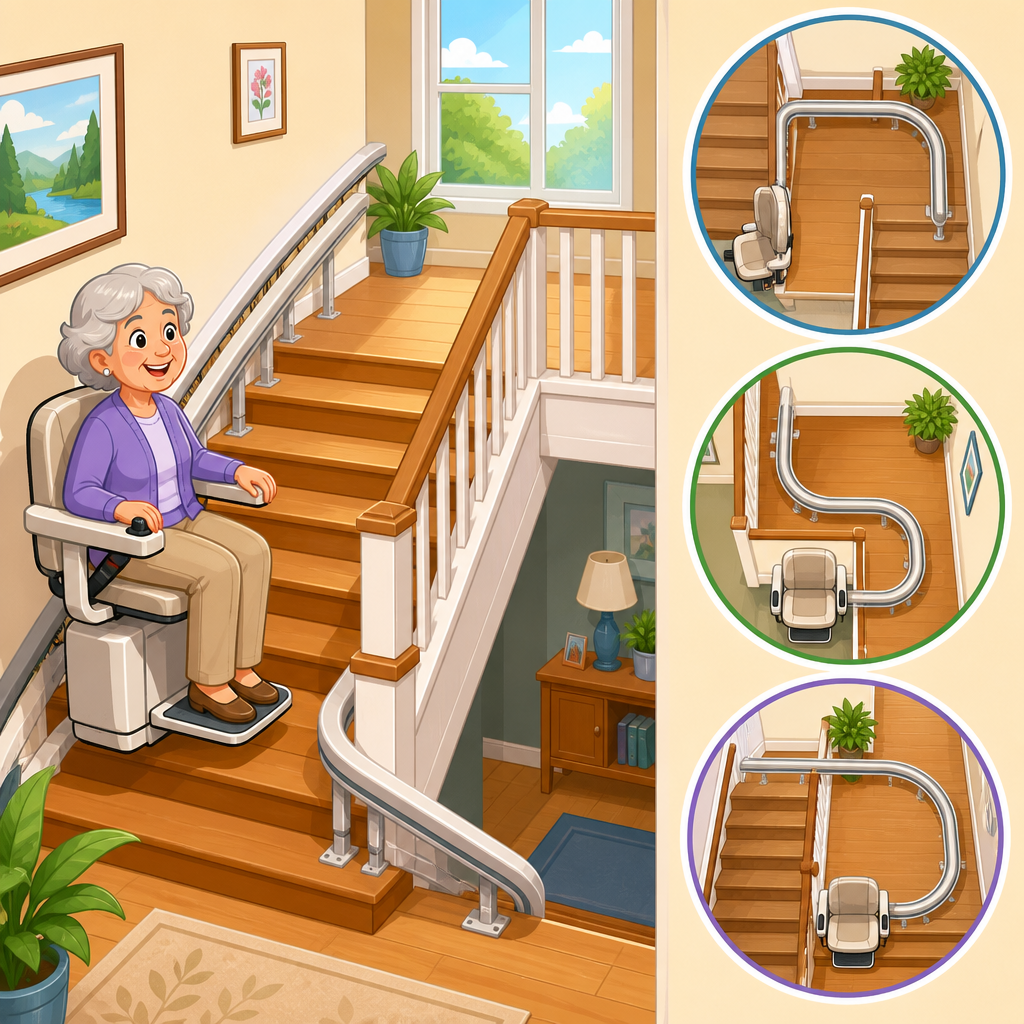
A stair lift can go around a landing, but the right solution depends on stair geometry, turning radius, rail design, user mobility needs, and building constraints. In most homes, a landing is not a deal breaker. It is simply a change in direction or a pause between flights, and modern stair lifts are designed to handle both. I have assessed straight runs, L-shaped stairs, U-shaped stairs, split landings, and narrow Victorian staircases, and the first question is always the same: is this a straight lift situation, or does the home need a custom curved rail?
To answer that well, it helps to define the core terms. A stair lift is a motorized chair that travels on a rail fixed to the stair treads, not usually to the wall. A landing is the flat platform between flights or at the top or bottom of the staircase. A straight stair lift runs on a single, linear rail and is typically used on one uninterrupted flight. A curved stair lift uses a custom-manufactured rail that can turn corners, travel around intermediate landings, and finish with parking or overrun sections where the chair can safely stop away from the main staircase.
This matters because landings change both cost and complexity. A straight lift is often the fastest and most affordable option when the staircase is simple. Once a lift must turn around a landing, the project usually moves into curved-lift territory, where rail measurements must be exact and installation planning becomes more detailed. For homeowners, caregivers, and occupational therapists, understanding these layout options helps avoid bad assumptions, compare quotes accurately, and choose a system that is safe every day, not just technically possible on installation day. As a hub for stair lifts within chair lift types and designs, this guide explains what layouts work, when custom rails are required, what limitations to expect, and how to think about safety, usability, and long-term value.
How Stair Lifts Handle Landings
Yes, stair lifts can go around landings, but not every landing is handled the same way. The defining factor is whether the lift needs to continue travel beyond the landing and change direction. If the staircase has one straight flight ending at a top landing, a standard straight stair lift may work perfectly. If the user needs to travel from a lower floor to an upper floor across a mid-stair platform, the lift generally needs a curved rail shaped to the staircase.
In practice, installers look at four things first: the number of flights, the angle of each flight, the depth and width of the landing, and whether there is enough clearance for knees, footrest, and seat swivel. A landing itself is not the obstacle; the transition into and out of the landing is. The chair must remain level while the rail changes angle, and the rider must be able to get on and off at a safe point. That is why reputable manufacturers use detailed photo surveys, digital measurement tools, or templating systems before building a curved rail.
Most modern curved stair lifts are built specifically for one staircase. Brands such as Handicare, Stannah, Bruno, Access BDD, and Acorn all offer models designed for bends and intermediate landings, though exact capabilities vary by market and product line. In my experience, the best outcomes come when the installer plans not only movement around the landing but also parking position, charger location, and transfer safety at both ends.
Common Stair Layouts and the Best Lift Option
Home staircases usually fall into a few repeatable patterns, and each pattern points to a likely stair lift design. A single straight run from one floor to the next is the simplest case and usually takes a straight lift. An L-shaped staircase turns once, often at a ninety-degree landing, and generally requires a curved stair lift. A U-shaped staircase doubles back on itself around one larger landing or two smaller ones, which also typically calls for a curved system. Split-level homes may have several short flights and one or more landings, making custom rail design especially important.
There are edge cases. Some homeowners ask whether two straight stair lifts can replace one curved model on a staircase with a landing. Technically, yes, two separate lifts can be installed if the user can safely transfer on the landing between rides. This can reduce upfront cost in some situations, but it introduces an extra transfer, more waiting, more controls, and more room for error. I usually recommend that approach only when the landing is large, the user is steady during transfers, and budget constraints rule out a single curved lift.
| Stair layout | Typical lift type | Main advantage | Main limitation |
|---|---|---|---|
| Single straight flight | Straight stair lift | Lowest cost and fastest installation | Cannot turn around an intermediate landing |
| L-shaped with one landing | Curved stair lift | Continuous ride around one turn | Custom rail increases lead time and price |
| U-shaped with half landing | Curved stair lift | Handles 180-degree change in direction | Needs careful parking and clearance planning |
| Wide landing between flights | Two straight lifts or one curved lift | Can offer budget flexibility | Transfer on landing may be difficult |
| Multi-landing or split-level stair | Custom curved stair lift | Best one-seat travel path | Most complex survey and fabrication process |
That layout-based view helps homeowners ask better questions during quotes. Instead of asking only, “Can it fit?” ask, “Can it travel continuously around the landing, where will it park, and will I need to transfer?” Those questions reveal whether a proposed solution truly matches the user’s daily routine.
Straight vs Curved Stair Lifts: What Changes at a Landing
The biggest difference between straight and curved stair lifts is the rail. Straight rails are modular, predictable, and often stocked in standard lengths. Curved rails are bespoke. They are engineered to match the exact tread positions, rise, going, and turning points of the staircase. Around a landing, that custom work is what allows the chair to continue smoothly rather than stopping at the platform.
Cost changes accordingly. In many markets, a straight stair lift may cost roughly a few thousand dollars installed, while a curved lift often starts much higher because of design, manufacturing, and longer installation planning. The reason is not just the bend itself. Curved systems may include powered swivel seats, linked footrests, special call stations, parking curves, and rail overruns designed to move the rider away from the stair edge.
Lead time also changes. A straight unit can often be installed quickly because the rail can be cut and fitted on site. A curved rail usually requires a post-survey manufacturing phase. If speed is critical after a hospital discharge, some families temporarily use first-floor sleeping arrangements or explore rental options for a straight run while the final curved system is fabricated. This is one of the most practical conversations to have early.
Another difference is resale and reuse. Straight lifts are easier to remove and reinstall elsewhere. Curved lifts are staircase-specific, so reused equipment usually still needs a newly made rail. That affects long-term value calculations and is one reason a home assessment should include future mobility expectations, not only current needs.
Key Design Factors That Determine Whether a Lift Can Go Around a Landing
Several physical factors decide whether a stair lift can go around a landing comfortably and safely. Stair width is one of the first. Many manufacturers can work on relatively narrow staircases, but minimum clearances differ by model, seat style, and local code expectations. The parked chair, folded footrest, and arm position all matter, especially if others still need to walk the stairs.
Landing size is equally important. A curved lift may pass through a compact landing, but boarding or dismounting there may still be unsafe if there is little room to swivel the seat or place mobility aids. Top and bottom access zones often matter more than the middle of the rail because that is where falls are most likely to occur. A rail overrun can help by carrying the user beyond the top step onto a safer floor area, though not every layout has space for one.
Obstructions also shape the design. Radiators, door swings, skirting profiles, newel posts, low ceilings, and nearby thresholds can all interfere with rail placement. I have seen a seemingly generous landing become tricky because a door opened into the only safe parking area. In those cases, powered hinges, alternative parking points, or a different side of installation may solve the issue, but each adjustment must be measured, not guessed.
Power and charging matter too. Most current stair lifts use battery-powered drive systems that charge at designated points on the rail. This means the unit can usually continue to operate during a household power outage for a limited number of trips, but only if batteries are healthy and the charger position is accessible. On landing-heavy layouts, charger placement should be planned so the chair is likely to be parked on charge during normal use.
Safety, Comfort, and Daily Usability Around Landings
A stair lift that can technically turn around a landing is not automatically the right lift. Daily usability is what separates a successful installation from an expensive compromise. The rider should feel stable through turns, able to reach controls easily, and confident getting on and off at both ends. Features such as seat belts, obstruction sensors, overspeed governors, swivel seats, and foldable arms are standard on quality units because they directly reduce risk.
On curved systems, ride quality matters more than many buyers expect. Sharp transitions, seat height, and rail position all affect how secure a turn feels. Heavier users may need a model with a higher weight capacity and wider seat, but that can also increase folded dimensions. Homes with multiple users may benefit from remote call/send controls so the chair can be parked away from the main living area yet summoned when needed.
For users with limited trunk control, arthritis, or poor balance, a landing transfer between two straight lifts may be unrealistic even if it looks economical on paper. This is where assessment by an occupational therapist or experienced mobility specialist adds real value. The right question is not simply whether the rider can sit down. It is whether they can do so consistently, safely, and without fatigue several times a day.
Maintenance is part of safety as well. Regular service keeps charge contacts clean, batteries tested, rollers aligned, and safety edges functioning correctly. Around landings, where rails curve and transitions are more complex, periodic inspection is especially important. A well-installed curved stair lift is highly reliable, but it relies on precise setup and routine maintenance to stay that way.
Planning, Installation, and How to Choose the Right Provider
If you are considering a stair lift for a staircase with a landing, start with a detailed home survey, not with a brochure. A competent provider will measure each tread, photograph the staircase, assess transfer areas, and ask about the user’s diagnosis, height, weight, balance, and whether others need full stair access. They should explain why they recommend a straight lift, a curved lift, or two separate units, and they should identify tradeoffs clearly.
Ask which standards the equipment follows, what warranty is included, who performs service, and how quickly repairs are handled. In many regions, recognized safety and testing frameworks such as ASME standards, CE marking requirements, or manufacturer certification programs help indicate product quality, though local compliance requirements differ. Also ask whether the rail is mounted to the stairs, how much disruption installation causes, and whether any electrical work is needed near the charging point.
Good providers are transparent about timelines. For a curved stair lift around a landing, expect a survey, design review, manufacturing period, and installation appointment. Request a drawing or digital layout showing rail path, parking positions, and any overrun sections. If the quote is much lower than others, check whether it omits powered options that the user actually needs, such as a powered swivel or powered folding rail at the bottom to prevent a trip hazard near a doorway.
As the hub page for stair lifts within chair lift types and designs, this article should leave you with one clear understanding: a landing usually does not prevent a stair lift, but it changes the design from simple to tailored. Straight lifts suit uninterrupted flights. Curved stair lifts are the standard answer for L-shaped, U-shaped, and multi-landing stairs because they provide one continuous ride. Two straight lifts can work in limited cases, but only when the landing transfer is genuinely safe and practical.
The best stair lift layout is the one that fits the staircase, protects the rider during boarding and dismounting, and works smoothly every day. Focus on rail type, transfer safety, landing clearance, parking position, and service support rather than price alone. If you are comparing options for a home with a landing, book a professional survey and get a layout-specific recommendation before making any decision.
Frequently Asked Questions
Can a stair lift go around a landing, or does the landing stop the lift?
Yes, a stair lift can absolutely go around a landing in most cases. A landing is not usually an obstacle by itself. It is simply a flat transition point between one flight of stairs and another, and modern stair lifts are designed specifically to deal with changes in direction, pauses between flights, and multi-level stair layouts. Whether the lift can travel around the landing depends on the exact stair configuration, how much room is available for the rail to turn, and where the user needs to get on and off safely.
In a simple straight staircase with a mid-landing, the solution may be more straightforward than people expect. In other homes, especially with L-shaped stairs, U-shaped stairs, or split landings, a custom curved stair lift is usually the best fit. The rail is made to follow the shape of the staircase, including the landing area, so the chair can continue smoothly from one section to the next. The landing does not stop the lift unless the available space, turning radius, or structural limitations make that route impractical.
The key point is that the stair lift is chosen to suit the staircase, not the other way around. During an assessment, the installer will look at stair width, headroom, the shape of the landing, doorways nearby, handrails, and how the user transfers on and off the seat. In most homes, there is a workable solution, and a landing is often just one design detail to be planned around rather than a reason to rule a stair lift out.
What type of stair lift is usually needed for stairs with a landing?
The answer depends on the layout. If the staircase is a single straight run with no change in direction, a straight stair lift is normally enough. But once the staircase turns at a landing, such as in an L-shaped or U-shaped design, a curved stair lift is usually required. Curved stair lifts use a custom rail that follows the bends, corners, and flat sections of the staircase, allowing the chair to move continuously around the landing rather than stopping at the edge of one flight.
There are also cases where two separate straight stair lifts are installed instead of one continuous curved unit. This can happen when the staircase has a large landing between flights and the user is comfortable getting off one lift, crossing the landing, and using a second lift on the next section. That option can sometimes reduce cost, but it is not ideal for everyone. If the user has balance issues, fatigue, or difficulty transferring, a single continuous curved lift is usually the safer and more practical solution.
In some properties, especially older homes with narrow or unusual stairs, there may be more than one technically possible arrangement. For example, the rail may be mounted to the inside of the turn to save space, or to the outside to achieve a gentler curve. Some systems can include parking bends or hinged rail sections to keep hallways and doorways clear. The best type of stair lift is the one that matches the geometry of the staircase and the mobility needs of the person using it every day, not just the one that fits on paper.
How does the stair layout affect the rail design around a landing?
The stair layout has a major impact on how the rail is designed. A landing changes the path the chair has to follow, so the rail cannot simply continue in a straight line. The shape of the turn, the depth of the landing, the width of the staircase, and the position of walls, banisters, and door openings all influence how the rail is fabricated. In a curved stair lift system, the rail is custom built to mirror the staircase as closely as possible while still allowing smooth travel and safe clearance.
For an L-shaped staircase, the rail usually includes a 90-degree bend. For a U-shaped staircase, it may include a 180-degree turn, often wrapped around an intermediate landing. Split landings can be more complex because the chair may need to travel across a flat platform before changing direction again. In narrow staircases, the turning radius becomes especially important. If the bend is too tight, the chair and footrest may project into the walkway more than desired, so the installer may adjust the rail position, choose a compact model, or recommend a folding rail feature.
Another important factor is the start and finish position of the chair. The rail can often be extended beyond the top or bottom step to create a safer boarding point away from the staircase edge. This is particularly useful when a landing is small or awkwardly shaped. In some homes, the rail may even be designed to park the chair around a corner so it is less visible and less in the way. Good rail design is not just about making the lift fit; it is about making sure the user can ride, board, and exit with confidence and without creating unnecessary obstruction for everyone else in the home.
Are there space or structural limits that can make a landing difficult for a stair lift?
Yes, there can be limits, but they are often manageable with the right equipment and planning. The most common concerns are stair width, the amount of room available for a turn, the size and shape of the landing, and the position of nearby doors or hallways. A narrow staircase does not automatically rule out a stair lift, but it may narrow the choice of models and require a more precise rail design. Older homes, including many Victorian and period properties, can present extra challenges because the stairs are steeper, tighter, or less uniform.
Structural issues are less common than people assume because stair lifts are generally fixed to the stairs, not the wall. That means the wall does not usually need to carry the load. However, the stairs themselves must be sound enough to support the system, and there must be enough physical clearance for the chair, user, and footrest to travel safely around the landing. Low headroom, radiators, skirting details, newel posts, and door swings can all influence what is possible. These are not necessarily deal breakers, but they must be measured accurately.
In practical terms, the biggest limitation is often not whether a lift can technically be installed, but whether it can be installed in a way that remains safe and convenient for daily use. If the route around the landing is too tight, the user may feel cramped or the remaining walking space may become too restricted for other household members. This is why a professional survey matters. A good assessor will not just confirm that a stair lift can go around a landing; they will determine whether the solution works well in real life, which is a much more useful standard.
What is the best option for safety and ease of use if someone has limited mobility?
For someone with limited mobility, the best option is usually the one that minimizes transfers and reduces the number of steps in the process. In many cases, that means a single continuous curved stair lift that travels around the landing from the lower floor to the upper floor without the user needing to get off midway. This is especially important for people with poor balance, reduced stamina, joint pain, or neurological conditions that make standing and turning difficult. Crossing a landing between two separate lifts may be manageable for some users, but it adds complexity and can increase fall risk.
Safety also depends on how the lift is configured at the top and bottom of the stairs. Features such as a powered swivel seat, seat belt, obstruction sensors, folding footrest, and remote call controls can make a significant difference. On a staircase with a landing, careful attention should be paid to the boarding position. The safest arrangement is often one where the user gets on and off at a level area with good support and enough room to turn, rather than directly at the edge of the staircase. Rail overruns can help achieve this by moving the chair to a more secure stopping point.
The best decision always comes from matching the equipment to the person, not just the staircase. A solution that saves money upfront may not be the best long-term choice if it is tiring, awkward, or unsettling to use. During a proper assessment, the installer should look at transfer ability, posture, body size, hand function, and whether another person may need to assist. When a stair lift around a landing is designed with the user’s actual mobility needs in mind, it can provide a safe, smooth, and reliable way to stay in the home without treating the landing as a major barrier.