


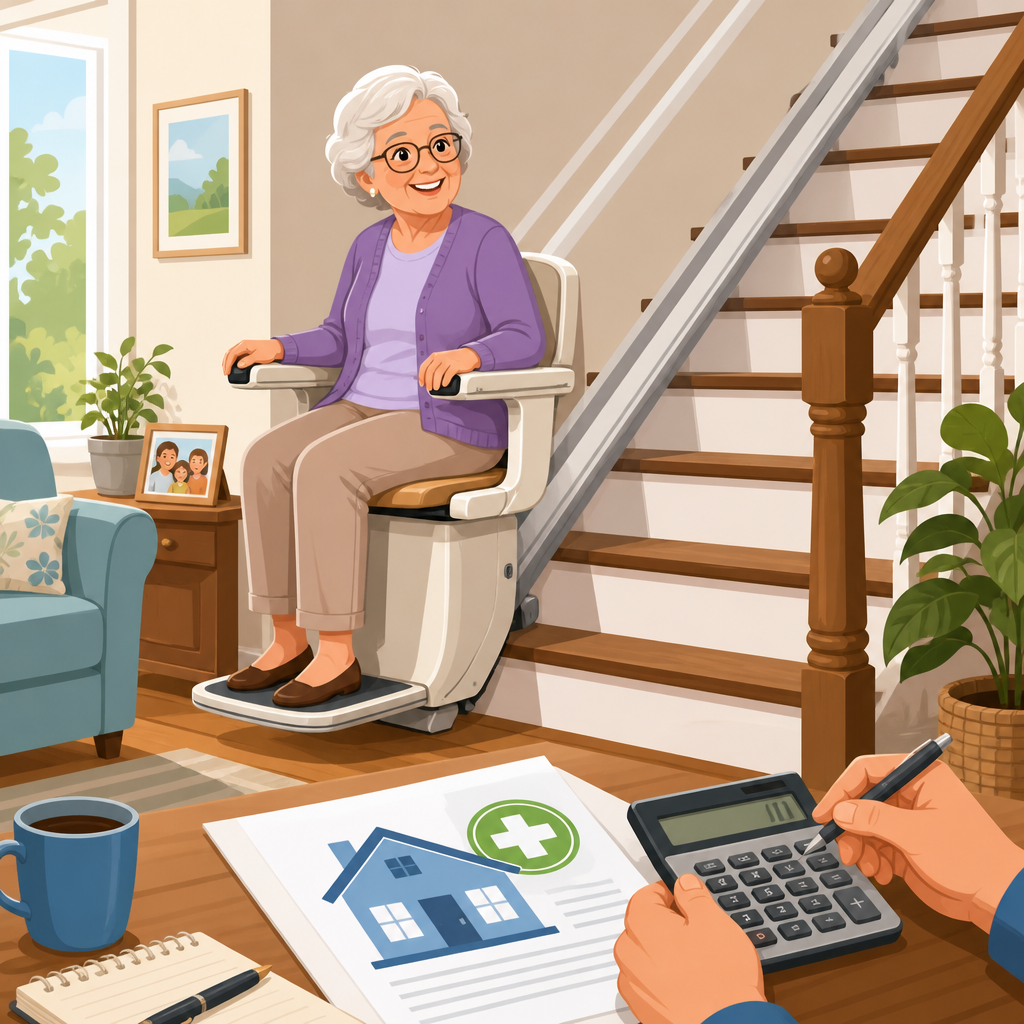
A stair lift can qualify as a medical home improvement for taxes, but only when it is installed primarily for medical care and the costs meet Internal Revenue Service rules for deductible medical expenses. For families comparing mobility solutions, that distinction matters because a qualifying deduction can reduce the after-tax cost of a stair lift by hundreds or even thousands of dollars. In practice, however, the answer is not simply yes or no. Tax treatment depends on why the lift was installed, whether a physician recommended it, how much of the project increased the home’s value, and whether total unreimbursed medical expenses exceed the applicable adjusted gross income threshold for itemized deductions.
In this context, a stair lift is a motorized chair or platform that travels along a rail mounted to a staircase, allowing a person with limited mobility to move safely between floors. A medical home improvement is a modification made to accommodate a diagnosed condition, prevent injury, or enable access to essential parts of the home. Common examples include ramps, widened doorways, roll-in showers, grab bars, and in many cases stair lifts. The tax issue is whether the stair lift is considered a medical expense under IRS guidance rather than a general home upgrade or convenience purchase.
I have worked with families gathering invoices, physician letters, and contractor documentation after mobility equipment purchases, and stair lifts are one of the most misunderstood items in this category. People often assume that any accessibility product is automatically deductible. It is not. Others assume that because a stair lift is attached to the home, it must be treated like a capital improvement that never counts as a medical expense. That is also incomplete. The tax rules allow certain capital expenses for medical care, but they impose a value-based limitation that many homeowners do not anticipate until tax season.
This article serves as a hub for tax deductions and medical expenses within the broader cost and financing conversation. If you are evaluating whether to buy now, request financing, use a health savings account where permitted, or plan for itemized deductions, tax treatment should be part of the analysis from the start. Understanding the rules before installation helps you collect the right records, ask the right questions of your installer and tax preparer, and avoid overstating a deduction that could be challenged later.
When a stair lift qualifies as a deductible medical expense
A stair lift generally qualifies when it is installed to diagnose, cure, mitigate, treat, or prevent disease, or to affect a structure or function of the body. That standard comes from the IRS definition of medical care. In plain terms, the lift must be medically necessary, not merely helpful, convenient, or desirable for aging in place. Strong facts include a diagnosis such as severe osteoarthritis, multiple sclerosis, Parkinson’s disease, post-stroke mobility impairment, spinal cord injury, chronic balance disorder, or a heart condition that makes climbing stairs unsafe. A written recommendation from a licensed physician is not explicitly required in every case by statute, but in real audits it is one of the most important pieces of support.
The timing and purpose of the installation also matter. If the stair lift was added after a fall, after discharge from rehabilitation, or after a clinician advised the patient to avoid stairs, the medical purpose is clearer. If it was installed during a broader remodel that also upgraded flooring, lighting, and finishes, the IRS may examine whether part of the project was personal or aesthetic. A dedicated stair lift installation with a medical rationale is easier to defend than a mixed project with lifestyle benefits layered in.
For example, consider a homeowner with advanced knee degeneration who can no longer reach a second-floor bedroom safely. Her orthopedic specialist documents mobility limits and recommends a stair lift to prevent further falls. She pays $9,500 for the lift, rail, power supply, and installation, and insurance does not reimburse the cost. That expense may qualify as a medical home improvement, subject to the increase-in-value rule discussed below and the general limit on deducting medical expenses. By contrast, if a healthy homeowner adds a stair lift in anticipation of possible future needs, the medical nexus is weaker and a deduction is far less likely to hold.
How the IRS treats home improvements for medical purposes
The key tax concept is that a stair lift is often a capital expense to the home. IRS Publication 502 explains that capital expenses for medical care can be included as medical expenses if their main purpose is medical care. However, when the improvement increases the value of the home, only the cost that exceeds that increase is treated as a medical expense. This rule prevents taxpayers from deducting the full cost of an improvement that also functions as an asset-enhancing upgrade.
Here is the practical formula. Start with the total amount paid for the stair lift project, including required installation charges. Then determine how much the installation increased the fair market value of the home. Subtract the increase in value from the total project cost. The remainder is the potentially deductible medical expense. If the installation did not increase the home’s value at all, the full cost may be eligible, subject to the itemized deduction threshold. If it increased value by the full amount, there may be no deductible capital expense, though maintenance and operating costs tied to medical use may still be considered in some cases.
Stair lifts often differ from permanent structural changes such as additions, elevators, or major bathroom reconstructions because they can be specialized and may not increase market value significantly. In some markets they may even be viewed as neutral or as a feature a future buyer would remove. That does not guarantee full deductibility, but it is one reason stair lifts can fit more comfortably within medical expense rules than homeowners expect. A local appraisal, comparative market analysis, or written opinion from a qualified real estate professional can help substantiate that the lift added little or no value.
Some medically necessary improvements are specifically recognized by the IRS as not typically increasing home value, including entrance ramps, widening doorways, modifying hallways, installing railings or support bars, lowering cabinets, and altering warning systems. Stair lifts are not always listed in every simplified summary, but they fit the same analytical framework: the question is medical purpose first, value impact second. Tax preparers who understand accessibility modifications will usually evaluate stair lifts alongside ramps and bathroom access changes rather than as ordinary remodeling.
Documentation you should collect before and after installation
Documentation determines whether a valid deduction remains defensible years later. The most important item is a physician’s letter of medical necessity that links the stair lift to a diagnosed condition and explains why the patient needs safer vertical access in the home. Ideally, the letter should be dated before installation, identify the patient by name, describe mobility limitations, and state that the stair lift is recommended to reduce fall risk or enable access to essential living areas. Brief chart notes can help, but a direct letter is better.
You also need detailed invoices from the stair lift dealer or installer. The invoice should separate equipment, labor, electrical work, permits, service plans, and optional upgrades such as power swivel seats or custom upholstery. Clean itemization matters because medically necessary features are easier to support than luxury options. Keep proof of payment, financing agreements, correspondence about the patient’s needs, and any occupational therapy home safety assessment used to select the model.
For the home-value question, I usually advise obtaining a written estimate from a licensed appraiser or a knowledgeable real estate broker stating whether the stair lift increased market value and by how much. A simple statement that the lift is highly specialized, removable, and unlikely to raise selling price can be useful. If the installer had to build structural reinforcements or modify walls, document those separately because they may influence valuation differently than the lift itself.
| Document | Why it matters | Best practice |
|---|---|---|
| Physician letter | Shows medical necessity | Get it before installation |
| Itemized invoice | Proves exact eligible costs | Separate equipment and add-ons |
| Proof of payment | Supports amount actually paid | Keep bank or card records |
| Value opinion or appraisal | Addresses increase in home value | Obtain written dated analysis |
| Insurance denial or EOB | Shows unreimbursed expense | Retain all benefit paperwork |
Finally, maintain a tax file with the year’s other unreimbursed medical expenses, because stair lift deductions rarely stand alone. Prescription costs, Medicare premiums in eligible circumstances, hospital bills, dental work, hearing aids, home health services, and mileage for medical travel may all combine to push total expenses above the deduction threshold. A stair lift that seems nondeductible on its own can become valuable when added to a broader medical expense picture.
Limits, thresholds, and common tax mistakes
Even if the stair lift qualifies as a medical home improvement, you do not automatically receive a dollar-for-dollar tax benefit. Medical expenses are generally deductible only to the extent that total unreimbursed eligible expenses exceed 7.5 percent of adjusted gross income, and only if you itemize deductions on Schedule A. For a household with $100,000 of adjusted gross income, the first $7,500 of eligible medical expenses produces no federal deduction. Only the amount above that floor counts. If the taxpayer uses the standard deduction instead of itemizing, the stair lift provides no federal medical expense deduction at all.
That threshold changes the planning discussion. A retired couple with high prescription costs, long-term therapy, and a $12,000 stair lift may exceed the floor easily, making the deduction meaningful. A higher-income household with few other medical expenses may not. State income tax treatment can differ, so some taxpayers who receive little federal benefit may still see a state-level deduction, subject to local rules. This is one reason a stair lift purchase should be reviewed in the context of the entire year’s medical spending rather than in isolation.
The most common mistakes are predictable. First, taxpayers deduct the full invoice without considering any increase in home value. Second, they fail to distinguish medically necessary features from elective upgrades. Third, they claim costs reimbursed by insurance, a flexible spending arrangement, or another tax-advantaged source. Fourth, they do not keep records proving the lift was for a specific patient rather than general household convenience. Fifth, they miss related expenses that may also be eligible, such as repair and maintenance costs required to keep the lift functioning for medical use.
Another trap is assuming every financing charge is deductible as part of the medical expense. Generally, the deductible amount is the qualifying medical cost itself, not broad borrowing costs or credit card interest. If you finance the stair lift, preserve the contract and ask a tax professional how to treat setup fees, interest, and extended warranties. The answer can vary depending on the structure of the transaction and whether portions are medical or personal in nature.
How stair lifts compare with other accessibility modifications
Within tax deductions and medical expenses, stair lifts sit alongside a larger set of accessibility modifications that households often combine in one care plan. Ramps, vertical platform lifts, home elevators, first-floor bedroom conversions, walk-in tubs, curbless showers, toilet-height adjustments, widened doorways, and non-slip flooring each raise similar tax questions but not always the same answers. The more permanent and marketable the improvement, the more likely home-value analysis becomes important. The more specialized and patient-specific the equipment, the stronger the case that value increase is limited.
In real projects, the cleanest deductions usually come from modifications that directly solve a documented access barrier. A ramp to replace unsafe entry steps, grab bars prescribed after a fall, or a stair lift needed to reach a bathroom all present clear medical logic. A luxury bathroom remodel that happens to include one accessibility feature is much harder to parse. For this reason, many advisors recommend separating contracts where possible: one contract for medical modifications, another for cosmetic remodeling. That creates better records and reduces disputes about mixed-purpose spending.
Stair lifts also compare favorably with alternatives on cost. A straight stair lift often costs far less than a residential elevator and usually requires fewer structural changes. Curved stair lifts are more expensive because the rail is custom fabricated to the exact staircase geometry, yet they still tend to be less invasive than major construction. From a tax perspective, lower cost and limited effect on resale value can make stair lifts easier to document as primarily medical. The tradeoff is that they serve one staircase only and may not work well if the user transfers poorly or needs wheelchair access at every level.
As the hub page for this subtopic, this article connects the main tax principles you should apply before moving deeper into related questions: whether maintenance is deductible, how state rules differ, how financing intersects with tax treatment, how health savings accounts and flexible spending accounts may apply, and how to document mixed projects involving bathrooms, ramps, or lifts. Start with medical necessity, confirm unreimbursed cost, evaluate home-value impact, and review itemized deduction thresholds. Those four steps shape nearly every stair lift tax decision.
The short answer is that a stair lift can qualify as a medical home improvement for taxes, but only when you can show that the installation was primarily for medical care and that the claimed amount reflects IRS rules on capital improvements. That means the strongest cases include a diagnosed condition, a physician recommendation, detailed invoices, proof that insurance did not reimburse the expense, and evidence about whether the lift increased the home’s value. Without that foundation, a legitimate purchase can become a weak deduction.
The practical benefit of understanding these rules early is financial clarity. Instead of treating taxes as an afterthought, you can build a record before installation, coordinate with your dealer and tax preparer, and estimate your likely deduction based on total annual medical expenses and adjusted gross income. This is especially important for households balancing stair lift costs against other funding sources such as savings, financing, veterans benefits, Medicaid waiver programs where available, or family caregiving budgets. Good planning does not create a deduction that the law does not allow, but it does help you capture one that might otherwise be lost.
If you are considering a stair lift, gather the medical documentation first, request itemized quotes, and ask a qualified tax professional to review the project before you file. Then use this page as your starting point for the wider tax deductions and medical expenses landscape under cost and financing options, so every decision around accessibility improvements is made with the full financial picture in view.
Frequently Asked Questions
Can a stair lift qualify as a deductible medical home improvement for taxes?
Yes, a stair lift can qualify as a deductible medical home improvement if it is installed primarily for medical care rather than for general convenience, comfort, or home modernization. The key issue is medical necessity. Under Internal Revenue Service rules, certain home improvements made to accommodate a diagnosed medical condition may be treated as medical expenses. That means a stair lift installed so a person with limited mobility, arthritis, balance problems, a neurological condition, or another medically documented impairment can safely access different levels of the home may potentially qualify.
However, the deduction is not automatic. The IRS generally looks at whether the improvement was made for a legitimate medical reason and whether the expense otherwise meets the requirements for deductible medical expenses. In many cases, the deductible amount may also depend on whether the improvement increases the value of the home. If the installation adds value, only the portion of the cost that exceeds that increase may be deductible, although some medically necessary accessibility modifications may have little or no effect on market value. Because of that, the tax benefit can vary significantly from one household to another. For many families, the most important takeaway is that a stair lift may qualify, but only when the facts clearly support its medical purpose and the deduction is properly documented.
What makes a stair lift medically necessary in the eyes of the IRS?
A stair lift is generally considered medically necessary when it is installed to diagnose, cure, mitigate, treat, or prevent a physical or mental condition, or to affect the structure or function of the body. In practical terms, that usually means the user has a documented health condition that makes using stairs unsafe, painful, or impossible. Examples can include severe joint disease, recovery from a major surgery, heart or lung conditions that limit exertion, multiple sclerosis, Parkinson’s disease, stroke-related impairments, or another mobility-limiting diagnosis.
What matters most is the primary reason for the installation. If the stair lift was added because a doctor recommended it to reduce fall risk or to help a patient remain safely in the home, that is much stronger support for a medical expense deduction than installing one simply because stairs have become inconvenient with age. A physician’s letter of medical necessity can be especially helpful. That letter should ideally identify the patient’s condition, explain why climbing stairs is medically problematic, and state that the stair lift is recommended as part of the patient’s care or safety plan. While a doctor’s note alone does not guarantee a deduction, it can be important evidence that the installation was tied to medical care rather than personal preference.
How much of the stair lift cost can be deducted on a tax return?
The amount you may be able to deduct is not always the full purchase and installation price. Medical home improvements are subject to special tax treatment. In general, if the stair lift does not increase the value of your home, the full eligible cost may potentially count as a medical expense. If it does increase the home’s value, then the deductible portion is usually limited to the amount by which the total cost exceeds that increase in value. For example, if a stair lift costs $8,000 installed and is determined to increase the home’s value by $1,500, then $6,500 may be the amount treated as a medical expense, assuming all other requirements are met.
It is also important to remember that deductible medical expenses are generally subject to the applicable adjusted gross income threshold for itemized deductions. In other words, even if the stair lift qualifies as a medical expense, it only produces a tax benefit to the extent your total eligible medical expenses exceed the IRS threshold and you itemize deductions instead of taking the standard deduction. This is one reason why two taxpayers with similar stair lift purchases can see very different tax outcomes. The deduction depends not just on the lift itself, but also on home value impact, total annual medical spending, income level, and filing position.
What records should you keep to support a stair lift medical expense deduction?
Good documentation is essential. If you plan to claim a stair lift as a medical home improvement, you should keep all invoices, contracts, receipts, proof of payment, and any installation paperwork. Those records should clearly show what was purchased, when it was installed, and how much was paid for the equipment, labor, and any related modifications. If there were added expenses such as electrical work, rail customization, or structural adjustments required to make the lift usable for the patient, those costs should be documented separately if possible.
You should also keep medical support records, especially a physician’s written recommendation or letter of medical necessity. In addition, if there is any question about whether the stair lift increased the value of the home, it may be wise to retain an appraisal or other credible valuation evidence showing the before-and-after effect, if any. Many homeowners do not think about this point until tax time, but it can become important if the deduction is ever questioned. Finally, maintain copies of the tax return where the deduction was claimed and any worksheets used to calculate the deductible amount. Complete records help show that the lift was installed primarily for medical care and that the amount claimed was determined in a reasonable, supportable way.
Should you talk to a tax professional before claiming a stair lift as a medical expense?
Yes, speaking with a qualified tax professional is a smart step before claiming the deduction. The general rule sounds simple, but the real-world application can be nuanced. A tax advisor can help determine whether your specific stair lift installation meets the medical expense standard, whether a home value adjustment needs to be considered, and whether claiming the expense will actually benefit you based on your overall tax situation. This matters because some taxpayers assume that any medically helpful improvement is fully deductible, when in reality the deduction may be limited or may produce little tax savings if they do not itemize or do not exceed the medical expense threshold.
A professional can also help you organize the right documentation and avoid common mistakes, such as claiming a convenience upgrade as a medical necessity or overlooking related costs that may properly be included. For families comparing mobility solutions, this guidance can be especially valuable because the tax treatment may affect the true after-tax cost of a stair lift versus other accessibility options. In short, a stair lift can qualify for favorable tax treatment, but the safest approach is to confirm the details before filing so the deduction is accurate, defensible, and aligned with current IRS rules.