


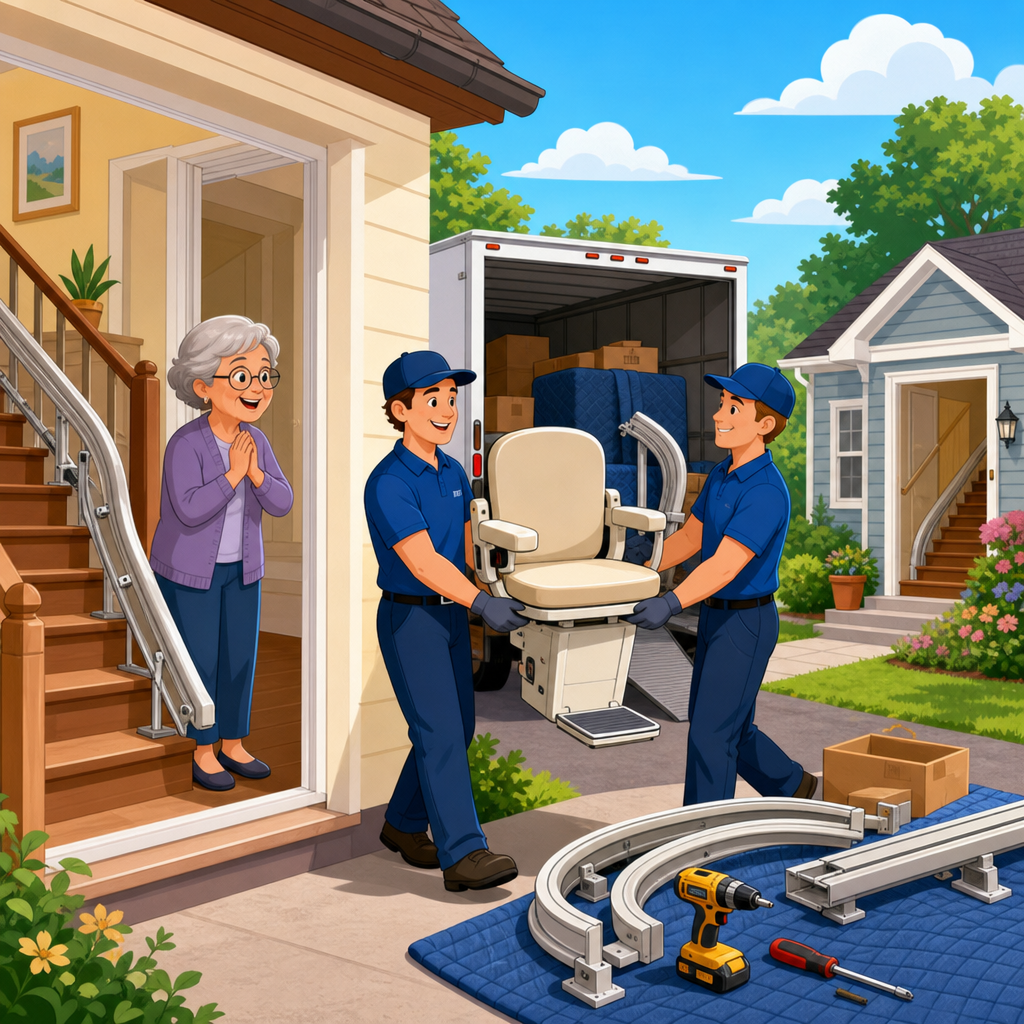
Chair lifts can often be moved to another home, but the answer depends on the lift type, staircase layout, safety standards, and the condition of the equipment. Homeowners usually ask this question when downsizing, moving after surgery, helping an aging parent relocate, or trying to save money by reusing an existing stair lift instead of buying a new one. In practice, some lifts transfer smoothly, while others are poor candidates for reinstallation because the rail was custom built, parts are outdated, or the new staircase creates code and fit issues.
A chair lift, also called a stair lift or stair chair, is a motorized seat that travels along a rail mounted to stair treads. Straight chair lifts run on a simple, linear rail for staircases without turns, landings, or intermediate curves. Curved chair lifts use a custom rail engineered to match bends, spirals, or split-level transitions. Outdoor chair lifts include weather-resistant components, sealed controls, and corrosion-protected rails. Transferability largely follows those categories: straight models are usually the easiest to move, curved models are the hardest, and outdoor units can sometimes be moved indoors but require evaluation.
This matters because the cost difference is significant. A new straight stair lift commonly ranges from about $2,500 to $5,500 installed, while a curved model often starts near $10,000 and can exceed $20,000 depending on complexity, powered options, and rail length. Removal, transport, rail modification, battery replacement, and reinstallation add more cost. I have seen homeowners assume a lift can simply be unscrewed and bolted into the next house in an afternoon. That is rarely how it works. The rail geometry, charging points, footrest clearances, seat offset, and top and bottom overrun distances all need to be checked carefully.
For this reason, the real question is not only can chair lifts be moved to another home, but should they be. A reusable unit can be a practical asset when the equipment is recent, the manufacturer still supports the model, and the destination staircase closely matches the original application. Reuse becomes less attractive when the lift is old, heavily worn, unsupported, or installed on a staircase that differs materially from the new one. The rest of this guide answers the most common questions people ask, explains how professionals evaluate a relocation, and shows when moving a stair lift makes financial and safety sense.
When a chair lift can be moved successfully
The simplest and most reliable relocation involves a straight chair lift from a major brand such as Bruno, Harmar, Stannah, Handicare, or Access BDD. If the unit is only a few years old, has documented service history, and the new staircase is also straight with similar width and landing space, installers can often remove the carriage and rail, inspect the brackets, and reinstall with either the original rail or a newly cut rail section approved by the manufacturer. In many cases, the seat assembly, transmission, charger, call stations, and safety sensors remain usable even if the rail needs replacement.
Curved lifts are different because the rail is generally made to exact measurements using photo surveys, digital templates, or manufacturer software. Even small differences in tread depth, rise, angle changes, or landing dimensions can make the original rail unusable in the next home. The carriage may still be reusable, but the custom rail almost never fits another staircase without a full redesign. That means the move becomes closer to purchasing a reconditioned curved system with a new rail rather than simply relocating the old lift intact.
Age is another deciding factor. Most stair lifts use rechargeable batteries housed in the base of the carriage and charge at one or more points on the rail. Batteries usually need replacement every few years, and older control boards, gear racks, swivel interlocks, and seatbelt switches can become harder to source. If a model has been discontinued and the installer cannot obtain manufacturer-approved parts, relocation may create a service problem. A lift that works today in one house is not automatically a lift that a dealer will certify for use in another.
The staircase itself must also qualify. Professionals will check stair width, headroom, landing safety, power availability, obstruction points, and whether the parked seat blocks traffic flow. In many homes, the issue is not the run of the stairs but the top or bottom dismount position. A user with limited mobility needs enough space to get on and off safely. If the new home has a narrow hallway, a door swing at the bottom tread, or a top landing with limited clearance, the moved chair lift may technically fit but still fail practical use.
How professionals evaluate whether a stair lift should be relocated
A proper assessment starts with the lift’s make, model, serial number, and installation history. Reputable dealers review whether the unit remains within manufacturer support, whether there are open recalls or service bulletins, and whether the original installation followed current guidance. They then inspect wear points including the drive system, seat swivel locks, overspeed governor if equipped, arm controls, limit switches, and obstruction sensors on the footrest and carriage. On battery-powered units, voltage stability and charger output are tested before any move is approved.
The next step is a site survey of the new home. Installers measure total rail run, tread dimensions, nose projection, stair angle, clear width, upper and lower landing depth, and any nearby doors or radiators. For curved applications, many firms use photo measurement tools or digital surveying systems because a small measuring error can cause major fabrication problems. During surveys I have also seen contractors evaluate user transfer ability, cane or walker use, body size, and whether a powered swivel or powered folding rail will be required in the new setting.
Safety and liability are central. Stair lifts in North America are generally installed with reference to ASME A18.1, the Safety Standard for Platform Lifts and Stairway Chairlifts, along with manufacturer specifications and local rules. Dealers who provide warranties usually will not reinstall equipment they cannot inspect fully, document, and test under load. That matters for homeowners considering do-it-yourself removal or buying used lifts from classifieds. Saving money upfront can eliminate professional support later, which is a poor trade if the user depends on the lift every day.
Price comparisons should include the total project, not just the reused seat. Many people focus on the original purchase price and forget removal labor, transport, rail refitting, new batteries, replacement remotes, new brackets, service calls, and disposal of unusable components. A realistic comparison often shows that moving a straight chair lift can be worthwhile, while moving a curved unit may only make sense if the carriage is high-end and the manufacturer allows a new custom rail to be paired with it.
| Scenario | Likelihood of Reuse | Main Cost Drivers | Best Option |
|---|---|---|---|
| Straight lift, newer model, similar stairs | High | Removal, transport, reinstall, batteries | Relocate after dealer inspection |
| Straight lift, old or discontinued model | Moderate to low | Parts availability, safety updates, labor | Compare relocation with buying reconditioned |
| Curved lift, new home has different layout | Low for rail, moderate for carriage | New custom rail, survey, fabrication | Reuse seat only if manufacturer approves |
| Outdoor lift moving indoors | Moderate | Inspection, cleaning, corrosion review | Possible if components remain in good condition |
| Used lift bought privately with no records | Low | Unknown condition, no warranty, missing parts | Use dealer-vetted equipment instead |
What can be moved, what must be replaced, and what often surprises homeowners
Homeowners are often surprised that the seat and drive unit may be reusable while the rail is not. On straight lifts, the rail can sometimes be cut to length or replaced with a compatible section, depending on the brand. On curved lifts, the rail is usually the least transferable component because it was fabricated for one staircase only. Chargers, call-send stations, hinges, and mounting brackets may also need replacement if they are damaged during removal or no longer match the new configuration.
Batteries almost always deserve attention during relocation. Most modern stair lifts run on DC power from onboard batteries, with a charger connected to household AC power. Even if the unit seems to operate, weak batteries can create intermittent faults, reduced travel speed, beeping at charge points, or failure under load. I generally advise homeowners to budget for fresh batteries during a move unless they were replaced recently and test well. It is a modest expense compared with the inconvenience of immediate post-installation service calls.
Another overlooked item is seat orientation and user ergonomics. Some lifts allow different seat heights, arm widths, or joystick sides. In the new home, the user may approach the seat from a different direction or need a powered swivel to avoid twisting on the landing. A move is the right time to reassess whether the existing setup still matches the user’s mobility. People often relocate because health conditions changed, and the original configuration may no longer be ideal even if the hardware still works.
Cosmetic condition also matters more than many expect. Scratched rail finishes, cracked arm caps, worn upholstery, and yellowed plastics do not always affect function, but they influence resale value, user confidence, and whether a dealer wants the project. Reputable companies stake their reputation on installations that look professional and operate quietly. If a used chair lift appears heavily worn, some dealers will decline relocation and instead offer trade-in credit or a reconditioned replacement with updated components and a service warranty.
Costs, warranties, and the used stair lift market
The cheapest path is not always the lowest-risk path. A homeowner might find a used straight stair lift online for a few hundred dollars and assume installation will be inexpensive. In reality, dealers often charge more to assess and fit unknown used equipment than to install one of their own reconditioned units. They know the service history of their inventory, they can confirm part compatibility, and they can back the finished job with labor coverage. Private-sale lifts frequently arrive with missing remotes, dead batteries, damaged harnesses, or rails cut for a different stair length.
Warranty status is equally important. Many manufacturer warranties apply only to the original purchaser or only when installed by an authorized dealer. Once a lift is removed, transferred, or sold privately, factory coverage may end. That does not mean relocation is a bad idea, but it changes the economics. If future repairs are likely and parts are expensive, a lower upfront relocation cost can be offset quickly by service bills. Ask specifically about labor warranty, parts warranty, emergency callout fees, and whether the installer will support the system long term.
Rental is another option worth comparing. For short-term recovery after surgery, a stair lift rental may cost less than moving an older unit, especially for a straight staircase. Many dealers maintain rental fleets of straight lifts because the rails can be reused efficiently. Curved rentals are less common because the rail still must be custom fabricated. If the user’s mobility needs are temporary, rental or buying reconditioned can be more practical than transporting existing equipment across town or across states.
For sellers leaving a house, there is also a real estate angle. In some markets, leaving a working chair lift in place can help a buyer who needs accessibility, but in other cases it narrows appeal and buyers ask for removal. If you plan to take the lift with you, decide early. Scheduling removal after movers have packed the home often creates avoidable delays, especially when stair access is needed for furniture. Accessibility equipment works best when relocation is coordinated like any other specialized trade, not treated as a last-minute moving task.
Frequently asked questions and practical guidance for a smooth move
Can any stair lift be moved to another house? No. Most straight stair lifts can be moved if the unit is supported and the new staircase is suitable. Most curved rails cannot be reused on a different staircase, though the carriage may sometimes be reused with a newly fabricated rail. Is professional removal necessary? Yes, in nearly every case. Proper disassembly protects the gearbox, wiring, charge contacts, and safety circuits, and it preserves the chance of warranty or future dealer service.
How long does relocation take? A straight lift removal may take one to three hours, while reinstallation often takes several hours more depending on rail changes and testing. Curved projects take longer because of surveying and fabrication lead times. Should you move a very old chair lift? Usually only if parts are available, the installer will support it, and the total cost is materially lower than a reconditioned or new replacement. Otherwise, older lifts can become false economies.
Before committing, ask five direct questions. First, is the manufacturer still supporting this model with approved parts? Second, can the existing rail be reused, shortened, or must it be replaced? Third, what safety tests will be performed after reinstallation? Fourth, what warranty will the installer provide on labor and components? Fifth, if relocation is not advisable, what trade-in, buyback, rental, or reconditioned alternatives are available? Clear answers to those questions usually reveal the right path quickly.
The bottom line is simple: chair lifts can be moved to another home, especially straight stair lifts, but successful relocation depends on fit, supportability, safety, and total cost. The best outcomes come from a dealer-led evaluation, not guesswork. If you are planning a move, schedule an in-home assessment early, gather model information and service records, and compare relocation against reconditioned, rental, and new-install options. That approach protects mobility, avoids wasted money, and helps ensure the next home is accessible from day one.
Frequently Asked Questions
Can a chair lift really be moved to another home?
Yes, many chair lifts can be moved to another home, but whether it makes sense depends on several practical factors. The biggest issue is the type of stair lift you have. Straight stair lifts are often the easiest to relocate because they use simpler rail systems and are generally more adaptable if the new home also has a straight staircase with compatible dimensions. Curved stair lifts are much more complicated because the rail is usually custom manufactured to match the exact turns, landings, and measurements of the original staircase. In many cases, that custom rail will not fit a different home at all.
Beyond the rail shape, the installer also has to evaluate the condition of the motor, carriage, seat, batteries, controls, and safety sensors. A lift that is only a few years old and has been well maintained may be a reasonable candidate for transfer. An older unit, a discontinued model, or one with hard-to-find replacement parts may not be worth the labor and expense of moving. Safety standards also matter. A lift that was acceptable when first installed may need upgrades or may no longer meet current installation requirements in the new setting. That is why relocation is never just a matter of unbolting the lift and attaching it somewhere else. A professional assessment is the safest and most reliable first step.
Which types of chair lifts are easiest to reuse in a new house?
Straight stair lifts are usually the best candidates for reuse. These systems are designed for staircases that go in a single line without curves, intermediate landings, or directional changes. Because their rail sections are more standardized, there is a better chance the lift can be removed, resized, or reconfigured to fit another straight staircase. Even then, the new staircase still has to be measured carefully for width, angle, length, obstructions, and clearance at the top and bottom landings.
Curved stair lifts are much less likely to transfer successfully. Most curved systems are built specifically for one staircase, and the rail is fabricated to exact measurements. If the new home has even slightly different geometry, the original rail may be unusable. In some cases, the chair and drive components might be reused with a newly built rail, but that reduces the savings and still depends on manufacturer compatibility and part availability. Outdoor stair lifts also require extra scrutiny because exposure to weather can affect the condition of the components. Platform lifts and heavy-duty models can sometimes be moved, but they involve more structural and code-related considerations. In general, the simpler and more standardized the system, the better the chance it can be reused cost-effectively.
What factors determine whether moving a stair lift is worth it?
Cost-effectiveness comes down to more than the price of the equipment itself. Homeowners should compare the total cost of removal, transportation, storage if needed, rail replacement or modification, reinstallation, inspections, and any necessary repairs with the cost of buying a new or certified reconditioned unit. If the existing lift is older, out of warranty, or nearing the point where major parts may fail, moving it may offer only short-term savings. On the other hand, if the lift is relatively new and the new home has a highly compatible staircase, relocation can be a smart way to reduce expenses.
Timing and life situation also matter. People often explore moving a chair lift when downsizing, relocating after surgery, or helping an aging parent move into a safer home. In these situations, reliability is critical. Saving money is important, but not if the result is a lift that is difficult to service or poorly matched to the staircase. Manufacturer support should be considered as well. Some brands continue to support transferred units and offer replacement parts, while others may have discontinued certain models. A qualified stair lift company can provide an honest comparison between reuse, refurbishment, and replacement so you can make a decision based on safety, long-term value, and serviceability rather than upfront cost alone.
Can I remove and reinstall a chair lift myself?
In most cases, it is not recommended. While a stair lift may appear straightforward, it is a mobility device with electrical components, mechanical drive systems, charging points, seat interlocks, limit switches, and multiple built-in safety features. Improper removal can damage the rail, wiring, transmission components, or mounting points. Improper reinstallation can create more serious problems, including unstable rail alignment, charging failures, unsafe stopping positions, or malfunctioning obstruction sensors. Even a small installation error can affect rider safety.
Professional technicians do more than mount the unit to the stairs. They verify that the staircase is suitable, confirm proper clearances, inspect the power supply, test battery charging, check seat swivel locks, confirm the footrest and armrest safety systems, and ensure the lift stops exactly where it should. They also know whether the model can legally and safely be reinstalled under current standards and manufacturer guidelines. If you are moving a lift to help someone with limited mobility, reliability is too important to leave to guesswork. A professional inspection and installation protects both the user and your investment.
If my current chair lift cannot be moved, what are the alternatives?
If your existing chair lift is not a good candidate for relocation, you still have several practical options. One common solution is to purchase a new lift for the new home and sell, trade in, or responsibly remove the old one. Some stair lift dealers offer buyback, trade-in, or recycling programs depending on the age and condition of the unit. Another option is to purchase a reconditioned stair lift. For straight staircases, refurbished models can be a cost-conscious middle ground because they are typically inspected, serviced, and installed professionally while costing less than brand-new equipment.
If the new home has a staircase that is very different from the old one, especially if curves or landings are involved, starting fresh is often the better long-term decision. A new system can be designed to fit the space properly, meet current safety expectations, and come with warranty coverage and local service support. For short-term mobility needs, rental programs may also be available in some areas, particularly for straight stair lifts. The best path depends on how long the lift will be needed, the layout of the new home, and the importance of future serviceability. An experienced provider can walk you through those choices and help you avoid spending money on a move that does not deliver dependable results.