


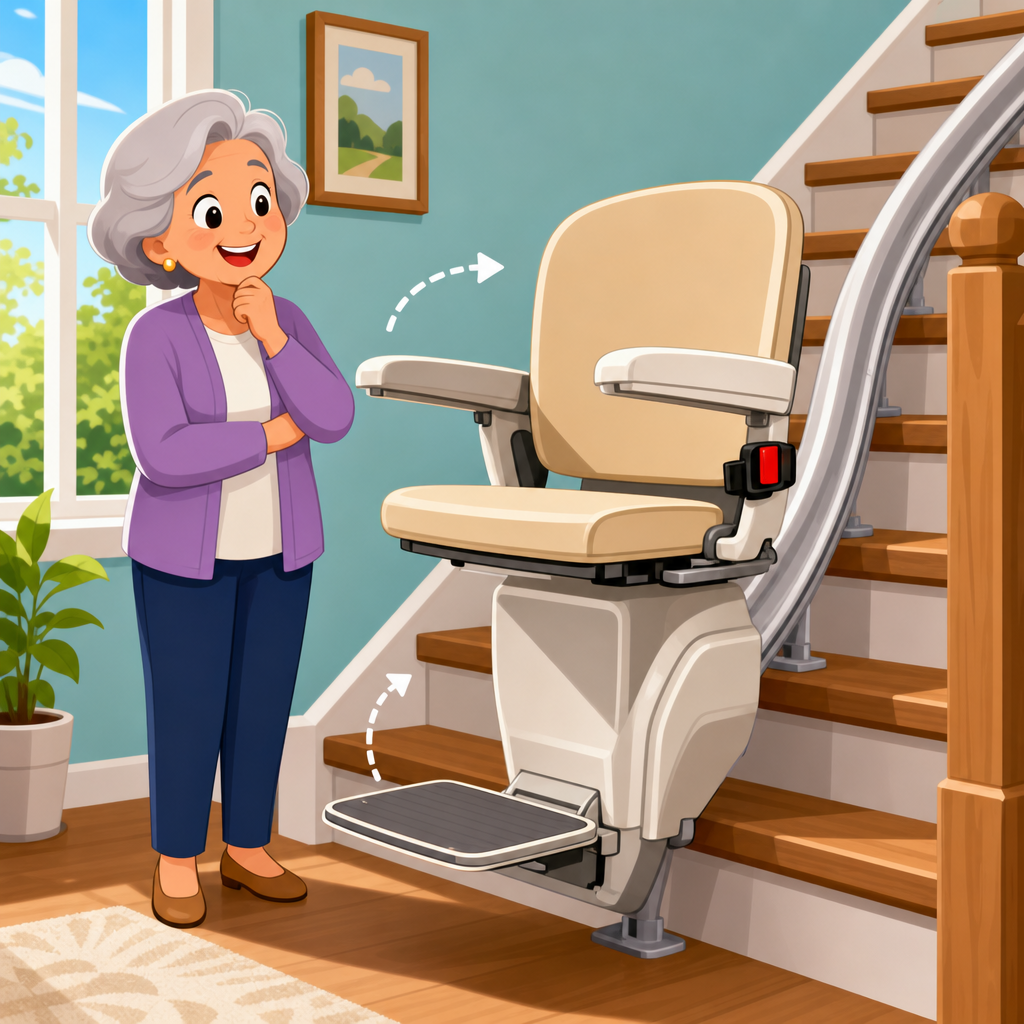
A chair lift with a folding seat and footrest is not only available, it is one of the most common and practical stair lift designs for homes where stairs remain a shared walkway. In day-to-day installations, I have seen folding components make the difference between a stairway that still feels usable and one that becomes an obstacle for everyone else in the house. For homeowners comparing chair lift types and designs, this feature often matters as much as weight capacity, rail style, or power source because it affects safety, clearance, comfort, and code awareness.
To answer the main question directly: yes, most modern stair lifts can be ordered or configured with a folding seat, folding armrests, and a folding footrest. Some models fold manually, while others offer powered folding footrests that reduce bending. These features are especially useful in narrow staircases, multi-user homes, and properties where the lift is parked at either the top or bottom landing when not in use. The design is simple in concept but important in practice. When folded, the chair projects less into the staircase, leaving more walk-through space for other people.
It helps to define terms clearly. A chair lift, often called a stair lift, is a motorized seat that travels along a rail mounted to the stair treads, not usually the wall. The seat supports a rider while the drive system moves up or down the stairs. A folding seat means the base flips upward when the lift is not in use. A folding footrest means the platform supporting the rider’s feet folds up as well. Many units also include swivel seats at the top landing, seat belts, obstruction sensors, battery backup, and call-send controls.
This matters because stair access problems rarely involve only the rider. In most homes, other residents, caregivers, children, and pets still use the stairs. A bulky parked chair can create trip hazards or make moving laundry, vacuum cleaners, groceries, or medical equipment harder. Folding designs reduce those problems without sacrificing the core benefit of seated stair travel. For people with arthritis, balance limitations, post-surgical recovery needs, or reduced lower-body strength, the right folding configuration can preserve both independence and household flow. That is why this article serves as a practical hub for the most common questions buyers ask before choosing a stair lift.
How folding seats and footrests work in real homes
Most folding stair lift components rely on straightforward hinges and locking points. The seat base lifts upward against the carriage, the armrests rise, and the footrest folds toward the rail. On premium models, the footrest may be linked mechanically to the seat so one motion folds both, or powered by a small motor activated with a switch or remote. In my experience, users who have back pain or limited hip mobility often appreciate powered footrests because manual folding requires reaching down, which can be difficult after riding.
The main benefit is clearance. A folded stair lift takes up less space than one left open, which is critical on staircases under about 36 inches wide. While exact dimensions vary by brand and rail, folded widths commonly fall in the range of roughly 12 to 16 inches from the wall or rail side, while open seats may project 20 to 25 inches or more. Installers measure the narrowest points carefully, including handrails, trim, and door swings, because even a few inches can determine whether other people can pass safely.
Another practical point is parking position. Many homes have enough room to fold the lift at one landing and send it out of sight with a remote. In tight entryways, a folding seat and footrest can keep the bottom of the staircase from feeling blocked. In upstairs hallways, a folding design can help maintain access to bedrooms or bathrooms. This is particularly important in split-level homes and in houses where the top landing opens directly into a corridor rather than a large open area.
Buyers should know that not every folding feature is automatic. Some basic models require the user or caregiver to fold each component by hand. Others offer powered options only on certain configurations. Curved rail stair lifts, which are custom built for staircases with turns or intermediate landings, often support folding seats and footrests too, but the options and final folded profile can differ from straight stair lift models. Asking for the folded width in writing is one of the smartest steps you can take before signing a proposal.
Who benefits most from a folding seat and footrest
People often assume folding features are only for very narrow stairs, but the user profile is broader. The first group that benefits is households with more than one person using the staircase on foot. If spouses, children, home health aides, or visiting relatives still walk the stairs regularly, a folded lift reduces interference. The second group is users with limited flexibility. A powered folding footrest can remove a daily strain point for anyone with spinal issues, knee replacements, or difficulty bending from standing.
Another important group is homeowners planning for long-term aging in place. Needs tend to change. Someone who can fold a footrest manually today may struggle in a year after a fall, stroke, or progression of arthritis. I have seen many families save money and avoid retrofits by choosing the powered option at installation rather than adding it later. Caregivers also benefit. In homes where a family member assists with transfers, a folded chair is easier to park neatly and keeps shared circulation areas clear.
There is also a safety benefit for households with children and pets. While no stair lift should be treated as a toy, folded components reduce protruding surfaces that invite climbing or bumping. Obstruction sensors help, but good household safety starts with minimizing avoidable hazards. For people carrying items up and down stairs, extra clearance can lower the chance of catching clothing, bags, or boxes on the chair. That everyday convenience is one reason folding designs have become standard on many leading models from Bruno, Stannah, Handicare, and Harmar.
| Question | Practical answer | Why it matters |
|---|---|---|
| Can the seat fold up? | Usually yes on most modern stair lifts | Improves stair clearance when parked |
| Can the footrest fold too? | Yes, manually or with a powered option on some models | Reduces bending and trip risk |
| Is this only for narrow stairs? | No, it helps on standard stairs as well | Makes shared use easier for the whole household |
| Does folding affect comfort? | No, comfort depends more on seat shape, height, and arm support | Useful for comparing designs fairly |
| Can curved lifts have these features? | Often yes, but dimensions vary by custom rail design | Requires detailed measuring before purchase |
Common buyer questions about comfort, safety, and operation
One frequent question is whether a folding stair lift feels less sturdy than a fixed seat. Properly installed equipment from established manufacturers does not. The seat locks in the riding position, and the footrest is designed to support the user’s feet, not excessive external weight. Comfort depends more on seat width, back angle, armrest placement, and how naturally the rider can sit down and stand up at the landings. A folding mechanism should be invisible during travel; if it feels loose, that is a maintenance issue, not a normal condition.
Another question is whether the footrest must be used. The answer is yes, riders should place their feet on the footrest during travel. Letting feet dangle can increase the chance of striking steps or losing proper seated posture. Most lifts include footrest safety edges that stop the unit if they contact an object on the stairs. That feature helps prevent crushing incidents with dropped items, but it does not replace good housekeeping. Installers should demonstrate obstruction sensors, seat belt use, swivel operation, and battery charging before completing the job.
People also ask if folding parts make the lift slower or harder to operate. In reality, ride speed is set by the drive system and safety controls, not by whether the seat folds. Stair lifts commonly move around 15 to 20 feet per minute, though exact speed varies. Using the folding functions may add a few seconds before or after a ride, especially on manual models. For many users, that tradeoff is worthwhile because it keeps the staircase cleaner and more accessible throughout the day.
Noise is another concern. Folding components themselves are usually quiet. Most sound comes from the motor, gearbox, and rail movement. A well-installed battery-powered stair lift should produce a smooth mechanical hum rather than grinding or clunking. If a folding footrest becomes difficult to move, lubrication and service may be needed, but owners should follow the manufacturer’s maintenance instructions rather than applying household oils randomly. Service intervals vary, yet annual inspection is a sensible baseline for residential use.
How to choose the right model and what to ask before buying
Start with the staircase, not the brochure. Accurate measurement determines what is possible. A reputable dealer will assess stair width, landing depth, headroom, handrail interference, door proximity, and any overrun needed to improve getting on and off. If folding seat and footrest features are a priority, ask for the open and folded projections, the seat-to-footrest height, and whether the footrest can be powered. Users with shorter legs or limited ankle mobility should test whether the riding posture feels stable and whether the knees remain comfortable.
Next, compare manual versus powered folding honestly. Manual systems cost less and have fewer electrical parts, but they require more reaching and hand strength. Powered footrests are often worth the extra cost for users with arthritis, degenerative disc disease, or poor balance. Some seats also swivel manually at the top landing, while others can be powered. The safer transfer is usually the one that places the user away from the stair edge. If the rider needs assistance standing, discuss transfer technique with the dealer and, if relevant, an occupational therapist.
Ask about service support, warranty coverage, and parts availability. Straight stair lifts often have faster installation timelines and more standardized parts. Curved lifts are custom manufactured and can take longer. If the home may be sold later, ask whether the unit can be removed cleanly and whether the stair treads can be restored easily. Also ask about weight capacity. Standard residential capacities commonly range from around 300 to 400 pounds, while heavy-duty models may exceed that, but seat size and folded dimensions can change as capacity increases.
Finally, insist on a live demonstration if possible. The best stair lift design on paper can still be wrong for a specific body type or home layout. Sit in the chair, buckle the belt, place your feet on the footrest, fold and unfold the components, and practice calling the lift from another landing. Notice whether your heels catch, whether your hands can manage the controls, and whether the parked lift leaves enough room for others. Those details determine satisfaction more than marketing language ever will.
Costs, limitations, and when folding features may not be enough
Pricing varies widely by rail type, seat options, and local labor rates. Straight stair lifts typically cost less than curved models because the rail is standardized. Adding a folding seat is often standard, but a powered folding footrest or powered swivel seat usually increases the price. While exact market numbers change by region and brand, homeowners should expect option packages to affect the quote meaningfully. It is wise to compare not just total price, but also what each estimate includes: installation, warranty, service call terms, and battery replacement expectations.
There are limitations to acknowledge. A folding seat and footrest improve clearance, but they do not solve every access problem. Extremely narrow stairs, unusually steep staircases, or top landings with very limited transfer space may require specialized solutions or may not be suitable for a standard chair lift at all. In some homes, a perch-style seat, standing stair lift, or alternative accessibility device may be considered, though these options fit a narrower user group. A full home assessment is essential because safe transfer matters more than fitting a product at any cost.
Users should also understand that folding does not eliminate maintenance needs. Hinges, linkages, and powered mechanisms experience wear over time. Heavy daily use, dust accumulation, pet hair, or accidental impacts can affect operation. That is normal equipment ownership, not a sign the design is flawed. The right response is preventive service, prompt attention to unusual noises, and battery care according to the manufacturer’s guidance. When selected carefully, a stair lift with a folding seat and footrest is one of the most practical mobility upgrades available for existing homes.
The key takeaway is straightforward: yes, you can get a chair lift with a folding seat and footrest, and for many households you should. These features are widely available, highly practical, and especially valuable when stairs remain a common pathway for other people. They improve clearance, reduce tripping hazards, and can make daily use easier for riders with pain, stiffness, or limited balance. In real homes, that combination of accessibility and shared-space efficiency is what turns a stair lift from a necessary device into a workable long-term solution.
When comparing chair lift types and designs, treat folding features as a core buying factor rather than a minor accessory. Look closely at folded dimensions, manual versus powered operation, transfer safety at both landings, and the specific needs of the person who will use the lift every day. A model that fits the staircase but not the user is the wrong model. A reputable dealer should measure carefully, explain tradeoffs clearly, and let you test operation before installation. That process leads to better outcomes and fewer surprises.
If you are building out your understanding of stair lift options, use this page as your starting point for the wider FAQs and practical guidance within the Chair Lift Types and Designs topic. Then schedule an in-home assessment, ask for exact folded-clearance measurements, and compare at least two models side by side. A well-chosen folding seat and footrest setup can preserve independence while keeping the staircase usable for everyone else in the home.
Frequently Asked Questions
Can you get a chair lift with a folding seat and footrest?
Yes, absolutely. In fact, a folding seat and footrest is one of the most common configurations available on modern stair lifts. Many homeowners assume these are special add-ons, but on a large number of residential models, folding components are either standard or widely available as part of the normal design. The reason is simple: stair lifts are often installed on staircases that still need to function as everyday walkways for other people in the home. When the seat, arms, and footrest fold up, the lift takes up much less space, which helps keep the stairs usable when the chair is parked.
This design is especially practical in homes with narrower staircases, shared family traffic, or landings where space feels tight. It allows the user to enjoy the accessibility benefits of the lift without making the staircase feel permanently blocked. For many buyers, the folding feature ends up being just as important as the lift’s weight capacity, rail layout, battery backup, or upholstery style. If your concern is whether you can find a stair lift that supports mobility needs while also preserving space, the answer is yes—and folding seats and footrests are often the first feature professionals recommend.
Why are folding seats and footrests so important on a stair lift?
Folding seats and footrests matter because they directly affect how practical the stair lift will be in daily life, not just for the person riding it, but for everyone else in the home as well. A stair lift is there to improve access, but if it leaves the stairs feeling crowded or difficult to pass, that can create a new problem. When the seat folds up and the footrest tucks in, the chair becomes much less intrusive. This helps preserve walking space on the staircase and reduces the feeling that the lift has taken over the entire stairway.
They also contribute to safety. A folded footrest, in particular, can reduce trip hazards for anyone using the stairs on foot. In busy households, that feature can make a major difference. It is also useful when the lift is parked at the top or bottom landing, where extra clearance can be important. From a usability standpoint, folding components make the lift feel more adaptable and less bulky. In real-world home settings, this often becomes one of the key reasons a family feels comfortable moving forward with installation. It is not just about convenience—it is about maintaining flow, comfort, and safe shared use of the staircase.
Do folding seat and footrest features come standard, or are they optional?
That depends on the manufacturer and model, but folding seats are extremely common and are often built into the chair lift’s base design. On many residential stair lifts, the seat, armrests, and footrest are all made to fold when the lift is not in use. However, there can still be differences in how those parts operate. Some models require the user to fold the seat and footrest manually, while others offer powered options, especially for users who have difficulty bending, reaching, or managing the components by hand.
It is important to ask exactly what is included in the quoted model rather than assuming every folding feature works the same way. For example, one lift may include a manually folding footrest as standard, while another may offer a powered footrest as an upgrade. In some cases, the seat folds easily, but the user may still need help with the footrest if mobility is very limited. A good dealer or installer should walk you through how the chair stores, how much clearance it leaves on the stairs, and whether any powered folding options are available. If preserving stair space is a priority, it is worth discussing those details early in the buying process rather than treating them as minor extras.
Will a chair lift with a folding seat and footrest leave enough room for others to use the stairs?
In many homes, yes, that is exactly what this design is intended to help with. One of the biggest reasons folding stair lift components are so popular is that they reduce the amount of space the lift occupies when not in use. When the seat, armrests, and footrest are folded, the chair sits closer to the wall or rail, making the staircase feel more open for other family members, caregivers, or guests. This is especially valuable on stairs that serve as the home’s main route between floors.
That said, the exact amount of remaining walking space depends on the width of the staircase, the side of installation, the rail design, and the dimensions of the specific lift. Straight stair lifts often fit more compactly than custom curved systems, but both can be designed with folded storage in mind. A professional assessment is the best way to determine whether your stairs will still provide adequate clearance for foot traffic. During an in-home evaluation, the installer should measure the staircase carefully and explain what the folded lift footprint will look like in real use. In most cases, folding features significantly improve shared stair access, but confirming the actual clearance is always the right step before purchase.
Are there any limitations or things to consider before choosing a folding stair lift design?
Yes. While folding seats and footrests are highly practical, they should be considered as part of the overall stair lift setup rather than as the only deciding feature. First, think about who will be using the lift and how easily they can operate folding components. If the user has limited hand strength, poor balance, or difficulty bending, a manual footrest may not be ideal, and a powered option may be worth considering. Comfort, seat height, swivel function, armrest support, and ease of getting on and off the chair can be just as important as the folding design itself.
You should also consider staircase width, landing space, parked position, and whether the lift can be sent away from the main traffic area when not in use. In some homes, a folding seat and footrest solve most of the space concern. In others, you may also want a folding rail, parking call/send controls, or a specific track layout to keep doorways and hallways clear. Maintenance and long-term reliability matter too, especially if you are choosing powered folding features. The best approach is to view folding components as an essential space-saving advantage, but still compare the full package: safety features, user fit, rail style, power source, and installation layout. That way, you end up with a chair lift that works not only in theory, but in everyday life.