


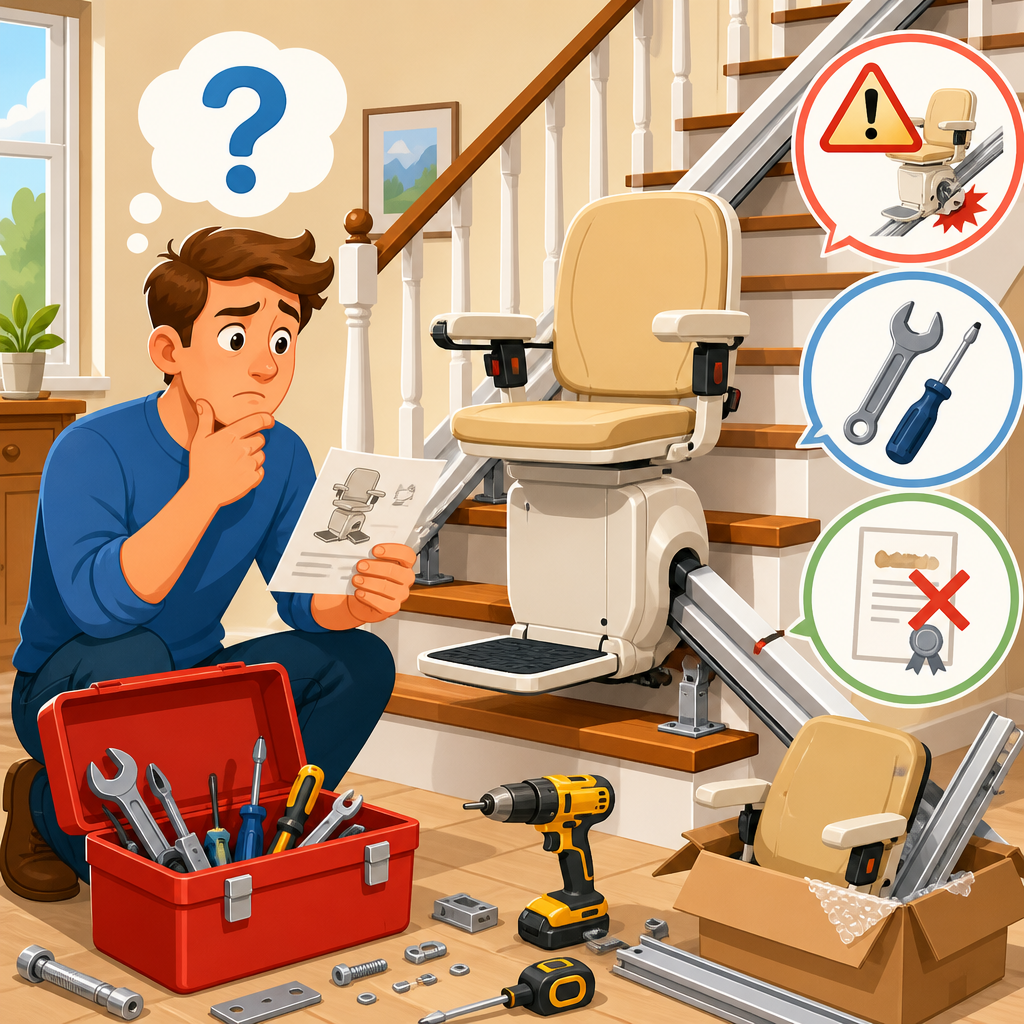
A used stair lift can look like a practical bargain, but installing one yourself raises serious questions about safety, code compliance, reliability, and warranty coverage. In the accessibility industry, I have seen homeowners buy secondhand units online, only to discover that the rail does not match their staircase, the charging points are missing, or the seat model is incompatible with the carriage. Before deciding whether you can install a used stair lift yourself, it helps to define the issue clearly: a stair lift is a motorized chair or perch system that travels along a rail fixed to stair treads or, less commonly, to a wall-supported structure. “Used” means the unit has already been installed elsewhere, with unknown wear history, service records, and configuration details. “DIY installation” means the homeowner handles planning, transport, mounting, wiring, setup, testing, and troubleshooting without a certified stair lift technician.
This matters because stair lifts are not decorative upgrades. They are mobility devices intended to carry people who may already be at elevated risk of injury from falls, poor balance, muscle weakness, or delayed reaction time. A small installation error can lead to abrupt stops, battery charging failures, seat wobble, footrest obstruction, or rail misalignment. Those defects are not merely inconvenient; they can make the lift unusable or dangerous. There is also a financial layer. A low purchase price on a used model can be offset by custom rail parts, replacement batteries, call-out labor, or the loss of any manufacturer-backed support. As the hub article for installation and setup, this guide explains the central comparison every buyer should understand: professional installation versus DIY, especially when the lift is secondhand. It also addresses the practical questions searchers usually ask first: Is self-installation possible, what tools are needed, what risks are involved, and what happens to the warranty?
Can you install a used stair lift yourself?
Yes, in a narrow technical sense, some mechanically skilled homeowners can physically mount certain straight used stair lifts themselves. Straight lifts are simpler than curved systems because the rail is linear, the staircase geometry is predictable, and the number of custom components is lower. If the exact rail length fits, all brackets are present, the carriage is compatible, the manual is available, and the power and charging layout are intact, a patient installer can sometimes complete the job. That is the best-case scenario.
In practice, however, most used stair lift purchases arrive with missing context. The seller may not know the production year, duty cycle, battery age, software revision, or whether a limit switch was previously adjusted to suit a different landing. I have seen online marketplace listings that describe a lift as “working when removed,” but the rack teeth were worn, the hinge section was absent, or the diagnostic key was missing. A stair lift removed from a narrow stairway may not have the bracket spacing needed for a different home. Curved stair lifts are especially poor candidates for DIY reuse because the rail is usually fabricated to the original staircase dimensions. Even if a curved carriage works, the custom rail almost never transfers cleanly to another property.
The direct answer is this: self-installation is possible for some straight used units, but it is rarely the safest or most cost-effective route unless the buyer has strong mechanical aptitude, electrical awareness, access to original documentation, and a plan for servicing. Most households should treat a used stair lift as a device that requires professional assessment before installation, not after.
Professional installation vs DIY: the real differences
The biggest difference between professional installation and DIY is not simply who holds the drill. It is who assumes responsibility for fit, safety, configuration, and post-installation performance. A professional stair lift installer starts with a site survey. That survey checks staircase width, rise and run, landing clearance, obstruction points, electrical proximity, user transfer space, seat orientation, hinge needs, and weight capacity requirements. Straight stairs typically need a minimum clear width around 27 to 30 inches depending on model, while many installers prefer more clearance when multiple users share the stairs. A DIY buyer often measures only rail length, which is not enough.
Professional installers also understand product-specific setup. Brands such as Bruno, Harmar, Acorn, Handicare, and Stannah use different rail systems, charging arrangements, diagnostic methods, and seat assemblies. A technician knows how to set final travel limits, verify charge contact alignment, confirm swivel lock engagement, torque fasteners correctly, and run loaded test cycles. More importantly, a professional can identify when a used unit should not be reused at all. Corroded connectors, cracked footrest hinges, obsolete control boards, or unavailable replacement parts can turn a cheap purchase into a dead end.
DIY installation shifts all of that screening onto the homeowner. If a bracket is mounted one tread off, if the rail joints are not perfectly aligned, or if the call/send station pairs inconsistently, the homeowner must diagnose the problem alone. That can mean hours of trial and error, plus the risk of a dangerous partial fix. Professionals cost more upfront, but they reduce uncertainty, shorten downtime, and usually provide labor guarantees. For a device intended to prevent falls, that difference matters.
Tools, materials, and technical tasks a DIY installer must handle
People often ask what tools are needed to install a used stair lift. The honest answer is that the tool list is only part of the challenge. The larger issue is whether you can use those tools to achieve precise alignment and safe load-bearing assembly. A typical straight stair lift installation may require a tape measure, digital level, stud or tread inspection tools, socket set, hex keys, torque wrench, drill/driver, masonry bits or wood bits depending on substrate, adjustable wrench, multimeter, and manufacturer-specific setup keys. Some units also require lifting assistance because the carriage and rail sections can be awkward or heavy.
Beyond tools, the installer must verify that all parts are present: rail sections, joint hardware, stair brackets, carriage, seat post, seat assembly, armrests, footrest, power supply, batteries, charge strips or charge contacts, remote controls, final limit cams or sensors, overruns, and folding rail components if applicable. On used lifts, missing small hardware is common. So are mismatched chargers and worn batteries. Sealed lead-acid batteries, common in many stair lifts, typically last around three to five years depending on temperature, charging consistency, and usage. If a used unit sat uncharged in storage, the batteries may be unusable even if the seller insists the lift worked before removal.
| Task | DIY Challenge | Why Professionals Usually Do Better |
|---|---|---|
| Measure staircase and rail fit | Easy to miss landing clearance, nose-to-nose length, or overrun needs | Uses site survey methods that account for transfer safety and obstruction points |
| Mount brackets and rail | Requires exact spacing, level alignment, and proper fastener torque | Follows brand-specific bracket layout and load testing procedure |
| Wire power and charging | Misplaced charger or dirty contacts can cause battery drain and shutdowns | Confirms correct voltage, charging contact engagement, and fault-free operation |
| Set limits and test travel | Improper limits can cause hard stops or poor landing position | Adjusts travel precisely and performs loaded ride testing |
| Diagnose faults | Error codes and intermittent issues can be hard to interpret without manuals | Uses service documentation, parts sourcing networks, and experience |
These tasks sound manageable on paper, but installation quality depends on precision. A stair lift is not like shelving where slight misalignment is cosmetic. Here, slight misalignment affects ride quality, charge continuity, mechanical wear, and user safety. That is why tool ownership does not equal installation readiness.
Safety risks of installing a used stair lift yourself
The primary risk is injury from incorrect installation or hidden defects in the used unit. Stair lifts carry live loads repeatedly, often for users who cannot recover easily from a jolt or stumble. If a rail bracket loosens, the seat rocks during transfer, or the footrest safety edge malfunctions, the user may fall while getting on or off rather than while riding. In real homes, transfer moments at the top landing are where I see the most concern, because users pivot, rely on the armrests, and may already be fatigued.
Used equipment adds another layer of uncertainty. Internal wear is not always visible. A gearbox can sound acceptable at first and still fail under regular use. Batteries can pass a no-load voltage check yet collapse under demand. Safety circuits can be bypassed temporarily by previous owners. Upholstery condition tells you almost nothing about motor health, overspeed protection, or PCB integrity. Some older units also have parts that are no longer supported, which means a future fault can leave the lift out of service for weeks or permanently.
There are home-specific risks as well. Carpeted stairs can compress differently under brackets. Older timber treads may need assessment before mounting. Narrow staircases can become pinch points if the folded seat and footrest protrude too far. Where a hinged rail is used near a doorway, incorrect setup can create trip hazards at the bottom landing. Even when a lift “works,” poor placement can reduce usable stair width for everyone else in the household. Professional installers account for these tradeoffs during the survey. DIY installers often discover them after drilling.
Warranty issues, liability, and support problems
Warranty confusion is one of the biggest traps in the used stair lift market. Most manufacturers tie their warranty coverage to authorized dealers, original purchasers, specific installation conditions, or both. When a stair lift is removed from one home and sold privately, the original manufacturer warranty is usually expired, non-transferable, or void once the system is reinstalled by an unauthorized party. That means if the control board fails a month later, the homeowner may have no manufacturer-backed remedy.
Labor warranties are even more important than many buyers realize. With new stair lifts, dealers often include installation labor coverage for a defined period, plus service access and parts support. Used private-sale units rarely come with any meaningful labor guarantee. If a local dealer did not supply the lift, some will not install or service it at all, especially if the brand is obsolete or the rail was modified. Others may agree to a paid inspection only, with no promise that parts are available. This is a practical support issue, not just a paperwork issue.
Liability also matters. If a family member or caregiver is injured using a self-installed lift, questions may arise about whether the device was fitted according to manufacturer instructions and local safety expectations. In some regions, electrical work related to the power supply may have permitting implications. Even where permits are not required, insurers and service providers may ask whether the lift was professionally installed. The central point is simple: DIY on a used stair lift does not just change who does the labor. It can eliminate warranty protection, reduce service options, and increase your share of the risk.
When DIY might be reasonable, and when professional installation is the better choice
There are limited cases where DIY may be reasonable. The best candidate is a straight stair lift from a known brand with complete documentation, available parts, intact rail and brackets, new batteries, and a staircase that closely matches the original installation requirements. The installer should be comfortable reading technical manuals, using a torque wrench, confirming charging voltage with a multimeter, and stopping the project if safety questions arise. Even then, a professional inspection after installation is wise.
Professional installation is the better choice in most other situations: curved stairs, outdoor lifts, units with folding rails, homes with narrow clearances, users with high transfer needs, and any purchase lacking service history. It is also the better choice when uptime matters. If the user depends on the lift daily, experimenting with a used system can create an access crisis if the device fails or cannot be completed quickly. I have advised families who thought they were saving money on a secondhand lift, only to spend more on corrective labor, replacement batteries, new remotes, and ultimately a compatible new straight rail package.
For many households, the smartest path is to compare three numbers instead of one: the purchase price of the used lift, the total installed cost after missing parts and service, and the price of a professionally installed reconditioned or new model. Reconditioned units from reputable dealers often include tested components, fresh batteries, installation, and short-term coverage. That package is frequently a better value than a private-sale bargain with no support chain.
How to decide before you buy
If you are considering a used stair lift, make the decision in this order: staircase fit, user needs, brand support, complete parts list, service history, and only then price. Ask for the exact model number, serial number, age, photos of every component, manual, charger specifications, and proof of operation before removal. Confirm whether local stair lift dealers will inspect or service that model. Measure your staircase carefully, including width, top and bottom landing space, and obstructions such as doors, radiators, banisters, or trim. If any seller cannot answer basic compatibility questions, walk away.
The key takeaway is straightforward. Yes, you can install some used stair lifts yourself, but “can” is not the same as “should.” DIY works only in a narrow set of conditions, and the cost of getting it wrong is far higher than with ordinary home improvement projects. Professional installation delivers fit verification, safer setup, better diagnostics, and a clearer support path. If you want the lift to protect mobility rather than become another repair problem, get a professional assessment before you buy and before anyone rides it.
Frequently Asked Questions
Can you install a used stair lift yourself, or is professional installation usually necessary?
Technically, some homeowners can install a used stair lift themselves, but in most cases professional installation is the safer and more practical choice. A stair lift is not just a chair that bolts to the stairs. It is a mobility device made up of a rail system, carriage, motor, transmission, seat assembly, charging system, limit switches, safety sensors, footrest components, and power connections that all have to work together correctly. With a used unit, the challenge becomes even greater because you are not starting with a factory-matched package. You may be dealing with missing brackets, worn batteries, older wiring, outdated controls, or parts that were originally configured for a different staircase.
One of the biggest issues is fit. Many people assume a stair lift rail is universally adjustable, but that is often not the case. Straight stair lifts are sometimes more adaptable than curved models, yet even straight rails must match the stair width, landing space, folding clearances, overrun needs, and mounting points. A rail that is too short, too long, or drilled for a different bracket layout can turn a bargain purchase into an unusable system. Curved stair lifts are even more difficult because they are typically custom-built for a specific staircase and are rarely suitable for another home without extensive modification or complete replacement.
Professional installers also know how to test final operation beyond basic movement. They check charging contact alignment, seat swivel locks, armrest functionality, obstruction sensors, battery performance, stop positions, and ride quality under load. Those details matter because a stair lift that appears to work can still be unsafe if it stops short of the landing, fails to charge consistently, or allows movement when the seat is not properly locked. If the user has limited balance, strength, or mobility, even a small installation error can create a fall risk.
For most households, especially where the lift is intended for an older adult or someone with a disability, a used stair lift should be evaluated and installed by a qualified technician. DIY installation may seem like a way to save money, but the consequences of improper setup can include equipment damage, personal injury, and a lift that cannot be serviced later because the manufacturer or local dealer will not support it.
What are the main safety risks of installing a used stair lift yourself?
The main safety risks involve structural mounting errors, electrical problems, incorrect calibration, and hidden wear in the used equipment itself. A stair lift carries a person up and down a staircase, so every part of the system has to be dependable. If the rail is not mounted according to manufacturer specifications, it may not remain stable under repeated use. Loose brackets, incorrect fasteners, poor spacing, or improper placement on stair treads can lead to vibration, misalignment, or premature failure.
Electrical and battery issues are another major concern. Many stair lifts run on batteries that charge at specific points along the rail. If those charging points are missing, damaged, or installed in the wrong position, the lift may operate briefly and then fail when needed most. Some used units are sold without the original power supply, wiring harness, or charger, and substituting incompatible electrical components can create reliability issues or, in the worst case, a fire hazard. Even when the lift powers on, that does not guarantee the charging system is functioning correctly.
Calibration and safety sensor setup are also critical. Stair lifts use limit switches and obstruction sensors to stop at the right positions and prevent unsafe movement. If those components are not adjusted correctly, the lift may overshoot the landing, stop unexpectedly on the stairs, or continue moving when it encounters an obstruction. The seat swivel mechanism must also lock securely at the top landing so the user can get off safely. If the seat does not lock fully, there is a real risk of a fall while transferring on or off the lift.
Used equipment adds another layer of uncertainty because wear is not always obvious. The gearbox may be noisy, the batteries may be near the end of their life, the seat belt may be damaged, or the carriage rollers may be worn. Cosmetic condition can be misleading. A stair lift that looks clean in an online listing may have internal issues that only become visible during testing. That is why the biggest safety risk is often not the homeowner’s effort, but the unknown history of the secondhand unit. Without proper inspection and setup, you may be trusting a critical mobility device that is incomplete, mismatched, or mechanically compromised.
What tools, measurements, and technical skills are usually required to install a used stair lift?
Installing a used stair lift typically requires more than basic household tools. At a minimum, you may need a drill, manufacturer-compatible mounting hardware, socket and wrench sets, screwdrivers, levels, measuring tools, stud or tread location knowledge, electrical testing equipment, and possibly specialty tools for rail joining, carriage placement, or seat assembly. The exact tool list varies by brand and model, but the larger issue is that the installer must also understand how the entire system is supposed to be configured.
Accurate measurement is one of the most important parts of the job. You need the staircase length measured correctly from the upper landing to the lower floor, along the nose of the treads, as well as the stair width, number of steps, tread depth, riser height, top and bottom clearance, and any obstructions such as doors, trim, radiators, or handrails. You also need to know whether there is enough room for the user to sit, ride, swivel, and dismount safely. In many cases, homeowners discover too late that the seat or footrest blocks the walkway or that the rail overruns do not line up with a safe transfer point.
Technical skills matter just as much as tools. The installer must be able to identify the correct mounting orientation, assemble the rail sections in sequence, secure the brackets at the correct spacing, place the carriage on the rail without damaging components, connect the charging system, and set the final travel limits. They must also understand how to verify battery charging, test call-send controls, inspect safety edges, and confirm that the lift stops smoothly and consistently at both landings. On certain models, programming or adjustment procedures may be needed that are not obvious without a service manual.
With a used stair lift, troubleshooting skills become especially important. You may open the box and find missing keys, mismatched armrests, a seat base that does not fit the carriage, or a rail drilled for another revision of the same product line. That means the job can quickly shift from installation to diagnosis and parts sourcing. In short, this is not usually a beginner DIY project. It is closer to installing and commissioning a specialized mobility device, where precise measurements and technical confidence are essential.
Will a used stair lift still have a warranty, and can DIY installation void coverage?
In many cases, a used stair lift will have little to no transferable warranty coverage, and DIY installation can absolutely void whatever protection might otherwise exist. Most manufacturers structure their warranties around the original purchaser, the original installation address, and installation by an authorized dealer or certified technician. Once the unit is removed from its first home and resold, the original factory warranty often ends or becomes non-transferable. Even if some parts coverage remains, labor is usually excluded, and support may depend on documented service history.
DIY installation creates additional problems because manufacturers and dealers generally want assurance that the equipment was installed according to their standards. If a homeowner installs the lift incorrectly and a component later fails, the company may deny warranty service on the basis that the failure could have been caused by improper assembly, rail alignment, electrical hookup, or calibration. That is true even if the failed part seems unrelated at first glance. From the manufacturer’s perspective, once an unauthorized installation has occurred, it can be difficult to verify whether the unit is still operating within design tolerances.
There is also the issue of future service support. Some local stair lift companies will not repair or maintain used lifts purchased privately, especially if they are older models, discontinued models, or units installed without documentation. Others may agree to inspect the lift but will charge diagnostic fees and may recommend replacing large sections of the system before they are willing to service it. That can eliminate the savings that made the used purchase attractive in the first place.
Before buying a secondhand stair lift, it is wise to ask specific questions: Is the serial number intact? Is the model still supported? Are replacement parts available? Is any warranty transferable in writing? Will a local dealer inspect or install it? If the answer to those questions is unclear, assume that you are buying the lift as-is. For a device that directly affects mobility and fall prevention, the lack of warranty and authorized support is a serious factor, not a minor detail.
How can you tell whether buying and installing a used stair lift is actually worth it?
A used stair lift is worth considering only when the total cost, compatibility, serviceability, and safety all make sense together. The purchase price alone should never be the deciding factor. A low-priced unit can become expensive once you add transportation, replacement batteries, missing parts, rail modifications, professional inspection, installation labor, and future repairs. What looks like a bargain online may cost nearly as much as a professionally installed reconditioned lift from a local provider, often with less support and more risk.
Start by evaluating the type