


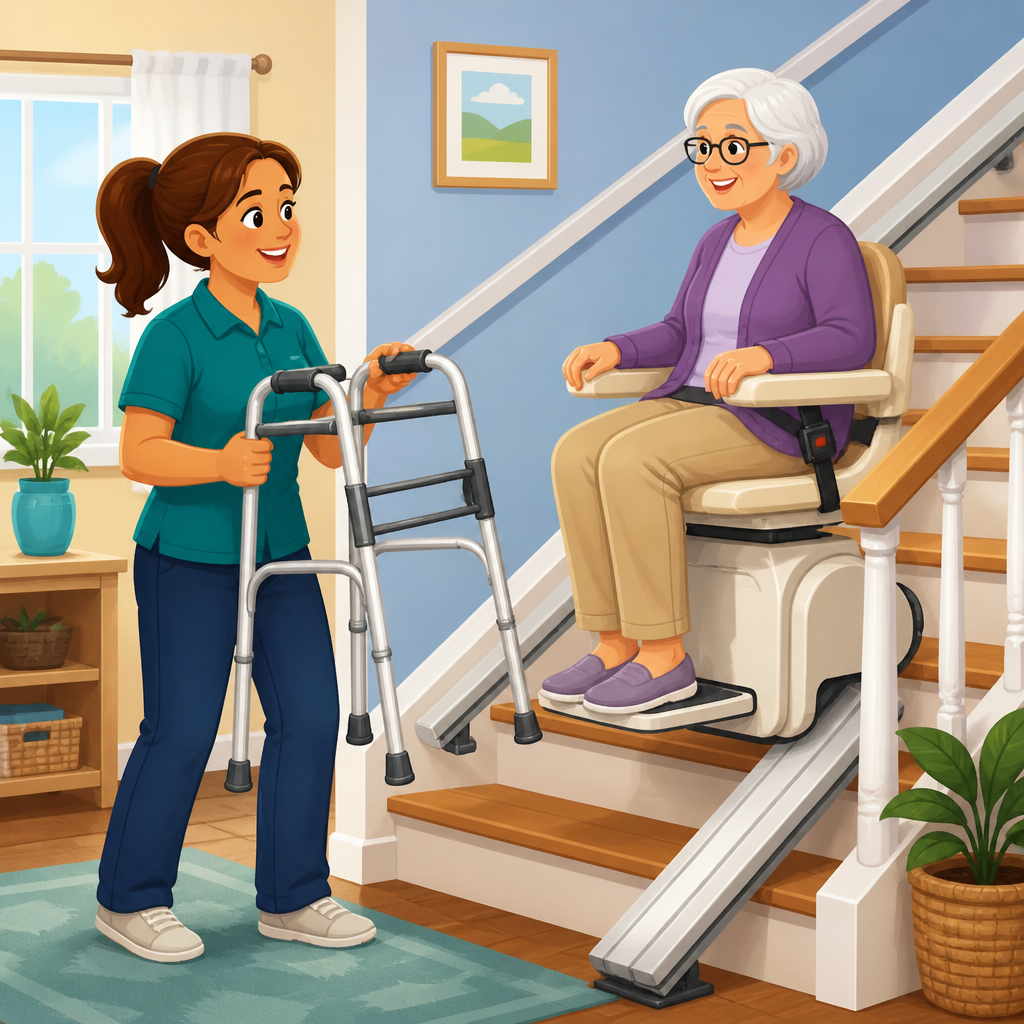
Moving a walker between floors when using a stair lift sounds simple until a caregiver has to do it safely, quickly, and without disrupting the rider’s balance or routine. In practice, this task sits at the intersection of fall prevention, home accessibility, transfer technique, equipment selection, and caregiver workload. A walker is any mobility aid designed to widen a user’s base of support, typically a standard walker, a two-wheel walker, or a rollator with four wheels and a seat. A stair lift is a motorized chair that travels along a rail mounted to the staircase, allowing a person with limited mobility to move between levels without climbing steps. The challenge is straightforward: the rider can use the lift, but the walker usually cannot travel with them on the chair.
That gap matters because the walker is often essential at both ends of the trip. If the walker is upstairs but the user exits the lift downstairs, or vice versa, the person may attempt unsupported standing or furniture walking. I have seen near-falls happen in the few seconds between lift dismount and walker access. For caregivers, the job is not only carrying equipment but creating a repeatable system that protects the rider, the caregiver’s back, and the stair lift itself. This guide explains the safest methods, the equipment decisions that make transfers easier, and the caregiver support resources that help families build a workable routine.
Understand the safety problem before choosing a method
The core rule is that the stair lift is designed to transport a person, not to serve as a cargo carrier for a walker unless the manufacturer explicitly allows a specific accessory. Most residential stair lifts have weight limits commonly ranging from about 250 to 400 pounds, with heavy-duty models going higher. That capacity includes the rider and any carried item. Even when a folded walker seems light, adding it to the user’s lap can interfere with seat belt placement, footrest clearance, swivel-seat transfers, and armrest use. A protruding frame can catch on the rail, wall, or knees during travel. For that reason, the default approach should be separate transport of the walker by the caregiver, not placing it on the rider or trying to balance it on the lift.
A caregiver also has to evaluate both landings. The top and bottom of the staircase need enough clear floor space for the user to stand, turn, and grasp the walker without backing toward open stairs. Occupational therapists often look for a stable transfer zone with good lighting, minimal clutter, and consistent walker placement. If there is no safe parking area at one landing, the family may need a second mobility aid, a wall-mounted fold-down perch, or a layout change. Safety here is less about strength than about sequence: who moves first, where the walker waits, and how the rider transitions on and off the lift every single time.
Choose the best walker transport strategy for your home
There is no one universal method because staircase width, stair lift design, caregiver strength, and the user’s walking ability vary. In homes where the caregiver rides separately or remains on the destination floor, carrying the folded walker by hand is often the cleanest option. Standard walkers and many two-wheel walkers fold by pressing release mechanisms near the front crossbar, reducing width and making them easier to grip close to the caregiver’s body. Rollators may fold side-to-side or front-to-back depending on model, but they are typically bulkier and heavier than basic walkers. If the rollator includes a basket, tray, or pouch, those accessories should be emptied before transport to avoid shifting weight.
In some households, the most effective solution is not moving one walker back and forth at all. Keeping one mobility aid on each floor can remove repeated lifting and timing errors. This is especially useful when the user reliably needs support immediately after exiting the stair lift. The tradeoff is cost and storage. A second standard walker is relatively affordable, while a second rollator may be more expensive and may require parking space on both levels. Even so, duplicate equipment often reduces fall risk and caregiver strain more than any carrying technique.
Another option is matching the device to the floor. For example, a compact folding walker upstairs may work in narrower bedroom and bathroom spaces, while a rollator with a seat remains downstairs for longer walking distances. I recommend this arrangement frequently because it aligns equipment with actual use patterns instead of forcing one device to do everything. The right strategy is the one that allows the rider to exit the lift and place both hands on a stable mobility aid within a controlled, practiced sequence.
Safe step-by-step technique for caregivers moving a walker between floors
The safest routine begins before the lift moves. Confirm the destination landing is clear, the stair lift seat and footrest are fully deployed, and the rider is wearing secure footwear. If the user can ambulate short distances, bring them to the lift with the walker, lock rollator brakes if applicable, and position the walker so it will not tip or roll toward the stairs during boarding. Assist the user to sit fully back in the chair, fasten the seat belt, and ensure feet are centered on the footrest. Only after the rider is stable should the caregiver handle the walker.
Next, fold the walker if the design allows it. Bend at the hips and knees rather than rounding the spine, keep the walker close to your torso, and carry it by the strongest part of the frame, usually the side rails rather than a tray or basket. Do not carry it while trying to steady the rider with your other hand. Once the rider begins travel, move the walker using the predetermined route. If the caregiver must use the stairs, maintain one hand free for the stair rail whenever possible. If the walker is too wide or heavy to carry one-handed on stairs, that is a sign the equipment plan needs to change.
At the destination floor, place the walker in the transfer zone before the rider stands. For a standard walker, set all four tips flat on the floor. For a rollator, engage the brakes and angle it so the user does not have to twist sharply after the lift swivels. When the chair arrives, the caregiver should stand to the side, never directly in front of the rider, unlock and swivel the seat if that feature exists, and cue the user to stand only when the walker is within immediate reach. The objective is simple: seat to standing, hands to walker, then away from the stair opening in one controlled movement.
Common mistakes that increase risk
The most frequent mistake is letting the rider hold or carry the walker while seated on the stair lift. This can block the seat belt, shift the center of mass, and create panic if the walker slips. Another common error is parking the walker too far from the lift at the arrival point. A gap of even two or three steps can be enough to trigger unsupported reaching, especially in users with weakness, neuropathy, Parkinsonian freezing, or post-stroke balance deficits. Families also underestimate how often brakes are left off on rollators, allowing the device to roll as soon as the user grabs it.
Caregivers also get hurt when they rush. Twisting with a folded walker while descending stairs, carrying extra items at the same time, or leaning over the stair opening to pass the walker can all lead to back strain or loss of balance. I have also seen unsafe improvisations such as hanging a walker on the stair lift armrest, tying it to the chair, or placing it on the rider’s lap under the assumption that a short ride makes it acceptable. It does not. If a method cannot be repeated safely under fatigue, it is not a safe method.
Equipment choices that make walker transfers easier
Not all walkers are equally practical in homes with stair lifts. Frame weight, folding mechanism, grip shape, wheel size, and accessory placement all affect caregiver handling. Lightweight aluminum standard walkers usually offer the simplest transport. Two-wheel walkers preserve some maneuverability without adding the bulk of a full rollator. Rollators are often best for users who need a seat or who walk longer distances, but they require stricter brake management and more parking space at both landings. For many families, equipment optimization reduces daily effort more than technique coaching alone.
| Option | Typical advantages | Typical drawbacks | Best fit |
|---|---|---|---|
| Standard folding walker | Lightweight, narrow, easy to carry, low cost | No seat, slower gait pattern, must be lifted during walking | User needs maximum stability in short indoor distances |
| Two-wheel walker | Easier forward movement, lighter than many rollators | Still no seat, can catch on thresholds, not ideal for all users | User needs support but has enough control for wheeled front movement |
| Four-wheel rollator | Seat, storage, smoother mobility over longer distances | Heavier, bulkier, must lock brakes during transfers | User walks farther and benefits from rest breaks |
| Duplicate walker on each floor | No repeated carrying, immediate support at both landings | Higher cost, storage needs, requires consistency | Frequent floor changes or caregiver lifting concerns |
Stair lift features matter too. Powered swivel seats, folding rails, call-send controls, and wider seat designs can improve transfer flow, but they do not remove the need for a separate walker plan. Before purchasing any accessory, review the manufacturer’s manual and dealer guidance. Leading brands such as Bruno, Harmar, Stannah, and Handicare provide specific instructions about safe use, and those instructions take precedence over informal advice. The best equipment setup is the one that reduces both user instability and caregiver handling load.
Caregiver support resources that help families build a sustainable routine
This topic sits within caregiver support resources because moving a walker between floors is rarely just a mechanical problem. Families need training, respite, and expert input. Start with the stair lift dealer and the walker supplier for model-specific handling guidance. Then involve a licensed occupational therapist or physical therapist, ideally through home health, outpatient rehab, or a private home safety assessment. Therapists can evaluate transfer technique, landing layout, gait aid fit, and whether a second device would be safer. They can also document needs for care planning and teach cueing strategies for users with cognitive impairment.
Community resources can reduce caregiver strain. Local Area Agencies on Aging, Centers for Independent Living, Veterans Affairs programs, and disease-specific organizations such as the Alzheimer’s Association or Parkinson’s Foundation may connect families with home modification funding, support groups, training, or durable medical equipment loan closets. If the user receives home care, add walker placement and stair lift sequencing to the written care plan so every aide follows the same routine. Consistency is a safety intervention. Within a broader accessibility and mobility solutions strategy, this page serves as the hub because it connects transfer safety, equipment selection, home modification, and caregiver education into one practical system.
When to change the plan
A walker transport routine should be reassessed whenever the user’s condition changes. Warning signs include new falls, fatigue after transfers, increasing confusion, inability to wait for the walker, worsened hand strength, or a caregiver who reports back pain. At that point, the safest answer may be a second walker, a different mobility aid, additional supervision, or a therapy reassessment. In some homes, the right decision is reducing unnecessary trips between floors by relocating sleeping, bathing, or laundry tasks to one level. Accessibility is not only about devices; it is about removing repeated points of failure.
The safest way to move a walker between floors when using a stair lift is to treat the walker and rider as separate transport tasks, then reunite them only in a controlled transfer zone. Caregivers should avoid placing the walker on the stair lift unless the manufacturer provides a specific approved solution. Instead, use a planned sequence, choose equipment that fits the home, and place the walker within immediate reach before the rider stands. If carrying the device creates strain or delays, duplicate equipment on each floor is often the most effective fix.
The broader lesson is that caregiver support resources matter as much as hardware. A stair lift, a walker, and a determined family are not enough without training, clear routines, and periodic reassessment. Use this guide as your hub for caregiver support planning within accessibility and mobility solutions: review the equipment, map the transfer steps, and involve a therapist or qualified dealer when the setup no longer feels easy or safe. Small changes in process can prevent serious falls. Start by testing your current routine today and correcting the first weak point you find.
Frequently Asked Questions
What is the safest way for a caregiver to move a walker between floors when a stair lift is being used?
The safest approach is to treat the rider and the walker as two separate safety tasks rather than trying to manage both at the same time. In most homes, the rider should get fully seated on the stair lift, fasten the seat belt if the model has one, place feet securely on the footrest, and keep hands positioned as instructed by the lift manufacturer before the caregiver turns attention to the walker. Once the rider is stable, the caregiver can move the walker to the destination level using the method that best matches the home layout, the type of stair lift, and the caregiver’s physical ability.
In practical terms, that often means the caregiver brings the walker to the opposite landing before or after the lift trip rather than trying to maneuver it while the rider is transferring. The landing should be clear, well lit, and free of rugs, cords, pet items, or furniture that could create a trip hazard. If the walker folds, many caregivers find it easier to fold it before carrying or repositioning it. If it does not fold, or if it is a rollator, the caregiver should maintain control of the frame and avoid awkward twisting, reaching across the staircase, or carrying it in a way that blocks their vision.
What matters most is preserving transfer safety. The rider should never be left in a half-standing or unstable position while the caregiver rushes to manage the walker. Likewise, the caregiver should not try to balance the walker on the stair lift, hang it from the chair, or hold it while assisting the rider unless the equipment manufacturer and a qualified professional have specifically approved that setup. A slower, organized routine is almost always safer than a fast improvised one.
Can a walker be carried on the stair lift with the rider?
Usually, this should not be assumed to be safe. Whether a walker can travel with the rider depends on the stair lift’s weight capacity, seat size, obstruction clearances, rail design, and manufacturer instructions. A walker that seems lightweight can still create serious safety problems if it shifts during travel, catches on a wall or banister, interferes with the footrest, or changes how the rider sits and balances in the chair. Even a brief snag can destabilize the situation and turn a routine trip into a fall risk.
For that reason, caregivers should avoid placing the walker across the rider’s lap, wedging it beside the seat, or hanging it from armrests unless the lift manufacturer explicitly allows an accessory or transport method designed for that exact purpose. Some stair lift systems have approved add-ons or storage solutions, but many do not. The rule of thumb is simple: if the user manual does not say it is allowed, do not improvise.
There is also the issue of rider safety during transfers. A walker may be needed immediately at the top or bottom landing, but having it physically attached to the chair during movement is not always the best answer. In many cases, the safest workflow is for the rider to travel alone on the lift while the caregiver moves the walker separately, then positions it correctly at the receiving landing before helping the rider stand. If carrying or transporting the walker feels difficult, it may be time to discuss alternatives such as a second walker, a lighter model, or a storage method that reduces lifting demands.
Is it better to keep a second walker on the other floor instead of moving one walker back and forth?
In many homes, yes. Keeping a second walker on the destination floor is often one of the simplest and safest solutions because it reduces caregiver workload, shortens transfer time, and minimizes the chance of distraction during stair lift use. Instead of making walker transport part of every trip, the caregiver can focus entirely on safe positioning, communication, and balance support. For users who go up and down multiple times a day, this can make routines smoother and much less tiring for everyone involved.
A second walker is especially helpful when the rider needs the device immediately upon standing from the stair lift. If a walker is already waiting at both landings, the caregiver does not need to leave the rider unattended, carry equipment while supervising the transfer, or rush to retrieve the mobility aid after the chair arrives. This improves continuity of support and can reduce the risk of the rider taking unsupported steps, reaching for unsafe furniture, or trying to stand too soon.
That said, a second walker should not be purchased casually without considering fit and function. The height should be set correctly, brakes should work reliably if it is a rollator, and the model should match the user’s mobility needs. Some people do best with the exact same type of walker on each floor, while others may benefit from a standard walker in tighter spaces and a rollator in more open areas. A physical therapist, occupational therapist, or mobility equipment provider can help determine what is appropriate. If budget or space is a concern, caregivers can still gain many of the same safety benefits by creating a consistent parking spot and transport plan for the existing walker.
How should a caregiver position the walker at the top or bottom landing for the safest transfer off the stair lift?
The walker should be placed where the rider can reach it naturally after standing, without twisting, overreaching, or stepping before they are balanced. In most cases, that means placing the walker directly in front of the rider’s expected standing position, with all four tips or wheels stable on a flat surface and enough room around it for the caregiver to assist. The landing should provide adequate clearance for the stair lift seat to swivel if applicable, and the walker should not block the chair’s path, the footrest, or the rider’s feet as they prepare to stand.
For a standard walker or two-wheel walker, the caregiver should ensure the frame is square to the rider and not angled awkwardly. For a rollator, the brakes should be locked before the rider reaches for it. This is a critical detail because many falls happen when a wheeled device moves unexpectedly during the first moment of standing. The caregiver should also make sure the walker is not sitting on a throw rug, threshold edge, slick floor patch, or cluttered area that could cause shifting.
Communication matters just as much as placement. Before the rider stands, the caregiver can give clear cues such as, “Your walker is right in front of you,” or, “Stand first, then place your hands on the walker.” Depending on the person’s strength and training, they may need to push up from the stair lift armrests before taking hold of the walker rather than pulling on the walker to rise. That distinction is important because using the walker itself to pull to standing can make the device tip or slide. A therapist’s transfer instructions should always take priority, especially if the rider has weakness on one side, poor balance, or cognitive impairment.
What should caregivers do if moving the walker between floors is becoming physically difficult or unsafe?
If walker transport is becoming a strain, that is a sign to reassess the setup rather than simply pushing through. Repetitive lifting, carrying an awkward rollator, bending at crowded landings, or hurrying to keep up with the rider can increase the risk of caregiver back injury and user falls. The safest next step is to look at the whole routine: the type of walker, the stair lift features, the amount of landing space, the rider’s transfer ability, and how often trips happen each day. Often, small changes make a major difference.
One of the best solutions is to consult a rehabilitation professional or home accessibility specialist. A physical therapist or occupational therapist can observe the transfer and recommend a safer sequence, a more suitable walker style, or a different positioning strategy. They may suggest a lighter folding walker, a second device for the other floor, a rollator only on one level, or modifications to the landing setup so the caregiver does less carrying and less turning. A stair lift dealer or manufacturer may also confirm whether any approved accessories exist for transporting mobility aids safely.
Caregivers should also be honest about red flags. If the rider is reaching for walls or furniture because the walker is not in place on time, if the caregiver has to leave the rider alone during transfers, if the walker catches on the stairs or rail, or if anyone has nearly fallen, the routine needs to change. The goal is not just getting the walker upstairs or downstairs; it is maintaining a reliable, low-risk transfer process every single time. When in doubt, simplify the routine, reduce manual carrying, and build the environment around safety rather than convenience alone.