


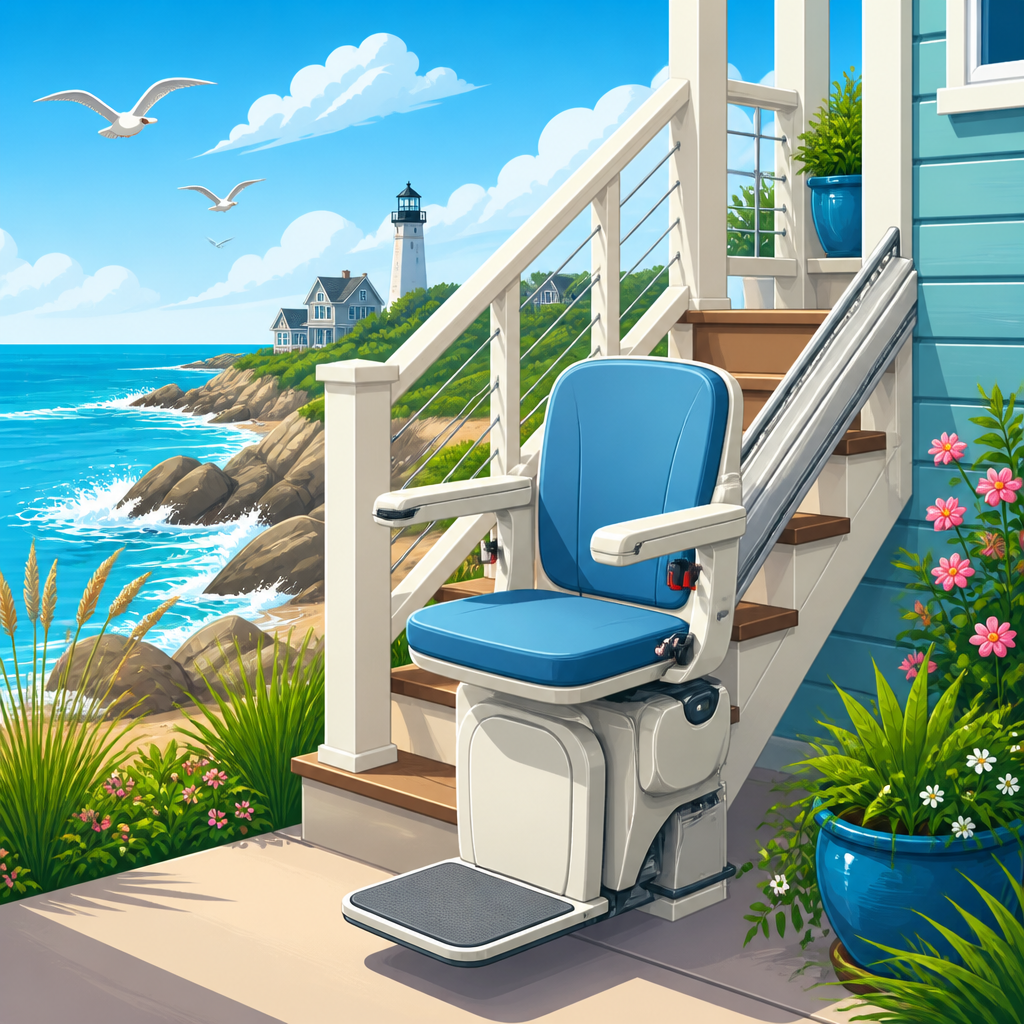
Chair lifts for coastal homes require a different standard of planning than lifts installed inland because salt air accelerates corrosion, wind drives moisture into exposed components, and outdoor access routes often include stairs, decks, dunes, and raised entry landings. In practice, an outdoor chair lift near the ocean is not simply an indoor unit placed outside; it is a weather-exposed mobility system that must be specified for marine conditions, maintained on a tighter schedule, and matched to the site’s structure and usage pattern. Homeowners, builders, and accessibility professionals who understand these differences can prevent premature rust, electrical faults, and service interruptions while extending equipment life and protecting rider safety.
When I evaluate outdoor chair lifts for coastal properties, I start with three definitions. First, an outdoor chair lift is a motorized seat that travels along a rail mounted to stair treads or, less often, an adjacent structural support, allowing a user to move up and down exterior stairs safely. Second, corrosion is the electrochemical breakdown of metal caused by reaction with oxygen, moisture, and contaminants such as chlorides. Third, salt-air exposure refers to the persistent presence of airborne sea salt, humidity, and windblown spray that settle on surfaces and create a highly conductive film. That film is the reason a lift two miles from the shoreline may age more slowly than one facing open water, even when both are labeled for exterior use.
This matters because coastal homes often depend on outdoor access. Elevated foundations, flood-zone construction, rear deck entries, and dune walkovers can turn a short exterior staircase into the only practical route into the home. For residents aging in place, recovering from surgery, or living with arthritis, a reliable outdoor chair lift can determine whether the property remains usable. The stakes are financial as well. Replacing a failed transmission, call station, or rail section due to corrosion costs far more than choosing marine-suitable materials, proper covers, and routine cleaning from the beginning. The central question is not whether an outdoor chair lift can work near the coast. It can. The real question is which design, materials, maintenance plan, and installation details will keep it working safely in a salt-heavy environment.
As the hub article for outdoor chair lifts within the broader chair lift types and designs topic, this guide covers the essentials homeowners usually ask first: what coastal conditions damage lifts, which components need the most protection, how leading outdoor chair lift designs differ, what installation details matter most, and how to compare maintenance demands with long-term cost. It also sets up related topics you may explore next, including straight versus curved rail layouts, weatherproofing accessories, battery systems, code considerations, and service planning for second homes. If you need one principle to remember throughout this article, it is simple: in coastal environments, durability comes from the combination of the right lift type, corrosion-resistant materials, disciplined maintenance, and a site-specific installation.
Why Coastal Conditions Are Hard on Outdoor Chair Lifts
Salt air damages outdoor chair lifts because chlorides speed up oxidation, hold moisture against metal, and penetrate small gaps where protective coatings are weakest. Coastal environments add three stressors at once: corrosive deposition, high humidity, and frequent wet-dry cycling. That combination is more destructive than ordinary rain exposure. A powder-coated steel bracket may look intact, for example, but if the coating is scratched during installation or by blowing sand, corrosion can begin underneath and spread unseen. I have seen footrest hinges, seat swivels, fastener heads, and exposed rack sections show early deterioration long before a homeowner notices performance changes.
Wind exposure makes the problem worse. Ocean-facing stairs receive salt-laden gusts that carry abrasive sand and drive moisture into charging contacts, key switches, and hinge points. Even lifts mounted under a porch roof are not fully protected if the sides remain open. Condensation is another overlooked threat. In humid climates, metal parts cool overnight and collect moisture by morning, leaving a thin film on rails, carriage housings, and electrical enclosures. That is why a lift can corrode in a covered location that rarely gets direct rain. Proximity to the surf line, prevailing wind direction, elevation, and whether the staircase is shaded or enclosed all influence how aggressive the environment will be.
Not every coastal property faces equal risk, so exposure should be graded. A home directly on the beach with open, windward stairs is a high-exposure site. A house several blocks inland with a screened stair tower is moderate exposure. A raised home in a bay community with occasional splash and persistent humidity may be different again because marsh air can still be corrosive. Manufacturers often approve a unit for “outdoor use,” but that label does not erase these distinctions. The practical takeaway is straightforward: the closer the staircase is to surf, spray, and wind, the more heavily material selection and maintenance discipline should weigh in the buying decision.
Materials, Finishes, and Components That Resist Corrosion
The best outdoor chair lifts for coastal homes use corrosion-resistant metals, sealed electronics, weather-rated upholstery, and hardware chosen to minimize galvanic reaction. Aluminum is commonly favored for rails and covers because it naturally forms a protective oxide layer and performs better than ordinary carbon steel in wet, salty conditions. Stainless steel fasteners, especially higher-grade marine-oriented alloys, are often used where strength and rust resistance are critical, although stainless is not invincible if lower grades are exposed to chlorides without cleaning. Powder coating adds another defense layer, but coating quality, pretreatment, and edge coverage matter more than marketing language on a brochure.
One issue homeowners rarely hear explained clearly is galvanic corrosion. When dissimilar metals are connected in the presence of an electrolyte such as salty moisture, one metal can corrode faster. In outdoor chair lifts, this may affect brackets, bolts, washers, and rail interfaces if materials are mixed carelessly. Installers can reduce risk by following manufacturer-specified hardware, using isolating washers where appropriate, sealing penetrations, and avoiding field substitutions. I treat unauthorized hardware swaps as a red flag, especially in coastal jobs, because a single uncoated fastener can stain surrounding surfaces and become the weak point that starts a larger failure.
Electrical protection is equally important. Outdoor units should have weather-resistant controls, protected charging points, insulated wiring routes, and battery systems housed away from direct intrusion. Most residential stair lifts use battery-powered operation with automatic charging at designated points on the rail. In coastal conditions, those contacts and charging strips must stay clean and aligned. If corrosion forms there, homeowners may first notice slow travel, intermittent beeping, or a chair that fails after sitting unused. UV-resistant covers, sealed gearboxes, drainage-conscious component design, and molded armrest controls all contribute to real durability, but none eliminate the need for regular rinsing and inspection.
| Component | Preferred Coastal Feature | Why It Matters |
|---|---|---|
| Rail | Aluminum or heavily protected exterior-rated metal | Reduces rust risk on the longest exposed surface |
| Fasteners | Stainless hardware specified by manufacturer | Prevents early seizure, staining, and bracket weakness |
| Seat and cover | UV-stable, water-resistant materials with fitted cover | Limits cracking, fading, and water intrusion |
| Electrical controls | Sealed switches and protected call/send stations | Improves reliability in humidity and windblown spray |
| Charging system | Corrosion-resistant contacts in sheltered positions | Maintains battery charge and reduces service calls |
Outdoor Chair Lift Types and Design Choices for Coastal Homes
Outdoor chair lifts for coastal homes generally fall into straight and curved configurations, with some platform-adjacent or heavy-duty variants depending on user needs and stair geometry. Straight outdoor chair lifts are the simplest and usually the most durable because they use a single direct rail with fewer joints, custom bends, and alignment variables. They work well for standard entry stairs, deck stairs, and raised cottage access. Curved outdoor chair lifts are custom-built for turns, intermediate landings, and complex elevations. In coastal installations, every added bend, joint, and custom connection creates another place where debris, moisture, and wear can accumulate, so precision fabrication and service access become especially important.
Seat design also affects long-term performance. Fold-up seats and footrests reduce weather exposure when parked, especially under a fitted cover. Perch seats can help riders who have trouble bending their knees, but they require careful evaluation on outdoor stairs where stability and transfer space are tighter. Swivel seats are essential at many top landings, yet the swivel mechanism is also a moving part that must resist corrosion and remain easy to lock. For users with larger body types, heavy-duty outdoor models may provide wider seats and higher capacity, but capacity increases often require more clearance and stronger stair structures. A coastal home with narrow egress stairs may need a code and usability review before a larger unit is selected.
Drive systems vary by manufacturer, but most residential models use rack-and-pinion or cable-driven arrangements paired with onboard batteries. In my experience, the best coastal installations are the ones where the chosen design matches how the property is actually used. A full-time resident using the front stairs several times daily needs a different maintenance plan than an owner of a seasonal beach house that may sit closed for weeks in humid weather. Intermittent use can be harder on batteries if charging contacts foul. Frequent rental turnover can be harder on seats, armrests, and covers. The right outdoor chair lift design is therefore not just about stair shape; it is about traffic pattern, storage habits, user mobility, and response time for service in a coastal market.
Installation, Maintenance, and Service Life in Salt-Air Environments
Proper installation determines whether even a well-built outdoor chair lift survives near the coast. The rail should be positioned to encourage drainage, minimize direct spray when possible, and preserve enough clearance for safe boarding. Stair structure matters because many coastal homes use treated lumber, composite treads, concrete, or steel-framed assemblies, each with different fastening requirements. Installers should verify substrate condition, moisture damage, and movement before mounting brackets. On older beach houses, I often find stair vibration or hidden wood decay that must be corrected first. A chair lift cannot compensate for an unsound staircase, and coastal moisture exposes structural weaknesses quickly.
Maintenance should be more frequent than many owners expect. A sensible coastal routine includes fresh-water rinsing where approved by the manufacturer, wiping down exposed surfaces, keeping the protective cover on when the lift is parked, checking the rail for grit, and scheduling professional service at least annually, often semiannually in high-exposure locations. Lubrication must follow manufacturer guidance exactly. Over-lubricating can trap salt and sand, while using the wrong product may damage plastic components or attract debris. Battery testing, contact cleaning, fastener inspection, seatbelt checks, and limit switch verification are standard service tasks that matter more outdoors than indoors because environmental stress shortens the margin for neglect.
Expected service life varies widely. In a mild inland installation, a residential stair lift may provide many years of dependable use with routine service. On an exposed oceanfront stair, lifespan can shorten substantially if the unit is underspecified or poorly maintained. That does not mean coastal homeowners should avoid outdoor chair lifts. It means budgeting realistically for upkeep and choosing a local dealer with parts access and documented experience in exterior installations. Ask how many outdoor lifts the company services within a few miles of the shore, what corrosion issues they see most often, and whether they stock covers, batteries, chargers, and weather-exposed switch assemblies. Good answers there are often more valuable than a discount on the initial quote.
Buying Checklist for Coastal Homeowners and Property Managers
The best buying process for a coastal outdoor chair lift starts with a site survey focused on exposure, stair condition, rider needs, and service support. Ask whether the model is specifically rated for outdoor installation and what limitations apply in beachfront or high-salt locations. Request details on rail material, fastener grade, weather cover design, battery type, operating temperature range, and warranty exclusions related to corrosion. If the dealer cannot explain the difference between general outdoor exposure and marine-adjacent exposure, keep looking. Clear, technical answers are a sign that the company has installed and maintained lifts in conditions similar to yours.
Property managers and owners of vacation homes should also think beyond the equipment itself. Who will keep the cover on between guest stays? Who will notice a low-battery alarm or a sticking footrest? Is there remote monitoring, or at least a caretaker who can cycle the unit and inspect it periodically? Coastal homes often face long vacancy periods, and that changes risk. A minor issue that would be caught quickly in a primary residence can become a dead battery, corroded contact set, or water-damaged control after a month of neglect. For rental properties, simple user instructions posted discreetly near the lift can reduce misuse and service calls.
Cost should be evaluated as total ownership cost, not just purchase price. A less expensive outdoor chair lift with weak materials, limited weather protection, and poor local service may become the costliest option within a few seasons. By contrast, a well-specified unit installed by an experienced coastal dealer usually delivers better uptime, safer operation, and slower visible wear. For most buyers, the strongest decision framework is simple: prioritize corrosion resistance, verified outdoor design, local service capability, and a maintenance plan you will actually follow. If you are comparing outdoor chair lifts for a beach house, marsh-front property, or raised coastal residence, start with a professional site assessment and build from there. The right system preserves access, protects independence, and stands up far better to salt air.
Frequently Asked Questions
Why do chair lifts for coastal homes need different specifications than standard outdoor lifts?
Coastal environments are much harsher on mobility equipment than most homeowners expect. Salt suspended in ocean air settles on metal surfaces, electrical connections, fasteners, and moving parts, where it speeds up corrosion far more aggressively than normal humidity or rain exposure. In addition, coastal winds can push moisture into seams, housings, and track components that might hold up well in a typical outdoor setting but degrade faster near the shoreline. That is why a chair lift for a beachside property should not be treated as a basic outdoor unit. It needs to be selected, installed, and maintained as a weather-exposed system intended for marine conditions.
In practical terms, that means focusing on corrosion-resistant materials, sealed or better-protected electrical components, durable finishes, and hardware designed to withstand salt-air exposure. It also means carefully evaluating where the lift will be installed. Many coastal homes have elevated entrances, exposed decks, open staircases, dune walkovers, or raised landings, all of which change how wind, sand, water, and sun affect the equipment. A properly specified coastal chair lift accounts for those conditions from the beginning, helping reduce premature wear, service interruptions, and avoidable replacement costs.
What materials and features help a chair lift stand up better to salt air and corrosion?
The most important protective features are the ones that resist rust, slow corrosion, and limit moisture intrusion. Outdoor chair lifts used near the coast often benefit from aluminum or other corrosion-resistant structural components, stainless steel hardware where appropriate, and high-quality protective coatings on rails, brackets, and exposed metal parts. Not all stainless steel performs equally in marine environments, so the specific grade and overall system design matter. Powder-coated finishes, sealed covers, and weather-resistant seat materials also play a role in extending service life.
Beyond the visible materials, the hidden components are just as important. Wiring connections, charging contacts, switches, circuit boards, and motor housings should be better protected against moisture and salt accumulation. A fitted weather cover can help when the lift is not in use, but a cover alone is not a substitute for marine-conscious equipment selection. Homeowners should also ask about drainage, lubrication points, battery placement, and whether the manufacturer approves the lift for exposed coastal installation. The best-performing systems are usually the ones designed as complete outdoor solutions rather than indoor lifts adapted to survive outside.
How often should a coastal chair lift be cleaned, inspected, and serviced?
Coastal chair lifts usually need more frequent attention than inland installations because salt residue accumulates continuously, even when the lift does not look visibly dirty. Regular rinsing or cleaning of approved exterior surfaces can help remove corrosive buildup before it begins to attack finishes and hardware. However, cleaning should always follow the manufacturer’s instructions, since excessive water, harsh cleaners, or improper techniques can damage sensitive components. In many cases, simple routine wipe-downs and visual checks are recommended more often in oceanfront or near-ocean settings than in standard outdoor environments.
Professional service intervals are also typically tighter for coastal homes. Instead of waiting for obvious problems, owners should plan for preventive inspections that focus on corrosion, fastener integrity, track condition, battery performance, charging reliability, seat operation, and signs of moisture intrusion. A technician familiar with outdoor and marine-adjacent installations can catch small issues early, such as rust beginning at connection points or wear caused by wind-driven grit. This proactive schedule is one of the most effective ways to protect both reliability and safety. In a salt-air setting, delayed maintenance often turns minor deterioration into expensive component failure much faster than it would inland.
Can any outdoor staircase at a coastal property accommodate a chair lift?
Not necessarily. Coastal properties often present more complicated access routes than a standard exterior stairway. The staircase may connect to a deck, boardwalk, dune crossing, or raised entry platform, and it may be fully exposed to wind, blowing sand, and rain. Some stairs are narrow, uneven, or constructed with materials that require special mounting considerations. Others may include turns, long rises, intermediate landings, or shifting adjacent structures caused by settling, humidity, or age. Before recommending a lift, a qualified professional should assess the stair geometry, available clearances, structural support, exposure level, and safe boarding and dismounting areas at both ends.
The surrounding environment matters just as much as the staircase itself. For example, if the bottom landing collects sand or water, or if the top landing is too tight for safe transfer, the lift may require a different configuration or may not be the best accessibility solution. In some homes, a platform lift, vertical lift, or other mobility option may be more appropriate than a chair lift. The key is to match the equipment to the access challenge, not to force a standard product into a coastal setting that demands more careful planning. A thorough site evaluation helps ensure the final installation is safe, durable, and practical for everyday use.
What should homeowners ask before buying a chair lift for a beach or oceanfront home?
Homeowners should start by asking whether the proposed model is specifically rated and recommended for outdoor use in coastal or salt-air conditions, not simply for occasional weather exposure. They should also ask what corrosion-resistant materials are used throughout the system, how exposed electrical and charging components are protected, what type of weather cover is included, and what maintenance schedule is recommended for a marine environment. It is smart to ask about the warranty as well, including whether coastal exposure affects coverage for rust, finish breakdown, electronics, or service frequency.
In addition, buyers should ask the installer about long-term support. Questions about local service availability, replacement part access, inspection frequency, and technician experience with oceanfront properties can be just as important as the lift itself. A reputable provider should be willing to explain how the home’s specific layout, wind exposure, stair construction, and proximity to the shoreline influence product selection. That kind of consultation is a strong sign that the project is being approached correctly. For coastal homes, the right chair lift is not just about getting up and down the stairs; it is about investing in a system that can safely perform in a demanding environment over time.