


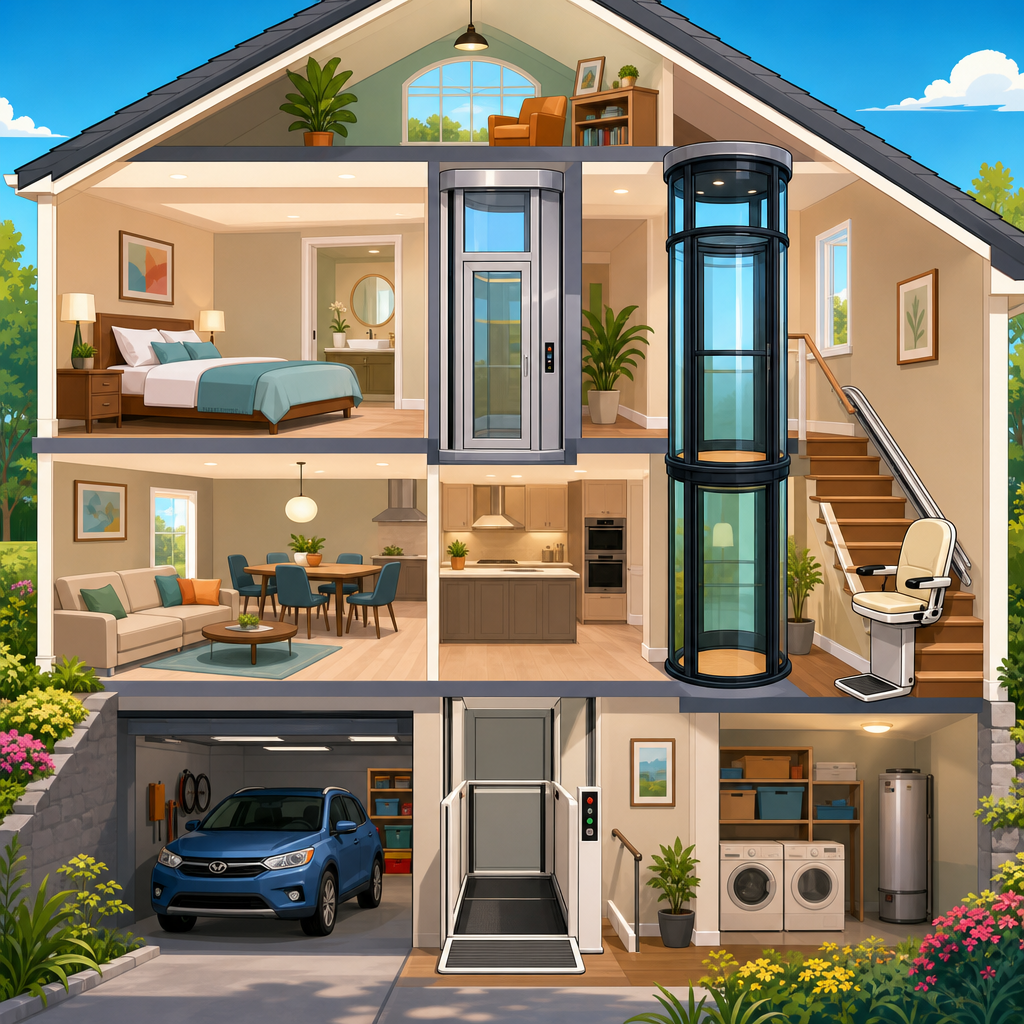
Combining lift types in one property is often the smartest way to make a complex home fully accessible, because architecture, user needs, and budget rarely fit a single product category. In residential accessibility, a hybrid solution means using two or more lift systems, or blending standard components with custom engineering, to solve movement challenges across split levels, narrow stairs, garages, exterior entries, basements, and multigenerational living spaces. I have worked on projects where a straight stair lift handled the main staircase, a vertical platform lift bridged a garage entry, and a compact home elevator connected upper floors, all within one house. That mix was not excessive; it was necessary. Homes built over decades, expanded with additions, or adapted after illness, injury, or aging in place usually develop circulation problems that no single chair lift type can fix. Understanding custom and hybrid designs matters because the wrong choice creates bottlenecks, forces unsafe transfers, and wastes money on equipment that solves only part of the route. The right combination creates a continuous, practical path from driveway to bedroom, without asking the user to navigate impossible steps, landings, or door thresholds. This hub explains the main lift combinations, where each works best, the engineering and code issues that shape design decisions, and how homeowners can evaluate options with confidence before committing to a custom installation.
What hybrid lift design means in residential accessibility
A hybrid lift design combines different mobility systems so the whole travel path works as one coordinated plan rather than as isolated devices. In practice, that can mean pairing a curved stair lift with an inclined platform lift, adding a porch lift outside and a seated lift inside, or specifying a through-floor lift for daily use while keeping a stair lift as a lower-cost secondary route. The key idea is route continuity. Accessibility fails when one unresolved transition remains, such as three garage steps, a half landing, or a raised front stoop. I start projects by mapping every movement from vehicle arrival to bathroom access, because users do not experience products separately; they experience journeys. A useful rule is simple: if one device cannot cover every required level change safely and comfortably, a hybrid solution is the correct design category.
Custom design enters when standard rails, platform sizes, door swings, pit depths, or machine locations do not match the house. Custom does not always mean radically bespoke. Sometimes it means a made-to-measure curved rail, a narrowed carriage, a folding hinge rail to clear a hallway, or a platform gate reconfigured around an existing column. In other cases, it means structural alterations, electrical upgrades, or integrating lift controls with automatic doors. Reputable manufacturers and dealers usually treat custom and hybrid work as a site-specific engineering exercise, not a catalog purchase. That distinction protects both performance and safety.
When one lift type is not enough
Several home conditions consistently point toward combining lift types. Split-level houses are the most obvious example. A traditional two-stop solution assumes stacked floors, but many split-level layouts require movement between short flights arranged around half landings. A curved stair lift may cover part of the route, yet a separate platform lift or exterior porch lift may still be needed at the entry. Homes with additions create similar issues because the old and new floor heights often do not align cleanly. I have seen kitchen extensions one step below the original ground floor and bedrooms over garages reached by narrower stairs than current products prefer. Hybrid planning prevents these odd transitions from becoming daily barriers.
User profile also drives mixed designs. A person who can transfer independently may prefer a chair lift indoors but require a platform lift outdoors for wheelchair access from the driveway. In a multigenerational household, one resident may need seated travel while another remains in a power wheelchair. Installing only one system forces compromise. Hybrid configurations let each user retain the safest method without making the entire home depend on the largest and most expensive device. This is often the difference between an adaptable home and a partially accessible one.
Budget phasing is another reason. Many families cannot fund a full residential elevator immediately, especially when structural work is involved. A phased hybrid design can solve urgent access first, then reserve pathways for later upgrades. For example, an exterior vertical platform lift may provide immediate entry, while blocking and electrical rough-in are added for a future through-floor lift. Planning the end state early avoids rework and keeps current spending aligned with future mobility changes.
Common hybrid combinations and the problems they solve
The most effective hybrid solutions are predictable because recurring home layouts produce recurring accessibility challenges. Each combination below addresses a distinct type of circulation problem and should be evaluated against user transfer ability, available footprint, weather exposure, and long-term maintenance expectations.
| Hybrid combination | Best use case | Main advantage | Main limitation |
|---|---|---|---|
| Straight stair lift + exterior porch lift | Conventional interior stair with inaccessible front steps | Lower cost than a full elevator solution | Two separate transfers may be required |
| Curved stair lift + vertical platform lift | Split-level home with wheelchair entry need | Handles irregular interior stairs and exterior level change | Higher customization cost |
| Home elevator + short-rise platform lift | Luxury renovation with isolated garage or patio steps | Full-floor access plus targeted barrier removal | Requires more construction coordination |
| Through-floor lift + stair lift | Small home where stacked rooms allow vertical travel but basement stairs remain | Compact primary access with low-cost secondary route | Different user interfaces to learn |
| Inclined platform lift + seated stair lift | House shared by wheelchair and ambulatory users | Serves multiple mobility profiles on one staircase zone | Space and parking positions must be managed carefully |
A straight stair lift plus porch lift is common because entry steps and indoor stairs are often disconnected problems. This pairing works well when the resident can stand briefly and transfer safely. By contrast, a curved stair lift plus vertical platform lift is typical in older split-level homes where exterior wheelchair access is essential and interior runs include turns, intermediate landings, or narrow geometry. In higher-budget remodels, a home elevator may become the main system, with a short-rise platform lift handling the one awkward level change that would otherwise require major structural reconstruction. These combinations are practical, not indulgent. They align the device to the barrier instead of forcing the whole home into one equipment category.
Design factors that determine the right combination
The right hybrid lift solution comes from a structured assessment, not from choosing the most advanced product. I look first at travel path, then user capability, then building constraints. Travel path includes every threshold, landing, door width, and turning radius. User capability includes transfer strength, balance, wheelchair type, caregiver involvement, visual acuity, and likely progression of mobility needs. Building constraints include stair width, headroom, floor construction, available machine space, and whether exterior installations must tolerate rain, snow, salt air, or freeze-thaw cycles.
Stair geometry matters more than homeowners expect. A curved stair lift can navigate turns and intermediate landings, but its rail projection, parking positions, and seat swivel zones must be measured precisely. An inclined platform lift demands even more width and often affects stair usability for others. Vertical platform lifts need landing space, gate clearance, and a stable support base. Through-floor lifts require stacked locations and enough clear area on both levels for safe entry and exit. Residential elevators add concerns such as hoistway dimensions, pit and overhead requirements, drive system selection, and emergency lowering provisions. When several systems are combined, these constraints interact. A folded rail cannot block the circulation needed to reach a second lift, and door swings cannot conflict with platform gate operation.
Controls and human factors also shape the result. If a user has arthritis or cognitive impairment, consistency across controls matters. Call stations, key switches, remote send features, seat belts, gate latches, and obstruction sensors should be positioned and labeled clearly. On projects for older adults, I have found that the simplest interface often outperforms the most feature-rich one. Reliability in daily routines matters more than novelty.
Engineering, safety, and code considerations
Hybrid lift projects succeed when engineering and code issues are addressed early. Residential mobility equipment spans several regulatory categories, and requirements vary by jurisdiction. In the United States, residential elevators are commonly aligned with ASME A17.1 or A17.3 provisions, while platform lifts and stairway chairlifts are addressed under ASME A18.1. Local adoption, permit process, inspection requirements, and fire separation rules can differ significantly. Dealers who work regularly with inspectors understand what can be approved in your area and what requires redesign. That experience is valuable.
Electrical planning is frequently underestimated. Some lifts run on battery power with a charging strip, while others need dedicated circuits, disconnects, or machine-room-adjacent equipment. Exterior units may require weather-protected feeds, heat options, or drainage coordination. Structural support is equally important. A stair lift rail imposes loads into treads or wall brackets; a vertical platform lift may need a concrete pad and attachment points; a through-floor lift may require trimming joists and reinforcing openings. If the home is older, hidden conditions such as undersized framing, out-of-level floors, or legacy wiring can affect feasibility and price.
Safety design should include emergency descent, battery backup where applicable, obstruction sensing, non-slip flooring, and clear rescue procedures if a unit stops between levels. In family homes, lockable controls may be necessary to prevent unsupervised use by children. In coastal or cold climates, material choice matters: powder-coated steel, stainless fasteners, sealed controls, and weather covers extend service life. No hybrid solution is truly successful unless maintenance access is preserved. Technicians need room to inspect rails, drives, batteries, and safety circuits without dismantling finished carpentry every time.
Cost, maintenance, and planning for long-term use
Costs vary widely because hybrid lift solutions combine equipment, customization, and construction. A straight stair lift is usually the most affordable element, while curved rails, platform lifts, and elevators increase price through fabrication complexity and permitting. The most useful budgeting method is to separate equipment cost from building work. Homeowners should ask for line items covering product, installation, electrical, structural modification, finish restoration, permit fees, inspection, and service plan. Without that breakdown, comparisons between proposals are misleading.
Maintenance should be evaluated before purchase, not after breakdowns begin. Battery replacement cycles, annual inspections, call-out response times, and parts availability differ by brand and region. Established manufacturers with local dealer networks generally provide more dependable support than import-only suppliers with limited inventory. I advise clients to ask one direct question: who services this exact model within fifty miles, and what is the average response time? If the answer is vague, the risk is real.
Long-term planning means matching the system to likely mobility changes over five to ten years. A seated stair lift may solve today’s problem but fail if wheelchair use becomes permanent. Conversely, installing a full elevator where a porch lift and straight stair lift meet foreseeable needs may consume funds better used for bathroom adaptation, doorway widening, or backup power. The best custom hybrid design is not the largest one; it is the one that maintains independence with the least friction over time.
Combining lift types is the most effective strategy for complex homes because accessibility problems rarely occur in one neat location. Entry steps, half landings, narrow stairs, additions, garages, and changing mobility needs create layered barriers that demand a coordinated response. A hybrid solution treats the home as a complete travel route, matching each level change with the lift type that handles it best. That may mean pairing a chair lift with a porch lift, blending a through-floor lift with a secondary stair lift, or integrating a home elevator with a targeted platform system where structure makes a single-device answer impractical.
The main takeaway is straightforward: start with the user journey, not the product brochure. Measure every transition, assess transfer ability honestly, plan for future mobility changes, and verify code, structural, and service requirements before selecting equipment. Custom work is not a luxury feature in this category; it is often the only way to make standard products function safely within real homes. When the design is done properly, hybrid lift systems reduce risk, preserve independence, and avoid costly rework later.
Use this hub as your starting point for evaluating custom and hybrid lift designs, then compare the specific lift types that fit your layout, entry conditions, and long-term goals. The right combination can turn a difficult house into a workable home.
Frequently Asked Questions
What does a hybrid lift solution mean in a complex home?
A hybrid lift solution means combining two or more accessibility systems so the home works as a whole rather than forcing every circulation problem into one product type. In practice, that might mean using a through-floor lift for the main daily route between floors, a short platform lift at an exterior entry, and a stair lift for a secondary staircase that is difficult to alter structurally. It can also mean blending standard lift equipment with custom fabrication, modified landings, gate systems, or tailored controls to suit the architecture and the people using it.
This approach is often the most effective in homes with split levels, garages below the main floor, narrow staircases, converted basements, or additions built at different times. Many houses simply do not have one ideal shaft location or one uninterrupted route from entrance to bedroom. A hybrid design allows each transition point to be solved with the most appropriate tool, instead of overspending on a single large intervention or compromising usability. The result is usually better accessibility, more practical daily movement, and a design that respects both the building and the household’s budget.
When is combining different lift types better than installing one home elevator?
Combining lift types is often better when the home’s layout is fragmented or when different access challenges require different technical responses. A home elevator can be an excellent solution, but it is not always the most efficient answer for every level change in a property. For example, if the main issue is reaching the living floor from a garage, accessing a raised front entrance, and moving between two interior floors, a single elevator may only solve part of the journey unless major remodeling is done. In those cases, pairing systems can be more practical and less disruptive.
Hybrid solutions also make sense when structural limitations, headroom, pit depth, stair width, or planning constraints prevent one universal installation. A vertical platform lift may work well in a garage-to-kitchen route, while a compact through-floor lift can handle internal movement, and an exterior platform lift can address steps at the entrance. This layered approach is especially valuable in multigenerational homes, where one user may need wheelchair access, another may benefit from a seated stair lift, and everyone still wants the house to remain comfortable and visually coherent. Rather than asking one lift to do everything, the design can match each route to its actual function.
How do you decide which lift types to combine in one property?
The right combination starts with understanding how the home is actually used day to day. A good accessibility plan looks at who needs access, what mobility equipment is involved, which routes are essential, and how frequently each route is used. The primary questions are usually practical: How does someone enter the home from outside? Can they get from parking to the main living space independently? Is there step-free access to a bedroom and bathroom? Are there family members using different levels for work, care, or privacy? Once those movement patterns are clear, it becomes much easier to assign the right lift type to each challenge.
From there, the decision process becomes technical. Stair width, turning space, load requirements, travel height, structural capacity, weather exposure, fire separation, and electrical supply all matter. Budget matters too, but it should be considered alongside long-term usability and not just upfront cost. In many projects, the best outcome comes from mixing a standard product with limited custom work rather than commissioning a fully bespoke system from scratch. For example, a standard platform lift may be paired with a custom bridge landing, or a compact lift may be positioned strategically so that minor internal alterations eliminate the need for a second major intervention. The most successful hybrid designs are the ones that treat accessibility as a route strategy, not just a product purchase.
Are hybrid lift solutions more expensive, or can they actually save money?
They can do either, depending on the property, but in many complex homes a hybrid solution is actually the more cost-effective choice. People sometimes assume that combining multiple lift systems must automatically cost more than installing one larger system, but that is not always true. A single residential elevator may require significant structural works, a new shaft, relocation of rooms, changes to services, and extensive finishing costs. If the house has awkward levels or multiple access points, forcing everything into one elevator strategy can quickly become expensive and still leave gaps in usability.
By contrast, a hybrid scheme can target spending where it delivers the biggest functional benefit. A smaller through-floor lift plus a short-rise platform lift at an entry may cost less overall than major reconstruction for a full elevator installation. It may also reduce building disruption, shorten installation time, and preserve more of the home’s existing layout. That said, cost planning has to be realistic. Multiple systems mean multiple interfaces, and sometimes multiple servicing requirements. The key is to compare total project cost, not just equipment prices. That includes construction, electrical work, finishes, permits where relevant, maintenance, and the value of keeping the home livable during the work. In many real-world situations, hybrid solutions save money by avoiding unnecessary structural intervention while delivering better accessibility exactly where it is needed.
What should homeowners consider before starting a hybrid accessibility project?
Homeowners should begin by thinking beyond the immediate problem and planning for the full accessibility journey through the home. It is important to identify the essential routes first: entry, parking, main living areas, bathroom access, sleeping accommodation, and any spaces needed for caregiving or independent living. Future needs should also be part of the conversation. A system that works for a current mobility limitation may need to accommodate a wheelchair later, or support aging-in-place for more than one family member. In multigenerational households, that forward planning is especially important because needs can change quickly and several people may rely on the same access routes in different ways.
It is also wise to consider integration, not just installation. Homeowners should ask how the lift types will work together, how intuitive the controls will be, what happens during a power issue, how servicing will be handled, and whether the design preserves privacy, circulation, and aesthetics. External lifts may need weather protection, internal lifts may affect furniture layouts, and stair lifts may interact with handrails, door swings, or escape routes. The best projects are shaped early by a detailed site assessment and a realistic conversation about priorities, constraints, and budget. When done properly, a hybrid accessibility strategy does not feel like a collection of add-ons. It feels like a coordinated solution that makes a complex home safer, more independent, and more comfortable for everyday life.