


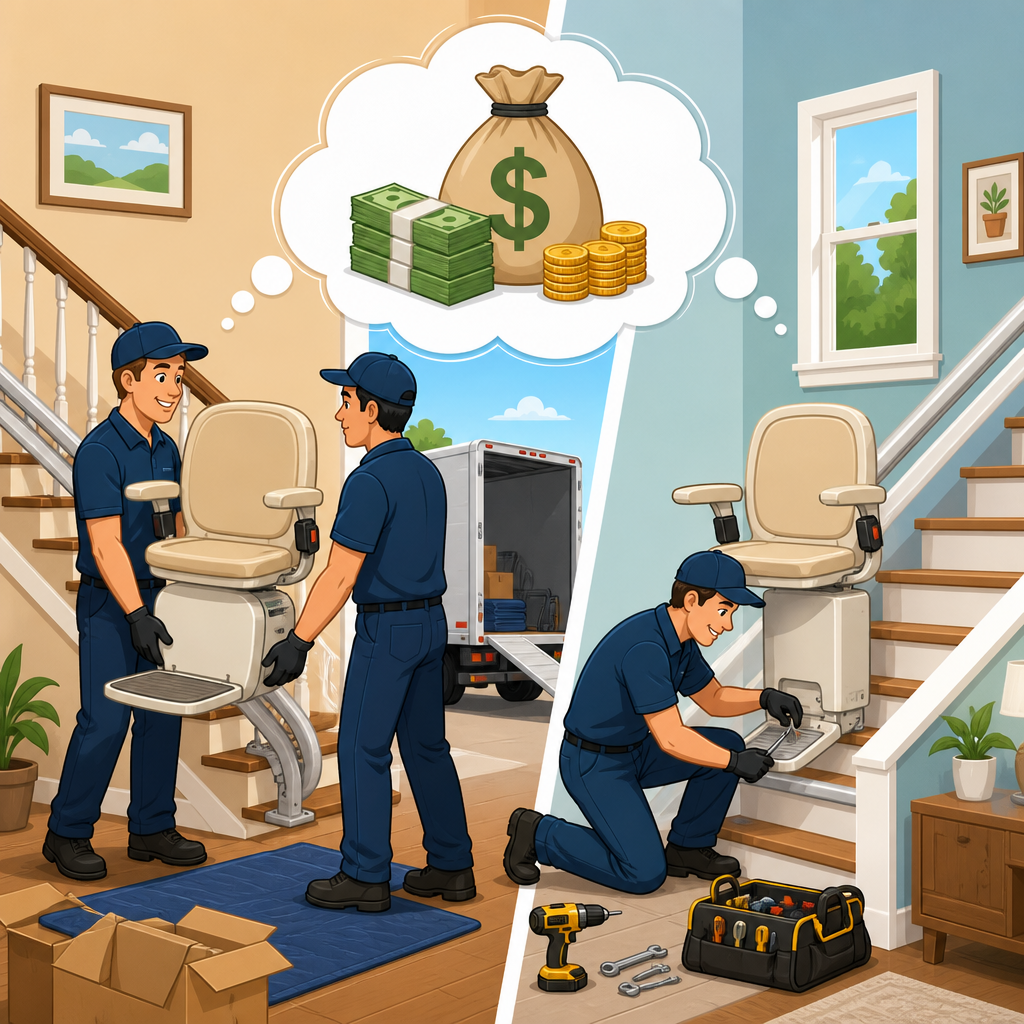
Buying a stair chair lift is only part of the financial picture. Many homeowners focus on the purchase price and installation quote, then discover later that ownership costs continue if the lift needs to be moved, reinstalled after remodeling, adapted for a different staircase, or transferred to a new home. The cost of moving or reinstalling a chair lift later depends on the rail type, staircase layout, local labor rates, code requirements, and the condition of the equipment itself. As a hub page for cost of ownership over time, this guide explains what drives those future expenses, when a move makes financial sense, and which related costs owners should plan for before signing a contract.
A chair lift, often called a stair lift, includes the seat assembly, motor, transmission, battery system, call stations, charging contacts, and the rail mounted to stair treads or, less often, another approved surface. Reinstalling means taking an existing unit off one staircase and putting it back on the same or a different staircase. Moving can mean shifting it during flooring work, removing it for a home sale, relocating it to another floor, or transporting it to a different property. Straight stair lifts are generally simpler and less expensive to move because they use modular rail sections. Curved stair lifts usually require custom rail fabrication and precise surveying, so later changes can become far more expensive.
This matters because mobility equipment is long-term infrastructure, not a disposable appliance. In my work with accessibility planning, the homeowners who feel best about their purchase are usually the ones who budget beyond day-one installation. They ask practical questions early: What if we remodel the stairs? What if we move in three years? Can this unit be reused upstairs? How much will battery replacement add over time? Those questions belong together because the real cost of ownership includes service visits, replacement parts, warranty limits, transfer feasibility, and potential resale value. Understanding those factors now helps you compare models, negotiate better terms, and avoid paying twice for equipment that cannot realistically be reused.
What it usually costs to move or reinstall a chair lift
For a straight stair lift, moving or reinstalling later often costs a few hundred to a few thousand dollars, depending on scope. A simple same-home removal and reinstallation after carpet replacement may involve labor, travel, new fasteners, and system testing. A move to a similar straight staircase in another property may also require rail adjustments, power checks, and permit-related work. If the original rail length does not match the new staircase, the installer may need additional rail sections or an entirely new track. In many markets, labor is the predictable portion of the bill; rail compatibility is the variable that changes the economics.
Curved stair lifts are different. Because curved rails are measured to the staircase and made to order, the original rail rarely fits another stairway exactly. The powered seat and carriage may be reusable if the manufacturer still supports the model and replacement parts remain available, but a new custom rail can cost enough that relocation becomes only marginally cheaper than buying a new system. Multi-landing layouts, tight inside turns, overrun sections at the top or bottom, and powered hinge rails add more complexity. When owners ask whether a curved unit can be moved, the accurate answer is usually yes in theory, but not always cost-effectively in practice.
Another factor is who performs the work. Most reputable manufacturers and dealers strongly prefer certified technicians because stair lifts are safety devices carrying seated users on an incline. Proper torque settings, bracket spacing, charger alignment, limit switches, final stops, and obstruction sensors all need verification after the unit is disturbed. A handyman may be able to remove visible hardware, but full reinstallation should include manufacturer procedures, diagnostic checks, ride testing, and battery charging confirmation. If unapproved work causes damage, the warranty may be reduced or voided, creating a hidden future cost.
Main factors that change lifetime ownership cost
The biggest cost driver is stair configuration. Straight stairs with a single uninterrupted run are the most transferable. Curved stairs, split-level landings, and transitions around corners create custom requirements that reduce reuse. The second major driver is age. Older lifts can be more expensive to move because replacement parts are harder to source, batteries may already be near end of life, and manufacturers may have discontinued the controller board or carriage assembly. In those cases, paying to relocate the lift can be poor value even if the basic mechanism still runs.
Brand support matters almost as much as design. Established manufacturers such as Bruno, Stannah, Harmar, Handicare, and Access BDD often have clearer service networks and documented parts availability than lesser-known private-label units. That does not guarantee a low relocation bill, but it improves the odds that your carriage can be serviced and a compatible rail or charging component can still be ordered. I advise owners to ask dealers a simple question before purchase: if this unit must be removed and reinstalled in five years, what parts are likely to be reused and what usually gets replaced?
Household timing also influences cost. A planned move tied to remodeling is cheaper than an emergency transfer after a fall or hospital discharge because installers can survey the site, bundle labor, and order parts in advance. Rush scheduling, same-week transport, or after-hours service adds cost quickly. Location matters too. Travel charges, permit fees, and labor rates vary by region, especially where certified accessibility contractors are in short supply.
| Cost factor | Why it affects price | Typical impact on move or reinstall cost |
|---|---|---|
| Straight vs. curved rail | Straight rails are modular; curved rails are custom-made to exact measurements | Straight units are often much cheaper to reuse than curved units |
| Age of the lift | Older models may need batteries, boards, or unsupported parts | Can turn a low-cost reinstall into a replace-versus-repair decision |
| New staircase length | Rail may be too short or too long for the destination stairs | Additional rail sections or a full rail replacement may be needed |
| Labor and travel | Removal, transport, mounting, testing, and technician travel are billed separately | Often the baseline cost even when equipment is reusable |
| Permits and code checks | Some jurisdictions require electrical or accessibility-related approvals | Adds administrative cost and scheduling time |
| Warranty status | Unauthorized moves can void parts or labor coverage | Raises long-term ownership risk after reinstallation |
When moving an existing lift makes sense
Moving a chair lift is usually worth considering in four situations. First, the lift is a relatively new straight model from a supported manufacturer, and the new staircase is similar in length and pitch. Second, the temporary removal is part of home maintenance, such as stair tread replacement or wall repair, where the same rail can go back into the same location. Third, the owner has a premium model with powered swivel, folding rail, or upgraded upholstery and wants to preserve that feature set rather than start over. Fourth, insurance, budget limits, or timing constraints make reuse the fastest path to restored access.
In one common example, a family removes a straight lift during a first-floor remodel, stores the carriage indoors, then reinstalls it two months later. If the rail is unchanged and no critical parts were damaged, the bill is mostly labor plus possible battery replacement if the unit sat discharged. That is very different from trying to move a ten-year-old curved unit into a new townhouse with a different landing geometry. In the second case, custom rail fabrication, surveys, and older electronics can eliminate the savings.
Home resale is another practical scenario. Some sellers remove a lift before listing because they want broader buyer appeal or need the unit at their next property. Others leave it in place because an aging-in-place feature can help a specific buyer. The financial decision depends on whether the destination home can use the existing equipment and whether removal will require wall repair, tread patching, or electrical work. The stair lift itself is only one line item; the surrounding finish work counts too.
When replacement is smarter than reinstallation
Replacement is often the better choice when the existing unit is near the end of its service life, has a history of intermittent faults, or comes from a brand with weak local support. Batteries for DC stair lifts are consumables and typically need replacement every few years depending on usage, charging consistency, and environment. If a lift already needs batteries, seat switch service, new rollers, or a board replacement, those costs should be evaluated before paying removal and transport fees. Spending good money to move a failing system usually delays rather than solves the problem.
Another reason to replace is mismatch. Rail angle, stair width, upper landing clearance, seat-to-wall offset, and required overrun length all affect whether a previous installation can work safely in a new setting. For a narrow staircase, a different model with a slimmer folded profile may be necessary to preserve walking clearance. In homes with a doorway or obstruction at the base of the stairs, a hinged rail may be needed even if the original unit had a standard lower stop. Accessibility is site-specific, and a reused unit is not automatically the right fit.
There is also the issue of future parts support. If a dealer tells you the carriage can be moved but the model is no longer actively supported, ask for that estimate in writing and request a parts availability statement. A cheaper reinstall is not truly cheaper if one failed component later turns the lift into unserviceable equipment. Long-term cost planning means looking beyond the moving invoice to the next five years of maintenance risk.
Other ownership costs people overlook over time
The hub topic of cost of ownership over time includes more than moving. Battery replacements are routine. Most residential stair lifts use rechargeable batteries inside the base carriage so the lift can operate during a power outage, provided it remains charged at the parked station. These batteries wear out. Service calls are another recurring cost, especially if the unit is heavily used or in a household with pets, dust, or temperature swings that affect sensors and contacts. Annual maintenance is not always mandatory, but preventive service can catch loose hardware, charger issues, and worn components before a breakdown occurs.
Repairs after home changes are also common. New carpet thickness can affect rail alignment and bracket stability assumptions. Painting, drywall work, or stair refinishing may require temporary removal and recalibration. If a homeowner upgrades to a heavier-duty seat, powered footrest, or folding hinge later, that accessory cost becomes part of ownership too. Some owners also pay for extended warranties or service plans, which can be worthwhile if they clearly cover labor, travel, batteries, and electronics rather than offering narrow parts-only protection.
Finally, there is depreciation and resale reality. Used straight stair lifts may have some secondary value when supported and in good condition, but resale markets are inconsistent because buyers still need professional installation and, often, a different rail length. Used curved rails usually have little value outside the original staircase because they are custom. That is why total ownership cost should include likely end-of-life value, not just hopeful assumptions about selling the unit later.
How to estimate costs before you buy
The best way to control future expense is to ask detailed questions during the initial sales process. Request an itemized quote separating equipment, rail, installation labor, electrical work, permits, and optional features. Then ask for a written outline of typical future charges: removal, reinstallation on the same stairs, relocation to a different home, annual maintenance, battery replacement, and out-of-warranty diagnostic visits. A serious dealer should be able to give realistic ranges based on local practice, even if exact future pricing changes.
Ask whether the rail is modular, whether extra sections can be added later, and whether the seat and carriage are commonly reused if the rail must be replaced. Confirm weight capacity, folded width, parking position options, and power requirements. If your household may renovate or move, discuss that now rather than after installation. Keep survey drawings, model numbers, serial numbers, warranty documents, and service records in one file. Those documents speed future estimates and reduce the chance of paying for duplicate site visits.
Before deciding, compare the transfer cost to the price of a new unit with fresh warranty coverage. In many straight-stair cases, reusing a newer lift is sensible. In many curved-stair cases, replacing the rail or buying new may deliver better value. The key benefit of planning for the cost of moving or reinstalling a chair lift later is simple: you avoid surprise expenses and make accessibility decisions that stay practical over time. Review your quote, ask transfer questions in writing, and build a realistic ownership budget before you commit.
Frequently Asked Questions
How much does it usually cost to move or reinstall a chair lift later?
The cost to move or reinstall a chair lift later can range from a few hundred dollars for a simple removal and reinstallation on the same staircase to several thousand dollars if the rail must be replaced, the staircase configuration is different, or electrical and code-related updates are required. In many straightforward cases, homeowners pay for labor to uninstall the unit, transport it, and remount it, plus a service inspection to confirm the lift is safe to operate. However, the final price rises quickly when the project involves a curved rail, a landing change, track modifications, or a move to a different house.
Most providers look at several pricing factors at once: whether the lift is straight or curved, how old the unit is, whether the original rail can be reused, how accessible the staircase is for installers, and whether any replacement parts are needed. A straight chair lift is usually less expensive to move because the rail sections are simpler and more standardized. A curved chair lift often costs much more because the rail is typically built to match one specific staircase. If the new location does not match the original layout, a new custom rail may be required, and that can be one of the largest expenses in the entire project.
Homeowners should also expect possible charges for site evaluation, travel, disposal of unusable parts, permit-related work in some areas, and battery replacement if the unit has been in service for years. The most accurate way to budget is to request an on-site assessment from a qualified dealer or manufacturer-authorized technician. A written estimate should separate labor, rail reuse or replacement, new parts, transportation, and warranty coverage so you can clearly compare the true cost of moving the chair lift versus replacing it with a new system.
Can any chair lift be moved to a different staircase or a new home?
Not every chair lift can be moved easily, and not every move makes financial sense. The answer depends on the type of lift and how closely the new staircase matches the original one. Straight stair lifts are generally the most transferable because they are designed for a single uninterrupted run of stairs and often use rail sections that can be resized or replaced at a lower cost. If the new staircase is also straight and has enough width, headroom, and appropriate landing space, moving the unit may be practical.
Curved stair lifts are much more complicated. In many cases, the chair, carriage, and power components might still be usable, but the rail itself is custom-made for a specific staircase shape, including turns, intermediate landings, and bottom or top overruns. That means a curved lift taken from one home may need an entirely new rail to fit another home. When that happens, the total project cost can approach the price of buying a new system, especially if the lift is older or no longer supported by the manufacturer.
There are also technical and safety issues to consider before relocating a lift. The receiving staircase must meet installation requirements related to width, structural condition, power supply, and user clearance. The unit may need updated brackets, seat adjustments, call/send controls, charging points, or safety sensors. If the model has been discontinued, parts availability can become a serious concern. For that reason, homeowners should not assume that a chair lift is a portable appliance that can simply be picked up and reused anywhere. A professional inspection is essential to determine compatibility, cost, and whether relocating the equipment is safer and more economical than starting fresh.
What factors make the cost of reinstalling a chair lift go up?
Several common issues can push reinstall costs significantly higher than expected. The biggest cost driver is rail compatibility. If the original rail cannot fit the new staircase, the installer may need to order a new straight rail or fabricate a new custom curved rail. Beyond that, the staircase layout matters a great deal. Tight turns, narrow stairs, split landings, or unusual wall and banister conditions can increase labor time and hardware requirements. Even if the chair itself is still in good condition, the installation environment may be much more complex than the original one.
Age and condition of the equipment are also major factors. A chair lift that has been used for many years may need fresh batteries, new rollers, updated wiring, replacement seat components, or servicing of safety features before it can be reinstalled. If technicians discover wear during removal or testing, those repairs add to the final bill. In some cases, older lifts no longer meet current installation standards or manufacturer recommendations without upgrades. That can make a simple reinstallation turn into a partial refurbishment project.
Local labor rates and regional service availability can affect cost just as much as the equipment itself. In some markets, certified stair lift technicians are limited, and travel charges may apply, particularly in rural areas. Remodeling work can also complicate timing. If the chair lift was removed for flooring, painting, stair reconstruction, or a larger accessibility remodel, the installer may need to coordinate around contractors, return for multiple visits, or wait until finished dimensions are confirmed. All of those details matter. The more changes there are to the home or to the unit, the more likely the project will cost more than a basic remove-and-reinstall service call.
Is it cheaper to move an existing chair lift or buy a new one?
It depends on the age of the lift, the type of staircase, and how much of the original system can be reused. In many straight-stair situations, moving an existing chair lift can be the lower-cost option, especially if the unit is relatively new, from a reputable brand, and in good working condition. Reusing the chair, motor, and possibly the rail can save a meaningful amount compared with the full purchase and installation of a brand-new model. For homeowners staying in the same property and simply reinstalling after remodeling, repair or reinstallation often makes clear financial sense.
That said, lower upfront cost does not always mean better long-term value. If the lift is older, out of warranty, or near the end of its service life, moving it may only delay a larger replacement expense. When a used system needs a new rail, multiple replacement parts, and substantial labor, the price difference between relocation and a new unit can narrow quickly. This is especially true for curved chair lifts, where a custom rail can represent a large share of total cost. In those cases, a new lift may provide better reliability, stronger manufacturer support, and a fresh warranty that protects against future repair costs.
The best approach is to compare total ownership value, not just the initial quote. Ask for side-by-side pricing on relocation versus replacement, including labor, parts, new rail requirements, batteries, service coverage, and warranty terms. Also ask how long the manufacturer expects parts to remain available for your current model. If the existing lift is still current and compatible, moving it may be a smart and economical choice. If it is outdated or requires extensive adaptation, buying new may be the more cost-effective and dependable decision over time.
Who should handle chair lift removal and reinstallation, and what should homeowners ask before hiring?
Chair lift removal and reinstallation should be handled by a qualified professional, ideally a dealer or technician authorized by the lift’s manufacturer. This is not a typical handyman project. A chair lift is mobility equipment with mechanical, electrical, and safety systems that need to be tested and calibrated correctly. Improper removal can damage the rail, carriage, or charging system, and improper reinstallation can create safety risks for the user. Professional technicians know how to evaluate stair dimensions, anchoring requirements, battery performance, charging points, seat operation, and obstruction sensors before putting the lift back into service.
Before hiring, homeowners should ask whether the company has direct experience with the specific brand and model being moved. They should also ask whether the lift is still supported by the manufacturer, whether replacement parts are available, and whether the company can provide a written estimate based on a site inspection rather than a rough verbal quote. Good questions include whether the rail can be reused, what parts may need replacement, whether there are travel or disposal fees, how long the work will take, and what testing will be done before the lift is considered safe to use again.
It is also wise to ask about warranty coverage after the move. Some warranties do not transfer, and some manufacturers may limit support if the system is relocated by a non-authorized installer. Homeowners should request proof of licensing or relevant credentials where applicable, confirm insurance coverage, and ask whether follow-up service is available if issues arise after reinstallation. A reputable company should be willing to explain the process clearly, outline any code or safety concerns, and tell you honestly when moving the existing chair lift is not the best option. That level of transparency is often the best sign that you are dealing with a knowledgeable and trustworthy provider.