


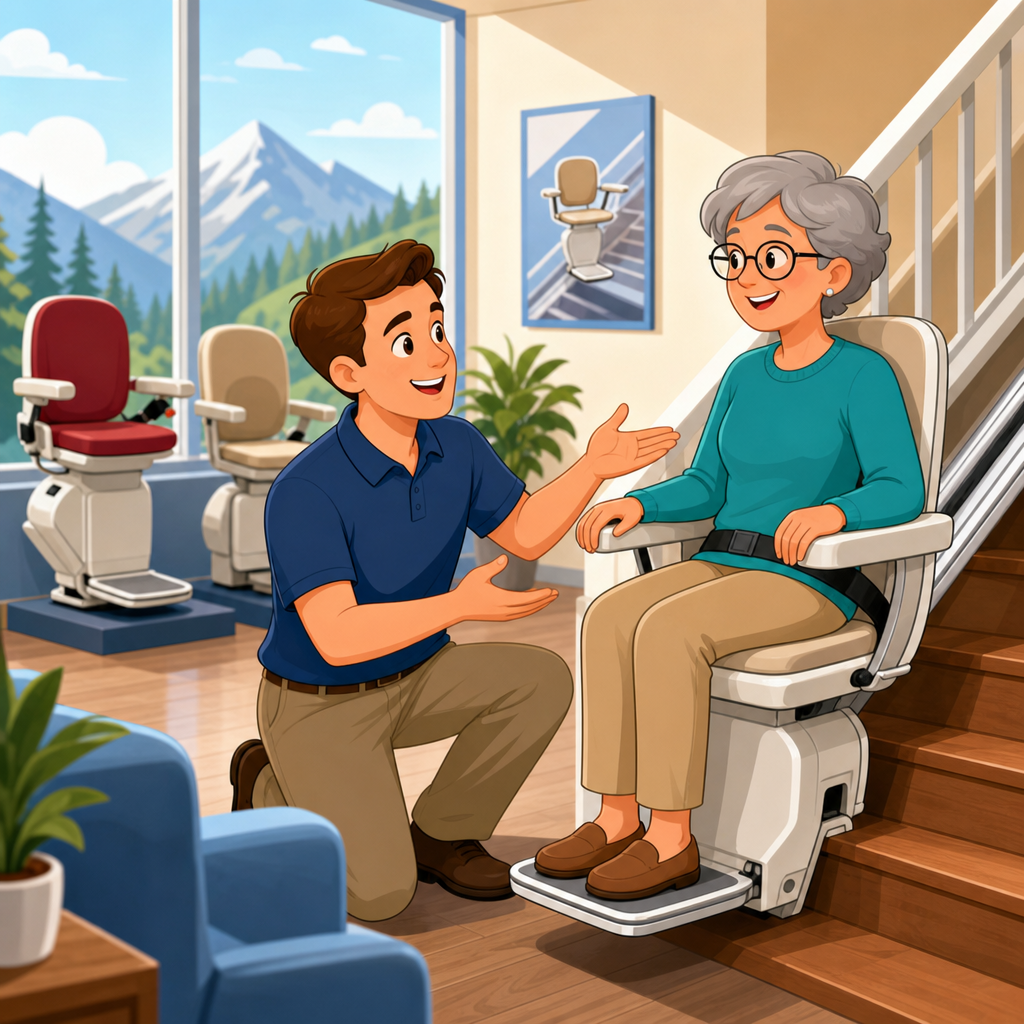
Shoppers researching mobility equipment often ask a practical question before spending thousands of dollars: do retailers offer chair lift trials or demos? In many cases, yes, but the format varies widely by retailer, product type, location, installation complexity, and safety rules. Some stores provide showroom demonstrations on a working stair lift or lift chair, some arrange an in-home assessment with a dealer representative, and some online-first sellers rely on video consultations, measurements, and manufacturer support instead of a true trial period. Understanding these differences matters because chair lifts are not ordinary consumer products. They are installed devices or medically relevant seating systems that must match the user’s body, home layout, transfer ability, and long-term mobility needs.
For buyers, the term chair lift can mean several products. In retail conversations, it usually refers either to a stair lift that carries a seated user along a rail on the staircase, or to a lift chair recliner that helps a person move from sitting to standing. Retailers and online stores may use the phrase loosely, which is why clear definitions help when comparing offers. A stair lift demo usually means seeing the unit operate, riding it under supervision, or scheduling a home survey to verify rail fit, power supply, seat position, and clearance. A lift chair demo usually means trying floor models in a showroom to test seat height, cushioning, remote controls, recline positions, and stand-assist motion.
This topic matters because the wrong buying path creates expensive mistakes. I have seen shoppers assume a stair lift could be returned like a mattress, only to learn that custom rail sections, installation labor, and restocking terms made returns limited or impossible. I have also seen families buy a lift chair online without checking seat depth or user weight capacity, resulting in poor posture, skin pressure issues, and difficult transfers. Trials and demos reduce those risks. They help buyers confirm comfort, fit, speed, noise, swivel clearance, battery backup behavior, and whether the user actually feels secure operating the equipment. They also reveal whether a retailer understands accessibility standards, service obligations, and realistic timelines.
As a hub page for retailers and online stores, this guide explains what kinds of trials and demos exist, where they are common, how major sales channels differ, what questions to ask before committing, and when an in-person demo is essential. If you are comparing local mobility dealers, national chains, direct-to-consumer sites, or marketplace sellers, the goal is simple: know exactly what experience you can expect before purchase, and use that information to choose a safer, better-supported option.
What counts as a chair lift trial or demo?
A chair lift trial is any pre-purchase opportunity to evaluate the product in operation, but not all trials are equal. For stair lifts, the most common option is a showroom demo on a standard straight-rail unit. This lets a customer test seat comfort, seatbelt use, armrest positioning, call-send controls, folding footrests, swivel locks, and ride quality. However, a showroom ride does not prove the lift will fit a specific staircase. That requires an on-site assessment, often done with laser measurement tools, incline readings, landing clearance checks, and photographs. For curved stairs, the home survey is effectively the real demo stage because every rail is built to the home’s geometry.
For lift chair recliners, a demo is typically closer to a true product trial. In-store buyers can compare two-position, three-position, and infinite-position models, test chaise support, verify whether their heels stay planted during stand assist, and check if the hand control is intuitive. Better retailers will measure hip width, lower-leg length, and seated shoulder height before recommending a size. Pride Mobility and Golden Technologies, two established brands in this category, both publish sizing guidance because seat width, seat-to-floor height, and back style directly affect comfort and transfer safety.
Retailers may also offer conditional trial-like policies. A dealer might waive a consultation fee, provide a refundable deposit before installation, or allow an exchange on an in-stock lift chair within a short window if the product remains in resalable condition. That is not the same as a risk-free trial. Installed stair lifts are usually subject to stricter terms because labor, rail cutting, and custom fabrication change the resale value immediately. Buyers should distinguish among demo, home assessment, return policy, exchange policy, and warranty service. Those are related but not interchangeable.
Where demos are most commonly available
Local mobility dealers are the most reliable source of chair lift demos. These businesses often maintain a showroom with one or more working stair lifts, several lift chairs, scooters, and bathroom safety products. Because they also handle installation and service, they are better positioned to evaluate whether a demo unit reflects the final setup in the customer’s home. In practice, this is where most meaningful pre-purchase experiences happen. A dealer can demonstrate battery charging, obstruction sensors, manual lowering, seat swivel behavior at top and bottom landings, and folding dimensions against an actual wall.
National retailers sometimes offer displays, but availability depends on store footprint and category focus. Big-box home improvement chains may sell stair lifts through lead-generation partnerships rather than in-store inventory, meaning the “retailer” is really a referral point to a regional installer. Medical supply chains may stock lift chairs on the floor but rarely install stair lifts directly. Warehouse clubs and online marketplaces generally do not offer hands-on trials, though they may list major brands or third-party sellers.
Online-first stores vary significantly. The stronger operators compensate for limited physical access with detailed consultations, measurement guides, live video appointments, spec sheets, and manufacturer-backed dealer networks. This can work well for lift chairs if the dimensions are clear and the buyer has already tested a similar frame locally. It is less ideal for stair lifts, especially on narrow staircases, split landings, or curved runs, where field measurement is critical. If an online seller cannot name who will measure, install, and service the unit locally, that is a warning sign.
| Sales channel | Demo availability | Best for | Main limitation |
|---|---|---|---|
| Local mobility dealer | High | Stair lifts and lift chairs needing fit guidance | Selection may be limited to a few brands |
| Medical supply showroom | Moderate | Lift chair comparisons | Often limited stair lift installation capability |
| National chain referral model | Low to moderate | Initial quote gathering | Demo depends on local partner quality |
| Online specialty retailer | Low in person, moderate virtual | Experienced buyers replacing known products | No true hands-on test before delivery |
| Marketplace seller | Very low | Price checking only | Weak service accountability |
How stair lift demos differ from lift chair demos
Stair lift purchases are installation-driven. The product cannot be judged only by catalog features because stair width, rise, run, landing depth, wall obstructions, door swings, and user transfer mechanics determine suitability. A useful stair lift demo therefore includes both a ride and a site survey. For example, a straight stair lift from Bruno, Harmar, or Stannah may look similar on paper, but rail overrun options, footrest folding geometry, seat perch height, and diagnostic interfaces differ in ways that affect the final user experience. I have watched customers reject a model after trying the swivel sequence and realizing they could not rotate safely at the top landing with one weak leg. That insight only appears during a live demonstration.
Lift chair demos are more like seating evaluations. Comfort, pressure distribution, lumbar support, fabric, and control usability matter more than home geometry, although doorway width and delivery path still matter. A showroom trial can answer most major questions if the retailer knows how to fit the chair properly. For instance, if the user’s knees sit too high relative to the seat edge, standing assistance may feel unstable. If the seat is too deep, the pelvis slides forward and the back loses support. A skilled sales associate will not just say a chair feels soft; they will check alignment and ask how long the user expects to sit in it daily.
That difference affects return expectations. Many lift chairs are stocked, delivered assembled or semi-assembled, and sometimes eligible for exchange. Stair lifts, especially curved models, are often custom ordered and become difficult to return once fabrication begins. This is why stair lift buyers should prioritize the quality of the demo and measurement process even more than advertised price.
What to ask retailers before relying on a demo
The best buying decisions come from asking direct operational questions. First, ask whether the demo unit is the same brand and model being quoted. Some stores demonstrate an entry-level unit but sell a different configuration in the home. Second, ask who performs the in-home assessment: an employee, subcontractor, or manufacturer-certified technician. Third, ask whether the retailer services what it sells. A demo has less value if post-installation repairs are outsourced across a large territory.
Buyers should also ask specific fit and policy questions. For stair lifts, ask whether the quoted rail is straight or custom, whether a power swivel or power footrest is available, what the folded width is, whether there is battery backup, and how many rides the unit typically provides during a power outage. For lift chairs, ask about seat dimensions, user height range, weight capacity, foam density, motor type, backup battery options, and whether white-glove delivery includes setup and operation review.
Policy language deserves careful attention. Ask if deposits are refundable, at what stage a stair lift order becomes noncancelable, whether a lift chair can be returned after use, who pays return freight, and whether installed units carry labor coverage in addition to parts coverage. Reputable sellers will answer clearly. Vague answers such as “we usually work something out” or “the manufacturer handles that” often indicate weak process control. Good retailers document these terms in writing before the sale, not after a problem appears.
How to evaluate online stores and remote consultation models
Online stores can be useful, but they require stricter vetting. Start by checking whether the seller lists full product specifications, downloadable manuals, warranty terms, and brand authorization status. Authorized dealers generally have access to current parts, training, and manufacturer support. If a site hides dimensions, omits duty cycle details, or provides only marketing descriptions, it is not ready to guide a high-stakes mobility purchase.
Next, assess the consultation process. Strong remote sellers use phone or video intake, ask for staircase photos, request width and landing measurements, and explain what still must be confirmed in person. They do not pretend that a few smartphone images can replace a proper curved-stair survey. For lift chairs, good online support includes size charts, fabric swatches, room-of-choice delivery options, and realistic guidance on who should avoid buying sight unseen. Bariatric users, people with significant edema, and buyers with complex positioning needs usually benefit from in-person fitting first.
Finally, verify the local support chain. Ask who installs, who handles warranty labor, and how service calls are scheduled. Manufacturers such as Bruno and Harmar typically rely on dealer networks; the quality of that network matters as much as the website you buy from. If an online seller offers an unusually low price but cannot identify the servicing dealer, the savings may disappear the first time a sensor fault, charger issue, or upholstery defect needs attention.
When a demo is essential and when it is less critical
A demo is essential when the user has balance deficits, limited trunk control, significant joint contractures, or anxiety about transfers. It is also essential for narrow stairs, multi-landing layouts, curved runs, or homes with obstruction risks such as radiators, door trim, and low hallway clearance. In these cases, a demonstration combined with a technical survey is not a luxury; it is part of safe prescribing and installation. Occupational therapists and aging-in-place specialists often encourage this approach because the transfer onto and off the device can be riskier than the ride itself.
A demo is less critical, though still helpful, when replacing a known product with the same or very similar model, especially for lift chairs. If a buyer has already used a medium-size infinite-position chair from a major brand and the dimensions match closely, a remote purchase may be reasonable. Similarly, a straightforward straight staircase in a standard-width home may allow a simpler path if the dealer has a strong measurement process and service reputation.
The core principle is that the more individualized the product, the more important the demo. Retailers and online stores that understand mobility sales do not resist that reality. They build it into their process, explain the limits honestly, and focus on matching the right product to the right user rather than closing the fastest sale.
So, do retailers offer chair lift trials or demos? Yes, many do, but buyers should expect a spectrum rather than a single standard experience. Local mobility dealers usually provide the strongest hands-on demonstrations, especially for stair lifts that require technical measurement and installation planning. Medical supply showrooms commonly offer lift chair trials, while online stores tend to rely on virtual consultations, detailed specifications, and local service partnerships. The key is understanding that a demo is only valuable if it reflects the real product, the real home, and the real user.
For stair lifts, the best pre-purchase process includes a showroom ride when possible and a detailed in-home assessment before any final order. For lift chairs, the most useful demo is a fit-focused seating trial that checks dimensions, stand-assist motion, and long-duration comfort. In both categories, return rights are often narrower than buyers expect, so written answers about deposits, customization, installation labor, exchanges, and warranty coverage are essential. Price matters, but service capacity, measurement accuracy, and product fit matter more.
Use this retailers and online stores hub as your starting point when comparing sellers under buying guides and product reviews. Shortlist providers that offer clear demo options, transparent policies, authorized brand status, and reliable local support. Then ask direct questions, test the equipment whenever possible, and choose the retailer that can still help after delivery day. That approach leads to a safer purchase, fewer surprises, and a chair lift that actually improves daily independence.
Frequently Asked Questions
Do retailers usually offer chair lift trials or demonstrations before purchase?
Yes, many retailers do offer some form of chair lift trial or demonstration, but the experience can look very different depending on the seller, the type of equipment, and where you live. For stair lifts and lift chairs, the most common options are in-store showroom demos, in-home consultations, or virtual demonstrations by video call. A showroom demo usually lets you see a working model, sit in the chair, test the controls, and get a feel for comfort, speed, seat height, swivel features, and safety sensors. In-home consultations are more common for stair lifts because the product must be matched to the staircase, landing space, power setup, and user mobility needs.
Some retailers, especially local mobility dealers, are more likely to provide hands-on demonstrations because they also handle measurement, installation, and service. Online-first retailers may not have a showroom near you, so they often substitute a video walkthrough, photos, measurement guidance, and a discussion of available models. In other words, the answer is often yes, but shoppers should not assume every retailer offers a formal “trial period” in the way consumer products sometimes do. In mobility equipment, a “demo” is much more common than a temporary installed try-before-you-buy arrangement.
What is the difference between a showroom demo, an in-home assessment, and a true trial period?
A showroom demo usually takes place at a retail location or dealer showroom where a customer can try a display model. This is helpful for evaluating basics such as seat comfort, remote controls, folding footrests, armrest width, ease of getting in and out, and how the chair moves. It is especially useful for lift chairs, where comfort, positioning, and upholstery choices matter a lot. For stair lifts, a showroom setup may include a short demonstration track that shows how the unit starts, stops, folds, and swivels, but it may not fully reflect the exact conditions of your home staircase.
An in-home assessment is more personalized and often more valuable for stair lifts. A dealer representative visits the home, measures the stairs, checks for obstructions, reviews the user’s mobility limitations, and recommends appropriate models and rail configurations. This is not always a “trial” in the sense of using a fully installed unit for several days, but it is often the best way to determine fit, safety, and feasibility before committing to a purchase.
A true trial period typically means the equipment is delivered or installed with the option to return it within a set timeframe. That is much less common with stair lifts because installation is customized, labor-intensive, and often involves special-order parts. Lift chairs are more likely than stair lifts to have limited return windows, but even then, return policies may include restocking fees, pickup charges, or restrictions once the chair has been used. Shoppers should ask directly whether the retailer is offering a demonstration, a consultation, or an actual returnable trial, because those are not the same thing.
Why don’t all retailers offer in-home chair lift trials?
The biggest reason is that many chair lifts, especially stair lifts, are not simple plug-and-play products. They often require customization, professional installation, and safety verification. A stair lift rail is typically cut or configured to the exact dimensions of a staircase, and the installer must account for landings, curves, doorways, wall clearance, power access, and the user’s transfer ability. Because of that, installing a unit temporarily just for a short test period can be expensive and impractical for the retailer.
Safety is another major factor. Retailers do not want a customer using a lift that has not been properly selected, installed, and reviewed for the user’s physical needs. For example, seat width, weight capacity, transfer stability, and the user’s ability to fasten a seat belt or operate controls all matter. Liability concerns also affect whether retailers allow informal home testing. In many cases, a trained dealer would rather provide a structured assessment and recommendation than install a temporary unit that may not be ideal.
Location also matters. In larger metro areas, you may find dealers with showrooms and dedicated assessment teams. In rural areas, options may be more limited, and retailers may rely on phone support, measurement forms, and scheduled site visits rather than full demos. For this reason, trial availability often depends less on the product category itself and more on the retailer’s service model, installer network, and regional coverage.
How can I tell whether a retailer’s demo is actually useful before I buy?
A useful demo should help you answer practical questions, not just show that the product turns on. For a lift chair, that means sitting in it long enough to judge cushioning, back support, seat depth, recline positions, standing assistance, hand control simplicity, and whether it feels stable during transitions. For a stair lift, a valuable demonstration should show how easy it is to sit down, buckle in, swivel safely at the landing, fold the seat and footrest, and operate the controls without confusion or strain. If possible, the shopper and any caregiver should both be present so everyone understands the day-to-day use of the equipment.
Ask the retailer whether the demo model is similar to the unit you would actually receive. A basic straight stair lift on a showroom track may not reflect the ride, turns, or space requirements of a curved stair lift. Likewise, a standard lift chair in a showroom may feel different from a larger or medically targeted model. It is also smart to ask whether the consultation includes measurements, discussion of weight capacity, maintenance expectations, battery backup, warranty coverage, and service response times. The most helpful demos combine product testing with professional evaluation, because comfort alone is not enough if the equipment is not appropriate for the home and user.
Finally, pay attention to how clearly the retailer explains limitations. A trustworthy dealer will be honest if a demo cannot fully replicate your home setup. That kind of transparency is a good sign, and it often matters more than a flashy showroom display.
What should I ask a retailer before scheduling a chair lift demo or consultation?
Start by asking what kind of demonstration they actually provide. Ask whether it is an in-store demo, an in-home assessment, a virtual consultation, or a temporary trial period. Then ask whether there is a fee for the visit, whether measurements are included, and whether the representative is an employee, an authorized dealer, or a third-party installer. This helps you understand how much support the retailer really offers and whether they will also handle installation and future service.
You should also ask what products can be demonstrated. Some retailers only show standard straight stair lifts in a showroom, while others can evaluate more complex curved stairs or outdoor applications in person. For lift chairs, ask whether multiple sizes and seat styles are available to try. Ask about return policies, warranty coverage, labor warranties, maintenance plans, and whether there are fees for cancellation, restocking, or removal. If the purchase may involve insurance, veterans’ benefits, Medicaid waivers, or financing, this is the right time to ask what paperwork or documentation the retailer can provide.
It is also wise to ask practical use questions: What is the weight limit? How much stair width is needed? What happens in a power outage? Can the chair fold to save space? How quickly can it be installed? What service support is available after the sale? A strong retailer should be able to answer these questions clearly and confidently. The goal of the demo is not just to see the equipment move, but to decide whether the product, the installation process, and the company itself are a good fit for your needs.