


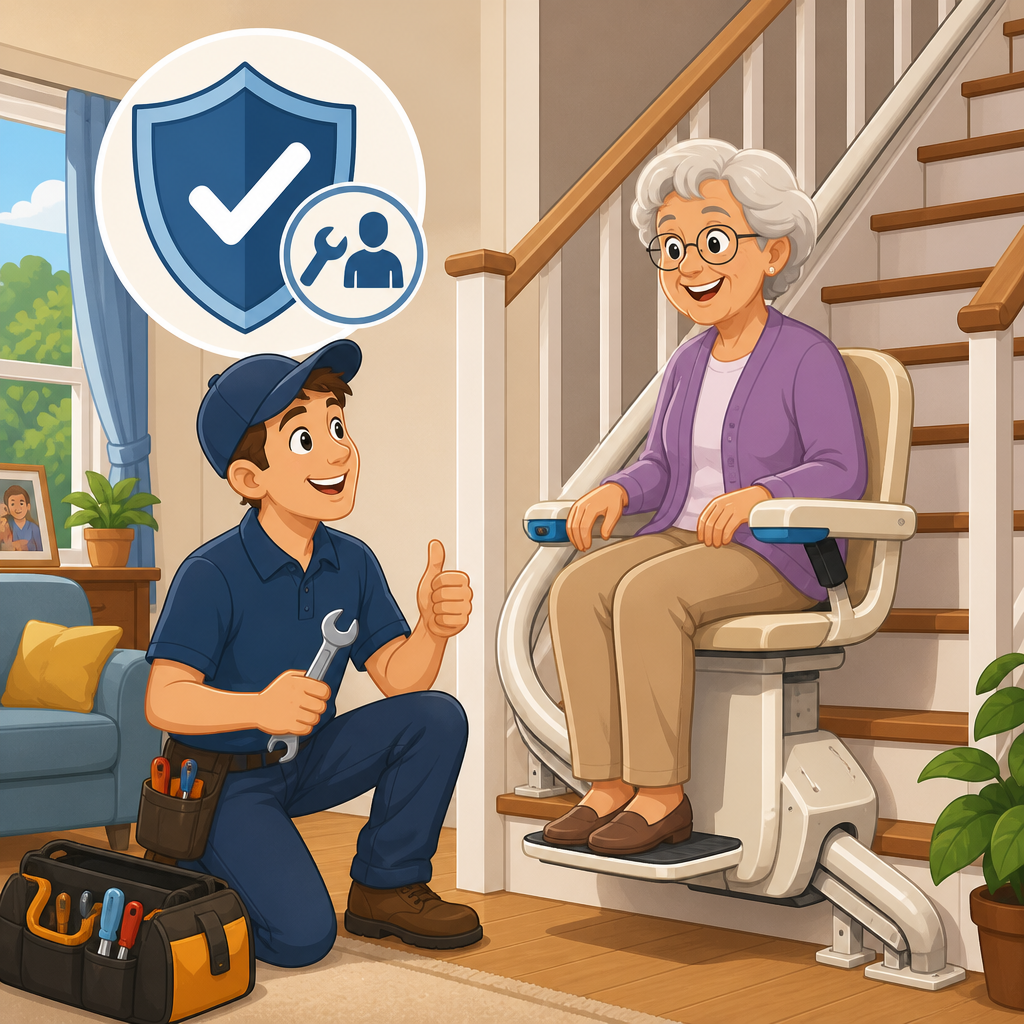
Buying a stair lift is not only about choosing the right rail, seat, and drive system; it is also about understanding what happens after installation when something needs adjustment, repair, or replacement. The question many shoppers ask first is simple: does a stair lift warranty cover labor and service calls? The honest answer is that some warranties do, many do not, and the difference can significantly change the real cost of ownership over five to ten years. A stair lift warranty is the manufacturer’s or dealer’s written promise describing which parts are covered, for how long, under what conditions, and whether technician labor, travel time, and in-home service visits are included or excluded.
In the stair lift industry, those details matter because products are installed in private homes, not swapped out at a retail counter. If a charging fault, seat swivel issue, footrest safety edge problem, or battery failure occurs, a trained technician usually must come to the home. That visit often generates two separate charges: labor for diagnosis and repair, and a service call fee that may include dispatch, travel, mileage, or minimum visit time. I have reviewed many dealer agreements where a homeowner assumed “full warranty” meant every repair was free, only to learn that the motor gearbox part was covered while the trip charge and one to two hours of labor were not.
This article explains how stair lift warranties typically work, what labor and service call language actually means, how return policies differ from repair coverage, and what buyers should confirm before signing a sales agreement. Because this page serves as a hub for warranty and return policy questions, it also frames the wider issues that connect to battery warranties, refurbished unit guarantees, transferability, rental terms, and post-installation cancellation rules. If you understand the structure of coverage now, you will compare quotes more accurately, avoid surprise bills later, and negotiate from a stronger position before the lift is installed.
What a stair lift warranty usually covers
A standard stair lift warranty usually divides coverage into parts categories rather than one blanket promise. Major components often include the motor, gearbox or transmission, circuit board, charger, batteries, carriage, seat assembly, rail, remote controls, and safety sensors. Straight stair lifts commonly come with a manufacturer parts warranty ranging from one to five years, while some premium brands advertise lifetime coverage on the drivetrain or rail for the original owner. Curved stair lifts may have similar component coverage, but because they use custom rails and more expensive installations, policy wording tends to be more specific and dealer-dependent.
In practice, parts coverage means the manufacturer will supply a replacement component if that component fails due to defects in materials or workmanship during the stated term. It does not automatically mean a technician will come out for free to diagnose the issue, remove the defective part, install the replacement, test the system, and document the claim. Dealers and manufacturers separate those responsibilities because parts are one cost center and field service is another. That separation is why two stair lift quotes that look similar on the product side can have very different long-term maintenance costs.
Another important distinction is between factory warranty and dealer warranty. The manufacturer may cover specific components, but the local dealer controls installation workmanship and usually performs service. If the rail was mounted incorrectly, charge points were misaligned, or the seat was not adjusted properly at install, the dealer may be responsible under a short workmanship guarantee even if the manufacturer’s parts warranty is longer. Buyers should ask for both documents in writing. When I audit stair lift proposals, missing dealer workmanship terms are one of the most common warning signs.
Does a stair lift warranty cover labor and service calls?
Usually, a stair lift warranty does not cover labor and service calls for the entire warranty term unless the contract explicitly says so. Many policies include parts only after an initial period, often thirty days to one year, during which labor may be covered. Some higher-end packages include one year of labor, while others provide ninety days of labor and then bill every visit afterward. Service calls are even more likely to be excluded, especially travel to rural homes or after-hours emergency visits.
The fastest way to read a warranty is to look for exact phrases such as “parts only,” “labor included,” “trip charge excluded,” “dealer call-out not covered,” or “onsite service subject to prevailing rates.” If those phrases are absent, ask the dealer to write the terms directly on the purchase agreement. Verbal assurances are difficult to enforce once ownership changes hands or a dealership is sold. A reliable dealer will not resist putting labor coverage in writing.
Why are labor and service calls often excluded? Stair lifts are serviced at the customer’s home by technicians with specialized training, insurance, stocked vehicles, and scheduling overhead. Even a minor issue can consume half a day when drive time is included. Dealers therefore price warranties carefully. A low advertised purchase price is sometimes offset by narrower labor coverage later. By contrast, a quote that looks higher at first may include twelve months of labor, annual maintenance, or discounted call-out rates, making it less expensive over time.
| Warranty element | Often covered? | Typical details |
|---|---|---|
| Major parts | Yes | Motor, gearbox, board, charger, rail, seat components for a stated term |
| Batteries | Sometimes | Often shorter coverage, commonly one year due to wear characteristics |
| Labor | Limited | May be included for 30 days to 1 year, then billed hourly |
| Service call or trip charge | Often no | Dispatch, mileage, travel time, minimum visit fee commonly excluded |
| Installation workmanship | Usually yes | Dealer-backed for a shorter period, such as 30 to 90 days |
| Preventive maintenance | Rarely | Annual tune-ups usually sold separately unless in a service plan |
Key terms buyers must understand before signing
Several warranty terms are routinely misunderstood. “Parts and labor” means both the component and technician time are covered, but it still may not include travel or emergency service. “Service call” can mean dispatch only, or dispatch plus the first hour of labor, depending on the dealer. “Wear items” refers to components expected to degrade through normal use, such as batteries, upholstery, armrest pads, or remote batteries, and these may carry shorter terms. “Lifetime warranty” usually applies only to selected components for the original purchaser and almost never means every repair is free for life.
“Return policy” is different from warranty coverage. A return policy addresses whether the buyer can cancel, remove, or return the stair lift after purchase or installation, and under what financial terms. For straight lifts, some dealers permit returns before installation or during a short trial window, but custom curved lifts are often non-returnable once the rail is manufactured. This is consistent with custom-goods rules across home accessibility equipment. Buyers should also know whether removal fees, restocking charges, or rail disposal costs apply.
Another important term is “transferability.” Most stair lift warranties are non-transferable and apply only to the original purchaser at the original address. That matters if the homeowner moves or if an adult child buys a lift for a parent and title documentation is unclear. I recommend confirming whose name will appear on the invoice and warranty registration so there is no dispute later.
How manufacturers, dealers, and installers split responsibility
A stair lift sale usually involves three layers of responsibility. First, the manufacturer builds the product and defines the base component warranty. Second, the dealer sells the unit, registers the warranty, and often adds its own labor or workmanship terms. Third, the installer or service technician performs the onsite work and determines whether a problem is caused by defective parts, installation error, user damage, electrical supply issues, or ordinary wear. Understanding that chain helps explain why claims are sometimes approved for parts but denied for labor.
For example, if a diagnostic visit finds that a charger failed prematurely, the manufacturer may approve a replacement charger under warranty. If the same visit reveals that the home outlet was switched off, overloaded, or tied to an unreliable circuit, the trip may be billed because the product itself was not defective. Similarly, if a seat hinge is damaged by force during a move, accidental damage exclusions may apply even though the lift is still within the warranty period.
Recognized brands such as Bruno, Harmar, Stannah, Acorn, Handicare, and Savaria each use their own dealer networks and policy language. That is why brand reputation matters, but local dealer capability matters just as much. I have seen excellent manufacturer warranties undermined by slow regional service, and modest warranties supported by strong dealers who resolved problems quickly and fairly. Ask who performs service locally, how many certified technicians cover your area, and whether replacement parts are stocked nearby.
Common exclusions, limitations, and real-world claim scenarios
Most stair lift warranties exclude damage from misuse, neglect, unauthorized repairs, improper power supply, water exposure, pest damage, fire, flood, and alterations to the unit. Battery performance may be excluded if the lift was left off the charger for long periods. Cosmetic wear, upholstery tears, and damage from moving furniture are also common exclusions. On outdoor stair lifts, weather-related deterioration may be limited unless the unit is protected with the approved cover and maintained according to the manual.
Real-world examples clarify the difference. A lift stops midway because the overspeed governor detects a fault caused by an internal component issue: that may qualify for parts coverage and possibly labor if still within the labor term. A lift beeps because the swivel seat was not fully locked after use: that is not a warranty repair, and some dealers bill for the visit if no defect is found. Batteries that no longer hold charge after three years are usually treated as consumables, not major defects. A custom curved rail that fits properly but no longer suits a remodeled staircase is not returnable simply because household needs changed.
These limitations are not unfair; they reflect how durable medical and home accessibility equipment is typically supported. The key is disclosure. A clear policy lets buyers budget accurately and compare offers on equal terms. A vague policy shifts risk to the homeowner.
Comparing new, used, rental, and refurbished stair lift coverage
Coverage changes substantially by product type. New stair lifts usually have the strongest manufacturer-backed parts terms and the best chance of bundled labor. Refurbished lifts may include shorter parts warranties, often ninety days to one year, because some components are reused and dealer refurbishment standards vary. Used lifts sold privately may have no remaining warranty at all, and many manufacturers will not transfer coverage to a second owner.
Rental stair lifts follow a different model. Instead of a long ownership warranty, the renter typically receives service protection during the rental term, but only under the rental agreement’s conditions. That agreement may include repairs from normal use while excluding abuse, stairway modifications, electrical work, or charges related to missed appointments. Removal at the end of the rental is usually covered, but early termination fees can apply.
For shoppers balancing cost and protection, refurbished and rental options can be practical, especially for temporary recovery after surgery. But the lower upfront price should be weighed against shorter coverage, fewer return options, and possible future parts availability. Always ask whether the unit model is still actively supported by the manufacturer and how long critical parts are expected to remain available.
Questions to ask and how to use warranty terms in your buying decision
Before you buy, ask five direct questions. First, what exact parts are covered, and for how long? Second, how long is labor covered? Third, is the service call or trip charge included, and if not, what is the current rate? Fourth, what is the return or cancellation policy before and after installation? Fifth, who provides local service, and what is the normal response time? These questions reveal far more than a brochure headline ever will.
Also request the owner’s manual and written warranty before installation, not after. Review maintenance requirements, charging instructions, and user responsibilities, because claim denials often stem from avoidable issues such as leaving the unit away from a charge point or using extension cords. If a dealer offers an extended service plan, compare its annual cost with the likely price of one uninsured call-out. In some markets, a single out-of-warranty visit can cost enough that a well-priced service plan makes financial sense, especially for older users who rely on the lift daily.
Ultimately, the best stair lift warranty is not the one with the boldest headline; it is the one that clearly states what happens when your lift needs help in your home. Read the exclusions, confirm labor and service call terms, and compare dealer support with the same care you use to compare the lift itself. That approach protects your budget, reduces downtime, and leads to a safer long-term purchase. Before signing, ask for every warranty and return promise in writing and keep those documents with your installation records.
Frequently Asked Questions
Does a stair lift warranty usually cover labor and service calls?
Not always, and that is exactly why this question matters so much before you buy. Many stair lift warranties focus primarily on parts, meaning the manufacturer may replace a covered component if it fails during the warranty period, but the homeowner may still be responsible for the technician’s labor, trip charge, diagnostic fee, or service call cost. In other words, a warranty can sound comprehensive while still leaving you with out-of-pocket repair expenses. Some premium dealers or manufacturers do include labor coverage for a limited period, such as one year, and a smaller number offer broader protection that includes both parts and service for longer terms. The key point is that “under warranty” does not automatically mean “no-cost repair.” Buyers should ask for the warranty in writing and confirm whether labor, travel time, emergency visits, and in-home service are included or excluded.
What is the difference between parts coverage and labor coverage on a stair lift warranty?
Parts coverage typically applies to the physical components of the stair lift, such as the motor, transmission, control board, charger, seat swivel mechanism, arm controls, or rail-related hardware, depending on the manufacturer’s policy. If one of those covered components fails due to a defect in materials or workmanship, the warranty may provide a replacement part. Labor coverage is separate and refers to the cost of sending a trained technician to inspect the lift, diagnose the problem, remove the failed component, install the replacement, test the unit, and make any necessary adjustments. Service call coverage may also include the technician’s trip to your home, which can be a significant charge, especially in rural areas or after normal business hours. This distinction matters because stair lifts are specialized mobility devices, and repairs usually require professional service rather than a simple homeowner fix. A parts-only warranty can still leave you paying for the most expensive portion of the repair visit.
Why can two stair lift warranties with similar lengths have very different real-world value?
The length of the warranty is only one part of the story. A five-year warranty sounds stronger than a one-year warranty, but its true value depends on what it actually covers. One company may advertise a long-term warranty on major drivetrain components while excluding labor after the first year, batteries after 12 months, cosmetic items altogether, and any service call fees. Another company might provide shorter overall coverage but include full labor, technician travel, and in-home service during the entire warranty term. In practical terms, the second warranty may save the homeowner more money. You should also pay attention to whether the warranty is prorated or non-prorated, whether it covers wear items, whether annual maintenance is required to keep it valid, and whether coverage transfers to a new owner if the home is sold. The real value of a stair lift warranty comes from the combination of covered components, labor terms, exclusions, response expectations, and the strength of the local dealer network that will actually provide service.
What repair or maintenance costs might I still have to pay even if my stair lift is under warranty?
Even during the warranty period, there may be several charges that are not included. Common examples include labor after an initial coverage window expires, trip or mileage fees for the technician, emergency or weekend service, battery replacement, damage caused by misuse, power surge damage, accidental impact, neglect, or problems related to a home’s electrical supply. Some warranties also exclude routine maintenance, adjustments caused by normal wear, or issues caused by environmental conditions such as moisture, corrosion, or excessive dust. If the stair lift was not installed according to manufacturer requirements, or if an unauthorized company performed repairs, the warranty may be limited or voided. This is why it is smart to ask not only “What is covered?” but also “What will I still be billed for?” A stair lift is a long-term accessibility investment, so understanding these possible charges helps you estimate the true cost of ownership over five to ten years rather than focusing only on the upfront purchase price.
How can I tell before buying whether a stair lift warranty offers strong protection for labor and service calls?
The best approach is to ask direct, specific questions and get the answers in writing. Start by asking whether the warranty covers parts only or parts and labor. Then ask how long labor coverage lasts, whether in-home service is included, whether there is a deductible or trip charge, and whether service calls are handled by the dealer or the manufacturer. You should also ask what happens after the labor period ends, what the average non-warranty service call costs, and whether extended service plans are available. A strong warranty is usually transparent, easy to read, and backed by a reputable local dealer with trained technicians and a clear service process. If a salesperson gives vague answers such as “you’ll be taken care of” without showing actual terms, that is a sign to slow down. The most reliable buyers compare warranty details line by line, not just the headline promises, because the difference between included labor and excluded labor can add up quickly over the life of the stair lift.