


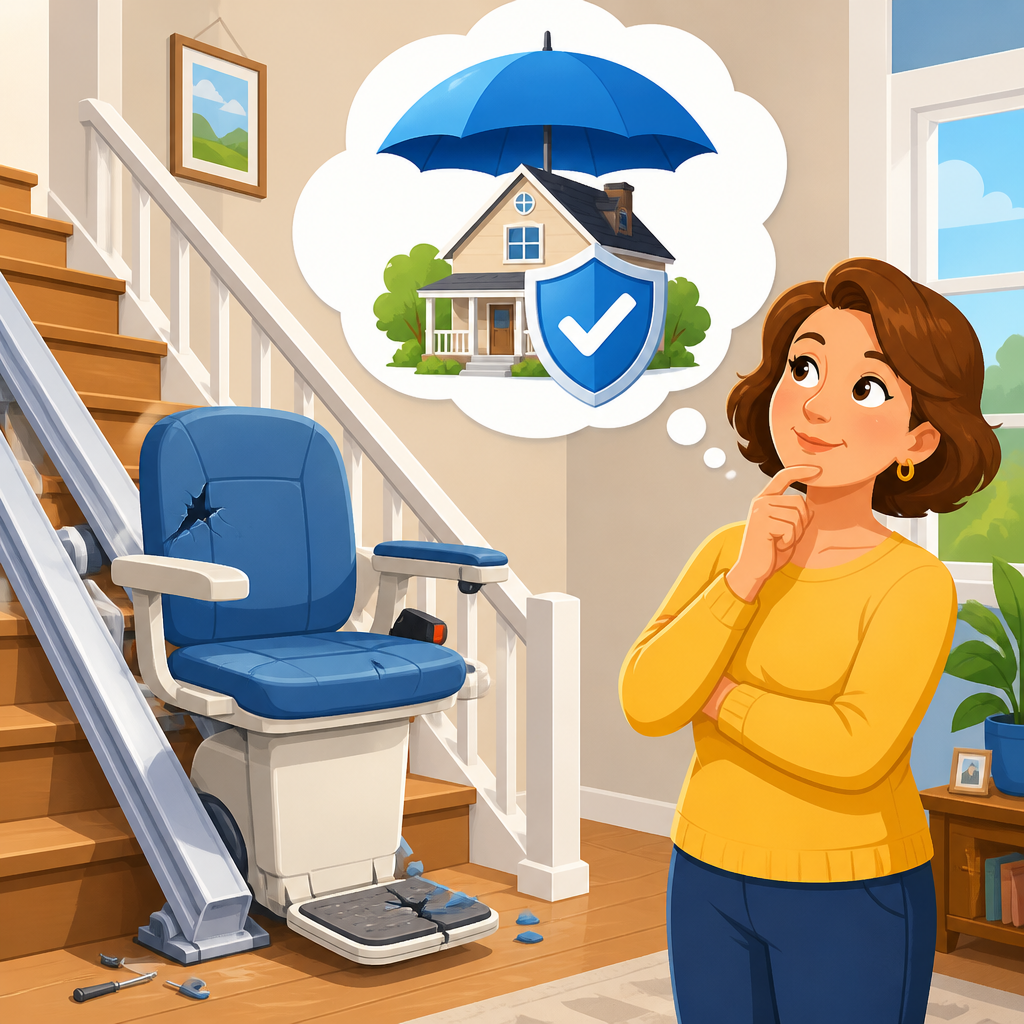
Homeowners often ask whether homeowners insurance covers stair lift damage or repairs, and the short answer is that it depends on why the damage happened, how the stair lift is classified, and what the policy excludes. A stair lift, sometimes called a chair lift for stairs, is a motorized seat that travels on a rail mounted to a staircase so a person with mobility limitations can move safely between floors. In insurance terms, the key question is whether the lift is treated as part of the dwelling, as attached equipment, or as medical equipment with limited property coverage. I have reviewed many policy forms and claims scenarios, and the outcome usually turns less on the lift itself than on the cause of loss. If a burst pipe soaks the motor, a covered water claim may extend to the lift. If the motor fails from age, wear and tear is almost never covered. That distinction matters because stair lifts are expensive to install, with straight models often costing several thousand dollars and curved systems costing substantially more. For families planning around accessibility, knowing where insurance may help can prevent unpleasant surprises and guide better budgeting.
This topic matters because homeowners insurance, health insurance, Medicare, Medicaid waivers, and warranty protection each play different roles, yet many consumers lump them together under the general question, does insurance cover chair lifts. A homeowners policy is designed primarily to insure the house and personal property against sudden, accidental, and named or open-peril losses, depending on the form. It is not a maintenance contract. It usually will not pay simply because a stair lift stopped working, the battery weakened, or the gear rack wore down. However, a policy may respond when a covered peril such as fire, lightning, wind, vandalism, or certain types of water damage harms the lift. Liability and medical payments coverage may also become relevant if the lift contributes to an injury claim, though that analysis is separate from repair reimbursement. As a hub article under cost and financing, this guide explains what homeowners insurance may cover, what it usually excludes, how claims are evaluated, and which other programs may help pay for stair lift costs, repairs, or replacement.
How homeowners insurance usually treats stair lifts
In practice, most insurers analyze a stair lift under the dwelling coverage section if it is permanently attached to the home, especially when the rail is bolted to stair treads or structure and the electrical connection is dedicated. Some adjusters instead evaluate parts of the system under other structures or personal property if the installation is less integrated, but permanently installed lifts are commonly handled as part of the residence premises. The classification affects limits and valuation, yet the central rule remains the same: coverage depends on a covered cause of loss. On a standard HO-3 policy, the dwelling is often insured on an open-perils basis, meaning direct physical loss is covered unless excluded. That sounds broad, but exclusions are exactly where many stair lift repair questions are decided. Mechanical breakdown, neglect, rust, corrosion, latent defect, smog, settling, and normal wear are commonly excluded or limited. If the chair lift motor burns out because components aged over time, that is a maintenance issue, not an insured event.
When people ask, does homeowners insurance cover stair lift damage, I tell them to think in scenarios. If a kitchen fire sends smoke through the stairwell and damages the upholstery, wiring, and call stations, that is the type of sudden accidental loss policies were built to cover. If a tree falls during a windstorm, breaks a roofline, and rain enters, damaging the upper rail electronics, coverage may apply because the water followed a covered opening caused by wind. If a contractor accidentally drops debris during unrelated remodeling and bends the rail, coverage may involve the contractor’s liability insurer first, though your own policy might respond subject to deductible and subrogation. These examples show why policy language and facts matter more than broad assumptions. The lift’s status as accessibility equipment does not automatically create or eliminate coverage; the triggering peril still drives the claim decision.
Covered causes of loss that may pay for stair lift damage
The most common path to coverage is direct physical damage from a peril the policy covers. Fire is the clearest example. If a house fire damages the stair lift track, seat assembly, charger, and wiring harness, the insurer typically includes those items in the building repair estimate or in a specialty line item. Lightning can also damage electronic boards, chargers, and battery systems, especially in homes without whole-house surge protection. Wind and hail may matter when a storm damages the structure and creates openings that allow water intrusion to reach the lift. Vandalism is another possible covered peril if someone intentionally damages the unit during a break-in. In each case, documentation helps: photographs, the installer’s invoice, maintenance records, and a technician’s report tying the damage to the event rather than to preexisting failure.
Water losses require more nuance. Sudden and accidental discharge from plumbing, heating, air conditioning, or household appliances is commonly covered, subject to the exact policy form. For example, if a second-floor supply line bursts and water runs down the stairwell, soaking the chair lift carriage and shorting the controls, the resulting damage may be covered. By contrast, long-term seepage, repeated leakage, flood water entering from outside, and sewer backup are frequently excluded unless specific endorsements were purchased. Earth movement and flood are especially important limitations. If a basement floods after heavy rain and moisture damages the lower charge point of a stair lift, a standard homeowners policy usually will not cover that unless the policyholder carries separate flood insurance and the facts fit that form. Knowing the source and timing of water is often the difference between approval and denial.
What homeowners insurance usually excludes for stair lifts
The largest category of denied claims is ordinary mechanical failure. Stair lifts contain motors, batteries, gears, rollers, sensors, charge contacts, and controls that wear out over time. Homeowners insurance does not function like a service agreement, so failures caused by age, use, lack of maintenance, or inherent defect are generally excluded. I regularly see confusion around batteries because they feel like replaceable parts rather than major components, but that is exactly why policies usually do not pay for them. A battery losing capacity after years of charging cycles is predictable deterioration, not a fortuitous loss. The same logic applies to frayed seat belts, worn swivel mechanisms, noisy carriage rollers, and rails that need routine adjustment. Even when the failure creates inconvenience or safety concerns, the policy response is usually no.
Another common exclusion issue involves manufacturer defects and installation problems. If the stair lift stops because an internal control board was defective from the factory, the better remedy is warranty service or action against the seller, not a homeowners claim. If the installer anchored the rail incorrectly and the unit loosens, that points to workmanship. Insurers are also skeptical when there is no visible external event and the only evidence is that the unit suddenly quit. They may request inspection reports to determine whether the loss came from power surge, water, impact, or simple breakdown. Cosmetic damage presents another limitation. Minor scratches on the rail from moving furniture may not exceed the deductible, and some policies restrict payment where function is unaffected. In short, if there is no covered peril, there is usually no coverage, even if the stair lift must be replaced for safety reasons.
How policy details, endorsements, and settlement rules affect payment
Even when a peril is covered, payment depends on deductibles, valuation, limits, and policy endorsements. Many homeowners carry deductibles from $500 to several thousand dollars. If a service technician quotes $1,200 to replace storm-damaged electronic components and your deductible is $1,500, the claim may produce no payout. Replacement cost versus actual cash value also matters. Some policies settle dwelling components at replacement cost if repaired or replaced promptly, while others reduce payment for depreciation, especially if the lift is treated under personal property terms. A ten-year-old stair lift may still be functional, but if the insurer values it on an actual cash value basis, age and obsolescence can significantly reduce reimbursement. That is important because stair lift parts can become proprietary, and older rails may require complete system replacement rather than component repair.
Equipment breakdown coverage is one endorsement worth checking. This add-on, offered by many carriers, can cover sudden accidental mechanical or electrical breakdown of home systems and certain permanently installed equipment. It does not transform the policy into a maintenance plan, but it may help with motor burnout, electrical arcing, or power surge damage that a base policy would not cover. Terms vary widely, so homeowners should confirm whether accessibility equipment such as stair lifts is included, excluded, or subject to sublimits. Service line coverage, water backup endorsements, and ordinance or law coverage can also affect claim value. If local code requires upgraded electrical work when a damaged stair lift is replaced, ordinance or law coverage may help with the additional compliance cost. Reading declarations and endorsements closely is essential because two policies from different carriers can treat the same loss very differently.
| Scenario | Typical homeowners coverage outcome | Why |
|---|---|---|
| Fire damages rail and seat | Often covered | Fire is a standard covered peril causing direct physical loss |
| Battery no longer holds charge | Usually not covered | Normal wear and tear or maintenance issue |
| Burst pipe soaks motor and controls | Often covered | Sudden accidental discharge is commonly covered |
| Floodwater enters from outside | Usually not covered | Flood requires separate flood insurance |
| Motor fails from age | Usually not covered | Mechanical breakdown and deterioration exclusions apply |
| Lightning fries circuit board | Often covered | Lightning is a covered peril; surge damage can qualify |
| Installer mounted rail incorrectly | Usually not covered by homeowners | Workmanship issue, better addressed by installer or warranty |
Does health insurance, Medicare, or Medicaid cover chair lifts?
Because this page is the hub for does insurance cover chair lifts, it is important to separate homeowners insurance from health-related coverage. Original Medicare generally does not cover stair lifts because they are usually considered home modifications or convenience items rather than durable medical equipment used primarily for a medical purpose in the way Medicare defines that category. Medicare Part B may cover some mobility equipment, but stair lifts typically fall outside those rules. Medicare Advantage plans sometimes offer supplemental benefits, yet coverage is inconsistent and often limited to broader home support allowances rather than direct payment for the lift itself. Private health insurance plans also rarely pay for stair lifts, though some flexible spending accounts or health savings accounts may allow reimbursement if a physician documents medical necessity and the expense qualifies under tax rules. That can reduce out-of-pocket cost even when insurance does not directly reimburse the purchase.
Medicaid is more promising, though still uneven. Many states use Home and Community-Based Services waivers to support aging in place and may help pay for accessibility modifications, including stair lifts, when medically necessary and cost-effective compared with institutional care. Veterans may also have options through the Department of Veterans Affairs, including grants tied to home accessibility for service-connected disabilities, although eligibility standards are specific. Workers’ compensation or personal injury settlements can sometimes fund a stair lift if the mobility limitation resulted from a covered injury. In my experience, the biggest mistake families make is filing the wrong type of claim first and assuming a denial from one program settles the entire question. It does not. Homeowners insurance addresses accidental property damage; health-related programs address medical necessity and functional independence. Those are different pathways with different documentation requirements.
How to file a stair lift insurance claim and improve your odds
If a covered event damages your stair lift, move quickly and document everything. Start by preventing further loss if it is safe to do so, such as shutting off water, placing a tarp over an opening, or switching off power to the unit if advised by a technician. Then photograph the staircase, the rail, the carriage, the seat, the power supply, and any related structural damage before cleanup or removal. Locate your original purchase contract, proof of payment, model number, serial number, and any maintenance records. Insurers respond better when the file clearly shows that the unit was in serviceable condition before the event. Contact the stair lift company for a written diagnostic report that states the observed damage and, crucially, the likely cause. A note saying “unit not working” is weak; a report saying “control board failure consistent with lightning surge on date of storm” is far more persuasive.
When speaking with the insurer, ask how the lift is being categorized, whether replacement cost applies, and whether an adjuster with specialty equipment experience will inspect it. Get at least one repair estimate and, if parts are discontinued, ask for a letter confirming that replacement is more practical than repair. If the claim is denied, request the denial in writing with the exact policy language cited. Some denials are correct, but others rest on incomplete facts or misclassification. A contractor’s invoice, electrician’s report, or manufacturer statement can change the outcome on review. Also weigh the claim against your deductible and claims history. Filing a small claim for a modest repair may not be worthwhile if the payout is minimal. The best approach is methodical: understand the peril, match it to the policy, assemble evidence, and escalate politely when the facts support coverage.
Choosing the right financial backup when insurance will not pay
Because homeowners insurance will not cover many stair lift repairs, households need a backup plan. The most practical protection is often a strong manufacturer warranty combined with a local service agreement. Reputable brands may offer warranties on drivetrain components, motors, gearboxes, and major electronics, while labor coverage is frequently shorter. Extended service plans can make sense for high-use lifts, curved systems with expensive custom rails, or households where downtime creates a serious safety problem. For buyers still shopping, ask about battery replacement intervals, annual maintenance costs, emergency callout fees, and parts availability. Those routine expenses matter more than many consumers expect. Financing can also help. Dealers may offer installment plans, and nonprofit or state assistive technology programs sometimes provide low-interest loans for accessibility equipment and home modification projects.
The main takeaway is straightforward. Homeowners insurance may cover stair lift damage when a covered peril such as fire, lightning, vandalism, or sudden accidental water discharge causes direct physical loss. It usually will not cover wear and tear, aging batteries, mechanical breakdown, defective workmanship, or losses tied to flood without separate protection. Health insurance and Medicare rarely pay for chair lifts, while Medicaid waivers, veterans benefits, tax-advantaged accounts, warranties, and service plans may fill part of the gap. Read your policy before you need it, review endorsements like equipment breakdown coverage, and keep installation and maintenance records organized. If you already own a lift, contact your insurer and ask how it would be treated under your current form. If you are considering a purchase, compare warranty terms and likely repair costs alongside the sticker price. A few careful questions now can save thousands later and help you plan confidently for safe mobility at home.
Frequently Asked Questions
Does homeowners insurance cover damage to a stair lift?
Sometimes, but coverage usually depends on what caused the damage. Homeowners insurance is designed to cover sudden and accidental losses tied to covered perils, such as certain types of fire, lightning, wind, vandalism, or damage from a burst pipe, depending on the policy. If a stair lift is damaged because of one of those covered events, there is a reasonable chance the policy may help pay for repairs or replacement. For example, if a house fire damages the staircase and the stair lift rail and motor along with it, that loss may fall under the dwelling or attached fixtures portion of the policy, depending on how the insurer classifies the lift.
What homeowners insurance usually does not cover is damage caused by wear and tear, age, corrosion, mechanical breakdown, lack of maintenance, or gradual deterioration. So if the motor stops working after years of normal use, the seat mechanism fails, or the battery wears out, that is generally considered a maintenance issue rather than an insurable event. In other words, the reason for the damage often matters more than the fact that the stair lift itself was damaged. The best way to know for sure is to review the policy language and ask the insurer whether the stair lift is considered part of the dwelling, an attached fixture, or personal property under that specific policy.
Is a stair lift considered part of the home or personal property for insurance purposes?
This is one of the most important questions because the answer can affect how a claim is handled. A stair lift is often installed on a rail that is mounted directly to the staircase, making it look and function like a built-in accessibility feature. Because of that, some insurers may treat it as part of the dwelling or as a permanently attached fixture. If it is classified that way, damage from a covered peril could potentially be handled under the portion of the homeowners policy that protects the physical structure of the home.
However, not every insurer classifies stair lifts the same way. In some cases, a stair lift may be viewed more like specialized equipment or personal property, especially if it is not considered fully permanent or if it can be removed without major structural changes. That distinction matters because dwelling coverage and personal property coverage can have different limits, deductibles, and claim rules. It can also affect whether replacement cost or actual cash value applies. Since policy wording and insurer interpretation vary, homeowners should not assume a stair lift is automatically covered the same way as a furnace, built-in cabinetry, or plumbing. It is smart to contact the insurer directly, explain how the lift is installed, and ask how it is classified under the policy before a claim ever becomes necessary.
Will homeowners insurance pay for stair lift repairs if the lift simply stops working?
Usually no, at least not under a standard homeowners policy. If the stair lift stops working because of a dead battery, worn motor, failed circuit board, broken switch, or other routine mechanical issue, that is generally considered maintenance, aging, or equipment breakdown. Standard homeowners insurance is not a home warranty and does not usually pay to fix household equipment just because it malfunctioned over time. This is similar to how a policy typically would not pay to replace an air conditioner that quit due to old age or a garage door opener that failed from normal use.
That said, if the stair lift stopped working because of a covered event, the answer could be different. For instance, if a lightning strike caused an electrical surge that damaged the stair lift’s control system, or if smoke and water from a covered fire loss affected the lift’s operation, then repairs might be covered subject to the policy terms and deductible. The key difference is whether the failure was sudden and caused by a covered peril, or whether it resulted from internal breakdown and ordinary use. Homeowners who want protection for equipment failure may want to ask about equipment breakdown coverage endorsements, service contracts, or manufacturer warranties, since those are sometimes better suited to this kind of loss than standard homeowners insurance.
Are stair lift damage claims subject to exclusions, deductibles, or coverage limits?
Yes, absolutely. Even when a stair lift is covered in principle, the claim still has to fit within the policy’s exclusions, limits, and deductible structure. Most homeowners policies exclude losses caused by neglect, wear and tear, rust, corrosion, latent defects, settling, and mechanical breakdown. That means a stair lift may be physically damaged, but the insurer can still deny the claim if the cause of loss falls into one of those excluded categories. For example, if the rail becomes misaligned over time or the motor burns out after years of use, the insurer will likely view that as an excluded maintenance-related issue rather than a covered loss.
Deductibles also matter in a practical sense. If a repair costs $1,200 and the homeowners policy has a $1,500 deductible, the policy may provide no payment even if the cause of damage would otherwise be covered. There may also be sublimits or valuation differences depending on whether the stair lift is covered as part of the dwelling or as personal property. Some policies reimburse on a replacement cost basis, while others may pay actual cash value if depreciation applies. Because stair lifts can be expensive specialty items, it is worth asking the insurer how claims would be valued, whether any special endorsements apply, and whether adding or disclosing the lift affects coverage in any way.
What should a homeowner do to improve the chances of insurance coverage for a stair lift?
The most helpful step is to be proactive before there is ever a problem. Homeowners should notify their insurance company after a stair lift is installed and ask how it is classified under the policy. It is wise to keep installation contracts, invoices, model information, serial numbers, and photos showing how the lift is attached to the staircase. Those records can help support both the existence and value of the lift if a claim ever needs to be filed. If the stair lift was installed as part of a larger accessibility renovation, homeowners may also want to keep documentation showing whether structural changes were made, since that can influence how the insurer views the equipment.
Regular maintenance is also important. While maintenance does not create coverage for wear and tear, it can help prevent avoidable failures and reduce disputes about neglect. If damage occurs, document the loss immediately with photos, note the date and cause, and report the claim promptly. Be ready to explain whether the damage came from a specific sudden event, such as fire, storm damage, or water from a covered plumbing issue. Finally, ask the insurer whether endorsements or additional coverage options are available for accessibility equipment or equipment breakdown. A little preparation can make it much easier to understand whether homeowners insurance may cover stair lift damage or repairs and to avoid surprises during the claims process.