


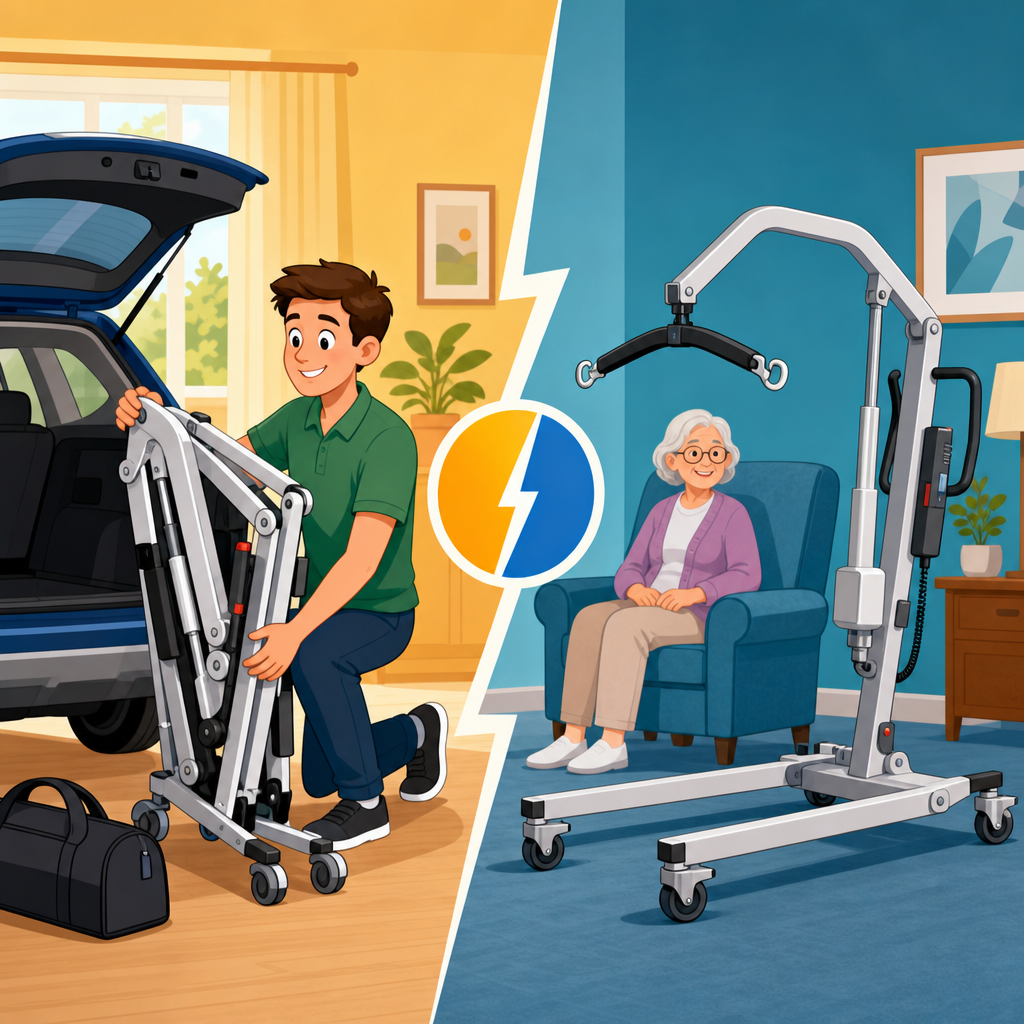
Portable lifts solve a specific mobility problem: how to provide safe seated transfers when a fixed ceiling lift, track system, or permanent floor-mounted hoist is impractical. In the field, I have seen portable lifts used in homes, rehabilitation clinics, schools, airports, hotels, and temporary care settings where space, transport, and setup time matter as much as lifting capacity. Within this category, the biggest design split is between foldable portable lift frames and rigid portable lift frames. Choosing between them affects storage, caregiver effort, transfer stability, maintenance needs, and long-term cost.
A portable lift frame is the wheeled structural base and mast assembly that supports a sling and lifting mechanism for moving a person from bed to wheelchair, chair to commode, or floor to seated surface. A foldable frame is built to collapse partially for transport or storage, usually through hinged legs, a folding mast, or quick-release joints. A rigid frame does not collapse in normal use; its geometry stays fixed, although some models may disassemble with tools or pins for service transport. Both designs can use hydraulic, battery-powered, or electric actuators, and both may support compatible slings for different body shapes and transfer tasks.
This distinction matters because portable lifts are often purchased under practical pressure. A family may need a solution after hospital discharge. A facility may need overflow equipment during renovations. A traveling caregiver may need to load a lift in a van several times a week. In each of those cases, the wrong frame design creates daily friction. The right design reduces transfer time, minimizes musculoskeletal strain for staff, supports safer handling, and fits the physical environment without constant improvisation. For anyone researching chair lift types and designs, portable lifts deserve their own hub because they combine biomechanics, room layout, transport logistics, and user-specific support needs in one decision.
The central question is not whether foldable or rigid is universally better. It is which is better for a specific use pattern. Foldable portable lift frames usually win when storage space is tight, equipment travels frequently, or a lift must pass between sites. Rigid portable lift frames usually win when the priority is maximum structural stability, faster readiness, simpler mechanical architecture, and repeated daily transfers in one place. Understanding those tradeoffs requires looking beyond product brochures and focusing on how portable lifts actually perform in homes and care environments.
What Foldable and Rigid Portable Lift Frames Are Designed to Do
Both frame types aim to support safe patient handling, but they optimize different constraints. Foldable frames are engineered around portability. Their value comes from reducing the footprint for storage in closets, vehicle cargo areas, or equipment rooms. Common examples include home-care patient lifts that fold by narrowing the base legs and releasing the mast, as well as travel-oriented lifts designed for occasional use across multiple locations. In practice, these models are often chosen by families in small apartments, outpatient teams, or agencies rotating equipment among clients.
Rigid frames are engineered around operational consistency. The base geometry, mast angle, and spreader bar alignment remain fixed, which reduces setup steps and often improves the feel of the lift under load. In high-frequency transfer environments, that matters. A rigid lift parked near a bed can be used immediately without unfolding, locking, or rechecking alignment points. That convenience sounds minor until a caregiver performs six to ten transfers in a shift. Over time, fewer setup steps usually mean better compliance with safe lifting procedures and less temptation to improvise manual transfers.
The frame type does not determine every performance factor. Battery quality, caster size, leg spread mechanism, boom range, sling compatibility, and safe working load are equally important. Standards such as ISO 10535 for hoists for the transfer of persons with disabilities provide a baseline for safety and testing. Reputable manufacturers also specify duty cycles, turning radius, lifting range, and the lowest point the spreader bar can reach. Still, foldable versus rigid remains a primary design decision because it shapes how the entire lift is used day after day.
Stability, Safety, and Transfer Confidence
Rigid portable lift frames generally provide the most confidence during repeated transfers because they eliminate hinge movement in the primary structure. Even when a foldable lift is properly engineered and fully locked, every additional joint introduces another point that must be inspected, maintained, and correctly engaged. In my experience evaluating lifts in tight bedrooms and therapy spaces, users and caregivers often describe rigid models as feeling more planted, especially when turning under load or crossing a threshold strip. That perception is not only psychological; fixed geometry can reduce micro-movements that occur when a frame includes folding interfaces.
That does not mean foldable frames are unsafe. Many are highly reliable when used within their rated capacity and according to manufacturer instructions. Modern locking mechanisms, spreader bases, and anti-entrapment features have improved markedly. However, safe performance depends more heavily on correct setup. If a caregiver rushes assembly after unloading the lift from a car, misses a locking pin, or fails to widen the base fully, transfer risk increases. The practical lesson is simple: a foldable frame can be very safe, but its margin for user error is usually narrower than that of a comparable rigid frame.
Floor conditions also affect safety. On thick carpet, ramps, uneven tile transitions, or crowded rooms, rigid frames tend to track more predictably. Larger rear casters and a wider fixed stance help distribute load and resist side-to-side sway. In contrast, some compact foldable lifts achieve portability by shortening the wheelbase or narrowing structural members. That can be acceptable for occasional transfers on smooth floors, but it may feel less stable for bariatric users, taller users, or people who become anxious when suspended.
Storage, Transport, and Setup Practicality
Foldable portable lift frames are the clear winner when equipment must be stored out of sight or transported routinely. In real homes, this is often the deciding factor. A rigid lift can dominate a bedroom corner, block closet access, or create hazards in narrow hallways. A foldable model can be collapsed after use and tucked against a wall, under certain beds, or into a utility area. For adult children caring for a parent in a shared home, that storage flexibility can be the difference between owning a lift and attempting unsafe manual assistance.
Vehicle loading is where foldable frames show their strongest advantage. Home-care agencies, accessible transportation operators, and traveling families often need a lift that fits in a minivan or SUV without removing multiple structural sections. A foldable design can cut loading height and make the device manageable for one trained person. Rigid frames, even lighter ones, are awkward because their bulk is fixed. Some can be disassembled, but repeated assembly is slower and introduces wear on fasteners and connection points.
There is a tradeoff. Every gain in compactness usually costs time at the point of use. A foldable lift must be unfolded, locked, and function-checked before transfer. In low-frequency use, that is acceptable. In urgent toileting support or nighttime bed transfers, it can be frustrating. Rigid lifts are always ready, which is why facilities often prefer them in resident rooms and why many home users who have enough space stop folding their lift after the first few weeks.
| Factor | Foldable Portable Lift Frame | Rigid Portable Lift Frame |
|---|---|---|
| Best use case | Travel, shared spaces, limited storage | Frequent daily transfers in one location |
| Setup time | Moderate; requires unfolding and locking checks | Minimal; generally ready to use |
| Perceived stability | Good when assembled correctly | Usually higher due to fixed geometry |
| Vehicle transport | Much easier | More difficult unless partially disassembled |
| Storage footprint | Smaller | Larger |
| Maintenance focus | Locks, hinges, pins, folding joints | Casters, actuator, base, sling points |
Caregiver Ergonomics, User Comfort, and Room Fit
Ergonomics often decide whether a lift gets used correctly. A portable lift that is hard to position around furniture, difficult to push, or awkward to open will encourage shortcuts. Rigid frames typically have an advantage in push feel because the structure does not shift during maneuvering. Caregivers can anticipate how the base will move around a recliner, wheelchair, or commode. Foldable lifts can feel slightly more flexible during turns, particularly if the design prioritizes compact transport over long wheelbase stability.
User comfort matters just as much. The frame affects how close the lift can approach a chair, whether the legs fit under a bed, and how smoothly the suspended person moves through the transfer arc. A well-designed rigid frame often offers better geometry for consistent seat-to-seat transfers because the mast and boom relationship does not vary between setups. Foldable frames can still perform well, but only when caregivers take time to open the base correctly and verify leg spacing. If that step is skipped, clearance and comfort suffer immediately.
Room fit is nuanced. Many people assume foldable means better in small rooms, but that is only partly true. Foldability helps with storage, not necessarily with active transfer space. During actual use, both frame types need enough floor area for leg spread, caster rotation, and caregiver access. A rigid lift with a smart open-base design may work better in a cramped bedroom than a foldable model with a bulky hinge assembly. Before buying, measure bed clearance, chair height, doorway width, and turning space. That simple step prevents many expensive mistakes.
Durability, Maintenance, and Total Cost of Ownership
Rigid portable lift frames usually have the simpler service profile. Fewer moving structural parts mean fewer wear points. In fleet environments, maintenance teams prefer designs that reduce inspection complexity and lower the chance of damage from repeated folding cycles. Casters, batteries, actuators, hand controls, emergency lowering systems, and sling attachment points still need scheduled checks, but the core frame is straightforward. That can translate into longer usable life, especially where multiple caregivers handle the same equipment.
Foldable frames require closer attention to hinges, locking collars, release pins, and telescoping sections. None of that is inherently problematic; it just means inspection discipline matters more. If a portable lift is moved in and out of vehicles, dropped over thresholds, or stored in humid garages, the folding interfaces deserve regular review for play, corrosion, or incomplete engagement. Manufacturer service manuals typically specify inspection intervals, load testing procedures, and replacement criteria. Following those recommendations is not optional when the lift supports a human load.
Total cost of ownership goes beyond sticker price. A foldable model may cost more up front because portability engineering adds hardware and design complexity. Yet it can still be the better value if it prevents delivery fees between locations or replaces two site-specific lifts. A rigid frame may cost less to maintain over five years and may spend fewer days out of service. Battery replacement, charger reliability, sling inventory, and staff training all affect budget. Buyers should compare full lifecycle costs, not just catalog pricing.
How to Choose the Better Portable Lift for Your Situation
If the lift will stay in one home room or one facility room and be used several times a day, a rigid portable lift frame is usually better. It offers faster readiness, more predictable handling, and stronger day-to-day confidence for both user and caregiver. It is the practical choice for routine bed, chair, and commode transfers where storage is not a constant problem. It is also often the safer choice for heavier users, anxious users, or environments with uneven flooring.
If the lift must travel, be stored after nearly every use, or serve temporary care arrangements, a foldable portable lift frame is usually better. It solves the real logistical problem that prevents many people from using lift equipment at all. This includes respite care, post-surgical recovery in guest rooms, agency equipment pools, and family travel. The key condition is that caregivers are trained, willing to perform setup checks every time, and working within the product’s rated capacity and environment limits.
For this portable lifts hub, the clearest guidance is to match frame design to workflow, not marketing claims. Start with transfer frequency, storage space, flooring, user size, caregiver strength, and transport needs. Then review lifting range, base width, under-bed clearance, battery system, and sling options. When possible, request an in-home or on-site trial from a dealer. A ten-minute test around the actual bed and chair setup reveals more than hours of online research. Choose the frame that makes safe transfers easiest to repeat, then explore related articles in this chair lift types and designs series to compare slings, power systems, and specialized portable lift configurations.
Frequently Asked Questions
What is the main difference between a foldable portable lift frame and a rigid portable lift frame?
The core difference is in how the frame is built and how it is meant to be used day to day. A foldable portable lift frame is designed to collapse, break down, or reduce its footprint for transport and storage. That makes it especially useful in environments where the lift needs to move between rooms, buildings, or temporary care locations. In homes with limited space, schools that share equipment, hotels, airports, and short-term rehabilitation settings, that portability can be a major advantage.
A rigid portable lift frame, by contrast, is built as a more fixed-geometry structure. It may still be technically portable in the sense that it is not permanently installed like a ceiling track, but it is generally less focused on quick folding and more focused on stability, structural consistency, and repeated use in a set location. In practice, rigid frames often feel more planted and may require less setup each time because the frame shape stays intact.
From a clinical and practical standpoint, the decision often comes down to priorities. If transport, compact storage, and flexibility across multiple care environments are most important, a foldable frame is often the better fit. If the lift will stay in one room or facility area for extended use and users want a more substantial, always-ready structure, a rigid frame may be preferable. Neither design is automatically better in all situations; the best choice depends on transfer frequency, available floor space, transportation needs, caregiver workflow, and the physical needs of the person being lifted.
Is a foldable portable lift frame as safe and stable as a rigid frame?
A well-designed foldable portable lift frame can be very safe, but safety should never be assumed based on the category alone. The real answer depends on engineering quality, proper assembly, user weight, sling compatibility, floor conditions, and whether the lift is used within its intended purpose. Reputable foldable frames are built with locking mechanisms, reinforced joints, and tested lifting capacities that allow them to perform safely when used correctly. However, because foldable models include hinges, latches, telescoping parts, or removable sections, they introduce more moving components that must be checked regularly.
Rigid frames often have an advantage in perceived stability because they usually have fewer structural transition points. That simpler construction can reduce setup errors and may inspire more caregiver confidence during repeated transfers. In busy clinical settings or high-use environments, that consistency can matter. A rigid frame may also be preferred when the user is heavier, when transfers are especially frequent, or when the lift must remain ready for immediate use without repeated assembly or repositioning.
That said, a foldable unit is not inherently unsafe. The safest frame is the one that matches the environment and is used properly every time. Caregivers should confirm weight ratings, verify that locking components are fully engaged, inspect the frame before use, ensure the base is positioned correctly, and follow manufacturer instructions for transfer technique. If a foldable frame is selected simply for convenience but is then used in a high-demand setting beyond what it was designed for, safety and performance can suffer. In short, rigid frames often offer a stability advantage, but many foldable frames are entirely appropriate and safe when chosen and maintained correctly.
Which type is better for homes, travel, and temporary care settings?
In many home and temporary care scenarios, foldable portable lift frames have the edge because they solve a practical space problem as much as a transfer problem. Private homes often do not have the room for a large, permanently assembled lifting structure. Bedrooms may be tight, bathrooms may have limited maneuvering space, and families may need to store equipment when it is not in use. A foldable frame can make the difference between having access to a lift and not having one at all.
Travel and short-term care use also favor foldable models. If a lift must be loaded into a vehicle, moved into a hotel, repositioned in an airport assistance area, or used temporarily during recovery after surgery or injury, a design that folds down more easily is usually far more manageable. Setup time matters in these situations, but so do transport weight, storage dimensions, and how easily caregivers can handle the equipment without specialized tools.
Rigid frames can still work in homes or temporary locations, especially if there is enough open floor space and the equipment will remain assembled for a period of time. Some users prefer them because they feel more substantial and may require fewer adjustments during each use. But when portability is a true operational requirement rather than a nice extra, foldable frames are often the stronger choice. The key is to think beyond the lift itself and consider doorways, flooring, vehicle transport, storage closets, assembly demands, and who will be responsible for moving the frame between uses.
When is a rigid portable lift frame the better choice?
A rigid portable lift frame is often the better option when reliability in a fixed-use area matters more than compact storage or frequent transport. If the lift will stay in one bedroom, treatment room, classroom support area, or rehabilitation space for ongoing transfers, a rigid frame can offer a more straightforward long-term workflow. Caregivers do not need to repeatedly fold, unfold, or reconfigure the structure, and that can save time while reducing the chances of setup mistakes.
Rigid frames are also commonly preferred in environments where transfer volume is higher. In rehabilitation clinics, schools, or care settings where multiple transfers may happen throughout the day, the predictability of a rigid frame can be valuable. It may provide a more consistent feel for both the caregiver and the person being lifted, which can support confidence and smoother handling. In some cases, rigid designs are also better suited to larger users, more demanding duty cycles, or situations where the lift remains assembled and available at all times.
Another factor is user presentation and transfer complexity. If the individual being transferred has significant postural instability, high anxiety during movement, or needs very controlled, repeatable positioning, some caregivers prefer the steadier feel of a rigid frame. Again, this is not universal, because actual performance depends on the specific model, but it is a common reason rigid systems are selected. In general, if you do not need to regularly transport or store the frame and your highest priorities are consistency, readiness, and structural simplicity, a rigid portable lift frame is often the better fit.
What factors should you compare before choosing between foldable and rigid portable lift frames?
The most important comparison points are use environment, transfer frequency, user needs, caregiver capacity, and equipment logistics. Start with where the lift will be used. A frame that works well in a spacious clinic may be frustrating in a small home bathroom or crowded bedroom. Measure floor space, bed clearance, doorway widths, turning radius, and storage area. If the lift must be moved between sites, also consider vehicle loading, transport dimensions, and whether one or two people are needed to handle it safely.
Next, evaluate how often the lift will be used and by whom. A foldable frame may be ideal for occasional or rotating use, but if staff or family members are doing many transfers every day, the simplicity of a rigid frame may outweigh the convenience of foldability. Think carefully about setup time, assembly steps, locking mechanisms, and maintenance checks. More moving parts can mean more inspection points, and in real-world care settings, ease of use strongly affects safety.
User-specific clinical needs should also guide the decision. Confirm the safe working load, lifting range, base clearance, sling compatibility, and whether the frame geometry supports the transfers you need to perform, such as bed to chair, chair to commode, or seated transfers in tighter spaces. A model that is easy to transport but awkward during actual transfers is not a good choice. Likewise, a highly stable rigid frame may still be impractical if it cannot fit the room or be moved where needed.
Finally, look at the full ownership picture: durability, service support, cleaning requirements, replacement parts, training needs, and how the frame fits into daily routines. The best choice is rarely about one feature alone. Foldable frames excel when portability and storage are central concerns. Rigid frames excel when consistency, immediate readiness, and repeated-use stability matter most. Comparing those tradeoffs honestly against the real care setting is the smartest way to choose.