


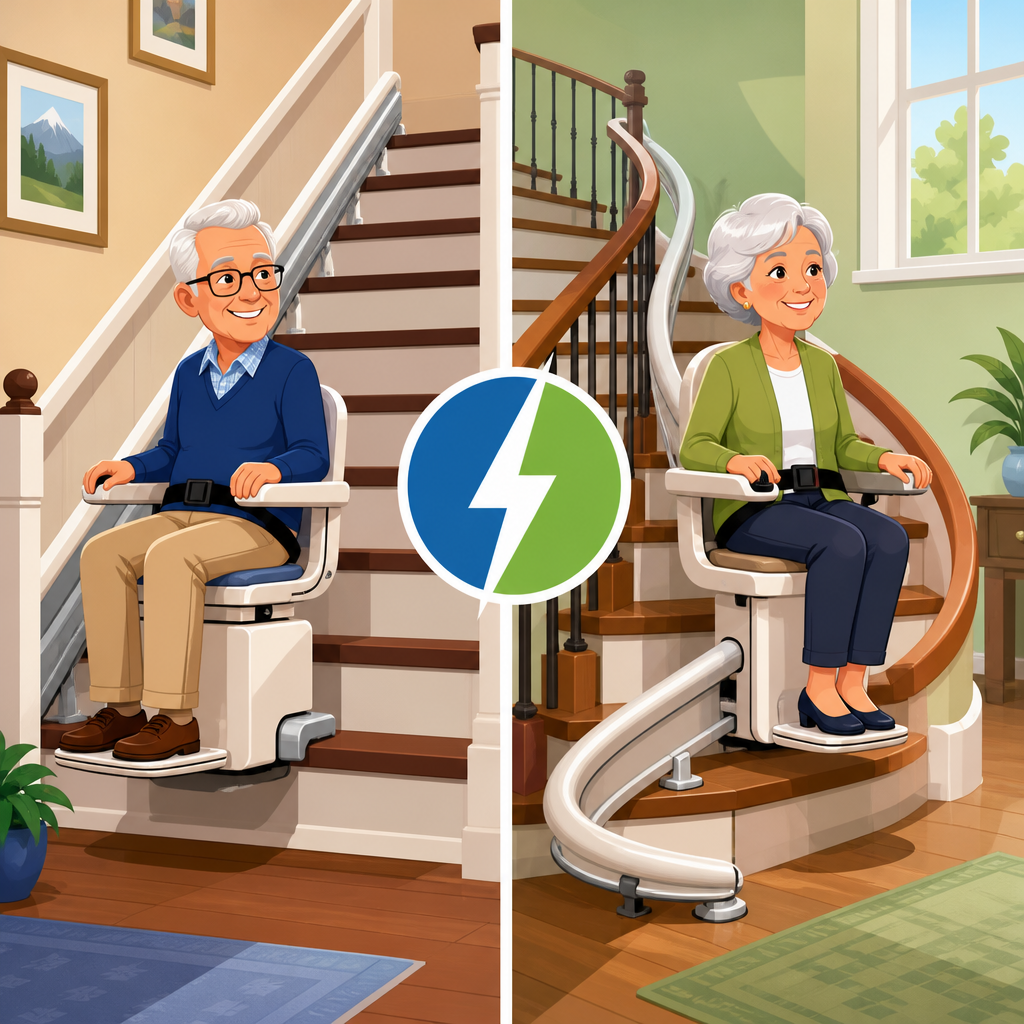
Choosing between the Harmar Pinnacle and Harmar Helix starts with understanding a simple fact: these stair lifts solve different problems, fit different staircases, and create different long-term ownership experiences. In stair lift buying guides, brand names often overshadow the practical issues that determine satisfaction after installation. I have seen shoppers focus on seat style or advertised weight capacity while missing the bigger questions of rail design, ride quality, maintenance access, and how well a lift fits the exact geometry of the staircase. For anyone researching top stair lift brands, this comparison matters because Harmar is one of the most recognized names in the category, and the Pinnacle and Helix are two of its most discussed models. The Pinnacle is Harmar’s established straight stair lift line, designed for staircases that run in a single uninterrupted path. The Helix is Harmar’s curved stair lift, built for stairs with turns, landings, or complex transitions. Straight stair lifts generally use standardized rails and faster installation. Curved stair lifts are custom fabricated to match the home. That difference affects price, lead time, service, and even resale value. This article explains how the Harmar Pinnacle and Helix compare in design, comfort, performance, installation, safety, and cost, while also placing them in the wider context of top stair lift brands such as Bruno, Stannah, Handicare, and Acorn. If you want a practical buying framework, this page will help you decide which Harmar model fits your home and which competing brand deserves a side-by-side quote.
Where Harmar Fits Among Top Stair Lift Brands
Harmar has built a strong position in North America by offering stair lifts, vertical platform lifts, vehicle lifts, and home access equipment through a broad dealer network. In real buying situations, that dealer network matters almost as much as the hardware. A well-installed stair lift from a responsive local provider tends to outperform a premium model supported poorly. Among top stair lift brands, Harmar is usually evaluated alongside Bruno for heavy-duty straight lifts, Stannah for custom engineering and ride refinement, Handicare for model variety, and Acorn for broad consumer awareness. Harmar’s reputation is strongest when shoppers want practical features, serviceable designs, and options that cover both standard and more specialized needs.
The Pinnacle and Helix illustrate Harmar’s two main stair lift paths. The Pinnacle addresses the largest segment of the market: homes with straight staircases. Dealers often recommend it because it is compact, familiar to technicians, and usually available more quickly than custom systems. The Helix targets homes where straight units simply will not work, including L-shaped, U-shaped, spiral-adjacent, or multi-landing stair runs. In those homes, the comparison is less about whether a curved lift is necessary and more about whether Harmar’s curved solution compares favorably with alternatives from Bruno Elite Curved, Handicare Freecurve, Stannah Sadler-style configurations, or Acorn’s modular curved offerings. As a hub article for top stair lift brands, the key point is clear: Harmar deserves serious consideration, but the best model depends first on staircase layout and second on user priorities such as weight capacity, seat ergonomics, transfer safety, and dealer support.
Harmar Pinnacle Overview: Best Fit for Straight Staircases
The Harmar Pinnacle is a straight stair lift family intended for staircases without curves, intermediate turns, or split landings. In plain terms, if a rail could run from the bottom step to the top step in one line, the Pinnacle is in its element. The design is known for a slim folded profile, battery-powered operation, and a rail mounted to stair treads rather than the wall. That tread-mounted approach is standard in the industry and means most homes do not need structural wall modifications. For many buyers, the biggest advantage is straightforwardness. The rail is standardized, the installation process is more predictable, and replacement parts are generally easier to source than parts for one-off custom curved systems.
In homes I have evaluated, the Pinnacle tends to work best where hallway clearance is tight and family members still walk the stairs daily. Folded width matters because residential staircases commonly narrow to around 30 to 36 inches. A compact seat and footrest reduce obstruction risk. Harmar has also offered heavy-duty variants in its straight lineup, giving buyers more flexibility if user weight, body frame, or transfer space is a concern. The straight-lift category is where buyers can compare top stair lift brands most directly because product purpose is similar across manufacturers. That makes details like rail charging points, swivel-seat effort, call-send controls, and service intervals more important than headline marketing claims.
Harmar Helix Overview: Built for Curves, Landings, and Complex Layouts
The Harmar Helix is designed for staircases that change direction or include intermediate landings. A curved stair lift is custom measured so the rail follows the exact path of the staircase while preserving as much walking space as possible. This is the central difference between the Helix and Pinnacle: the Helix is not simply a fancier model, but a different engineering solution. It addresses conditions a straight lift cannot. In many two-story homes with entry foyers, wraparound staircases, or ninety-degree turns, a curved system is the only practical seated option short of remodeling or installing a residential elevator.
Custom curved lifts require precise surveying, often using digital measurement tools and software-assisted layout planning. Small errors in measurement can affect clearances at turns, parking positions, and seat-to-landing transfer alignment. That is why dealer experience becomes critical. The Helix competes in a category where craftsmanship and configuration control matter as much as the brand label. When specified well, a curved lift can park around a corner, reduce visual impact, and improve safety by allowing the rider to get on and off away from the edge of the stairs. Those are meaningful benefits, especially for users with balance issues, reduced knee stability, or caregivers assisting during transfers.
Key Differences: Stair Type, Cost, Speed, and Ownership Experience
The simplest comparison is this: choose the Pinnacle for straight stairs and the Helix for curved or multi-landing stairs. But real buying decisions involve more than staircase geometry. Straight lifts usually cost far less than curved lifts because rails are standardized and installation is faster. Curved lifts cost more because the rail is fabricated for one home, with more design labor and more complex installation. Lead times differ too. A straight Pinnacle may be installed relatively quickly, while a Helix often requires surveying, manufacturing, and scheduling around custom delivery.
Ownership experience also differs. Straight lifts are easier to relocate or replace. Some dealers even offer reconditioned straight units. Curved lifts are much harder to reuse because the rail shape is home-specific. If a homeowner plans to move within a year or two, that affects the value equation. Ride feel can differ as well. Curved lifts need controlled speed through turns and smooth transitions at changing angles. Good engineering makes that movement feel secure rather than abrupt. Safety systems on both models typically include seat belts, obstruction sensors, battery backup, and swivel seating, but the practical safety benefit often comes from how naturally the user can board and exit at each landing.
| Feature | Harmar Pinnacle | Harmar Helix |
|---|---|---|
| Staircase type | Straight run only | Curved, angled, or multi-landing stairs |
| Rail design | Standard straight rail | Custom fabricated rail |
| Installation timeline | Usually faster | Usually longer due to custom build |
| Typical price range | Lower | Higher |
| Ease of reuse | Higher | Lower |
| Best buyer profile | Needs practical mobility on a straight staircase | Needs tailored access on a complex staircase |
Comfort, Safety, and Daily Usability
Comfort is not just about cushioning. It includes seat height, back support, armrest shape, footrest stability, and how easy it is to rotate the seat at the top landing. In evaluations with older adults, I pay close attention to transfer mechanics. A rider may tolerate a slightly firmer seat if the swivel action is secure and the standing movement feels controlled. The Pinnacle often appeals to users who want a simple, compact unit that does not dominate the staircase. The Helix often wins on placement flexibility because the custom rail can position start and stop points more effectively around real household traffic patterns.
Safety features should be judged in context, not as a checklist. Nearly every top stair lift brand offers battery backup and obstruction sensing, but the implementation matters. A footrest sensor that stops instantly when it contacts an object is more important than a flashy brochure claim. Likewise, the best seat belt is the one a rider will actually use. On a curved staircase, proper rail routing can improve safety by moving the transfer point away from stair edges. On a straight staircase, a clean overrun option can create a safer dismount area at the top or bottom. Buyers with arthritis, Parkinsonian symptoms, or post-stroke weakness should test control ergonomics carefully. Large rocker switches and responsive call-send remotes are practical quality-of-life features.
Installation, Maintenance, and What Dealers Should Measure
Installation quality determines whether a stair lift feels like a dependable mobility tool or a daily frustration. For the Pinnacle, installers need accurate stair measurements, tread condition checks, power location planning, and clear confirmation of user size and transfer needs. For the Helix, the process is more involved. Precise mapping of each turn, riser, tread depth, landing clearance, handrail interference, and final parking position is essential. Good dealers measure not only the staircase, but also the user. Hip width, knee bend, transfer side preference, and whether the rider uses a cane or walker can influence seat choice and stop location.
Maintenance should be discussed before purchase. Ask who services the lift, what response times look like, whether technicians stock common parts locally, and how battery replacement is handled. Stair lifts are usually charged from household current while running on batteries, so they can continue working during many power outages, but batteries are consumable items. Top stair lift brands vary in service coverage more than marketing materials suggest. A dependable local Harmar dealer can outperform a prestigious brand with thin regional support. Ask for the exact warranty on the motor, gearbox, electronics, and rail, and clarify what labor is covered after installation. That is where ownership costs often diverge from the initial quote.
How Harmar Compares With Bruno, Stannah, Handicare, and Acorn
Buyers researching top stair lift brands should never stop at one quote. Bruno is frequently compared with Harmar because both are strong in the U.S. market and both have respected straight-lift options. Bruno often stands out for robust build quality and premium feel, while Harmar is regularly chosen for practical value and dealer availability. Stannah has a long history and a reputation for refined ride quality and sophisticated custom solutions. Handicare offers a broad lineup and is often considered when shoppers want configuration flexibility. Acorn is highly visible and easy to find, but buyers should still evaluate local service depth and fit details carefully rather than relying on brand familiarity alone.
Against that backdrop, the Pinnacle is most competitive when a homeowner wants a compact straight lift from a recognized manufacturer with established dealer support. The Helix is compelling when a buyer needs a curved solution and receives a strong local installation team with proven custom measurement experience. In my experience, the best quote is rarely the cheapest or the most expensive. It is the one that clearly explains rail layout, transfer safety, service terms, and why that specific model suits the rider’s body and staircase. That standard should guide every comparison across top stair lift brands.
Which Model Should You Choose?
The decision framework is straightforward. If your staircase is straight, start with the Harmar Pinnacle and compare it against straight models from Bruno, Handicare, Stannah, and Acorn. If your staircase turns, bends, or includes landings, focus on the Harmar Helix and other custom curved lifts. Then narrow the choice by testing seat comfort, confirming folded clearance, reviewing service commitments, and asking where the rider will safely get on and off. Price matters, but transfer safety and dependable service matter more because they affect every single use.
For most buyers, the Pinnacle delivers the better value on straight stairs because it is simpler, faster to install, and easier to support over time. The Helix justifies its higher cost when a home requires custom routing and safer parking positions around corners or landings. Both can be strong choices within the top stair lift brands category when matched to the right staircase and installed by a capable dealer. The smart next step is to schedule in-home assessments from at least two providers, request a written layout and warranty breakdown, and compare not only the equipment, but the people who will stand behind it.
Frequently Asked Questions
What is the main difference between the Harmar Pinnacle and the Harmar Helix?
The biggest difference is that these two stair lifts are typically chosen for different staircase types and different ownership priorities. The Harmar Pinnacle is best known as a straight stair lift platform, designed for standard staircases that run in a single line without turns, landings, or curves. It has built a strong reputation because it is compact, efficient, and practical for homes where space on the stairs matters. The Harmar Helix, by contrast, is a curved stair lift system intended for staircases with bends, intermediate landings, spirals, or other non-linear layouts. That means the comparison is not simply about which model is “better,” but which one is appropriate for the physical structure of the staircase and the expectations of the user.
From a buying perspective, this matters because the rail design drives almost everything else. A straight lift like the Pinnacle usually has a more standardized rail, faster installation timeline, and lower overall project cost. A curved lift like the Helix uses a custom-built rail designed around the exact measurements of the home, which affects price, manufacturing lead time, and long-term service considerations. Ride feel can also differ because curved systems are engineered to navigate turns and transitions, while straight systems focus on simple up-and-down travel. In other words, the real decision begins with staircase configuration, then moves into comfort, budget, maintenance access, and how long the homeowner expects to remain in the property.
How do I know whether I need a straight stair lift like the Pinnacle or a curved model like the Helix?
The answer starts with the staircase itself, not the brochure. If the staircase goes straight from bottom to top with no curves, no directional changes, and no intermediate landings that require the lift to turn, a straight model such as the Harmar Pinnacle is often the logical fit. Straight stair lifts are generally simpler products because the rail can be mounted in a single line, and that usually translates into easier planning, quicker installation, and lower cost. For many homeowners, that simplicity is a major advantage, especially when mobility needs are urgent.
If the staircase has one or more turns, a 90-degree or 180-degree change in direction, multiple levels connected by landings, or an unusual shape, the Harmar Helix becomes the more relevant option because it is designed to follow a custom path. Curved stair lifts are not interchangeable with straight lifts, and trying to force a straight-lift mindset onto a curved staircase usually leads to disappointment. This is why a professional in-home assessment is so important. The dealer or installer should measure stair width, check headroom, identify obstructions, evaluate parking locations at the top and bottom, and discuss how the user gets on and off the seat safely.
Another important point is that “fit” means more than whether the rail can physically be installed. A proper recommendation also considers who will use the lift, whether multiple people share the stairs, how much folded clearance remains for walkers on the staircase, and whether the parking position reduces trip hazards. So while the general rule is straight stairs equal Pinnacle and curved stairs equal Helix, the best choice is confirmed by a full site evaluation focused on safety, usability, and day-to-day convenience.
Is the Harmar Pinnacle or the Harmar Helix more comfortable to ride?
Comfort depends on several factors, including seat design, body support, ride smoothness, start-and-stop behavior, and how well the lift matches the staircase layout. The Harmar Pinnacle is often appreciated for delivering a straightforward, efficient ride on straight staircases. Because it travels on a direct path without needing to navigate turns, many users find the experience predictable and uncomplicated. For people who value a simple transfer onto the seat and a compact lift that does not dominate the staircase, that can feel very comfortable in a practical sense.
The Harmar Helix, however, is engineered for a different kind of challenge: maintaining a smooth and secure feeling while traveling through bends and changing directions. On a curved staircase, that ability is essential. A well-designed curved lift should feel stable through transitions and should position the rider in a way that remains comfortable and confidence-inspiring throughout the trip. For some buyers, especially those who are anxious about mobility equipment, that sense of security is just as important as cushioning or armrest shape.
It is also important to remember that comfort is highly personal. One user may care most about seat height, another about swivel-seat operation at the landing, and another about how gentle the ride feels when the lift starts moving. That is why a showroom test ride, if available, can be helpful. If a test ride is not possible, ask detailed questions about seat dimensions, folding features, footrest design, and how the lift behaves at charging points and landings. In many cases, the most comfortable model is not the one with the flashiest feature list, but the one that matches the user’s body, confidence level, and staircase layout most naturally.
How do cost, installation, and long-term ownership compare between the Pinnacle and the Helix?
In most cases, the Harmar Pinnacle will be less expensive to buy and quicker to install than the Harmar Helix because straight stair lifts are simpler systems. The rail is generally standardized, the measurement process is more straightforward, and installation can often be completed faster than with a curved project. That makes the Pinnacle especially attractive for households that need a mobility solution soon or are working within a tighter budget. It can also be a more practical option for temporary needs, depending on the user’s situation and the condition of the home.
The Harmar Helix typically represents a larger investment because curved stair lifts require a custom rail manufactured to the exact dimensions of the staircase. That customization is what allows the lift to serve homes that a straight model simply cannot accommodate, but it also affects price and timeline. Buyers should expect a more involved planning process that includes detailed measurements and production lead time before installation. In return, the lift can provide full access across complex stair configurations without forcing the homeowner to relocate or attempt risky stair use.
Long-term ownership is where many shoppers overlook critical details. Maintenance access, service support, battery replacement expectations, rail cleanliness, and part availability all influence satisfaction over time. A straight lift may be easier and less costly to service simply because the system is less complex. A curved lift may be more specialized, so the quality of the local dealer becomes even more important. Ask who handles warranty work, how quickly service calls are typically scheduled, whether annual maintenance is recommended, and what happens if the home is sold. The right buying decision is not just about the day of installation; it is about how reliable, supportable, and convenient the lift will be over the years.
What should I ask a stair lift dealer before choosing between the Harmar Pinnacle and Helix?
Start with staircase compatibility and safety. Ask the dealer which model truly fits the staircase and why. Request a clear explanation of rail placement, folded clearance, seat height, transfer safety at the top landing, and whether any doorways, trim, radiators, or other obstacles affect installation. If the recommendation is the Harmar Helix, ask how the custom rail is measured, what the production timeline looks like, and how they ensure the final fit is accurate. If the recommendation is the Harmar Pinnacle, ask whether a track overrun or parking option would improve safety getting on and off the lift.
Then move into ownership questions that reveal the real quality of the purchase. Ask who performs the installation, whether technicians are factory trained, what the labor warranty covers, and how service is handled after the sale. Find out how the batteries charge, what routine maintenance is recommended, and how common replacement parts are. It is also smart to ask about ride expectations: how smooth the lift feels, how it behaves during a power outage, and what controls are easiest for the user to operate if hand strength or dexterity is limited.
Finally, ask the dealer to compare the practical trade-offs rather than simply listing features. A trustworthy professional should be able to explain why a particular rail design, seat configuration, or parking position will make daily life easier. That is the kind of guidance that leads to satisfaction after installation. The best dealer conversation should leave you with more than a product quote; it should give you confidence that the chosen lift matches the home, the user, and the long-term realities of living with the equipment every day.