


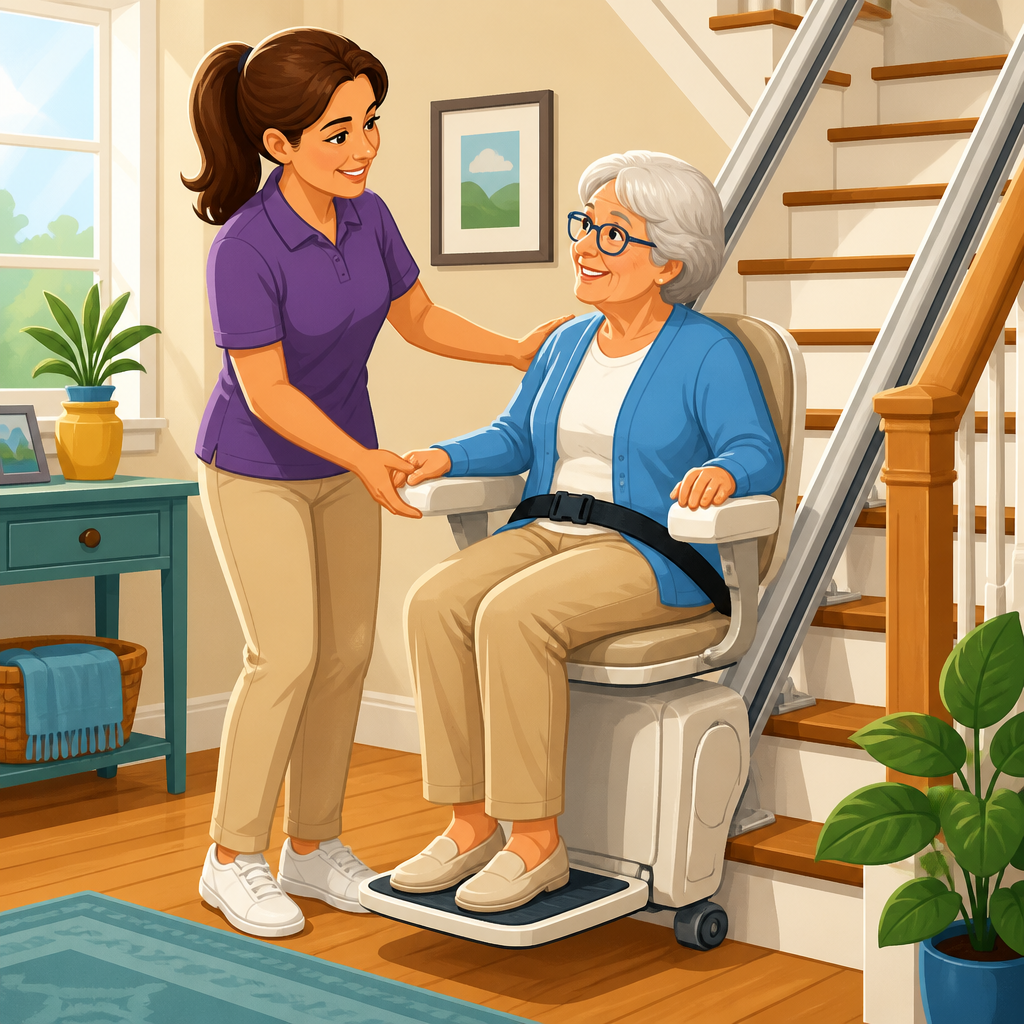
Helping someone get on and off a stair lift safely sounds simple, but entry and exit are the moments when balance, timing, posture, and caregiver technique matter most. In homes where a stair lift supports aging in place, the goal is not merely transportation between floors; it is safe transfers that protect the rider’s dignity and the caregiver’s body mechanics. By stair lift entry and exit, I mean the full transfer process: approaching the seat, sitting down in alignment, securing the body, rotating or positioning at the landing, standing up, and clearing the chair without a stumble or twist. Overreaching, in this context, happens when a caregiver stretches, pulls, leans, or lifts beyond a stable base of support, increasing the risk of falls, shoulder strain, and back injury.
This topic matters because transfer-related incidents are common in home mobility care. In practice, I have seen stair lifts function perfectly while the unsafe part happened before the ride even began: a rushed pivot, feet placed unevenly, an unlocked seat, or a caregiver trying to haul a person upright by the arms. Good stair lift safety is therefore a transfer problem as much as a mechanical one. It combines user safety best practices, home setup, communication, equipment checks, and realistic limits on what one helper can do. When caregivers understand how to assist without overreaching, they reduce fall risk, preserve independence, and create a repeatable routine that works every day.
A stair lift is a motorized chair that travels along a rail attached to the staircase, usually with a seat belt, footrest, armrests, call/send controls, and swivel features at the landing. Most manufacturers, including Bruno, Stannah, Handicare, and Acorn, publish operating guidance that emphasizes seated travel, clear foot placement, and using the swivel lock before standing at the top landing. Those instructions are not minor details. They are the basis of safe use. For caregivers, the key principle is simple: assist the person to do as much as they safely can, but do not substitute pulling for proper positioning. That principle runs through every best practice in this hub article.
Safe assistance starts before contact. The caregiver should confirm the stair lift is powered, parked correctly, and free of obstructions; the user should wear secure footwear, not socks on polished wood or loose slippers. The area at both landings needs adequate lighting, a stable handhold if one is part of the care plan, and enough clear floor space to turn without backing into clutter. If any step in the process requires the caregiver to reach across the rider, twist over the staircase edge, or block the user’s natural path of movement, the setup needs to change. The safest routine is the one that keeps both people close to neutral posture, facing the task squarely, and working in small, controlled movements.
Positioning the Stair Lift and Preparing the Transfer Zone
The safest entry and exit begin with setup. Park the chair at a height and orientation that minimize awkward movement. At the lower landing, the seat should be fully lowered and stable, with the footrest folded or unfolded according to the manufacturer’s transfer sequence and the user’s ability. At the upper landing, a powered or manual swivel seat should lock into position before the user stands. If the chair does not lock cleanly, treat that as a maintenance and safety issue, not a minor inconvenience. A sticky swivel, loose armrest, or delayed stop can turn a routine transfer into a near fall.
Clear the transfer zone at both ends of the rail. Remove baskets, cords, pet items, and mats that slide. Verify that the edge of the top landing is visually obvious; if depth perception is poor, use contrast tape recommended for flooring transitions, not anything that creates a trip edge. Keep commonly used mobility aids, such as a cane or walker, parked where the user can reach them after standing without twisting. The user should not have to step sideways to fetch a device while the caregiver is holding them off balance. In several homes I have assessed, simply moving the walker six inches closer to the seat exit path made the transfer substantially safer.
Body mechanics matter here. The caregiver should stand close enough to cue and guard, but never in the user’s path. At the bottom, that usually means standing slightly to the side and in front, facing the rider, with knees soft and weight evenly distributed. At the top, stand on the landing side, never below the user on the stairs during a standing transfer. If support is needed, use a gait belt when appropriate and when the person can tolerate it, rather than grabbing wrists or underarms. Pulling under the arms risks shoulder injury, especially in frail older adults and stroke survivors with subluxation risk.
How to Assist With Entry Without Pulling or Lifting
Entry should be a guided sit, not a drop and not a lift. Ask the rider to back up until they feel the chair against the backs of their legs. Cue them to reach for armrests if that matches the lift design and their strength. Then give short commands: “Feet apart, nose over toes, bend slowly.” If the user can control their descent, the caregiver’s role is to guard at the trunk or gait belt and block unsafe movement, not to bear the person’s full weight. The moment a caregiver starts hoisting, they tend to overreach, and the rider tends to lose active participation.
For users with one-sided weakness, arthritis, Parkinsonian bradykinesia, or limited hip flexion, small adjustments improve safety. Raise or lower the seat if the model allows it, ensure the stronger side has the more effective hand placement, and allow extra time for initiation. People with Parkinson’s often freeze during turns, so break the task into separate steps: approach, pause, align, touch chair, then sit. Users with dementia may do better with one cue at a time and a consistent caregiver position. The best transfer routine is not the fastest one; it is the most repeatable one.
Do not let the rider sit on the edge with feet tucked back or one foot on the staircase and one on the landing. Once seated, help them move fully back in the chair, place feet squarely on the footrest if required by the model, lower armrests, and fasten the seat belt. Confirm clothing, blankets, and oxygen tubing are clear of moving parts. On outdoor stair lifts, also check for water, leaves, or grit on the footrest and landing surface. A smooth transfer can still fail if the first standing step later happens onto a slick area.
Best Practices for Exit at the Top and Bottom Landings
Exit is often riskier than entry because the user may stand too early or rush toward a mobility aid. At the top landing, rotate the seat only according to the manufacturer’s design and verify the swivel lock engages fully. The rider should keep both feet planted on the landing side before attempting to stand. Cue them to scoot forward if needed, bring their hips toward the edge in a controlled way, and lean forward over their base of support. The caregiver should guard from the side of intended movement, with one hand at the gait belt or trunk and the other ready to steady, not pull.
At the bottom landing, the process is similar, but users sometimes want to step immediately away from the chair before balance is established. Encourage a full stand first, then hand placement to cane or walker, then turn. Sequence matters. If the walker is handed too early, the user may pull on it while rising, causing it to roll or tip. Standard walker safety guidance from rehabilitation practice remains important: the aid must already be stable on the floor before weight is transferred to it. If the person cannot stand without substantial lifting, the care plan may need revision, additional equipment, or professional transfer training.
The caregiver should avoid three common errors during exit. First, do not stand directly in front and let the user grab your neck or shoulders. Second, do not twist your torso while holding the person as they pivot. Third, do not reach across the rider to pull a mobility aid into place. Instead, stage the environment so the next support surface is already where it belongs. This is the heart of assisting without overreaching: use setup, sequencing, and cueing to replace force.
Communication, Cueing, and Matching Help to the User’s Ability
Safe stair lift transfers depend on communication that is brief, specific, and predictable. Many riders become anxious at the top landing because they know a misstep has higher consequences there. Before moving, explain the exact sequence: “We will stop, turn the seat, place both feet on the landing, stand together, then reach for the walker.” Countdowns help users with slower processing: “On three, lean forward.” What does not help is talking continuously, changing commands mid-transfer, or physically steering without warning. Consistency lowers hesitation, and lower hesitation usually means better balance control.
Match the amount of help to the person’s real function, not yesterday’s performance. A rider recovering from illness may need contact guard assistance one day and hands-on support the next. Someone with orthostatic hypotension may become dizzy after the ride and should pause before standing. Users with neuropathy may not feel foot placement accurately, so visual cueing is more important. For people with visual impairment, describe landmarks and hand positions clearly. For those with hearing loss, face them and confirm understanding before starting the lift. Good assistance is individualized, not generic.
Families also need clear rules about when not to assist alone. Two situations stand out: when the rider is unpredictable or combative, and when the rider requires more than minimal to moderate physical help to stand. In those cases, a solo family caregiver can get trapped between protecting the rider and protecting their own back. Occupational therapists and physical therapists can evaluate transfer safety in the home and recommend whether a gait belt, transfer pole, different mobility aid, or even a seat height change would reduce risk. Asking for that assessment early prevents avoidable injuries.
Common Hazards, Maintenance Checks, and When to Stop
User safety best practices include recognizing when the stair lift should not be used until a problem is resolved. Stop if the seat does not swivel or lock properly, the footrest safety edges malfunction, the lift stops unpredictably, the battery backup shows weakness, or the rail area is obstructed. Follow the manufacturer’s maintenance schedule and use qualified service technicians for repairs. Stair lifts are durable, but they are not maintenance-free. Batteries degrade, call/send controls fail, and seat hinges loosen. A transfer routine that once felt solid can become unsafe if equipment response changes.
The table below summarizes caregiver actions that reduce overreaching during entry and exit.
| Situation | Safer caregiver action | Why it works |
|---|---|---|
| User sits too far forward | Cue “scoot back” and guard at trunk | Reduces sliding and poor posture before travel |
| User rushes to stand at top landing | Confirm swivel lock, then cue feet placement before rising | Prevents standing toward the stair edge |
| Caregiver must reach for walker | Stage walker in advance on landing side | Eliminates twisting and one-handed support |
| User pulls on caregiver’s arms | Use gait belt and side guarding instead | Protects shoulders and improves control |
| Transfer feels heavier than usual | Pause and reassess; do not force the stand | Prevents falls and caregiver back strain |
Know the red flags that mean stop and seek reassessment: repeated near falls, new confusion, new leg weakness, pain during standing, skin tears from gripping, or a caregiver who finishes the transfer with back pain. Those signs usually indicate the current method exceeds the safe limit. Stair lift safety is a system, not a single device. If one part of the system changes, such as the user’s strength, medication effect, footwear, or landing setup, the transfer plan should change too.
Assisting with stair lift entry and exit without overreaching comes down to disciplined basics: prepare the area, position the chair correctly, cue the user clearly, guard from a stable stance, and never replace setup with force. The safest caregivers I have worked with do not look dramatic because they are not improvising. They create the same conditions every time, and that consistency protects both people. For families managing mobility at home, that reliability is often the difference between confident daily use and constant fear of a fall.
The main benefit of these user safety best practices is simple: they help the rider remain as independent as possible while reducing preventable injuries to caregivers. Entry and exit are the highest-risk points of stair lift use, but they are also the most trainable. When the user knows where to place their feet, when the seat is locked and the mobility aid is staged, and when the caregiver avoids pulling, twisting, and reaching across the body, transfers become smoother and safer. Equipment maintenance, lighting, footwear, and communication are not secondary details; they are core safety controls.
Use this article as your hub for evaluating every stair lift transfer in the home. Review your setup at both landings, compare your routine against the practices above, and involve a rehabilitation professional if any step feels uncertain or physically demanding. A few careful adjustments now can prevent a serious fall later and make stair lift use more secure every day.
Frequently Asked Questions
What is the safest way for a caregiver to help someone get onto and off of a stair lift without overreaching?
The safest approach is to think of stair lift entry and exit as a transfer, not a quick assist. A caregiver should position themselves close enough to guide, but not so far forward that they bend at the waist, reach across the rider’s body, or try to pull from the shoulders or arms. Ideally, the user backs up until they can feel the stair lift seat behind their legs, then lowers themselves in a controlled way with verbal cueing and light hands-on support as needed. The caregiver should keep a wide, stable stance, bend through the knees and hips instead of the back, and stay centered over their own feet. During exit, the process reverses: make sure the seat is fully stopped and locked at the landing, confirm the footrest and seat are in the proper position, allow the rider to bring their feet under them, and assist them in standing only when they are balanced and ready.
In practical terms, this means avoiding common mistakes such as twisting while supporting weight, reaching over the armrest to grab clothing, or trying to “lift” the person from a poor angle. A better method is to use clear step-by-step cues like “back up until you feel the seat,” “reach for the armrest,” “nose over toes,” and “push to stand.” If the person needs more than light to moderate assistance, it may be appropriate to involve a physical or occupational therapist to teach a safer transfer strategy. Good technique protects both people: the rider feels more secure and dignified, and the caregiver avoids shoulder strain, low-back injury, and fatigue from repeated awkward movements.
Where should a caregiver stand during stair lift entry and exit to provide help without blocking the transfer?
Caregiver positioning matters as much as hand placement. In most cases, the caregiver should stand slightly to the side and a bit in front of the rider’s stronger or safer side, depending on the individual’s balance, weakness, and mobility pattern. This position allows the caregiver to provide guidance at the gait belt or trunk if one is used, while still leaving room for the rider to turn, sit, and stand. Standing directly in front can block the knees and feet, interfere with the rider’s ability to align with the seat, and encourage the caregiver to pull backward with the arms. Standing too far away, on the other hand, often leads to overreaching and unstable support.
The best placement also depends on the landing layout. At the top of the stairs, space may be tighter, so the caregiver should make sure there is enough clear floor area for a full, safe transfer before the ride begins. That may involve folding the footrest, rotating the seat if the model allows, and removing clutter, rugs, baskets, or small furniture from the landing. If the stair lift has a swivel seat, the caregiver should wait until the seat is locked into the correct transfer position before cueing the rider to stand. The key is to create a position where the caregiver can stay upright, keep elbows close to the body, and respond quickly if balance becomes uncertain, all without trapping the rider or forcing a rushed movement pattern.
How can a caregiver help with balance and posture during the transfer without lifting the person’s full weight?
Caregivers are most effective when they guide movement rather than carry it. During both sitting and standing, balance is improved by proper setup: feet flat and placed under the knees as much as possible, hips aligned with the seat, hands placed on sturdy armrests or other approved supports, and the body brought forward before the transfer begins. A caregiver can reinforce these mechanics with verbal cueing and light contact at the trunk or gait belt, helping the rider shift weight in the right direction. For example, if the rider tends to lean backward, a cue such as “bring your nose over your toes” often improves the forward weight shift needed for a controlled stand.
What should be avoided is any technique that substitutes the caregiver’s body for the rider’s mechanics. Pulling upward under the arms, bracing the rider by the hands alone, or trying to hoist them from a bent-over position increases injury risk and often reduces the rider’s own participation. If the person cannot initiate standing safely even with good setup and cueing, that is a sign the current transfer may require adaptive equipment, environmental changes, or professional assessment. In many homes, small adjustments make a major difference: choosing supportive footwear, ensuring the seat height works for the rider, practicing the sequence at a calm time of day, and allowing extra time so no one feels pressured. Good posture and balance support come from preparation, not force.
What stair lift features and home setup changes can make entry and exit easier for both the rider and the caregiver?
Several stair lift features can significantly reduce awkward transfers. A swivel seat is one of the most helpful because it allows the rider to turn toward the landing before standing, rather than stepping off at an angle near the stairs. Locking the seat securely in the transfer position is essential so it does not move unexpectedly. Folding armrests and footrests can improve clearance, and a seat height that matches the rider’s functional range can reduce the effort required to sit down or stand up. A seat belt is also important, not only during travel but as part of a consistent safety routine that helps the rider feel secure and properly positioned from start to finish.
The surrounding environment matters just as much as the lift itself. Landings should be well lit, dry, and free of trip hazards. There should be enough open space at the top and bottom for the rider to turn safely and for the caregiver to stand in a supportive position without twisting. Shoes should have non-slip soles, and if the rider uses a walker or cane, it should be placed within easy reach on the landing before the transfer begins, not carried while getting on or off the lift. In some homes, adding a grab bar near the landing, improving contrast on floor edges, or rearranging furniture can make the transfer smoother and safer. The goal is to reduce the need for last-second reaching, awkward pivoting, and rushed repositioning.
When should a caregiver stop assisting on their own and ask a therapist or medical professional for help?
A caregiver should seek professional guidance whenever stair lift entry and exit feel unpredictable, physically strenuous, or unsafe. Warning signs include repeated loss of balance, sudden sitting or “plopping” onto the seat, inability to stand without being lifted, grabbing at the caregiver for support, confusion about the sequence, foot placement problems, or near-falls at the top or bottom landing. Pain during transfers, recent hospitalizations, medication changes, dizziness, progressing weakness, or cognitive decline are also reasons to pause and request an assessment. These issues often indicate that the current technique no longer matches the rider’s needs.
A physical therapist or occupational therapist can evaluate strength, balance, coordination, cognition, and the home environment, then recommend safer transfer methods and equipment. That might include gait belt training, revised cueing, transfer practice, footwear recommendations, grab bar placement, or even a determination that the person now needs two-person assistance or a different mobility solution altogether. Asking for help early is not a sign of failure; it is one of the best ways to prevent caregiver injury and rider falls. The goal is always sustainable safety: a process the rider can participate in confidently and the caregiver can repeat consistently without overreaching, straining, or improvising under pressure.