


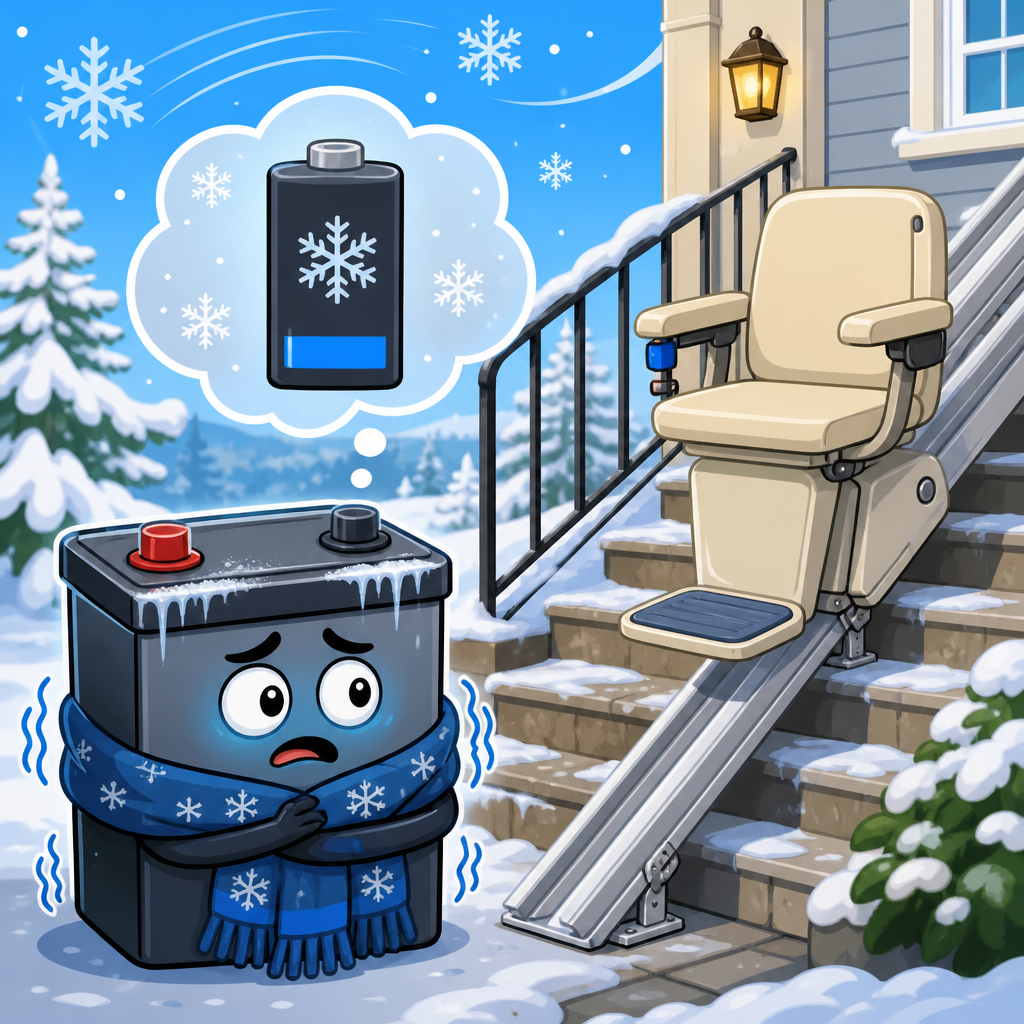
Outdoor stair lifts depend on batteries for safe, reliable travel, and cold weather is one of the most important factors affecting how those batteries perform. In simple terms, a stair lift battery stores electrical energy so the lift can run even when household power is interrupted. Most outdoor models use sealed lead-acid batteries, often in a pair, housed in the base of the chair or carriage and kept charged through contact points along the rail. Some newer systems use different battery chemistries, but the cold-weather principles remain similar: low temperatures slow chemical reactions, reduce available capacity, and make weak batteries fail faster.
I have seen this pattern repeatedly on service calls. A lift that seemed acceptable in late summer begins moving more slowly in November, then starts beeping, hesitating, or stopping midway during the first hard freeze. Homeowners often assume the motor, charger, or rail is the problem. In many cases, the battery is the root cause, or at least part of the chain of failure. Cold weather does not always damage a healthy battery immediately, but it exposes age, poor charging, corrosion, and maintenance gaps that warmer temperatures can mask.
This matters because outdoor stair lifts are usually installed where reliability is not optional. They help users navigate porch steps, deck stairs, garage entries, and sloped access points where a fall could cause serious injury. Battery condition directly affects travel speed, start-up torque, safety circuit performance, and the lift’s ability to complete a trip during a utility outage. If a lift stalls because the battery cannot supply enough current in freezing weather, the result is more than inconvenience. It can leave a rider stranded in an unsafe position outdoors, often in ice, wind, or snow.
Battery care and replacement therefore sit at the center of outdoor stair lift maintenance. Understanding how cold weather changes battery behavior helps owners plan inspections, recognize warning signs early, protect charging systems, and replace batteries before winter exposes a hidden weakness. This hub article explains the essential mechanics, the common symptoms, the maintenance practices that matter most, and the replacement decisions that keep an outdoor stair lift dependable through winter.
Why cold temperatures reduce battery performance
Cold weather affects batteries at the chemical level. In sealed lead-acid batteries, electrical energy comes from reactions between lead plates and electrolyte. As temperature drops, those reactions slow down. The battery can still hold a charge, but it cannot deliver power as efficiently or as quickly as it can at moderate temperatures. That means less usable capacity and lower voltage under load. A stair lift may appear fully charged while parked, yet the voltage can sag sharply when the motor starts.
This is especially important for outdoor stair lifts because the motor draws a brief surge of current during starting and while climbing. On a mild day, a marginal battery may cope. In freezing conditions, the same battery may not deliver enough current to maintain proper operation. The control board detects low voltage, triggers an alarm, or shuts the system down to protect components. That protective shutdown is a sign the system is doing its job, but it also signals that battery performance is below what the lift requires.
Temperature also changes charging efficiency. Batteries accept charge more slowly in cold conditions. If the charging contacts are slightly dirty or misaligned, the charger may already be delivering less than ideal current. Add low temperatures, and the battery may never fully recover between trips. Over several days, especially with frequent use, state of charge gradually drops. This partial-charge pattern accelerates sulfation in lead-acid batteries, a process where lead sulfate crystals harden on the plates and permanently reduce capacity.
Age compounds every cold-weather effect. Most stair lift batteries last roughly three to five years, though usage patterns, charger quality, and climate can push that range up or down. As batteries age, internal resistance rises. Higher internal resistance means more voltage drop when the motor demands power. That is why winter often reveals battery failure suddenly. The battery did not become old overnight; cold temperatures simply made its reduced reserve impossible to ignore.
Common winter symptoms and what they usually mean
Owners often ask the same practical question: what does a cold-weather battery problem look like in day-to-day use? The most common symptoms are slower travel, reduced run count between charges, warning beeps, failure to leave the charging point, stopping before the top or bottom landing, dim diagnostic lights, and total loss of operation after a cold night. Each symptom points to a slightly different possibility, but all deserve prompt attention in winter.
Slow movement usually indicates the batteries are struggling to maintain voltage while the motor is under load. If the chair starts normally but bogs down on the steepest section, battery weakness is likely. Repeated beeping while parked may point to the lift not charging correctly. That could still be a battery problem, but it can also mean dirty charge contacts, a failed charger, a tripped outlet, or moisture affecting the charging circuit. A lift that runs briefly and stops may be experiencing low-voltage shutdown, especially if it works again after sitting on the charge point.
I advise owners not to assume every winter shutdown means the batteries alone need replacement. Outdoor stair lifts are exposed systems. Snow buildup on the rail, ice near limit switches, a cover trapped in the mechanism, corrosion on terminals, or a GFCI-protected outlet that has tripped can all produce similar symptoms. Good troubleshooting starts with the basics: confirm the lift is parked correctly on its charge point, verify household power is available to the charger, inspect for visible corrosion or moisture intrusion, and then evaluate battery age and performance.
| Symptom | Likely battery-related cause | Other possible cause to check |
|---|---|---|
| Lift moves slowly uphill | Reduced cold-weather capacity or aging batteries | Rail contamination, drive drag, excess load |
| Beeping while parked | Battery not reaching full charge | Dirty contacts, charger failure, no outlet power |
| Stops midway on stairs | Voltage drop under load | Obstruction, safety edge activation, ice on rail |
| Works after warming up | Weak battery exposed by low temperature | Moisture affecting connections |
| No operation after outage | Batteries lacked reserve capacity | Faulty control board or blown fuse |
One pattern is particularly telling: if the lift works acceptably during the afternoon but struggles early in the morning, the battery is often near end of life. Overnight cold lowers available output, then daytime warming gives a temporary reprieve. That cycle rarely improves on its own. It usually means replacement should be scheduled before a complete failure leaves the user without access.
Battery care practices that matter most for outdoor stair lifts
The best battery care routine is simple, consistent, and focused on charging integrity. First, keep the lift parked on a designated charge point whenever it is not in use. Outdoor stair lifts are designed around this habit. Unlike a car battery, which is charged while the engine runs, stair lift batteries depend on frequent topping off. Parking away from the charge contacts for extended periods is one of the fastest ways to shorten battery life, especially in winter when self-discharge and reduced charging efficiency work against you.
Second, inspect and clean charging contacts regularly. I recommend checking them monthly during cold seasons. If the brass or copper contacts show oxidation, residue, or insect debris, charging becomes intermittent. Manufacturers typically advise cleaning with a dry cloth or a product approved in the service manual; abrasive sanding is rarely appropriate because it can damage contact surfaces. If the lift has a cover, make sure the cover does not interfere with proper docking on the charge point.
Third, protect the lift from weather without trapping moisture. A fitted, breathable outdoor cover helps reduce direct exposure to frost, rain, and UV damage. However, a non-breathable tarp wrapped tightly around the chair can hold condensation against electrical components. Moisture and cold together create more problems than cold alone. The goal is shelter, not a sealed environment. If snow is expected, clear the stairway and rail before operation rather than forcing the lift through packed accumulation.
Fourth, schedule preventive service before winter. A technician can load-test the batteries, verify charger output with a meter, inspect terminal tightness, apply dielectric protection where appropriate, and confirm that the rail charge points are correctly aligned. This is far more useful than waiting for an in-season breakdown. In my experience, pre-winter visits prevent many emergency calls because they catch batteries that still pass a simple resting-voltage check but fail under load.
Finally, use manufacturer-specified replacement batteries only. Voltage, amp-hour rating, terminal type, and physical dimensions must match the lift’s requirements. Generic substitutions can create charging mismatches, poor fitment, or reduced cycle life. A reputable dealer will typically install sealed AGM batteries approved for mobility equipment, test the charging system after installation, and date the batteries so future replacement timing is clear.
When to replace stair lift batteries and how replacement should be handled
Battery replacement should be based on age, performance, and test results, not on complete failure. If an outdoor stair lift battery is more than three years old and entering another winter, replacement deserves serious consideration even if the lift still runs. That is not a sales tactic; it is a risk-management decision. Outdoor systems face temperature swings, condensation, and heavier charging demands than indoor lifts. Once a battery has lost enough capacity to cause winter hesitation, it is already beyond the point of dependable service.
Proper replacement means changing the full matched set when the lift uses two batteries. Replacing only one old battery with one new battery is poor practice because the new unit is forced to work with the weaker one. The result is uneven charging and shortened life for the replacement battery. Technicians should also inspect the charger, wiring, fuse protection, and charging contacts during replacement. New batteries installed into a lift with a weak charger will fail early, and owners often blame the battery when the charging system was the real issue.
There are also clear signs that replacement should happen immediately: bulging battery cases, leakage, a sulfur smell, visible terminal corrosion that returns quickly after cleaning, persistent low-voltage alarms, and inability to complete normal travel after a full charge. Although sealed batteries are low maintenance, they are not risk free. Any physical deformation or heat damage calls for taking the lift out of service until it is inspected.
Cost varies by brand and region, but the cheaper choice is almost always timely replacement rather than emergency repair after a failure. A battery that dies during freezing weather often triggers additional service because users suspect the charger, control board, or drive train. Replacing aging batteries on schedule reduces diagnostic uncertainty and lowers the chance of unsafe winter downtime.
How this battery care hub connects to broader maintenance and safety
Battery care does not stand alone. It connects directly to troubleshooting, seasonal maintenance, and rider safety across the entire outdoor stair lift system. A healthy battery supports consistent seat swivel locking, reliable send-call operation, smoother starts and stops, and reserve power during outages. Weak batteries create misleading symptoms that overlap with charger faults, sensor issues, and environmental problems. That is why this topic functions best as a hub within maintenance, troubleshooting, and safety.
From here, the most useful next steps for readers are deeper guides on charger testing, how to identify corroded charge contacts, expected battery lifespan by usage pattern, safe winter cleaning practices for rails and footrests, and step-by-step warning sign checklists before calling for service. Those related topics all connect back to one central principle: outdoor stair lift reliability begins with stable battery power. If the batteries and charging path are neglected, every other component is asked to compensate for an unstable foundation.
Cold weather does not have to make an outdoor stair lift unreliable. It simply raises the standard for battery condition, charging consistency, and preventive care. Keep the lift parked on charge, inspect contacts, protect the unit from weather, clear snow and ice promptly, and replace batteries before age and freezing temperatures combine to create failure. If your lift is heading into winter with slow starts, warning beeps, or batteries older than three years, schedule a professional inspection and replacement assessment now. That one step is the most practical way to protect access, safety, and peace of mind all season.
Frequently Asked Questions
How does cold weather affect outdoor stair lift batteries?
Cold weather can significantly reduce how efficiently an outdoor stair lift battery performs. Most outdoor stair lifts rely on sealed lead-acid batteries, which are dependable and widely used, but they are sensitive to temperature changes. When temperatures drop, the chemical reactions inside the battery slow down. That means the battery may still be charged, but it cannot deliver power as effectively as it can in mild conditions. In practical terms, the stair lift may seem slower, less responsive, or more likely to struggle if it is used repeatedly during very cold weather.
Another important point is that cold weather affects available battery capacity. A battery that performs normally in moderate temperatures may provide noticeably fewer trips in freezing conditions. This does not always mean the battery is failing. Instead, it often means the cold is temporarily limiting the battery’s ability to supply energy. However, if the batteries are already older or weakened, winter weather can make those issues much more obvious. That is why cold temperatures often expose battery problems that were easy to overlook during warmer months.
Outdoor stair lifts are designed with weather resistance in mind, but battery performance still depends on proper charging, regular use, and good overall condition. If the unit remains parked away from its charging points, or if the batteries are near the end of their lifespan, cold weather can increase the chances of reduced runtime or a no-start condition. The key takeaway is that cold does not just lower comfort outdoors; it directly affects battery chemistry and can reduce the lift’s reliability if the system is not maintained properly.
Can freezing temperatures permanently damage a stair lift battery?
Freezing temperatures do not always cause permanent damage, but they absolutely can contribute to faster battery wear under the wrong conditions. A healthy, fully charged sealed lead-acid battery is much more resistant to freezing than a weak or partially discharged one. That is because the electrolyte inside a fully charged battery has a different freezing point than the electrolyte in a depleted battery. If the battery charge is allowed to fall too low during winter, the risk of internal damage increases.
Permanent damage may happen when a battery is repeatedly exposed to very low temperatures while not staying properly charged. Over time, this can encourage sulfation, which is a buildup of lead sulfate crystals on the battery plates. Sulfation reduces the battery’s ability to accept and hold a charge, and once it becomes severe, battery performance drops permanently. In addition, if a battery actually freezes internally, physical damage to the casing or internal components may occur, which usually means replacement is necessary.
The good news is that most outdoor stair lift systems are designed to keep batteries topped up when the chair is parked correctly at a charging point. That is one of the best protections against winter-related battery damage. Regular charging, seasonal inspections, and prompt replacement of aging batteries all help prevent long-term problems. So while freezing temperatures can be harmful, permanent damage is often preventable with good maintenance habits and attention to the lift’s charging routine.
What are the signs that cold weather is affecting my outdoor stair lift battery?
There are several warning signs that suggest your outdoor stair lift battery is being affected by cold weather. One of the most common is slower operation. If the chair seems to move more sluggishly than usual, especially first thing in the morning or after a very cold night, the batteries may be struggling to deliver full power. You might also notice shorter travel range, meaning the lift handles fewer trips before performance starts to decline. In some cases, the unit may stop partway, beep unexpectedly, or display a low-battery warning even though it seemed fine recently.
Another sign is inconsistency. A battery weakened by cold may work acceptably during the warmer part of the day and then perform poorly when temperatures drop again. This can make the problem seem random, but the pattern is often tied directly to outdoor temperature swings. Difficulty starting from a resting position, hesitation at the beginning of travel, or a lift that only operates reliably after sitting on the charger are also common indicators.
It is also important to watch for signs that go beyond temporary cold-related sluggishness. If the stair lift frequently loses power, does not hold a charge, or struggles even in milder weather, the batteries may be nearing the end of their service life rather than simply reacting to winter temperatures. A professional service technician can test battery voltage and charging performance to confirm the cause. If you notice repeated issues during cold weather, it is wise to schedule an inspection before the problem turns into a complete failure when the lift is needed most.
How can I help my outdoor stair lift batteries perform better in winter?
The most effective way to support battery performance in winter is to make sure the stair lift is always parked at its designated charging position when not in use. Outdoor stair lifts typically charge through contact points on the rail, and if the chair is left away from those points, the batteries may gradually discharge. In cold weather, even a small loss of charge can have a bigger impact on performance than it would in summer. Keeping the unit fully charged helps preserve available battery capacity and reduces the risk of freezing-related stress.
It also helps to keep the lift clean, dry, and protected. Use the manufacturer’s weather cover when the unit is not in use, especially during snow, freezing rain, or extended cold snaps. While the cover does not warm the batteries like a heater would, it can reduce direct exposure to moisture and harsh conditions that may affect the overall system. Clearing snow, ice, and debris from the rail and seat area is equally important, because mechanical resistance can make the lift work harder and place more demand on already stressed batteries.
Routine maintenance matters as well. Have the stair lift serviced according to the manufacturer’s recommendations, and do not ignore warning beeps or signs of poor charging. If the batteries are several years old, ask a technician whether they are still testing within normal range. Older batteries are much less tolerant of temperature extremes. In some cases, replacing them before winter becomes severe is the best way to avoid unexpected downtime. Consistent charging, proper protection, and preventive service together offer the best defense against winter battery problems.
When should outdoor stair lift batteries be replaced if cold weather is causing problems?
If cold weather is revealing repeated battery-related issues, replacement may be the right solution, especially if the batteries are already approaching the end of their normal lifespan. Most stair lift batteries do not last forever, and many sealed lead-acid batteries used in mobility equipment typically need replacement every few years, depending on usage patterns, environmental conditions, and charging habits. Winter often acts as a stress test, exposing batteries that may still function in mild weather but no longer have enough reserve capacity to perform reliably in the cold.
You should seriously consider replacement if the stair lift loses charge quickly, struggles to complete trips, moves more slowly than normal, or triggers low-battery warnings even though it is being parked properly on the charger. Another strong sign is when performance improves only temporarily after charging, then drops off again after limited use. In those situations, the issue is often not just the weather itself, but the fact that the batteries can no longer handle normal seasonal demands.
It is best not to wait for complete failure. Because an outdoor stair lift is a safety and accessibility device, dependable battery performance is essential. A qualified technician can test the batteries under load, inspect the charging system, and determine whether the problem is weak batteries, dirty charging contacts, or another electrical issue. If replacement is recommended, using the correct manufacturer-approved battery type is important for safe operation and proper fit. Replacing worn batteries proactively before or during the cold season can restore reliability and help ensure the lift is ready when needed most.