


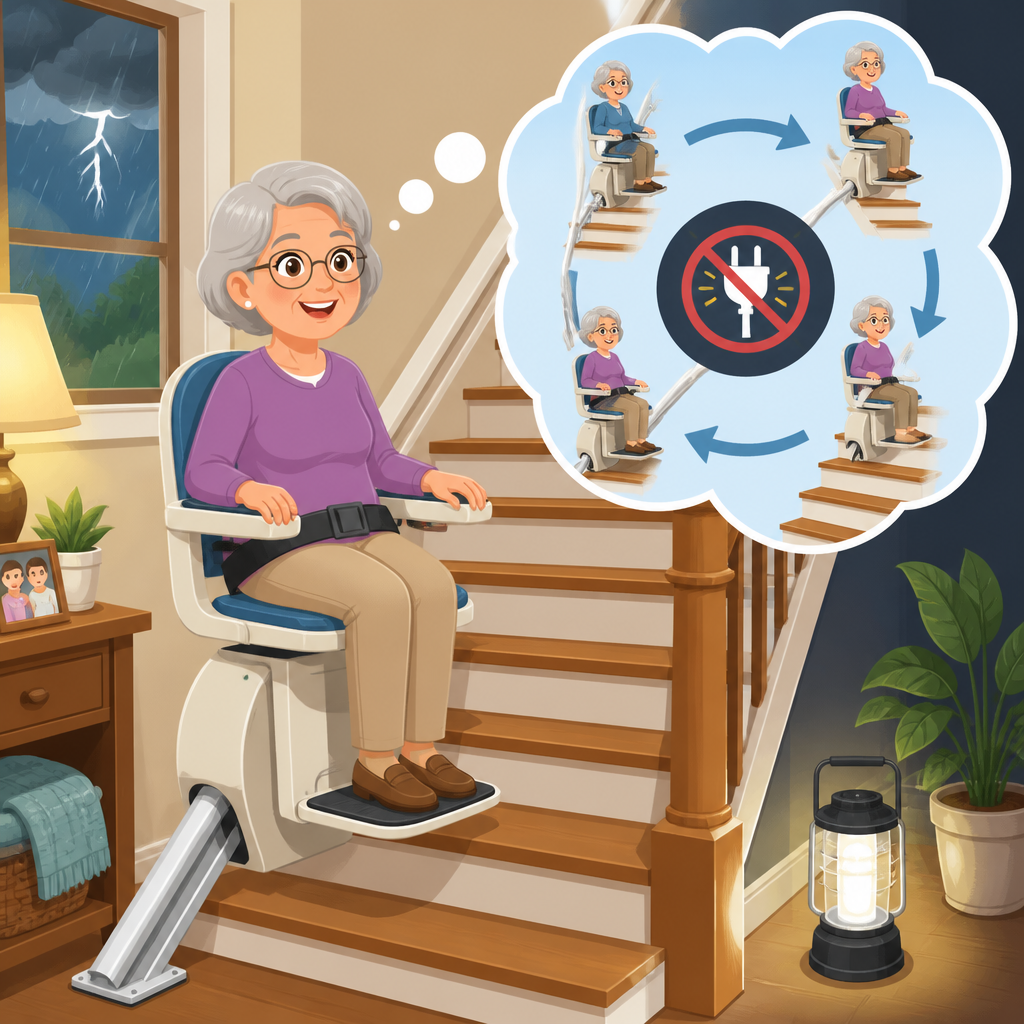
When homeowners ask how many trips a stair lift can make during a power outage, the honest answer is that most modern battery-powered models deliver roughly 10 to 40 trips before the batteries need recharging, but the true number depends on battery age, user weight, staircase length, drive efficiency, temperature, and maintenance history. A stair lift is a motorized chair that travels along a rail mounted to the stairs, and in most residential systems the motor runs on rechargeable batteries even though the unit is plugged into household electricity. That design matters because the wall power usually charges the batteries continuously at a charging point, while the batteries themselves provide the energy that moves the lift. During an outage, the charger stops, yet the lift can still operate until the stored battery capacity is used.
I have worked with homeowners who assumed a stair lift would stop immediately when utility power failed, and others who believed the chair could run indefinitely as long as it had batteries. Neither assumption is correct. The real question is not simply whether the lift works in a blackout, but how battery condition affects reliability, how many full up-and-down cycles remain, and what warning signs suggest the batteries no longer provide a safe reserve. Because this article serves as a hub for battery care and replacement within stair lift maintenance, troubleshooting, and safety, it covers outage performance, daily charging habits, testing methods, replacement timing, and practical steps that extend battery life without compromising readiness.
Understanding battery-backed operation is essential for mobility planning. A stair lift is often the primary way a user reaches a bedroom, bathroom, or exit route. If the batteries are weak, a power outage can quickly turn into a safety problem. If the batteries are healthy, most users can continue normal travel for several trips, often enough to get through a short outage comfortably. Manufacturers such as Bruno, Harmar, Stannah, Handicare, and Acorn all rely on variations of the same principle: sealed rechargeable batteries, typically 12-volt units wired in series to supply 24 volts to the drive system. Knowing how that system works lets you judge performance realistically and maintain it properly.
How battery-powered stair lifts work during an outage
The simplest answer is this: the charger needs household electricity, but the stair lift motor usually does not. Most current residential stair lifts use two sealed lead-acid batteries, commonly 7Ah to 12Ah each, though some heavy-duty or long-run systems may use different capacities. While the chair is parked at a charging contact, the charger keeps the batteries topped up. When the user presses the armrest control or a call/send station, stored battery power drives the motor, gearbox, and control board. If utility power disappears, the chair keeps operating until battery voltage drops below the minimum threshold set by the controller.
Manufacturers often publish estimated trip counts rather than runtime because trips are easier for owners to understand. A “trip” usually means one one-way ride over the installed rail. On a standard straight staircase with a properly maintained lift and a user within rated capacity, many systems can achieve around 15 to 20 one-way trips during an outage. Some can do more. Curved lifts, extra-long rails, hinged rails, and heavier loads consume more energy per ride, which reduces the count. Cold environments also lower effective battery performance because sealed lead-acid chemistry delivers less capacity at lower temperatures.
It is also important to separate marketing estimates from field reality. A brand may test under ideal conditions: new batteries, moderate user weight, average rail length, and proper charging before the outage. In homes, I regularly see lower numbers because users leave the chair slightly off the charge point, the batteries are two to four years old, or the lift has been beeping for weeks before anyone calls for service. A stair lift with neglected batteries may technically still move, yet only for a few trips before stopping. That is why battery care is the deciding factor in outage readiness.
What determines how many trips you actually get
Battery age is the biggest factor. Most stair lift batteries last about two to five years, with three years being a common replacement point in normal residential use. As batteries age, their voltage may appear acceptable at rest but sag sharply under load. That means the chair starts moving, then slows, alarms, or stops midway because the controller detects low voltage. User weight is the next major variable. A lift carrying 110 pounds requires less current than the same lift carrying 275 pounds, especially on a long incline. Staircase geometry matters too. Straight lifts are mechanically simpler and often more efficient than custom curved units, which may encounter tighter bends and longer travel distances.
Charging habits strongly affect reserve capacity. Stair lifts are designed to remain on charge whenever parked. If the user habitually leaves the chair halfway up the rail or away from the upper or lower charging contacts, the batteries may spend hours or days partially discharged. Sealed lead-acid batteries tolerate standby charging well, but they do not like being stored in a depleted state. Repeated undercharging shortens life through sulfation, a process that reduces active plate area and permanently cuts capacity. In plain terms, the batteries lose the ability to store enough energy for a reliable number of blackout trips.
Mechanical condition also changes battery consumption. Dirty charge contacts, misaligned charging strips, excessive rail friction, worn rollers, and a motor drawing more current than normal all reduce trip count. In service visits, I have seen lifts blamed for “bad batteries” when the deeper issue was a binding carriage or loose charging harness. That is why outage performance should be viewed as a system issue, not just a battery issue. Good batteries cannot compensate indefinitely for a lift that is dragging mechanically or failing to charge correctly.
| Factor | Effect on Trip Count During Outage | What to Check |
|---|---|---|
| Battery age | Older batteries provide fewer trips and may drop voltage suddenly | Replacement date, service records, load test results |
| User weight | Higher load increases current draw and reduces available rides | Rated capacity versus typical rider weight |
| Rail length and type | Long or curved rails use more stored energy per trip | Installation design, one-way travel distance |
| Charging habits | Incomplete charging reduces reserve power before outage begins | Whether chair is parked on charge points consistently |
| Temperature | Cold spaces reduce effective battery capacity | Garage, porch, basement, or unconditioned stairwell conditions |
| Mechanical condition | Friction and motor strain drain batteries faster | Rail cleanliness, noise, jerking, overdue service |
Typical trip estimates by lift type and battery condition
For a straight residential stair lift with fresh batteries, average rail length, and a rider well below maximum capacity, 15 to 30 one-way trips during a power outage is a practical expectation. Some manufacturers quote around 20 trips as a planning figure because it avoids overstating performance. For a curved lift, expect a lower range in many homes, often 10 to 20 trips depending on rail complexity. Heavy-duty lifts built for larger capacities may consume more power per trip, though larger battery packs can offset some of that demand. Outdoor stair lifts are especially sensitive because weather and temperature swings accelerate battery aging.
Battery condition changes the estimate more than brand differences do. A two-month-old set of matched batteries that always remains on charge may deliver close to published figures. A four-year-old set may deliver half that, or much less, even if the chair still works every day when household power is available. Owners often miss this distinction because the charger masks declining capacity. As long as wall power returns between trips, weak batteries can continue to function. The problem appears only during a blackout or when the lift is used repeatedly without time to recharge.
If you need a conservative household rule, assume fewer trips than the brochure suggests unless the batteries are known to be in good condition. For emergency planning, I advise clients to count on enough reserve for essential travel only, such as going upstairs at night and coming back down in the morning, rather than treating outage operation as business as usual. That mindset prevents unpleasant surprises and supports timely battery replacement.
Battery care practices that preserve outage performance
The most effective battery care habit is simple: always park the stair lift on its designated charging point. Most systems charge at the top, the bottom, or both. If the chair has manual or powered swivel, make sure it completes the parking position properly so the charging contacts align. Listen for normal status tones and look for the charging indicator described in the owner’s manual. If the lift begins beeping when parked, do not ignore it. Many lifts beep specifically to warn that the batteries are not charging or that voltage is low.
Keep the rail and charging contacts clean. Dust, pet hair, corrosion, and household grime can interfere with charging, especially in older homes or high-humidity environments. Cleaning should follow the manufacturer’s instructions, usually with a dry cloth or approved gentle method. Do not apply oils, grease, or household cleaners unless the manual explicitly allows them. I have seen contact surfaces damaged by spray cleaners that left residue and reduced charging efficiency. A basic visual inspection every month catches many preventable issues before they become battery failures.
Schedule professional service at the interval recommended by the manufacturer or dealer. Annual service is common for residential lifts, though heavy use may justify more frequent checks. A proper service visit should include charger output verification, battery voltage checks under load, inspection of wiring and contacts, and assessment of motor current draw. Replacing batteries proactively before winter or before a storm season is often sensible for users who rely on the lift as essential mobility equipment. If your home loses power frequently, battery health is not a minor maintenance item; it is core safety planning.
When stair lift batteries should be replaced
Most stair lift batteries should be replaced when they no longer hold a dependable charge, when the unit issues repeated low-battery alerts, or when testing shows voltage collapse under load. Age alone can justify replacement because sealed lead-acid batteries are consumable parts, not lifetime components. In many homes, replacing them every three years is a prudent benchmark even if the lift still seems operational. Waiting for total failure often means discovering the problem during an outage, which is the worst possible time.
Common warning signs include reduced speed, stopping partway on the stairs, frequent beeping away from the charge point, failure to operate after a short period off charge, and batteries that become warm or swollen. Swelling requires immediate service attention and safe replacement. Batteries should usually be replaced as a matched pair, not one at a time, because mixing old and new batteries in a series circuit causes uneven charging and shortens the life of the new battery. Use the exact specification recommended by the manufacturer or dealer, including voltage, amp-hour rating, terminal style, and physical dimensions.
Cost varies by brand and service market, but homeowners should expect both parts and labor. The cheapest battery option is rarely the best option if it comes from an unknown supplier with poor date control. Fresh stock from a reputable manufacturer matters because sealed lead-acid batteries age on the shelf. Quality replacement supported by proper testing gives a more reliable result than swapping batteries blindly and hoping the beeping stops.
How to test outage readiness safely
A practical test starts with confirming the chair has been parked on charge for enough time to reach full charge, typically overnight. Then unplug the stair lift from household power or switch off the dedicated outlet if accessible and safe to do so. Use the lift for one trip, park it correctly, and verify it still operates normally. For users who want a deeper check, a technician can perform a controlled load test with a meter while monitoring voltage sag and charger output. That method is far more informative than checking voltage at rest.
Do not run repeated do-it-yourself trips until the batteries are exhausted. Deep discharging sealed lead-acid batteries shortens their life, and intentionally stranding the chair on the rail creates unnecessary risk. The goal of testing is to confirm readiness, not to discover the exact failure point experimentally. If the lift behaves oddly during a basic outage simulation, book service rather than continuing the test. Strange noises, slowing, intermittent stopping, or fault codes point to issues that may involve more than battery age.
For households with medically necessary mobility equipment, consider broader backup planning. A stair lift battery is helpful, but it is not a substitute for a home emergency plan. Keep a flashlight nearby, store service numbers in an easy-to-reach place, and discuss sleeping arrangements or caregiver support if a long outage occurs. Battery care is strongest when it is part of overall safety planning, not treated as an isolated maintenance chore.
Key takeaways for battery care and replacement
Most stair lifts can make multiple trips during a power outage because they run on onboard rechargeable batteries, not directly on wall power. In real homes, a practical estimate is often 10 to 40 one-way trips, with many standard lifts landing around 15 to 20 under normal conditions. The number drops when batteries are old, the rider is heavier, the staircase is longer or curved, the environment is cold, or the lift has not been charging correctly. That is why the answer to how many trips a stair lift can make is inseparable from battery care.
The best way to protect outage performance is consistent charging, regular cleaning of contacts and rail surfaces, prompt response to warning beeps, and scheduled professional service that includes load testing. Battery replacement should be treated as routine preventive maintenance, usually every two to five years and often around the three-year mark for dependable service. Replace batteries as a matched pair using the correct specification, and do not assume daily operation means the reserve capacity is still strong. Utility power can hide battery decline until the moment you need backup most.
If your stair lift is central to safe movement at home, make battery health a standing maintenance priority. Review the owner’s manual, check when the current batteries were installed, and arrange a service inspection if you do not know their age or last test result. A short maintenance visit now is far easier than losing stair access during the next outage.
Frequently Asked Questions
How many trips can a stair lift typically make during a power outage?
Most modern battery-powered stair lifts can usually make about 10 to 40 trips during a power outage before the batteries need to be recharged. That range is a practical estimate rather than a fixed rule, because stair lift performance depends on several real-world factors. In a typical residential setup, the chair is powered by rechargeable batteries, even though the unit remains plugged into household electricity to keep those batteries charged. When utility power goes out, the lift switches to battery operation automatically, which is why many homeowners are still able to use it safely for a period of time.
The exact number of trips varies based on the model, the condition of the batteries, the length and angle of the staircase, and the total load being carried. A newer lift with healthy batteries on a shorter staircase may stay near the upper end of that range, while an older system with worn batteries on a long run may deliver fewer trips. It is also important to understand what manufacturers mean by a “trip.” In many cases, one trip means one complete one-way ride, either up or down. If you are planning for emergency use, it is wise to assume a conservative number rather than the best-case estimate.
What affects how many trips a stair lift can make when the power is out?
Several factors influence how long a stair lift battery will last during a blackout. Battery age is one of the biggest. Over time, rechargeable batteries lose capacity, so a lift that once handled many trips on backup power may provide noticeably fewer as the batteries get older. User weight also matters, because a heavier load generally requires more effort from the motor. Staircase length plays a major role too. A longer rail means the lift has to travel farther on each ride, which increases energy use. Likewise, a steeper or more complex staircase can place additional demands on the drive system.
Drive efficiency and general maintenance history are also important. A well-maintained stair lift with properly adjusted components typically uses power more efficiently than one with neglected service needs. Temperature can make a difference as well, especially in colder environments where battery performance often drops. Even small issues, such as debris on the rail or aging mechanical parts, can contribute to lower efficiency over time. That is why two stair lifts of the same brand and model may perform differently during an outage. If you want the most reliable estimate for your home, the best approach is to have the unit inspected and tested according to the manufacturer’s service recommendations.
Do all stair lifts work during a power outage?
Many residential stair lifts are specifically designed to keep working during a power outage because they rely on onboard rechargeable batteries for actual operation. In these systems, household electricity is used mainly to charge the batteries while the lift is parked at its charging point. When power is interrupted, the lift draws from stored battery power instead. This design is one of the most valuable safety features in modern stair lifts, since it helps homeowners maintain mobility access even when the lights are out.
That said, not every stair lift should be assumed to function the same way. Some older models may have different configurations, and performance can vary if the batteries are weak, disconnected, or overdue for replacement. The lift may also need to be parked correctly at a charging station between uses in order to stay fully charged. If a unit has not been charging properly, it may have little backup runtime available when an outage happens. Homeowners should review their owner’s manual, confirm whether their lift uses battery backup, and ask a qualified stair lift technician about expected outage performance. Knowing these details in advance can prevent confusion during an emergency.
How can I make sure my stair lift battery is ready for an outage?
The best way to prepare a stair lift for a blackout is through consistent maintenance and smart daily habits. First, make sure the chair is routinely left in a proper charging position if that is what the manufacturer requires. If the lift is not resting on its charge contacts, the batteries may not stay topped off. Second, schedule regular professional service. A technician can test battery health, inspect the charger, check rail alignment, and identify wear that could reduce efficiency. Preventive service is often the difference between a lift that performs reliably during an outage and one that does not.
Homeowners should also pay attention to warning signs. Slower travel, beeping alerts, failure to hold a charge, or inconsistent operation can all signal battery or charging problems. If the batteries are several years old, replacement may be recommended even if the lift still appears to work normally. It is also helpful to ask your stair lift provider for the expected battery life and the model-specific outage estimate for your system. If someone in the home depends on the lift every day, keeping service records current and replacing batteries before they fail is a practical and important safety step.
What should I do if I need my stair lift during a long power outage?
If you rely on your stair lift during an extended power outage, the first priority is to use the available battery power carefully. Because most lifts provide a limited number of trips, it helps to avoid unnecessary rides and plan movement strategically. For example, if possible, gather needed items before traveling between floors so you can reduce repeat trips. If more than one household member uses the lift, coordinate usage to preserve battery capacity. During a prolonged outage, conserving trips can make a meaningful difference.
You should also check whether the lift is still operating normally and whether any low-battery indicators are active. If the outage continues and battery power becomes limited, contact the stair lift manufacturer, dealer, or service company for guidance. In some cases, they can provide troubleshooting advice or explain what to expect from your specific model. If the user has medical or mobility needs that make stair access critical, it is wise to include the stair lift in a broader emergency plan. That may involve backup power options for the home, temporary relocation to a single-floor living area, or assistance from caregivers or family members. Planning ahead is the most effective way to stay safe and maintain independence when household power is unavailable.