


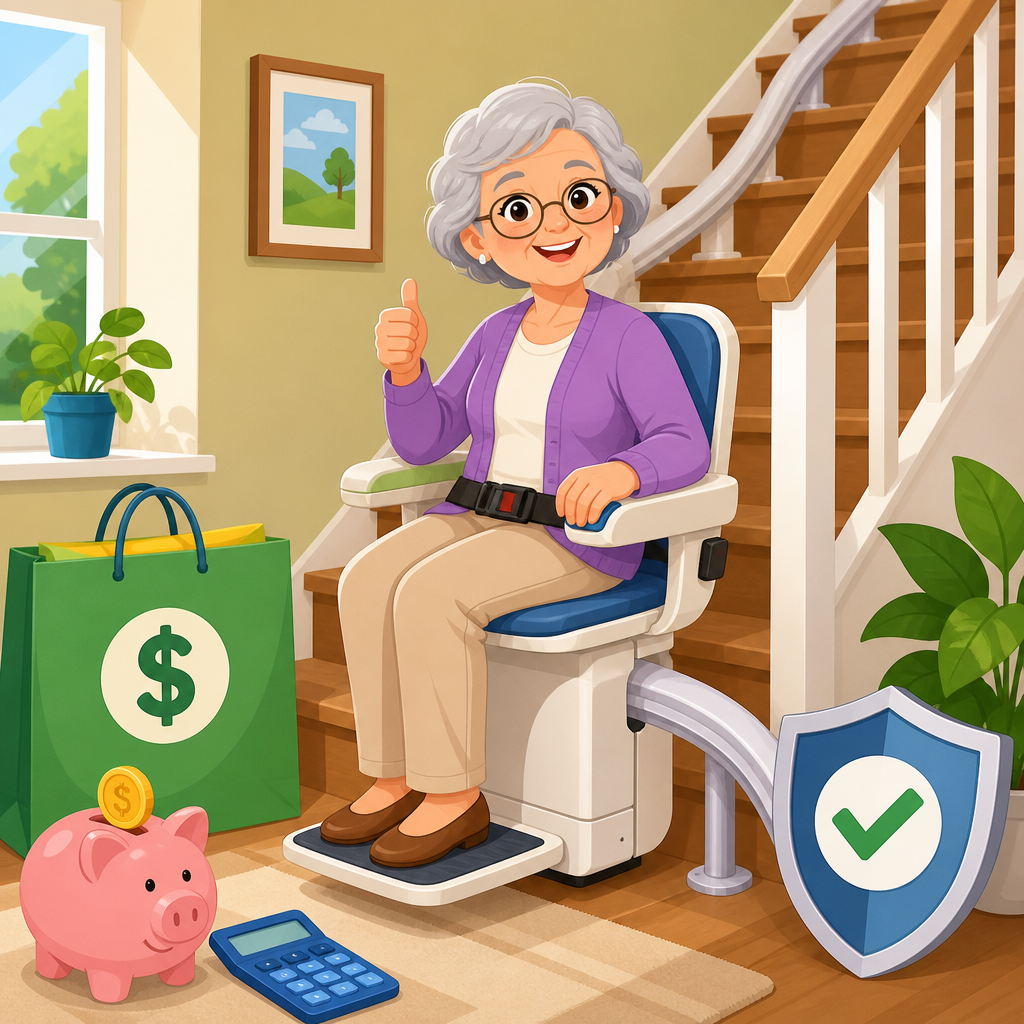
Buying a stair lift on a tight budget without sacrificing safety is possible when you understand how pricing works, which features are essential, and where careful compromises are acceptable. A stair lift is a motorized chair or standing platform that travels along a rail fixed to the staircase, helping people with limited mobility move between floors without climbing steps. For many families, it is not a luxury purchase. It is an alternative to unsafe stair use, a temporary move downstairs, or an expensive assisted living transition. I have helped families compare quotes, inspect used units, and sort through rental agreements, and the same pattern appears every time: people save the most money when they define their nonnegotiable safety needs first and shop around those requirements instead of starting with brand names.
Budget-friendly options include buying a straight stair lift instead of a custom curved model when the staircase allows it, considering certified reconditioned units, renting for short-term needs, and applying for grants or local support programs. Safety, however, cannot be treated as an add-on. A safe stair lift should include a seat belt, obstruction sensors, battery backup, a properly rated weight capacity, secure rail installation, and compliance with recognized standards such as ASME A18.1, the primary safety standard covering platform lifts and stairway chairlifts in the United States. Reputable manufacturers and dealers also follow building code requirements, electrical best practices, and documented maintenance procedures.
This guide serves as a hub for budget-friendly stair lift buying. It explains what drives cost, which features matter most, where to save, and what mistakes create hidden expense later. If you are comparing Bruno, Harmar, Stannah, Handicare, Acorn, or local dealers offering refurbished inventory, the goal is the same: get a lift that matches the user, the staircase, and the budget while reducing fall risk from day one. The best value is not the cheapest quote. The best value is the lowest total cost for a lift that fits correctly, operates reliably, and can be serviced quickly if a problem occurs.
What a Stair Lift Costs and Why Prices Vary
The fastest way to control cost is to understand the biggest pricing variables. Straight stair lifts, which run on a staircase with no turns, landings, or curves, are the most affordable option. In most markets, a new straight stair lift commonly falls around $2,500 to $5,500 installed, while curved stair lifts usually start much higher because the rail is custom fabricated to the exact dimensions of the staircase. It is common to see curved models priced from about $10,000 upward, especially when they require multiple bends, a powered folding rail, or complex parking positions.
Several factors explain that spread. Rail design matters most. A straight rail can often be cut to length from standard stock, but a curved rail must be measured precisely and manufactured for one staircase. Seat style also affects cost. A basic seated model is usually less expensive than a perch or heavy-duty version with a higher weight capacity. Power options matter too. Most modern stair lifts use battery-powered drive systems that charge at points on the rail, which improves reliability during outages but adds some hardware cost. Installation complexity, warranty length, local labor rates, and after-sales service availability also influence the final quote.
In my experience, many buyers focus only on the sticker price and miss the cost of ownership. Ask whether the quote includes a site survey, installation, permit handling if required locally, warranty coverage on parts and labor, service call fees after the warranty, and battery replacement intervals. A low quote with weak service support can become expensive quickly. If a user depends on the stair lift every day, downtime is not an inconvenience; it is a mobility crisis.
Where You Can Save Money Safely
The safest place to save money is on product configuration, not on installation quality or core safety features. Start with the staircase type. If you have a straight staircase, a straight lift will always provide the best budget path. Avoid upsells unless they solve a real access issue. For example, a powered swivel seat can be helpful for users with poor trunk control, but some buyers do fine with a manual swivel and save hundreds. A powered footrest is convenient, especially for users who struggle to bend, yet it is not essential for everyone. What is essential is that the user can board, ride, and dismount without twisting dangerously.
Refurbished stair lifts can offer substantial savings when sold through a qualified dealer. The key phrase is qualified dealer. A reputable dealer will disclose the unit’s age, confirm compatibility with the staircase, replace worn components such as batteries and seat upholstery as needed, test the carriage, verify safety circuits, and provide at least a limited warranty. Straight lifts are far easier to buy refurbished because rails are standardized or more easily adapted. Curved lifts are much harder to reuse because the rail was likely made for another home. If someone advertises a used curved lift at a dramatic discount, assume additional fabrication or incompatibility risk unless a dealer has confirmed the fit.
Rental is another smart budget option, especially after surgery, injury, or a temporary illness. I often recommend rental when the expected need is under a year. Many rental plans include installation, removal, and service, which can be more economical than purchasing and later reselling a unit. Rental inventory is typically limited to straight lifts, so curved staircases may not qualify. Still, for short-term needs, rental can preserve cash without compromising safety.
Safety Features You Should Never Skip
If the budget is tight, it helps to separate must-have safety features from convenience features. The following items belong firmly in the must-have category because they directly reduce accident risk or improve safe use during emergencies.
| Feature | Why it matters | Budget advice |
|---|---|---|
| Seat belt | Keeps the rider positioned securely during travel and sudden stops | Never waive it; confirm it is easy for the user to latch |
| Obstruction sensors | Stop the lift if it contacts an object on the stairs or rail path | Standard on quality models; avoid units without tested sensors |
| Battery backup | Allows operation during a power outage | Worth the cost in any multistory home |
| Swivel seat with lock | Helps the user get off facing the landing instead of the staircase | Manual is acceptable if the user can operate it safely |
| Weight capacity matched to the user | Prevents strain on the system and supports stable travel | Choose a model with margin above the user’s actual weight |
| Call/send controls | Lets the chair be moved to another floor when needed | Useful in shared homes and usually included |
Look also for a footrest, armrests, and smooth start-stop motion, because these improve safe transfers. Heavy-duty models can be essential for larger users, but they often require more staircase width. Most manufacturers specify minimum stair widths, and ignoring that specification is a serious mistake. A stair lift that technically fits but leaves unsafe clearance can create a new hazard for other household members.
Standards compliance should be part of your screening process. In the United States, ask whether the model conforms to ASME A18.1 and whether installation follows manufacturer requirements and local code. In the United Kingdom and Europe, dealers may reference Machinery Directive or relevant British and European standards. The exact framework varies by region, but the principle is the same: documented compliance matters more than sales claims.
Best Budget-Friendly Buying Paths
Most buyers on a tight budget do best with one of four approaches: buying a new straight lift, buying a refurbished straight lift from a servicing dealer, renting a straight lift for short-term use, or applying for financial assistance before signing a contract. A new straight lift is often the cleanest option because it includes a full warranty and current components. This route makes sense when the lift will be used for years and the household can manage the upfront cost.
A refurbished straight lift is usually the best balance between affordability and long-term utility. Dealers frequently take back straight units, inspect them, install new batteries, and remount them on another compatible staircase. When supported by a local company that stocks parts and offers service, this option can cut costs significantly while still delivering dependable daily use. Ask who performs the refurbishment, what was replaced, whether the rail is new or reused, and how long labor is covered.
Rental works best when mobility loss is expected to improve. For example, someone recovering from hip surgery may need access to an upstairs bathroom for three months. In that scenario, rental can be the most economical and least risky route because maintenance responsibility typically stays with the provider. Financial assistance should be explored in parallel, not afterward. Depending on location, support may come from Medicaid waiver programs, Veterans Affairs benefits, state assistive technology programs, nonprofit grants, Area Agencies on Aging, or disease-specific charities. Medicare generally does not cover stair lifts because they are usually classified as home modifications rather than durable medical equipment, so families should plan accordingly.
How to Compare Quotes Like a Careful Buyer
Collecting three quotes is useful, but only if you compare the same scope. I advise families to request itemized estimates showing model name, weight capacity, power system, warranty terms, included installation work, estimated timeline, and service response policy. Ask whether the price includes rail overruns, folding rail sections, parking options, remote controls, and any electrical work. A quote that appears lower may simply exclude essentials another dealer already included.
Dealer quality matters as much as product quality. A good dealer performs an in-home assessment, measures the staircase precisely, evaluates transfer safety at both landings, reviews medical and mobility needs, and discusses who will use the lift. They should ask about walker use, arthritis in the hands, balance issues, vision limits, and whether the rider can operate a seat belt independently. If a salesperson skips these questions and jumps to a quote, that is a warning sign.
Also ask about service infrastructure. How many technicians cover your area? Are parts stocked locally? Is emergency service available? What is the average response time? A stair lift from a respected brand is only as useful as the support behind it. In practical terms, a modestly priced lift with strong local service is often a better buy than a cheaper online unit with no regional installer. Direct-to-consumer bargains can become costly when setup, troubleshooting, and warranty claims depend on distant third parties.
Mistakes That Increase Cost or Reduce Safety
The most expensive mistake is buying based on price alone. Another common error is assuming any used stair lift can be moved easily from one house to another. Straight units sometimes can. Curved units usually cannot without major limitations. Families also underestimate the importance of transfer space at the top and bottom landings. If the rider cannot get on and off comfortably, the lift is not safe regardless of how little it cost.
Do not ignore maintenance. Batteries wear out, seat belts should be checked, rails must stay clear, and annual service is a wise investment for frequent users. Skipping maintenance may save money temporarily, but it raises failure risk. I have seen households blame a brand when the real issue was years of deferred service or an outlet that had been switched off, preventing charging.
Another mistake is hiding user needs to keep the quote low. If the rider is near the standard weight limit, has severe arthritis, or needs a powered option for safe transfers, disclose that upfront. Buying the wrong model and replacing it later costs far more than selecting correctly the first time. Finally, never accept informal installation from an unqualified handyman unless the manufacturer or dealer explicitly authorizes it. Proper anchoring, rail alignment, charging points, and final testing are safety-critical tasks.
Buying a stair lift on a budget works best when you treat safety as fixed and flexibility as negotiable. Save money with a straight model when possible, compare refurbished and rental options carefully, and prioritize a dealer with strong service support. Focus on the features that prevent falls and ensure reliable operation: seat belt, obstruction sensors, battery backup, proper weight capacity, and a secure swivel seat. Use itemized quotes, verify standards compliance, and ask hard questions about warranty and repair response before you commit.
This budget-friendly stair lift guide is the hub for smarter buying in this category because the same core rule applies across every related topic: low cost only matters if the lift remains safe, serviceable, and appropriate for the user. When you evaluate total ownership cost instead of headline price, the right option becomes clearer. Start by measuring your staircase, listing the rider’s mobility needs, and contacting reputable local dealers for detailed quotes. That process will help you protect both your budget and the person who depends on the lift every day.
Frequently Asked Questions
1. How can I buy a stair lift on a tight budget without compromising safety?
The best way to save money without increasing risk is to separate must-have safety features from optional comfort upgrades. Start by focusing on a lift that matches the staircase correctly, is installed by a qualified professional, and includes core safety components such as a seat belt, obstruction sensors, a secure swivel seat at the landing, battery backup, and reliable call/send controls. These features are not extras. They are part of what makes the lift safe to use every day.
Budget-conscious buyers often save the most by choosing a straight stair lift instead of a curved model when the staircase layout allows it, because straight rails are simpler to manufacture and install. It is also smart to compare several quotes, ask for an itemized breakdown, and find out whether the price includes delivery, installation, warranty coverage, and a service plan. A lower advertised price can become expensive if essential services are excluded.
You can also reduce costs by avoiding premium cosmetic finishes, luxury upholstery, or advanced smart features that do not directly improve safety. In many cases, a standard model from a reputable manufacturer is a better value than a feature-heavy model with unnecessary add-ons. The key is to be selective: save on appearance and convenience extras, but do not cut corners on fit, installation quality, or safety systems.
2. What safety features should never be skipped when choosing an affordable stair lift?
Even on a limited budget, there are several features that should be considered essential. First is a seat belt or restraint system, which helps keep the rider secure during travel. Second are obstruction sensors on the footrest and carriage, which stop the lift if it detects an object on the stairs or rail. This is especially important in homes where items may sometimes be left on the staircase.
A swivel seat with a locking mechanism at the top landing is another critical feature because it allows the user to get off facing away from the stairs rather than stepping sideways near the edge. Foldable arms, seat, and footrest can be helpful for keeping the staircase clear, but the swivel and lock function matters more from a safety standpoint. Battery backup is also very important. Many stair lifts charge continuously and can keep working during a power outage, which prevents a user from getting stranded between floors.
Finally, professional installation and a stair lift sized for the user’s weight, body position, and mobility level are safety essentials, not optional upgrades. A budget lift that is poorly installed or not suited to the user can be more dangerous than helpful. If money is tight, cut nonessential upgrades first, but keep the structural and operational safety features fully intact.
3. Is it safe to buy a used or reconditioned stair lift to save money?
A used or professionally reconditioned stair lift can be a practical and safe money-saving option, but only under the right conditions. The safest route is to buy from a reputable dealer who inspects, refurbishes, tests, and warranties the equipment rather than purchasing privately from an online marketplace or local classified listing. A private sale may look cheaper upfront, but it often comes without verification of condition, service history, compatibility, or proper installation support.
When evaluating a reconditioned stair lift, ask whether the rail, motor, batteries, seat, sensors, and control system have been checked or replaced as needed. You should also confirm that the unit meets current safety expectations and that replacement parts are still available. Some older models may be difficult to repair or may lack important features found on more recent units. A trustworthy seller should be able to explain exactly what was refurbished and what kind of warranty is included.
Used stair lifts tend to work best for straight staircases, because straight rails are easier to reuse and adapt. Curved stair lifts are usually custom-built to a specific staircase, so buying used in that category is more complicated and often less practical. In short, reconditioned can be a strong budget solution if it comes from a qualified source with professional installation and support. It becomes risky when buyers chase the lowest price with no verification, no warranty, and no expert setup.
4. What are the biggest factors that affect stair lift cost, and where can I safely save money?
The biggest cost factor is staircase type. Straight stair lifts are generally the most affordable because the rail is standardized and installation is simpler. Curved stair lifts cost more because the rail must be custom-made to follow turns, landings, or intermediate bends. Other price factors include weight capacity, seat style, power options, track length, installation complexity, and any home modifications needed before installation.
If your goal is to stay within budget, the safest places to save are usually the nonessential upgrades. For example, you may be able to skip premium fabrics, powered folding options, upgraded finishes, or advanced remote features if the user can operate a basic model comfortably. In some homes, a standard seat and manual swivel are perfectly suitable, provided the user has the mobility and strength to use them safely. This is where a careful assessment matters, because what counts as “optional” for one person may be necessary for another.
You can also save by getting multiple estimates, asking whether there are rental or short-term solutions for temporary recovery needs, and checking whether a dealer offers reconditioned straight lifts. Some families also find financial relief through local aging, disability, veterans, or nonprofit assistance programs. The safest mindset is this: spend where safety, fit, and reliability matter most, and trim only the features that do not change the user’s ability to ride securely and transfer on and off the lift confidently.
5. How do I make sure a lower-cost stair lift is still the right fit for the user and the home?
The right stair lift is not simply the cheapest one that moves up and down. It must fit both the staircase and the person using it. Begin with a professional assessment of the stairs, including width, length, landing space, power access, and whether there are any tight clearances or obstructions. Then consider the user’s mobility, balance, ability to sit and stand, body size, and whether they can safely use a seated or standing model. A lower-priced unit is only a good deal if it supports safe daily use.
It is also important to think beyond today’s needs. If the user’s mobility is likely to change, choosing the absolute bare minimum model may lead to another purchase sooner than expected. For example, a slightly more capable lift with a better seat design, easier controls, or higher weight capacity may offer better long-term value. The goal is to avoid paying for unnecessary luxury while still accounting for realistic use over time.
Before buying, ask for a demonstration, review the warranty, and find out how service calls are handled. A budget stair lift from a company with poor support can become frustrating and unsafe if repairs are delayed. Reliable after-sales service, clear maintenance guidance, and proper training on how to use the lift are part of the value. In the end, the right low-cost stair lift is one that is properly matched, professionally installed, easy for the intended user to operate, and backed by a company that stands behind its product.