


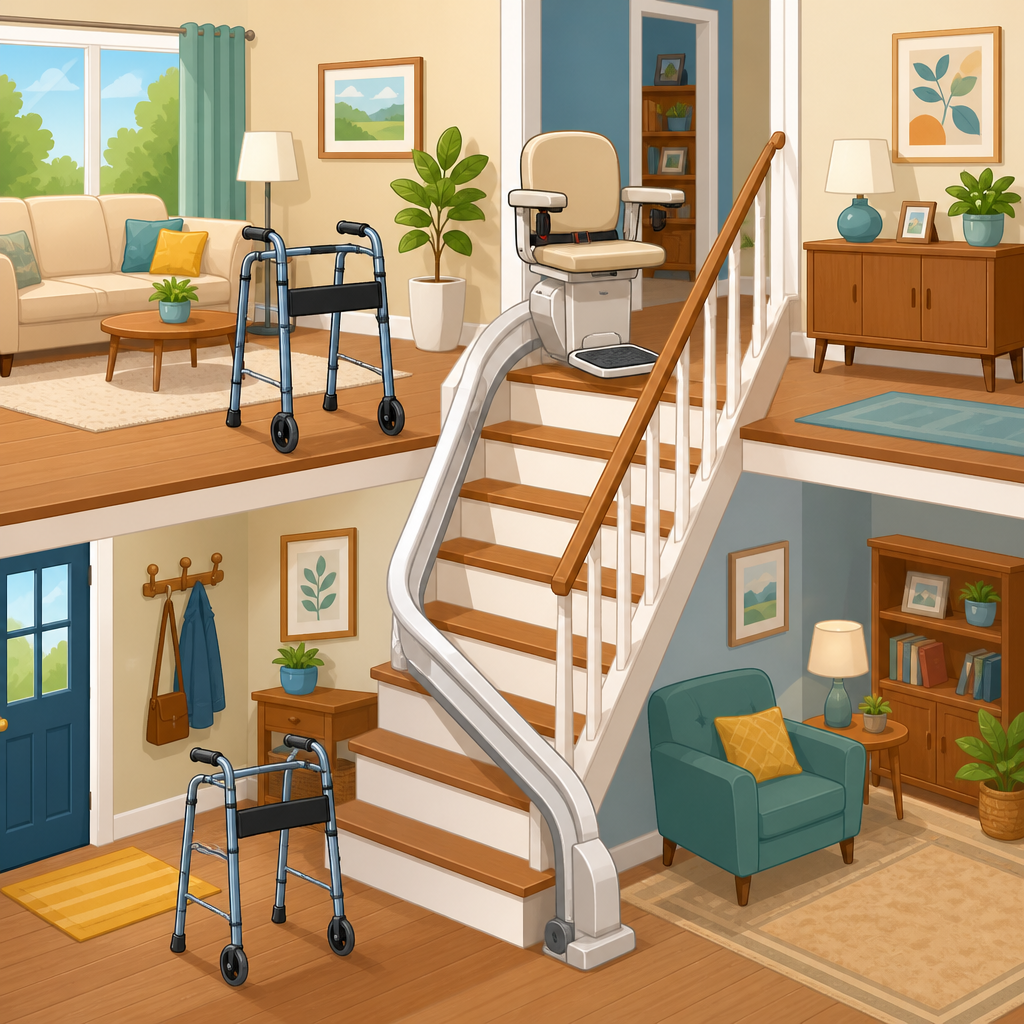
Keeping a walker available on both floors of a home with a stair lift is one of the most practical questions families face when they adapt a multilevel house for aging in place. A walker supports balance, weight transfer, and confidence during short household trips, while a stair lift transports the person between levels on a motorized chair attached to a rail. The challenge is simple to describe but important to solve correctly: when a person rides the stair lift, the walker often remains on the other floor, leaving them without support at the point of arrival. I have worked with homeowners, occupational therapists, and stair lift dealers on this exact problem, and the best answer is rarely a single device. It is usually a system that matches the user’s strength, cognition, home layout, and daily routines.
This topic matters because falls frequently happen during transitions, not during ideal conditions. A person may transfer safely onto the stair lift, arrive upstairs, stand up, and then realize the walker is downstairs. That brief unsupported moment can undo the benefit of every other accessibility upgrade in the home. The same risk appears when a caregiver parks a walker out of the travel path, when a narrow landing cannot hold a mobility aid safely, or when a folding walker is too awkward to carry while seated. Good planning protects mobility, reduces caregiver strain, and keeps both floors usable rather than turning the upper level into dead space.
For this hub article, “mobility aids and devices” includes standard walkers, two-wheel walkers, rollators, canes, transfer poles, stair lifts, grab bars, ramps, portable threshold bridges, and related accessories that improve movement through the home. The central question is how to keep a walker available on both floors, but the wider goal is building a coordinated home mobility setup. That means understanding device types, knowing which combinations work together, and recognizing when a low-cost fix is safe versus when a clinical assessment is necessary. If you are comparing solutions, start with this rule: the safest setup is the one that preserves support immediately before and immediately after every transfer.
Use the simplest reliable strategy: one walker per floor
The most dependable solution is to keep a dedicated walker upstairs and another downstairs. In practice, this is what clinicians and installers recommend most often because it removes the need to transport equipment during stair lift use. A second walker can be identical to the first or chosen for the space. For example, a standard walker with skis may work better on carpet upstairs, while a narrower two-wheel walker may fit a tighter first-floor hallway. The key is consistency in height adjustment, handgrip style, and brake operation if the person uses rollators. Matching devices reduces confusion and helps maintain a familiar gait pattern.
There are tradeoffs. Two devices cost more than one, and storage space matters on small landings. Yet compared with the cost of one fall, a second walker is usually a modest investment. Medicare generally covers durable medical equipment under specific conditions, but coverage rules can be restrictive, and duplicate devices for convenience may not qualify. Many families therefore use private pay, flexible spending accounts, health savings accounts, or local reuse programs. Area Agencies on Aging, loan closets, and nonprofit equipment exchanges often have clean, serviceable walkers available at low cost. When budget is tight, this is the first resource I suggest before considering complicated transport methods.
Placement matters as much as ownership. The walker should be parked where the user can reach it immediately after standing from the stair lift without twisting, overreaching, or stepping unsupported. That usually means parallel to the landing wall, clear of the swivel path of the seat and the footrest. If the stair lift has a powered swivel or a hinge track at the bottom, confirm that the parked walker does not interfere with operation. Installers can identify the chair’s clearance envelope, but homeowners should test the real routine several times, including with slippers, nighttime lighting, and any oxygen tubing or carry items used daily.
Choose the right walker for each level and each task
Not every mobility aid performs the same way in every room. Standard walkers offer the most stability because all four contact points remain close to the user, but they require lifting or sliding with each step. Two-wheel walkers reduce effort and work well for people who need support but still walk at a controlled pace. Rollators, which have four wheels, hand brakes, and often a seat, are useful for endurance and carrying items, but they are less stable for some users, especially on thresholds, thick carpet, or cluttered turns. On an upper floor with narrow bedroom doors and tighter turning space, a compact frame may outperform a wider rollator.
Bathrooms deserve special attention. A general household walker may not fit through the bathroom door once grab bars, vanities, and toilet clearances are considered. In those cases, people sometimes rely on a cane inside the bathroom and a walker outside the door, but this only works if strength and balance are adequate and if the transfer sequence has been assessed properly. A better answer can be an offset cane, a narrower walker, or a wall-mounted grab bar system placed to create a continuous support path. The point is that “a walker on both floors” should not be interpreted narrowly. Each floor may need a primary aid and one or more supplemental devices.
| Device | Best use in a two-story home | Main advantage | Main caution |
|---|---|---|---|
| Standard walker | Short indoor routes, high stability needs | Strong support for transfers and slow walking | Can be awkward on carpet and around tight corners |
| Two-wheel walker | General indoor mobility on either floor | Easier forward movement with good stability | Less support than a standard walker |
| Rollator | Longer indoor routes, carrying items, fatigue management | Seat, basket, and smoother movement | Requires brake control and can roll away during transfers |
| Cane | Bathroom access or very short distances when appropriate | Small footprint in narrow spaces | Not a substitute for a walker if high support is needed |
Plan safe transfer zones at the top and bottom of the stairs
The arrival and departure areas around a stair lift should function like miniature transfer stations. I look for five things during a home setup review: sufficient landing depth, solid lighting, non-slip flooring, reachable support, and a clear parking spot for the walker. The user should be able to bring the stair lift seat to a full stop, swivel toward the landing if that feature exists, place both feet securely, stand with armrest support or a nearby grab bar if approved, and then reach the walker without pivoting into empty space. When any one of those elements is missing, the routine becomes less predictable and therefore less safe.
Lighting is often underestimated. Motion-sensing night lights, brighter LED bulbs, and illuminated rocker switches can make a significant difference for early-morning bathroom trips. Contrast also helps; a dark walker against a dark wall can be harder to locate quickly for a person with reduced vision. Flooring should be flat and free of throw rugs, charging cords, and pet bowls. If the landing floor is slippery, use a low-profile non-slip treatment rather than a thick mat that could catch walker legs. The goal is to remove anything that introduces drag, wobble, or hesitation during the first step away from the chair.
Support surfaces must be selected carefully. Grab bars are excellent when anchored correctly into framing or approved mounting systems, but towel bars and decorative handles are not substitutes. If a wall is unavailable in the needed position, a floor-to-ceiling transfer pole may help near the landing, though it must not obstruct stair lift travel or emergency egress. I avoid recommending improvised solutions such as leaning on a door frame or using furniture with casters. The transfer zone should be intentionally designed, tested, and rechecked after installation because a stair lift changes how a person approaches the space.
When transporting one walker is necessary, use controlled methods only
Some households cannot store two walkers, or the user prefers a specialized model that is expensive to duplicate. In those cases, transporting one walker between floors may be possible, but it should never compromise the stair lift transfer. Most stair lift manufacturers do not intend the seated rider to balance a full-size walker across their body while moving. It can interfere with armrests, footrests, and seat belts, and it may catch on the rail or wall. More importantly, it divides attention during the transfer, which is already the highest-risk part of the sequence.
A folding walker may be carried by a caregiver before or after the ride, provided that the caregiver can do so without rushing and the stairs remain safe to climb independently. Some families use a second person: one assists the rider with the stair lift while another relocates the walker. If a solo caregiver must manage both tasks, timing matters. Secure the user fully on the stair lift first, send the chair, and move the walker only when the user has support waiting at the destination. Remote call-send controls built into many stair lifts are useful here because they allow the chair to be returned without extra stair travel.
I do not recommend attaching homemade hooks, bungee cords, or cargo straps to a stair lift chair to haul mobility aids. These modifications can obstruct moving parts, change weight distribution, and violate the manufacturer’s intended use. If a dealer offers an approved accessory or guidance for carrying a folded cane or lightweight item, follow that exact instruction and no other. For most walkers, however, dedicated duplicates remain superior. If transport is unavoidable, rehearse the full routine in daylight with supervision, then repeat it under realistic conditions such as evening use or carrying personal items, because that is when weak points appear.
Build a whole-home mobility system, not a single-product fix
A walker and stair lift solve only part of indoor mobility. The most successful homes pair them with smaller supports that close the gaps between rooms and tasks. Examples include grab bars near toilets and showers, raised toilet seats, shower chairs, handheld showerheads, threshold ramps at uneven doorways, bed rails designed for transfer assistance, and reachers for retrieving dropped items without bending. In kitchens, a stable perch stool, anti-fatigue mats with beveled edges, and frequently used items stored between knee and shoulder height reduce strain and walking distance. These details often determine whether a person can use both floors comfortably every day.
Device compatibility is essential. A rollator with a wide frame may not fit through a bedroom door once a hospital bed is in place. A walker tray can help carry meals, but it can also alter the user’s line of sight and create collisions in narrow halls. A cane holder on a stair lift may be practical for one person yet irrelevant for another who needs bilateral support from a walker. Occupational therapists are especially valuable here because they analyze activities of daily living, not just the equipment itself. They can evaluate bathing, dressing, toileting, and meal preparation as connected routines.
Maintenance is part of the system. Walker tips, glide skis, brake cables, and wheel bearings wear out gradually, and users often adapt to the decline without realizing the risk. Stair lifts need battery checks, rail cleaning, and periodic service according to the manufacturer’s schedule. I advise families to create a simple maintenance log and inspect every mobility aid monthly. Look for loose handgrips, uneven legs, frayed seat belts, sluggish swivel locks, and any new wobble during transfers. Accessibility equipment should age predictably. If it starts behaving unpredictably, treat that as a hazard, not an inconvenience.
Know when to involve professionals and when home conditions require changes
Professional input is warranted whenever the user has recent falls, progressive weakness, dizziness, Parkinsonian freezing, significant arthritis in the hands, or memory issues that affect sequencing. These conditions change what is safe. A person who can manage a standard walker in the morning may struggle in the evening when fatigue sets in. Someone with neuropathy may not feel the edge of a landing clearly. A stair lift dealer can measure clearances and explain the chair’s functions, but the decision about the correct mobility aid should ideally involve a physical therapist or occupational therapist who watches the person transfer, turn, and initiate walking.
Sometimes the right answer is not another walker but a change in the home. Widening a door, reversing a door swing, adding a half-step handrail, moving furniture, improving bathroom layout, or even relocating a bedroom to the main floor can do more for safety than any accessory. If landings are exceptionally tight, a perch seat stair lift, a different rail configuration, or a platform lift may be discussed, although each comes with structural, cost, and code considerations. The important point is to resist patchwork decisions. If the current setup causes repeated near-falls, it is time to redesign the environment, not simply add one more gadget.
The best way to keep a walker available on both floors of a home with a stair lift is usually straightforward: place a properly fitted walker on each level, position each one within immediate reach of the stair lift landing, and support the transfer zone with lighting, clear flooring, and secure handholds. From there, build outward into a complete mobility plan that matches the user’s abilities and the home’s layout. This approach protects the moments when falls are most likely, reduces dependence on improvised carrying methods, and helps both floors remain truly usable.
As a hub within accessibility and mobility solutions, this topic connects to every other mobility aid and device decision in the home. Walker choice affects bathroom access, hallway turning, kitchen tasks, and bedroom transfers. Stair lift placement affects parking space, support surfaces, and caregiver workflow. When these devices are selected and arranged as a coordinated system, the result is safer movement, less fatigue, and more confidence. Review your current setup floor by floor, note every unsupported step, and make the next improvement where it will have the biggest safety impact.
Frequently Asked Questions
How can someone keep a walker available on both floors when using a stair lift?
The most reliable solution is usually the simplest one: keep a walker on each level of the home. Because a stair lift carries the person but not a standard walker at the same time, having a dedicated walker upstairs and another downstairs removes the need to transport mobility equipment back and forth. This approach allows the user to get on and off the stair lift safely, with a walker ready at both the departure point and the arrival point. It also reduces the temptation to walk short distances without support, which is often when falls happen.
In some homes, families use a primary walker on the main floor and a second, matching walker on the upper floor. Matching the height, grip style, and wheel configuration can help the user feel more consistent and confident. If cost is a concern, a clinician or mobility dealer may be able to recommend a lower-cost secondary model, but it still needs to be properly fitted. The key idea is that the safest setup is the one that avoids carrying, lifting, or improvising with the walker during stair lift transfers.
Can a walker ride on the stair lift with the user?
In most cases, this is not recommended unless the stair lift manufacturer specifically allows it and the equipment is designed for that purpose. A standard stair lift is built to transport a seated person, not to serve as a cargo carrier for a walker. Trying to hold a walker on the lap, hang it from the armrest, or balance it beside the chair can create multiple hazards. It may interfere with the seat belt, footrest, swivel seat, armrests, or safety sensors. It can also shift during travel, catch on the wall or rail, or make it harder for the rider to maintain a stable and secure seated position.
Even lightweight folding walkers can become a problem if they obstruct the user during boarding or dismounting. If a family is exploring equipment options, it is worth asking a stair lift provider whether there are approved accessories or alternative mobility strategies for that specific layout. However, the general rule is to avoid transporting a walker on the stair lift unless the manufacturer and installer confirm it is safe. When in doubt, separate the person’s ride from the walker’s storage and keep a properly fitted walker at each end of the staircase.
Is it better to use two walkers instead of moving one walker between floors?
Yes, in most aging-in-place situations, two walkers are the safer and more practical choice. Moving one walker manually between floors usually means someone else has to carry it up or down the stairs, which can be inconvenient and, in some homes, unsafe for the caregiver as well. More importantly, if the walker is left on the wrong floor, the user may be stranded without needed support after exiting the stair lift. That can lead to furniture walking, reaching for walls, or taking unsupported steps, all of which increase fall risk.
Using two walkers creates a predictable routine. The person transfers to the stair lift, rides to the other level, and immediately has the correct support device available. That consistency matters, especially for older adults who benefit from familiar movement patterns. Families should make sure both walkers are adjusted to the user’s height and placed where they can be reached without twisting or overreaching. If the user’s needs change over time, a physical or occupational therapist can help determine whether the same type of walker should be used on both floors or whether one area of the home calls for a different mobility aid.
Where should walkers be placed near the stair lift for the safest transfer?
Walkers should be placed close enough to the stair lift to be easily reached after standing, but not so close that they block the chair, footrest, or swivel action of the seat. The goal is to create a clear transfer zone. At the top landing, this is especially important because space can be tighter and turning movements can be more risky. The user should be able to exit the stair lift onto a stable, level surface, stand fully, and then grasp the walker without needing to step, twist sharply, or lean too far forward.
Many families benefit from marking a consistent parking spot for the walker on each floor. This can be as simple as identifying a safe area beside the stair lift rather than directly in front of it. The landing must remain free of clutter, rugs, cords, baskets, or décor that could interfere with footing. If the user has limited balance, it is wise to have a therapist or experienced installer review the setup and confirm that the chair position, seat swivel, armrest support, and walker location all work together. A safe transfer depends not only on owning the right equipment, but also on arranging the space so the person can use it smoothly every time.
What other safety steps should families take when combining a walker and a stair lift in a multilevel home?
Beyond keeping a walker on each floor, families should focus on the full transfer process. The stair lift should be professionally installed, regularly maintained, and used exactly as instructed by the manufacturer. The user should always sit fully back in the seat, use the seat belt, keep feet on the footrest, and avoid trying to stand before the chair has reached its proper stopping point. At the top of the stairs, a swivel seat and locking mechanism can make exiting much safer by turning the user away from the staircase before standing.
It is also important to evaluate the surrounding home environment. Good lighting at both landings, secure flooring, reachable handholds if recommended, and enough clear space for the walker all contribute to safer movement. If the person is recovering from surgery, has one-sided weakness, experiences dizziness, or has cognitive changes, a therapist can recommend the safest transfer technique and determine whether supervision is needed. Families should also practice the routine during a calm time rather than waiting until the user is tired or rushed. When mobility equipment is thoughtfully matched to the person, the stairway layout, and the daily routine, it becomes much easier to keep both independence and safety in balance.