


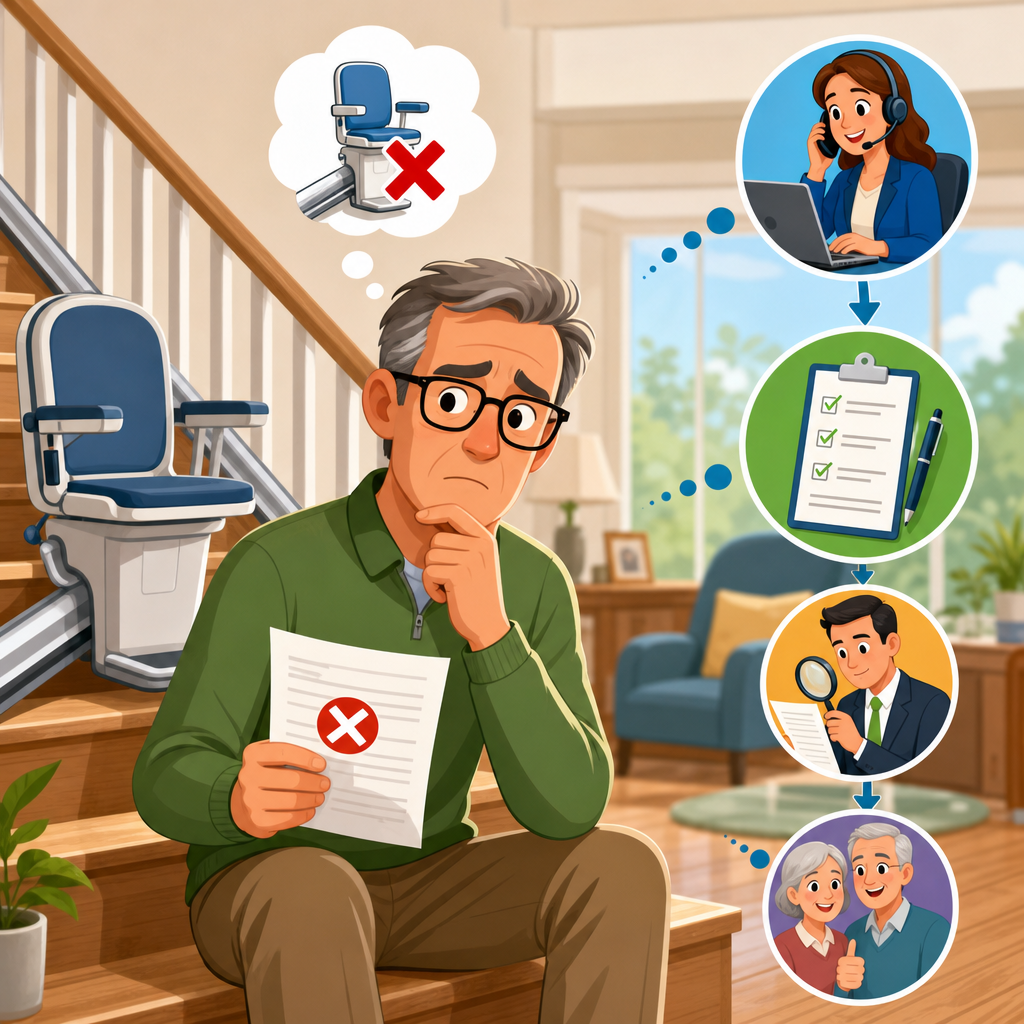
Insurance denied your lift claim, and now you need clear answers about what happens next, what chair lifts insurance may cover, and how to pay for equipment that can keep someone safe at home. In this context, a chair lift usually means a stair lift installed on a staircase, while some insurers and suppliers use mobility lift to describe vertical platform lifts, patient lifts, or seat lifts that help a person stand. Those distinctions matter because coverage decisions often turn on exact product type, diagnosis, and policy language. I have worked with families comparing quotes, gathering physician documentation, and appealing denials, and the first lesson is simple: a rejection is common, but it is not always final.
Does insurance cover chair lifts? Usually, standard health insurance, including Original Medicare, does not cover most stair lifts because they are considered home modifications rather than medically necessary durable medical equipment. Yet some plans may cover a portion of a related device, such as a seat lift mechanism, a patient transfer lift, or physical therapy evaluation tied to fall prevention. Medicaid waiver programs, Medicare Advantage plans, veterans’ benefits, workers’ compensation, and state assistive technology programs can sometimes help where basic health insurance will not. Understanding these categories is the difference between accepting a denial and finding a workable path forward.
This topic matters because the stakes are practical and immediate. Falls on stairs are a major injury risk for older adults and people recovering from stroke, joint replacement, spinal injury, or progressive neurological disease. A stair lift can delay or prevent a move, reduce caregiver strain, and preserve access to bedrooms and bathrooms located on another floor. At the same time, installed costs often range from roughly $2,500 to $15,000 depending on staircase shape, rail length, weight capacity, outdoor rating, and electrical needs. For many households, that is too large to treat as an impulse expense.
This hub article explains what insurers mean when they review lift claims, which types of lifts are most and least likely to be covered, why denials happen, and what steps improve your odds on appeal. It also outlines financing alternatives if insurance will not pay. If you are asking, “Does insurance cover chair lifts?” the short answer is no in many cases, but the complete answer is broader, more useful, and often more hopeful than the first denial letter suggests.
What insurance usually means by “chair lift”
Before you challenge a denial, identify the exact equipment category. Many consumers say chair lift when they mean a stair lift: a motorized chair that travels along a rail mounted to the stairs. Insurers may instead hear seat lift mechanism, which in Medicare terminology refers to a device that helps a person rise from a chair. These are not the same product, and claims get denied quickly when coding and documentation do not match the equipment requested.
There are four categories worth separating. First, stair lifts move a seated user up and down stairs inside or outside the home. Second, vertical platform lifts carry a wheelchair user between levels, often over a porch or short rise. Third, patient lifts, including Hoyer-style lifts, transfer a person between bed, chair, and toilet. Fourth, seat lift mechanisms help someone stand from a seated position. The last two are far more likely to fit durable medical equipment rules than a stair lift that becomes part of the home.
That distinction drives coverage. Original Medicare Part B generally covers durable medical equipment that can withstand repeated use, serves a medical purpose, and is appropriate for home use. A stair lift rail bolted to the staircase looks to Medicare like a home modification, similar to a ramp or widened doorway, not like portable medical equipment. By contrast, a patient lift may qualify when medically necessary, and a seat lift mechanism has its own limited rules. Private insurers often use similar logic even when their policies differ in detail.
When I review denial letters with families, I usually see one of three phrases: not medically necessary, benefit exclusion, or not durable medical equipment. Each points to a different problem. Medical necessity means the insurer believes safer or lower-cost alternatives exist, or that records do not show enough functional impairment. Benefit exclusion means the policy plainly excludes home modifications regardless of need. Not durable medical equipment means the requested item does not fit the plan’s covered category. Knowing which phrase appears in the denial tells you whether an appeal has a real chance or whether you need another funding route.
Does insurance cover chair lifts? The realistic answer by payer type
For most people, the practical answer is that health insurance rarely covers stair lifts, but several public and private programs may cover related lift devices or contribute through exceptions, supplemental benefits, or separate disability programs. The best way to judge your odds is by payer type, because Medicare, Medicaid, commercial insurance, veterans’ programs, and long-term care policies use very different rules.
Original Medicare usually does not cover stair lifts because they are treated as home modifications rather than covered durable medical equipment. Medicare may cover a seat lift mechanism under narrow conditions when a physician certifies severe arthritis or severe neuromuscular disease and when the person can walk once standing. Even then, Medicare covers the mechanism only, not the chair itself. Medicare may also cover patient lifts when transfer assistance is medically necessary and ordering criteria are met through a Medicare-enrolled supplier.
Medicare Advantage plans can differ from Original Medicare. Because these plans may offer supplemental home safety or in-home support benefits, some members find limited assistance for accessibility equipment, particularly through special supplemental benefits for the chronically ill. Coverage is not guaranteed and often depends on plan design, diagnosis, and network rules. I have seen plans approve home assessments, therapy visits, or care coordination that indirectly reduce the total out-of-pocket burden even when they do not pay for the stair lift itself.
Medicaid is the most variable but often the most promising payer. State Medicaid home and community-based services waivers sometimes fund environmental accessibility adaptations when the modification prevents institutional placement and supports safe living at home. A stair lift may be considered, especially if no first-floor bathroom or bedroom exists and a clinician documents risk. Waiver caps, waiting lists, prior authorization, and state-specific definitions apply, so the exact outcome depends on where the person lives and which waiver program they qualify for.
Commercial insurance usually follows contract language closely. Standard employer or individual plans often exclude stair lifts, but some flexible spending accounts and health savings accounts may allow payment with pre-tax dollars if the device is primarily for medical care and supported by a letter of medical necessity. Long-term care insurance may help in some cases when home modifications are tied to a covered plan benefit. Veterans may qualify for assistance through the Department of Veterans Affairs, including Home Improvements and Structural Alterations grants for certain service-connected or medically justified needs.
| Payer or program | Stair lift coverage likelihood | What may be covered instead | Key action |
|---|---|---|---|
| Original Medicare | Low | Seat lift mechanism, patient lift, therapy evaluation | Confirm HCPCS category and supplier enrollment |
| Medicare Advantage | Low to moderate | Supplemental home safety benefits, care coordination | Request evidence of coverage and prior authorization rules |
| Medicaid waivers | Moderate in some states | Environmental accessibility adaptations | Contact waiver case manager and occupational therapist |
| Commercial insurance | Low | Related DME, therapy, pre-tax account eligibility | Review exclusions and file a formal appeal |
| VA programs | Moderate for eligible veterans | Home modification grants | Ask prosthetics or social work about HISA options |
Why insurers deny stair lift claims
Most denials trace back to policy structure, not just paperwork. The first and biggest reason is classification. Insurers often place stair lifts in the home modification category, alongside grab bars, ramps, widened doors, and bathroom remodels. Even when those changes are clearly helpful, many medical plans are written to cover treatment and equipment, not alterations to real property. That is why a claim can be denied even when every clinician involved agrees the lift would reduce falls.
The second reason is incomplete medical necessity documentation. A short prescription that says “needs chair lift” is rarely enough. Reviewers want diagnosis, functional limitations, failed alternatives, caregiver situation, home layout, and a direct explanation of why climbing stairs is unsafe. Strong records often come from an occupational therapist or physical therapist who documents stair performance, transfer ability, fatigue, pain, fall history, and whether a first-floor setup is realistically possible.
The third reason is coding confusion. Suppliers sometimes quote one product while the prescriber writes for another. If the documentation discusses a stair lift but the claim uses language associated with seat lift mechanisms or transfer lifts, the insurer may reject it automatically. I have also seen denials caused by out-of-network suppliers, missing prior authorization, and estimates submitted without physician notes. Those are administrative errors, but they can still stop approval unless someone catches them quickly.
Finally, some denials are based on the insurer’s view that less costly alternatives exist. Reviewers may ask why the person cannot sleep on the first floor, use a bedside commode temporarily, rely on caregiver assistance, or move to an accessible residence. Those alternatives can be unrealistic, unsafe, or emotionally disruptive, but if the records do not explain why, the insurer’s lower-cost option may prevail on paper. That is why an effective appeal must address not only need, but also why the obvious substitutes do not work in this specific home.
What to do immediately after an insurance denial
Start by requesting the full denial packet, not just the summary letter. You need the reason code, the policy section cited, any internal medical review notes, and the deadline for appeal. Then obtain your plan document or Evidence of Coverage and read the sections on durable medical equipment, home health, exclusions, home modifications, and appeals. If the denial is based on a benefit exclusion, your strategy shifts toward alternate funding. If it is based on medical necessity, build a stronger clinical case.
Next, assemble documentation that connects the lift to safety and function. Useful records include physician notes, hospital discharge summaries, therapy evaluations, fall reports, imaging findings when relevant, and medication lists that may increase fall risk. Include a concise home description: number of steps, location of bedroom and full bathroom, railing condition, landing dimensions, and whether a first-floor living arrangement is feasible. Photos and a supplier assessment can help show why the requested model matches the staircase and user needs.
Then ask the prescribing clinician for a detailed letter of medical necessity. The strongest letters describe diagnoses, symptom severity, and specific risks. They explain why the person cannot safely use stairs, why caregiver lifting is not a safe substitute, and why a first-floor conversion is not practical or would still leave essential needs unmet. They also distinguish the requested stair lift from other equipment categories so the insurer cannot deny based on terminology alone.
File the appeal in writing and keep a dated record of every call, fax, portal message, and attachment. If the plan allows peer-to-peer review, request that the prescribing physician speak with the insurer’s medical reviewer. If the first appeal fails, check whether you can request an external review. At the same time, do not wait to explore other funding. Appeals take time, and households often need a backup plan to reduce risk immediately.
How to pay when insurance will not cover the lift
If insurance will not pay, several alternatives can lower the net cost. Medicaid waivers, state assistive technology programs, Area Agencies on Aging, Centers for Independent Living, and nonprofit disease organizations are the first places I check. Some states offer low-interest alternative financing programs for adaptive equipment. Veterans should ask the VA about grants and home modification support. Workers injured on the job may have options through workers’ compensation or vocational rehabilitation depending on the case history.
Tax treatment can also help. In some situations, a stair lift may qualify as a medical expense if installed for a diagnosed condition, especially when a clinician supports the need and the cost exceeds any increase in home value attributable to the improvement. Households using a health savings account or flexible spending account should ask the administrator whether a letter of medical necessity is sufficient for reimbursement. Rules vary, so confirm before purchase.
Supplier options matter too. Reputable dealers may offer financing, refurbished units for straight staircases, rental programs for short-term recovery, or buyback arrangements. Straight stair lifts are usually less expensive and faster to install than custom curved models because the rail is standardized. Used or reconditioned equipment can be a practical choice when the staircase is straight and the dealer provides a warranty, new batteries, and a safety inspection.
When comparing quotes, look beyond the base price. Ask about weight capacity, seat width, battery backup, call-send controls, folding rail sections for doorway clearance, service response times, and labor warranty. A cheaper unit that does not fit the user’s body size or the staircase geometry is not a bargain. The right purchase is the one that safely matches the home, the diagnosis, and the likely duration of need.
How this hub helps you evaluate every chair lift coverage path
The main takeaway is straightforward. If you are asking whether insurance covers chair lifts, expect a stair lift denial from many standard health plans, but do not assume every door is closed. Coverage often depends on the exact type of lift, the wording of the policy, and the quality of the clinical documentation. Medicare usually excludes stair lifts, while Medicaid waivers, certain Medicare Advantage benefits, VA programs, and tax-advantaged payment methods may offer a path forward.
The smartest next step is to separate three questions. What device is being requested? Why was the claim denied? Which alternative funding sources fit your situation? Once those answers are clear, decisions get easier. You can pursue an appeal when the denial appears document-driven, or move quickly toward waivers, grants, financing, or a refurbished unit when the policy plainly excludes home modifications. That approach saves time and reduces the chance of paying for the wrong product.
Use this article as your starting point for the broader Cost and Financing Options section. From here, compare payer-specific rules, learn the difference between stair lifts and covered durable medical equipment, and build an appeal package that addresses safety, function, and medical necessity in concrete terms. If a denial letter is sitting on your table today, request the full rationale, gather the right records, and start with one call to your insurer or case manager. Progress usually begins there.
Frequently Asked Questions
Why was my lift claim denied, and what should I do first?
Lift claims are often denied because the insurer says the equipment is not covered under your specific plan, the product was coded incorrectly, the medical records did not clearly show why the lift is medically necessary, or the item falls into a category the carrier treats differently than expected. This happens a lot with products that sound similar but are handled very differently by insurance. For example, a stair lift installed on a staircase is commonly viewed as a home modification or convenience item, while a patient lift, seat lift mechanism, or vertical platform lift may be reviewed under different durable medical equipment or mobility benefit rules. A denial does not always mean the equipment is never covered. It often means the insurer did not receive the right documentation, the wrong product category was submitted, or the plan excludes that type of lift even though it may cover a different one.
Your first step should be to read the denial letter carefully and identify the exact reason for the decision. Look for phrases such as “not medically necessary,” “benefit exclusion,” “investigational,” “not covered under durable medical equipment,” or “insufficient documentation.” Then request a full copy of the claim file, your plan’s Evidence of Coverage or Summary Plan Description, and any policy language that applies to lifts, mobility devices, or home modifications. It is also smart to confirm the exact name of the equipment submitted, the billing codes used, and the diagnosis codes attached to the claim. If the request was submitted as a stair lift but your provider believes a different type of mobility lift may qualify, that distinction could be central to the next step. Before you appeal, gather a detailed prescription, physician letter of medical necessity, therapy notes, and a home safety explanation showing why the lift is needed to prevent falls, support transfers, or make the home usable. A denial is a decision point, not necessarily the end of the process.
Does insurance cover stair lifts, chair lifts, mobility lifts, or patient lifts?
Coverage depends heavily on the exact device, the insurer, and the benefit category under your plan. In everyday conversation, many people say “chair lift” when they mean a stair lift that carries a person up and down a staircase. Insurers, however, may separate stair lifts from other products such as seat lifts that help a person rise from a chair, patient lifts used for transfers, or vertical platform lifts that raise a wheelchair user between levels. Those products are not interchangeable from an insurance standpoint. A stair lift is frequently excluded because it is considered a home modification attached to the property rather than portable medical equipment. That is why many people are surprised when a claim for a staircase-mounted lift is denied even though they have medical documentation showing serious mobility limitations.
Other lift-related equipment may have a stronger chance of coverage, but only under certain rules. A patient lift used to transfer someone from bed to chair, for example, may be eligible if a doctor documents that transfers cannot be performed safely without it and the patient would otherwise be confined to bed. Seat lift mechanisms have their own criteria and are often reviewed very narrowly. Vertical platform lifts are more complex because they can be treated as accessibility equipment or structural modifications, which many plans exclude. Medicare, Medicare Advantage, Medicaid, VA benefits, commercial insurance, and workers’ compensation may all apply different standards. The practical takeaway is that you should never assume all “lifts” are treated the same. Ask your insurer to identify the specific benefit category for your device and whether the denial is based on product type, plan exclusion, lack of medical necessity, or missing documentation. That one clarification can save a lot of time and lead you toward the right appeal or payment strategy.
Can I appeal a denied lift claim, and what makes an appeal stronger?
Yes, in many cases you can appeal, and a well-prepared appeal can make a real difference. The most effective appeals directly answer the insurer’s stated reason for denial instead of simply repeating that the equipment is needed. If the denial says the product is excluded, your appeal should focus on whether the device was misclassified, whether a covered alternative exists, or whether the plan language was applied incorrectly. If the denial says there is not enough proof of medical necessity, the appeal should provide stronger clinical support. That may include a detailed physician letter, occupational or physical therapy evaluations, fall history, transfer limitations, home layout concerns, failed alternatives, and a clear explanation of why a less costly or simpler device will not work. Insurers respond best when the appeal is specific, evidence-based, and tied closely to their own coverage criteria.
A strong appeal usually includes several pieces: the denial letter, a written appeal statement from you or your representative, a prescription, a detailed letter of medical necessity, chart notes showing diagnoses and functional limitations, and vendor information identifying the exact equipment requested. If the claim involved a stair lift, it can help to explain why stair navigation is unsafe, what injuries or near-falls have occurred, and why moving a bedroom or bathroom to the first floor is not practical. If the issue is actually a different type of mobility lift, make sure the documentation reflects the correct terminology. You should also request the insurer’s internal policy or medical review guideline used to deny the claim and address it point by point. If the first appeal fails, ask about a second-level appeal, external review, state insurance complaint process, or assistance through your employer’s benefits administrator if the coverage is employer-sponsored. Many denials are upheld simply because the appeal did not target the real issue. Precision matters.
If insurance will not pay, what are the best ways to cover the cost of a lift?
If your final answer from insurance is no, there are still several realistic ways to pay for a lift, and the best option usually depends on the type of equipment, your income, your age, and whether the need is short-term or long-term. Start by asking the supplier whether they offer used, refurbished, rental, or buyback options. For stair lifts in particular, refurbished units and rental programs can significantly reduce the upfront cost, especially if the staircase is straight rather than curved. Some vendors also offer financing, but compare the interest rate, service terms, and removal charges carefully before signing. If you are considering a patient lift rather than a staircase-mounted lift, ask whether there are lower-cost manual models that still meet the safety need.
Beyond the supplier, explore public and nonprofit funding sources. Medicaid waiver programs in some states may help with home accessibility or equipment, even when standard health insurance does not. Veterans may qualify for assistance through VA programs if the need is service-connected or otherwise meets eligibility criteria. Area Agencies on Aging, Centers for Independent Living, disease-specific nonprofits, community grant programs, and local disability organizations sometimes provide direct aid, low-interest loans, or referrals to reused equipment programs. Flexible Spending Accounts and Health Savings Accounts may also help if the expense qualifies, and there may be tax advantages to claiming medically necessary home modifications in some situations. If a workplace injury caused the mobility limitation, workers’ compensation may be relevant. If the need followed a car accident, auto insurance medical benefits may also be worth reviewing. The key is to widen the search beyond traditional health insurance and ask each program specifically whether it helps with stair lifts, transfer lifts, or accessibility equipment, because the answer varies widely by category.
How can I improve my chances of approval before resubmitting or requesting a different type of lift?
The biggest improvement you can make is to align the request with the exact equipment needed and the exact insurance rules that apply to that product. Many claims run into trouble because the paperwork uses broad terms like “chair lift” or “mobility lift” without defining whether the request is for a stair lift, a patient transfer lift, a seat lift mechanism, or a vertical platform lift. Those distinctions are not minor. They often determine whether the claim is reviewed as durable medical equipment, accessibility equipment, or a noncovered home modification. Before resubmitting anything, confirm the product name, model, billing code, and intended medical purpose with both the prescribing clinician and the supplier. Everyone should be describing the same device in the same way.
Next, strengthen the clinical record. Ask the physician and therapy team to document the person’s diagnoses, mobility limits, transfer abilities, fall risk, pain, endurance, caregiver burden, and why alternative solutions are unsafe or ineffective. If the need involves stairs, include details about how often stairs must be used, whether there is a bathroom or bedroom on the main floor, whether the person has already fallen or nearly fallen, and whether the home can be safely rearranged. If the request is for a covered alternative rather than a stair lift, make sure the chart notes support the medical criteria for that specific device. It also helps to obtain a written quote from the supplier, photographs of the home setup if relevant, and any manufacturer information that clarifies the equipment category. Finally, call the insurer before resubmitting and ask exactly what documentation is required, whether prior authorization is needed, and what wording or coding issues caused the original denial. A short pre-submission call can reveal the gaps that would otherwise trigger another rejection.