


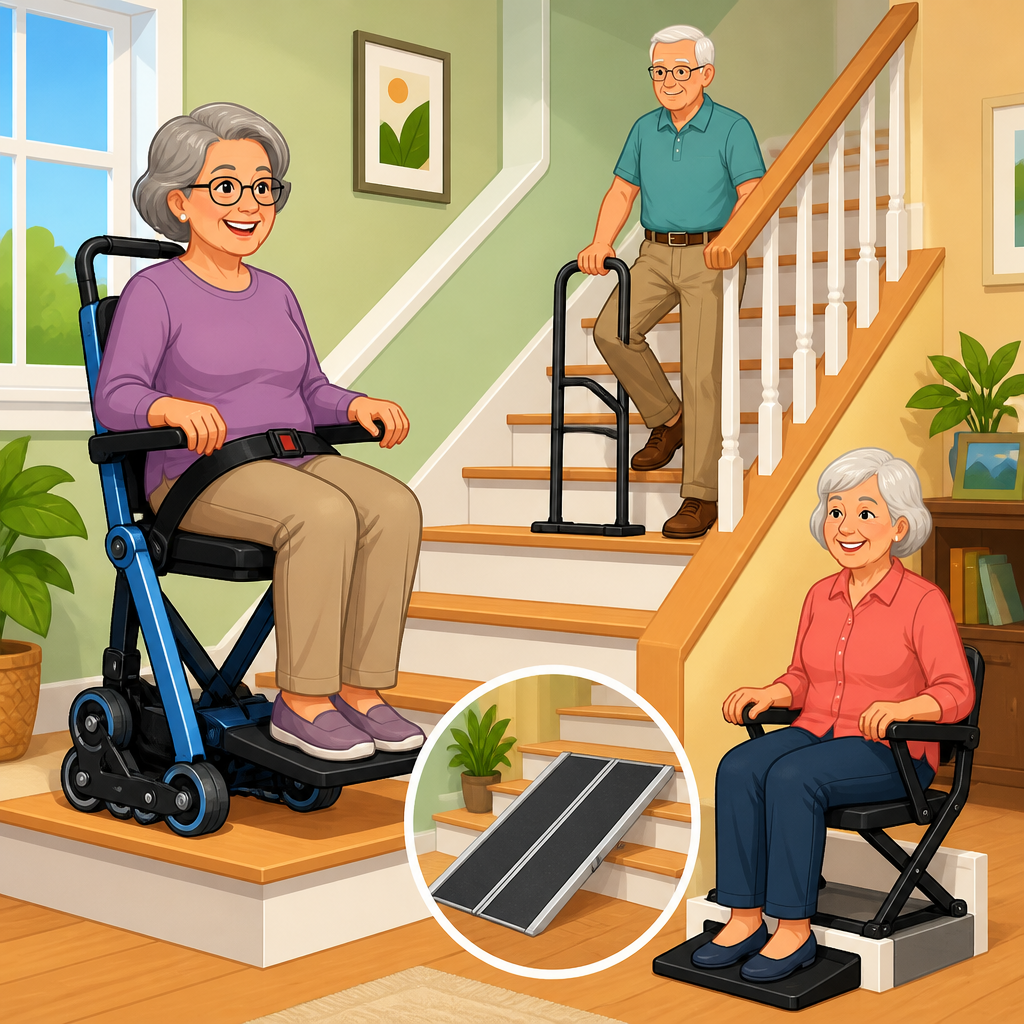
Low-cost stair lift alternatives for short flights of stairs can solve a pressing mobility problem without forcing a household into the expense, installation complexity, and maintenance commitments of a full powered lift. In practice, “short flights” usually means three to eight steps at an entryway, split-level landing, porch, garage threshold, or interior transition where one level changes modestly but still creates a daily obstacle. “Low cost” is relative, yet most buyers I have advised define it as meaningfully less than the typical installed price of a new stair lift, which often lands in the several-thousand-dollar range once track customization, electrical setup, safety features, and labor are included. That gap matters because many families need help quickly after surgery, stroke, arthritis flare-ups, or progressive balance loss, but they are not ready for a major purchase or a permanent remodel. The good news is that several budget-friendly options exist, including ramps, half-step modifications, grab bars, handrail upgrades, transfer platforms, vertical platform lifts for specific layouts, and carefully chosen portable mobility aids. The right choice depends on the user’s strength, fall risk, wheelchair needs, and whether the stairs are inside or outside. This guide explains the practical alternatives I recommend first when a full stair lift is too expensive, too bulky, or simply unnecessary for a short flight.
When a Stair Lift Is Not the Best First Option
A stair lift is a seated motorized chair that travels on a rail mounted to the staircase. It is effective for many users, but it is not automatically the smartest purchase for a short run of stairs. On compact stairways, a rail can narrow walking space, which may affect other family members and sometimes violates the spirit of local egress expectations even when technically permitted. For a porch with four steps, for example, spending thousands on a weather-rated lift may be difficult to justify when a code-compliant modular ramp or a pair of well-placed handrails could restore safe access at far lower cost.
Cost is only one factor. Transfer ability matters just as much. A stair lift still requires the user to sit down safely, swivel if needed, keep feet on the footrest, and stand up again at the top. People with poor trunk control, advanced Parkinsonian freezing, significant dizziness, or one-sided weakness after stroke may struggle with those transfers. In those cases, a platform-based solution, a layout change, or a simpler environmental modification can be safer than a bargain stair lift installation.
I also look closely at duration of need. If the limitation is temporary, such as six weeks after knee replacement, a permanent rail system often makes less sense than a temporary ramp, extra rail support, or relocating sleeping and bathing functions to one level. Short-term needs should be matched with short-term spending whenever possible.
Budget-Friendly Alternatives That Often Work Better
For short flights, the most practical low-cost alternatives usually fall into five categories: change the rise, add support, create a level transfer point, replace stairs with a slope where space allows, or use a small lift only when wheeled access is essential. Each approach solves a different problem. The best results come from matching the product to the user’s exact movement pattern rather than shopping by price alone.
Half-step systems are one of the most underrated options. These products reduce the height of each step by adding an intermediate tread, making climbing easier for people with limited knee flexion, hip weakness, or reduced confidence. They do not help a wheelchair user, but for ambulatory users they can dramatically cut exertion at a modest cost. I have seen older homeowners manage front-entry stairs independently again after adding half-steps plus a second handrail, avoiding a powered device entirely.
Another strong option is an additional handrail or a graspable rail replacement. Many homes still have decorative rails that are too wide, too low, or interrupted at landings. A round or oval graspable handrail, mounted at a consistent height and extended beyond the first and last step, can materially improve stability. Occupational therapists often prioritize this because the intervention is simple, affordable, and immediately useful to nearly everyone in the home.
Threshold and short-run ramps are highly effective when the elevation change is small. They work especially well at garage entries, sunken living rooms, and split-level transitions. Portable aluminum ramps, modular ramps, and solid threshold ramps can all be economical, but slope is critical. The Americans with Disabilities Act uses a 1:12 guideline for many public settings, meaning one inch of rise for every twelve inches of run. In homes, steeper slopes are sometimes used when a helper is present, but safety drops quickly as the ramp gets shorter and steeper.
For users who must remain in a wheelchair or scooter, a vertical platform lift may sound expensive, yet on certain very short rises it can be more practical than a stair lift because it avoids transfers. Used units, reconditioned equipment, or basic unenclosed models can sometimes narrow the price gap enough to be worth comparing, especially if the alternative would require extensive rail customization.
How the Main Options Compare
The table below summarizes where each alternative tends to fit best. Actual pricing varies by region, material, weather exposure, and labor rates, but these ranges reflect what buyers commonly encounter when comparing short-flight access solutions.
| Option | Best for | Typical cost range | Main advantage | Main limitation |
|---|---|---|---|---|
| Second handrail or graspable rail upgrade | Users who can still walk stairs with support | $100 to $1,000+ | Lowest-cost safety improvement | Does not remove the need to climb |
| Half-step system | Arthritis, reduced leg strength, limited flexibility | $300 to $2,000+ | Makes each step physically easier | Not for wheelchairs |
| Threshold or short modular ramp | Small rises and wheeled mobility aids | $150 to $3,500+ | Eliminates transfers on minor elevation changes | Needs enough horizontal space |
| Transfer platform or small landing modification | Users who need a pause point between levels | $500 to $3,000+ | Improves safety on awkward entries | Site-specific carpentry often required |
| Basic vertical platform lift | Wheelchair users on short rises | $5,000 to $12,000+ | No seated transfer needed | Higher upfront cost than other alternatives |
A key pattern emerges here: the cheapest successful solution is usually the one that reduces risk without over-solving the problem. If someone can walk four steps safely with bilateral hand support, a properly designed rail setup is smarter than any lift. If someone cannot transfer at all, spending a little less on a stair lift may still be money wasted.
Ramps, Mini Ramps, and Entry Reconfiguration
Ramps are often the first alternative people think of, but they are frequently misunderstood. A ramp is not automatically cheap, and a cheap ramp is not automatically safe. For a rise of 24 inches, a full 1:12 slope would require 24 feet of run before landings, which can exceed the available footprint at many homes. That is why ramps are most cost-effective on very short rises such as one to three steps, or when the site naturally allows a long side approach.
Threshold ramps are ideal for door saddles, single-step transitions, and low garage lips. They come in rubber, aluminum, and composite materials. Rubber models are quiet, slip-resistant, and simple to cut for custom widths, while aluminum keeps weight low for portable use. Modular aluminum systems are more expensive but allow handrails, turning platforms, and later reconfiguration.
Another route is entry reconfiguration. I have seen homeowners save money by moving the primary entrance from a front stoop with five steps to a side door with one step and enough space for a short ramp. The project may involve lighting, a new walkway, and weather protection rather than any stair device. This matters because the lowest-cost stair lift alternative is sometimes not a product on the stairs at all, but a smarter pathway around them.
Handrails, Grab Bars, and Low-Cost Safety Upgrades
When the user remains ambulatory, support modifications deliver the best value per dollar. A second handrail on the opposite side of the stairs can reduce sway, permit two-handed support, and help users descend facing forward instead of sideways. The rail should be continuous, easy to grip, securely anchored to framing, and contrast visually with the wall for users with limited vision. Building standards vary, but graspability and continuity matter more in daily use than decorative style.
Grab bars are different from handrails. They are shorter support points used at transitions, such as at the top step, beside a doorway, or near a landing where turning occurs. Installing a vertical bar at a door jamb can help a user steady themselves while opening the door before taking the first step. This is a common weak point in home access because many falls happen during transitions, not in the middle of the staircase.
Other low-cost upgrades include high-contrast anti-slip tread strips, brighter lighting, motion-sensor fixtures, and stair nosing repairs. The Centers for Disease Control and Prevention has long emphasized that falls are a major source of injury among older adults. In real homes, modest environmental fixes often prevent the fall that triggers the urgent, expensive equipment purchase later.
Half-Steps, Step Modifications, and Platform Solutions
Half-steps deserve special attention because they are specifically designed for people who can still climb stairs but cannot manage the original rise comfortably. Products such as intermediate outdoor half-steps effectively convert one tall step into two smaller ones. That change reduces joint demand and can improve confidence immediately. These systems are especially useful after joint replacement, for people with shorter stride length, and for users with limited ankle dorsiflexion.
Custom step modifications can achieve the same goal indoors. A carpenter may be able to add a broad intermediate tread, widen a narrow landing, or rebuild an awkward bottom step that currently creates a trip hazard. These are not glamorous projects, but they often outperform gadgets because they improve the architecture itself.
Transfer platforms are another strong niche solution. Imagine a garage entry with three steps where a user can stand briefly but tires quickly. A small platform halfway or at the top can provide a stable place to pause, reposition a walker, or manage a door. This can be enough to make a difficult transition safe without adding powered equipment.
Used Equipment, Rentals, and Financial Tradeoffs
If a powered option still seems necessary, budget-focused buyers should compare used, reconditioned, and rental equipment before buying new. Straight stair lifts are often easier to source used than curved models because their rails are standardized or easier to cut to length. Reputable dealers inspect motors, batteries, seat swivels, call stations, and safety edges before resale. Ask who performed the refurbishment, what warranty is included, and whether future service is available locally.
Rentals can make sense for recovery periods, but fees add up. In many markets, you will pay an installation fee, monthly rent, and removal fee. For a need lasting several months, a used lift may become cheaper than renting, while a handrail-plus-half-step setup may beat both. Always compare total cost over the expected duration of use rather than focusing only on the lowest monthly payment.
Funding sources can also influence the “best” low-cost choice. Veterans benefits, state assistive technology programs, Medicaid waiver programs, Area Agencies on Aging, and nonprofit reuse networks may offset some costs. Coverage rules vary widely, and Medicare generally does not pay for most home stair lifts. Families should verify eligibility early because the funding pathway may favor one type of solution over another.
How to Choose the Right Alternative Safely
Start by defining the user’s movement profile in plain terms: Can they walk the steps? Do they need one or two hands for support? Can they transfer safely from standing to sitting? Do they use a cane, walker, wheelchair, or scooter? Is the limitation temporary, progressive, or unpredictable? Once these answers are clear, the shortlist usually becomes obvious.
Measure the rise, run, clear width, landing depth, door swing, and available approach space. Note whether the location is exposed to rain, snow, or ice. Check local code requirements, homeowners association rules, and landlord permissions when relevant. For outdoor projects, drainage and surface traction deserve as much attention as the mobility product itself.
I strongly recommend involving an occupational therapist, accessibility contractor, or certified aging-in-place specialist when the user has complex balance issues or multiple diagnoses. A cheap solution that increases transfer risk is not truly low cost. The best buying decision is the one that reduces total risk, fits the home, and remains useful as needs change. Review the detailed guides linked throughout this budget-friendly options hub, compare your layout carefully, and choose the simplest modification that delivers safe, repeatable access every day.
Frequently Asked Questions
What are the most affordable alternatives to a stair lift for a short flight of stairs?
For a short run of three to eight steps, the most affordable alternatives usually include grab bars, extra handrails, threshold ramps, modular exterior steps with railings, portable or semi-permanent ramps, stair treads with high-traction surfaces, transfer platforms, and in some cases a small vertical platform lift or porch lift if a wheelchair must be accommodated. The right option depends on the person’s mobility, balance, strength, and whether they walk independently, use a cane or walker, or remain seated in a wheelchair.
If the goal is to make walking the steps safer rather than eliminate the steps entirely, adding a second handrail, improving lighting, increasing tread traction, and reducing step height with a platform or intermediate landing can be dramatically cheaper than installing a powered stair lift. These upgrades often cost a fraction of a lift and can be enough for someone who still has usable leg strength but needs more support and predictability.
If the person uses a walker or cannot safely manage even a few steps, a ramp or low-rise platform solution is often more practical than a chair lift. This is especially true at porches, garage entries, and split-level landings where there is enough room for a short ramp system or small lift enclosure. For wheelchair users, a chair-style stair lift may not solve the whole problem anyway, because the user must transfer on and off the seat and then have a wheelchair available on each level. In that situation, a platform lift or ramp can be more functional despite a higher upfront cost than handrails or traction improvements.
The key point is that “low cost” should be measured against the actual need. The cheapest option is not always the safest or most practical. A few well-chosen accessibility upgrades can outperform a basic stair lift for a short flight when the problem is limited, but if the person cannot reliably climb those steps at all, a more complete mobility solution is usually the better long-term value.
When is a ramp a better choice than a stair lift for just a few stairs?
A ramp is usually the better choice when the user relies on a wheelchair, scooter, or walker and needs continuous mobility without transferring in and out of a seat. It is also often preferable when multiple people in the household may benefit from the same access route, including visitors, caregivers moving equipment, or someone recovering from surgery. For a short set of exterior steps, a ramp can create straightforward access with fewer moving parts and less ongoing service than a powered lift.
That said, ramps are not automatically cheap or easy. The limiting factor is often space. To be safe and comfortable, a ramp needs a gradual slope, landings where required, railings in many cases, and a stable non-slip surface. Even a rise of just a few feet can require a ramp that is much longer than homeowners expect. On a tight porch, narrow side yard, or interior split-level area, there may simply not be enough room for a proper ramp layout. In those cases, a stair lift or small vertical platform lift may fit the space better.
Ramps also tend to be strongest as a long-term accessibility improvement because they work during power outages, do not require riding equipment, and are easier for some users to trust psychologically. Many people are more comfortable rolling or walking up a properly designed ramp with assistance than operating a motorized seat on stairs. Exterior ramps, however, must be built to handle weather, drainage, ice, and long-term wear, so material quality matters. Aluminum modular ramps are popular because they install relatively quickly and can often be reconfigured or removed, while wood ramps may have a lower initial price but often require more maintenance over time.
In short, choose a ramp when the user needs wheeled access, wants a low-maintenance solution, or cannot safely transfer onto a stair lift seat. Choose carefully, though, because the available footprint, local code requirements, and total rise will determine whether a ramp remains a low-cost alternative or becomes a larger construction project.
Can simple safety upgrades really replace a stair lift for short interior stairs?
Yes, in many cases they can, especially when the user is still ambulatory and the main issue is instability rather than an inability to climb. For short interior transitions such as a few steps down to a family room, up from a garage, or between split levels, targeted safety improvements can significantly reduce fall risk. Common upgrades include adding sturdy handrails on both sides, installing brighter overhead and step-level lighting, using contrasting edge strips to improve depth perception, replacing slick flooring with high-traction surfaces, and adjusting surrounding layout so the user has clear approach and turning space.
These changes are often far less expensive than a powered lift and involve little or no mechanical maintenance. They are also less visually intrusive and can preserve a more normal look inside the home. For older adults who are cautious but still physically able, a well-designed handrail setup can be the difference between struggling daily and moving comfortably. In homes where the steps are uniform and in good repair, the combination of railings, traction, and better visibility can be highly effective.
However, there is an important limit. Safety upgrades help people who can still bear weight, balance with support, and step up or down with control. They do not solve the problem for someone with severe knee or hip weakness, major neurological balance issues, advanced arthritis, post-stroke mobility loss, or a condition that makes lifting the feet unsafe. In those situations, the steps themselves remain the barrier, no matter how much safer they are made.
A practical way to think about it is this: if the person can already use the stairs but does so with fear or fatigue, simple upgrades may be enough. If the person avoids the stairs entirely, has had near-falls, or requires hands-on assistance every time, it is time to look beyond minor modifications and consider a ramp, transfer solution, or lift-based option.
How do I choose the safest low-cost option for an elderly family member?
Start by identifying exactly how the stairs are being used and what part of the task is failing. Is the person able to step up but not down? Do they lose balance while turning at the landing? Can they climb if they have a rail on both sides? Are they using a cane, walker, or wheelchair? The safest low-cost option comes from matching the solution to the real functional limitation rather than buying the cheapest product advertised as an accessibility fix.
For someone who still walks but needs confidence and support, dual railings, anti-slip tread covers, better lighting, and a rest point at the top or bottom may be the safest economical choice. For someone who cannot carry a walker up a few steps or cannot manage a threshold while maintaining balance, a small ramp or threshold bridge may be more appropriate. For someone who uses a wheelchair full time, options that avoid transfers altogether are generally safer than a chair lift, because transfers introduce another fall point and often require caregiver help.
It is also wise to consider fatigue, cognition, and consistency. A solution is only safe if the person will use it correctly every time. Some older adults can physically use a short stair lift but forget seatbelt steps, swivel procedures, or charging habits. Others may reject a ramp that feels too steep or a rail placement that does not match their dominant hand. In those cases, simpler systems often win because they demand less judgment and less coordination.
If possible, involve a licensed occupational therapist, aging-in-place specialist, or experienced accessibility contractor. Even a short assessment can prevent expensive mistakes. They can evaluate gait, transfer ability, doorway clearance, rail placement, and whether the stair geometry itself creates unusual hazards. The safest budget-friendly choice is the one that reduces fall risk today and still works as mobility changes, rather than the one with the lowest purchase price alone.
Are low-cost stair lift alternatives worth it long term, or do they usually become temporary fixes?
That depends on the user’s medical outlook and on whether the chosen solution addresses the underlying mobility problem. Some low-cost alternatives become excellent long-term answers. A properly installed handrail system, improved stair lighting, slip-resistant treads, or a well-designed ramp can serve a household for many years with minimal upkeep. These improvements are especially worthwhile when the mobility issue is mild, stable, or related to confidence and safety rather than a complete inability to navigate level changes.
Other alternatives are better viewed as transitional. For example, a portable ramp over a garage step may be a smart short-term measure after surgery, but it may not remain practical if the person later needs a wheelchair full time. Likewise, adding rails can help during early balance decline, but if leg strength keeps worsening, those rails may eventually stop being enough. In those situations, the low-cost option is still worth considering if it buys time safely and avoids rushing into an expensive installation before needs are fully clear.
From a value perspective, long-term success comes from choosing something scalable and durable. Modular ramps can often be expanded or reconfigured. Exterior step systems with matching handrails can sometimes be altered more easily than poured concrete. A porch lift may cost more than simple alternatives, but if the user’s mobility is predictably declining, it may prevent multiple rounds of spending on interim fixes. This is where honest planning matters most.
A good rule is to weigh three time horizons: what is needed now,