


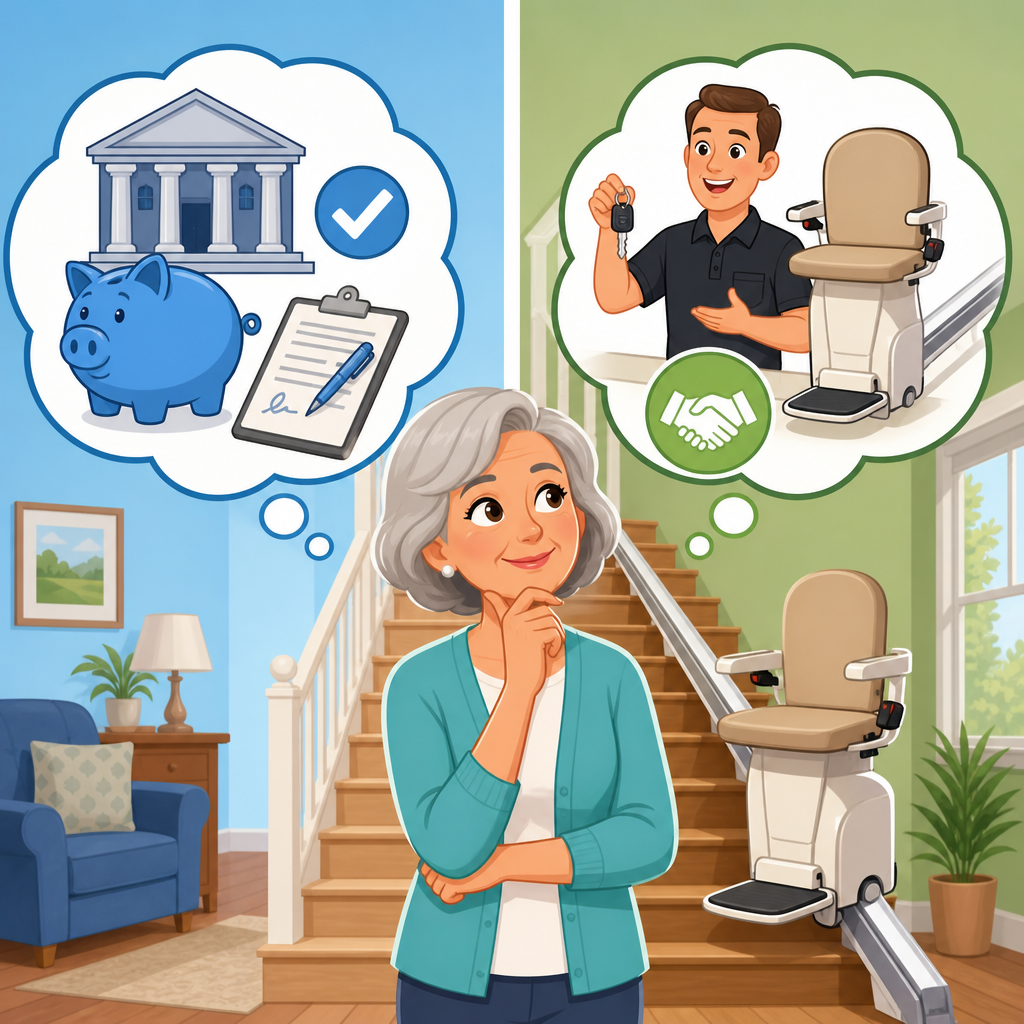
Paying for a stair lift often comes down to one central question: should you use a personal loan or accept dealer financing? The answer depends on your credit profile, installation timeline, cash flow, and the exact stair lift model you need, but the differences are clearer than many buyers expect. A personal loan is an unsecured installment loan from a bank, credit union, or online lender, usually repaid in fixed monthly payments over two to seven years. Dealer financing is credit arranged through the stair lift seller, often using a third-party lending partner, promotional terms, or in-house payment plans tied directly to the purchase and installation.
I have helped families compare both paths when a parent suddenly needed safe access between floors after surgery, a stroke, or a worsening balance disorder. In those moments, financing is not an abstract math problem. It affects how quickly the lift is installed, what total amount gets repaid, whether the home can stay livable, and how much financial pressure lands on the household each month. Because stair lifts are typically a medical-adjacent mobility purchase rather than a discretionary upgrade, the financing decision should be evaluated with the same care as the equipment itself.
This guide serves as a hub for financing and payment plans within the broader cost conversation. It explains how personal loans and dealer financing work, where each option fits best, what fees and approval standards matter, how promotional offers can mislead buyers, and what alternatives deserve attention before you sign. If you are comparing lenders, reviewing a dealer quote, or trying to understand whether monthly payments are manageable, this article gives you the framework to make a sound decision.
How Stair Lift Financing Works and Why the Details Matter
Stair lifts vary widely in price based on staircase design, weight capacity, seat features, power swivel options, and installation complexity. A straight stair lift is usually the least expensive because it uses a standardized rail. A curved stair lift requires a custom rail built to the dimensions of the staircase, which raises both manufacturing and installation costs. Reconditioned units can reduce the purchase price for straight stairs, while rentals may help in short-term recovery cases. Because many households do not budget for this expense in advance, financing becomes the bridge between urgent need and immediate safety.
The financing structure matters because stair lift costs are not just about the sticker price. Buyers should look at annual percentage rate, repayment term, origination fees, dealer administrative fees, prepayment penalties, required down payments, and whether the quoted monthly payment is based on a deferred-interest promotion. In my experience, the most expensive mistakes happen when families focus only on whether the monthly payment feels affordable without checking the total repayment amount. A lower payment spread over a longer term can cost far more than a slightly higher payment on a shorter schedule.
Timing also matters. Some installations must happen within days, especially after hospital discharge planning identifies stairs as a fall hazard. A personal loan may give you flexible funds you can use with any dealer, but approval and funding speed vary by lender. Dealer financing can streamline the process because the seller coordinates the financing application alongside the purchase order. That convenience is real, but convenience should never replace a line-by-line review of the contract.
Personal Loans for a Stair Lift: Strengths, Weaknesses, and Best Use Cases
A personal loan can be an effective way to finance a stair lift when you want freedom to shop among multiple dealers and maintain negotiating power on the equipment price. Because the funds are generally disbursed directly to you, the seller is paid as a normal cash customer. That matters more than many buyers realize. When a dealer knows you are not locked into its financing program, you can compare installation charges, service plans, seat upgrades, and warranty terms more independently. Credit unions are often especially competitive for borrowers with solid credit, and many online lenders provide decisions quickly.
The main advantage of a personal loan is flexibility. You can use it for the stair lift itself, electrical work, a folding hinge rail upgrade, or related home access needs. You also keep open the option to work with a local independent installer or a national brand. Fixed-rate personal loans provide predictable monthly payments, which helps households on retirement income. If there is no prepayment penalty, you can pay the balance down faster when insurance reimbursement, a tax refund, or family support arrives later.
The drawbacks are straightforward. The best rates usually go to borrowers with higher credit scores, stable income, and lower debt-to-income ratios. Unsecured personal loans can carry higher interest rates than promotional dealer offers, especially for fair-credit borrowers. Some lenders charge origination fees that effectively increase borrowing cost. Funding may also be less immediate than buyers expect if identity verification, income review, or bank linking slows the process. For urgent installations, even a short delay can be meaningful.
A personal loan is usually the better fit when you have good credit, want to compare several stair lift providers, need flexibility for related costs, and plan to repay the balance aggressively. It is also useful when dealer financing terms are vague, bundled, or contingent on promotions that could expire or convert to a much higher rate.
Dealer Financing for a Stair Lift: Convenience, Promotions, and Hidden Risks
Dealer financing is attractive because it simplifies the buying process at the point of sale. The stair lift company measures the staircase, recommends a model, presents a quote, and often offers monthly payment options on the same visit. For buyers who need immediate installation, this integrated process can reduce friction. Dealers may work with established financing platforms such as Synchrony, Wells Fargo partner programs, or regional lending companies, while some smaller providers arrange in-house installment agreements. Promotional offers may include no-interest periods, low introductory rates, or delayed payments.
The strongest advantage of dealer financing is speed paired with convenience. In time-sensitive situations, the ability to approve financing and schedule installation without separate lender shopping can be valuable. Some dealers also extend financing to buyers whose bank or credit union would move more slowly. In a few cases, dealer-arranged financing may include promotional terms that are cheaper than a standard unsecured personal loan, particularly if the buyer can pay off the balance within the promotional window.
However, dealer financing requires careful scrutiny. Promotional language such as “no interest if paid in full in 12 months” often refers to deferred interest, not waived interest. If the balance is not fully paid by the deadline, interest may be charged retroactively from the purchase date at a high rate. I have seen buyers assume they were receiving a simple zero-percent loan when the contract actually created a narrow payoff target. Another concern is price opacity. Some dealers focus the conversation on monthly payment affordability rather than the out-the-door cost of the stair lift, which makes comparison shopping harder.
Dealer financing is often best when installation is urgent, the terms are fully transparent, there are no punitive deferred-interest traps, and the offered rate compares favorably with outside lenders. It is less attractive when it reduces your leverage, hides fees, or distracts from evaluating the total purchase price.
Side-by-Side Comparison: Cost, Approval, Speed, and Flexibility
The better option depends on more than interest rate alone. Buyers should compare underwriting standards, funding timing, payment flexibility, and the effect on shopping power. The table below shows the practical differences families usually care about most.
| Factor | Personal Loan | Dealer Financing |
|---|---|---|
| Where funds come from | Bank, credit union, or online lender | Seller-arranged lender or in-house plan |
| Ability to compare dealers | High; you can shop as a cash buyer | Lower if financing is tied to one seller |
| Approval speed | Often same day to several days | Often immediate or very fast at point of sale |
| Rate structure | Usually fixed APR and fixed term | May include promotional, deferred-interest, or variable-like structures |
| Fees | Possible origination fee; usually disclosed clearly | Possible admin fees or embedded finance costs |
| Best for | Good credit, flexible shopping, broader project costs | Fast installation, simple checkout, competitive promo terms |
In plain terms, personal loans usually win on flexibility and pricing transparency, while dealer financing often wins on convenience. Neither is automatically cheaper. The lowest-cost path is the one with the lowest total repayment after all fees, not the one with the smallest advertised monthly payment.
How to Compare Offers Without Getting Distracted by Monthly Payments
When reviewing financing for a stair lift, start with the total installed price before discussing financing at all. That means equipment, rail, power supply, labor, permit-related work if applicable, service coverage, and warranty details. Ask each dealer for an itemized written quote. Once you have comparable quotes, then compare funding options. This sequence prevents financing from masking an inflated equipment price. I strongly advise buyers to request the annual percentage rate, exact term length, monthly payment, total of payments, all fees, payoff rules, and whether interest is simple, fixed, or deferred.
A practical example shows why this matters. Imagine Dealer A quotes a stair lift at $6,500 with dealer financing at a promotional rate that becomes expensive if not paid within 12 months. Dealer B quotes the same functional setup at $6,000, and you use a credit union personal loan with a fixed rate over 36 months. Dealer A may advertise a lower initial monthly payment, yet Dealer B may produce lower total repayment and less risk. The financing should support the purchase, not drive the purchase.
Buyers should also ask whether there is any discount for paying by cash, check, or outside financing. Some dealers bake financing cost into the price. Others maintain the same equipment price regardless of payment method. This is where shopping with independent funds can create negotiating leverage. If a salesperson cannot clearly explain the financing terms in writing, treat that as a warning sign.
Alternatives to Personal Loans and Dealer Financing
The hub for financing and payment plans should not stop at two options because many households have other avenues worth investigating. Medicare generally does not cover stair lifts because they are considered home modifications rather than durable medical equipment, but that does not mean assistance is unavailable. Medicaid Home and Community-Based Services waivers may help in some states for eligible individuals. Veterans may find support through VA programs tied to home accessibility, depending on service connection and eligibility. Area Agencies on Aging, state assistive technology programs, nonprofit loan closets, and disease-specific organizations sometimes offer grants, low-interest loans, or refurbished equipment.
Home equity loans or home equity lines of credit can offer lower rates than unsecured borrowing, though they place the home as collateral and may not be ideal for smaller purchases or urgent timelines. Health savings accounts or flexible spending accounts may be usable in some circumstances if the stair lift qualifies as a medically necessary expense and documentation supports the claim. Rentals are worth considering when the mobility limitation is temporary, such as after joint replacement recovery. For straight staircases, used or reconditioned stair lifts can reduce total cost materially, provided the dealer offers a solid warranty and current safety features.
If you are building your financing plan, related articles should cover stair lift grants, veteran benefits, renting versus buying, used stair lift pricing, Medicaid waiver pathways, and tax considerations for medically necessary home modifications. This page is the decision hub: compare all payment routes before choosing a loan product.
Which Option Is Better for Most Buyers?
For most buyers with good credit and enough time to compare quotes, a personal loan is usually better because it preserves shopping freedom, makes prices easier to compare, and often provides clearer repayment terms. For buyers facing urgent installation needs, dealer financing can be the better choice if the contract is transparent, the annual percentage rate is competitive, and there is no deferred-interest surprise. In other words, better does not mean universally cheaper or faster. Better means better aligned with your urgency, credit, and tolerance for financing complexity.
The key takeaway is simple: separate the equipment decision from the financing decision, then compare total cost, not just monthly payment. Ask for written quotes, read every term, and investigate assistance programs before borrowing more than necessary. A stair lift should improve safety and independence without creating avoidable financial strain. If you are weighing payment plans now, gather two dealer quotes, one outside loan offer, and one assistance-program check before you sign. That small amount of homework usually leads to the better outcome.
Frequently Asked Questions
1. Is a personal loan or dealer financing usually better for paying for a stair lift?
There is no single best option for every buyer, but in many cases the better choice comes down to total borrowing cost, speed, and flexibility. A personal loan can be a strong option if you have good credit, want to compare offers from multiple lenders, and prefer to keep your financing separate from the stair lift seller. Because personal loans are usually unsecured installment loans with fixed monthly payments, they can offer predictable budgeting over a set term, often between two and seven years. They may also give you the freedom to shop among different stair lift brands, installers, and models without being tied to one dealer’s financing program.
Dealer financing can be a better fit when convenience and fast approval matter most. Many stair lift dealers can help buyers apply during the quote or purchase process, which may reduce paperwork and speed up installation. This can be especially helpful when the stair lift is needed quickly after surgery, a fall, or a change in mobility. Some dealers also promote special financing offers, such as deferred interest or short-term promotional rates, though buyers should read those terms carefully. In practice, the better option is the one that gives you an affordable monthly payment, a reasonable interest rate, and terms you fully understand. Comparing annual percentage rate, fees, repayment timeline, and any penalties or promotional conditions will usually tell you more than the label “personal loan” or “dealer financing” alone.
2. How do interest rates and total costs typically compare between personal loans and dealer financing?
The biggest financial difference is often found in the annual percentage rate, or APR, along with any fees and promotional conditions. With a personal loan, your rate is usually based largely on your credit score, income, debt-to-income ratio, and lender underwriting standards. Borrowers with strong credit may qualify for relatively competitive fixed rates, which can make a personal loan less expensive over time. However, borrowers with fair or poor credit may see much higher APRs, which can substantially increase the total amount repaid.
Dealer financing can sometimes look attractive upfront, particularly when a dealer advertises low monthly payments or promotional financing. But buyers should look beyond the monthly number and focus on the complete financing structure. Some dealer financing arrangements are straightforward installment loans, while others may include deferred-interest promotions that become expensive if the balance is not paid off within the promotional window. In those cases, interest may be charged retroactively, which can surprise buyers who assumed the financing was interest-free. There may also be differences in loan origination fees, administrative charges, or limited flexibility in repayment terms.
To compare accurately, ask for the full APR, term length, monthly payment, total repayment amount, and whether the rate is fixed or variable. Also ask whether there is a prepayment penalty, late fee schedule, or deferred-interest clause. A stair lift is an essential mobility purchase, so the goal is not simply getting approved. The goal is choosing the financing structure that keeps the lift affordable without creating avoidable long-term debt. In many cases, a buyer who compares both options side by side can quickly see which one has the lower total cost.
3. Which option is easier to qualify for if my credit is limited or less than perfect?
Qualification standards vary, but dealer financing is sometimes easier for borrowers with limited credit history or weaker credit profiles because dealers may work with specialized financing partners that focus on medical equipment or home accessibility purchases. That does not guarantee approval, but it can expand the range of available financing options compared with applying only at a traditional bank. Some dealer programs are designed to serve buyers who need the equipment urgently and may not have ideal credit, though the tradeoff is often a higher interest rate or less favorable repayment terms.
Personal loans can be easier to compare across lenders, but approval standards may be stricter at banks and credit unions, especially for unsecured borrowing. Online lenders may be more flexible, and many allow prequalification with a soft credit check, which lets you review estimated rates without immediately affecting your credit score. That can be useful if you want to assess your options before committing to a stair lift purchase. If your credit is limited, you may also see better results by applying with a co-borrower, improving your debt-to-income ratio, or checking whether a credit union offers member-friendly loan terms.
If approval is your top concern, it often makes sense to explore both paths. Start with prequalification for personal loans, then compare that with dealer-arranged financing offers. Even if dealer financing is easier to obtain, it is still important to review the full terms carefully. The easiest financing to access is not always the most affordable financing to keep. For a purchase as important as a stair lift, balancing approval odds with realistic monthly affordability is essential.
4. Does dealer financing make installation faster than using a personal loan?
It often can, particularly when the dealer handles both the sale and the financing application in one process. For buyers who need a stair lift quickly, this convenience can be a major advantage. If the dealer can confirm financing promptly, schedule installation, and coordinate paperwork internally, it may reduce delays. This is especially relevant for urgent situations, such as returning home from the hospital, adapting a house for an older family member, or addressing a mobility issue before it becomes a safety risk.
With a personal loan, timing depends on the lender. Some online lenders can approve and fund loans quickly, sometimes within a few business days, while banks and credit unions may take longer depending on documentation requirements. Once the loan is funded, you can pay the dealer directly and move forward with the purchase. In that sense, a personal loan does not automatically mean a slow process, but it can involve more steps because you are arranging financing separately from the product purchase.
If speed matters, ask the dealer and the lender very practical questions: How long does approval usually take? When are funds available? Can installation be scheduled before final funding? Are there delays for custom stair lift models, curved rail systems, or home assessment requirements? A straight stair lift may be installed more quickly than a custom curved model regardless of financing method. In many situations, dealer financing wins on convenience and coordination, but a fast personal loan can still be competitive if you prepare documents in advance and work with a lender known for quick funding.
5. What should I ask before choosing between a personal loan and dealer financing for a stair lift?
Start by asking for the full out-the-door price of the stair lift, including equipment, rail configuration, installation, warranty coverage, service plans, and any electrical or structural modifications. Once you know the real project cost, ask each financing source for the APR, monthly payment, term length, total repayment amount, fees, and whether the interest rate is fixed. If a dealer advertises a promotion, ask whether it is true zero-interest financing or deferred interest, and what happens if the balance is not paid off within the promotional period.
You should also ask about flexibility. Can you make extra payments without penalty? Is there a prepayment fee if you pay the loan off early? Are there late fees? Does the financing cover only one dealer’s products, or can you use the funds with another provider? For personal loans, ask whether checking your rate requires only a soft credit inquiry and whether funding is fast enough for your timeline. For dealer financing, ask who the actual lender is, what credit standards apply, and whether multiple lender applications could affect your credit.
Finally, look beyond financing and consider the broader purchase decision. If one financing option pushes you toward a more expensive model than you need, it may not be the better deal. The right choice should support both mobility and financial stability. A well-chosen stair lift should solve an accessibility problem without creating a long-term payment problem. That is why the smartest buyers compare product fit, installation timing, and financing terms together rather than evaluating them in isolation.