


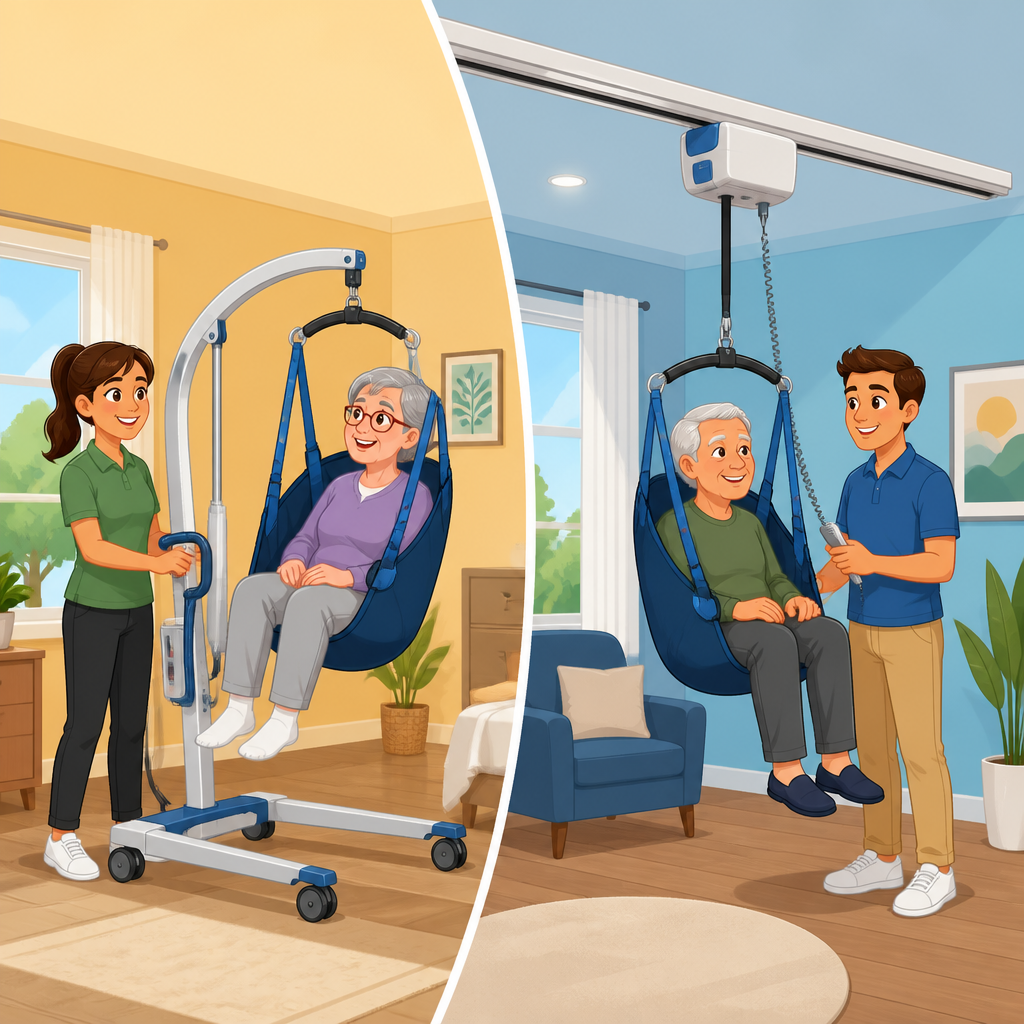
Ceiling track lifts are among the most important mobility systems used in homes, hospitals, rehabilitation centers, and long-term care settings because they reduce manual lifting, lower caregiver injury risk, and make transfers safer for people with limited mobility. Within this category, the most common decision is whether to choose a portable motor ceiling lift or a fixed motor ceiling lift. Both run on an overhead track and use a sling to move a person between a bed, wheelchair, toilet, bathtub, or therapy area, but they differ in how the motor unit is installed, shared, charged, and maintained. I have worked with families comparing these systems for tight residential budgets and with care teams planning equipment across multiple rooms, and the choice is rarely just about purchase price. It affects workflow, accessibility, emergency readiness, privacy, charging habits, and future adaptability.
A ceiling track lift is an overhead patient transfer system mounted to a fixed track, either straight or room-covering, designed to lift and move a person with minimal physical strain on a caregiver. The track stays in place, while the motor may either remain attached permanently to that track section or be moved from room to room as needed. A portable motor ceiling lift uses a detachable motor cassette that can travel between compatible tracks. A fixed motor ceiling lift has a dedicated motor unit installed on each track system. This distinction sounds simple, but it changes everything from staffing routines to capital planning. If one home has a bedroom track and a bathroom track, a portable motor can potentially serve both areas. With a fixed system, each area has its own ready-to-use motor.
This topic matters because transfer tasks are one of the leading causes of musculoskeletal injury among caregivers, and inconsistent equipment use often traces back to convenience. If the lift is hard to access, not charged, or located in another room, staff may improvise with unsafe manual transfers. In home care, the same friction appears when a spouse or adult child is working alone and needs an immediate, reliable transfer method. The best ceiling lift system is the one that matches frequency of use, user weight, room layout, number of caregivers, infection-control expectations, and budget over several years, not just on installation day.
As a hub page for ceiling track lifts within the broader chair lift types and designs topic, this article explains how portable motor and fixed motor systems work, where each performs best, what tradeoffs buyers often miss, and how to compare total value. If you are deciding between options for a private home, assisted living unit, bariatric room, or multiroom clinical environment, the practical differences below will help you narrow the right system faster.
How Ceiling Track Lifts Work and Where the Motor Choice Fits
Every ceiling track lift has four core elements: the track, the motor, the carry bar or spreader bar, and the sling. The track is anchored to the ceiling structure or a support system, and may run straight, use curves, or cover a full room through an XY gantry arrangement. The motor raises and lowers the user and, depending on design, may also traverse along the track manually or electrically. The sling is selected according to transfer type, postural support needs, skin integrity, amputee positioning, toileting access, or bathing use. Reputable manufacturers include Arjo, Guldmann, Handicare, Hillrom, and Prism Medical, and each offers different weight capacities, charging systems, and rail compatibility standards.
The portable versus fixed distinction concerns the motor assembly, not the track. In a portable motor setup, the caregiver can detach the motor from one room’s track and attach it to another compatible track using a transfer gate, docking station, or carry method, depending on product design. In a fixed motor setup, the motor remains on the installed track full time. Both can be clinically appropriate, but their daily use patterns differ sharply. In practice, I see portable units chosen when households want coverage in multiple spaces without buying multiple motors, while fixed units are selected when immediate availability and repeat transfers matter more than hardware sharing.
Ceiling track lifts are often compared with floor lifts, stair lifts, and sit-to-stand devices, but they solve a different problem. Floor lifts need storage space, turning radius, and enough clearance under beds or chairs. Ceiling lifts free up the floor, provide more predictable transfer paths, and usually feel less cumbersome for repeated moves. That is why many buyers searching for chair lift types and designs eventually focus on ceiling track lifts when they realize the issue is not climbing stairs, but safely moving from one surface to another inside a room.
Portable Motor Ceiling Lifts: Main Advantages and Typical Use Cases
The biggest advantage of a portable motor ceiling lift is cost efficiency across multiple rooms. If a home has tracks in the bedroom and bathroom, one portable motor can serve both, reducing upfront equipment costs compared with buying two fixed motors. This is particularly valuable when transfers are infrequent, when only one person uses the system, or when a family is budgeting carefully after a stroke, spinal cord injury, progressive neuromuscular diagnosis, or joint replacement complication. Instead of expanding the budget for a second motor, they invest in track coverage where it matters most.
Portable motors also offer flexibility when needs are changing. I have seen families start with one room, then add a second track months later without replacing the original motor. In temporary recovery scenarios, that modularity matters. If a user regains partial mobility, the home is not left with more dedicated lift equipment than necessary. In facilities, a portable motor can help cover lower-demand rooms, isolation spaces, or overflow areas. Some programs keep an extra portable unit as a contingency asset, which is useful during maintenance on a fixed unit.
Another benefit is easier equipment standardization. Staff can learn one motor interface, one battery format, and one emergency lowering procedure if every compatible track uses the same portable unit. This can simplify training, especially in home settings where multiple family members participate in care. Portable systems are also easier to replace quickly if the motor itself fails, because the issue is isolated to one module rather than embedded in every room’s setup.
Still, portability only helps if the transfer process remains practical. A detachable motor must be light enough, easy enough to latch, and available when needed. In well-run environments, caregivers establish charging docks, visual battery checks, and clear storage procedures so the motor is always where the next transfer will happen.
Fixed Motor Ceiling Lifts: Main Advantages and Typical Use Cases
The strongest advantage of a fixed motor ceiling lift is readiness. The motor is already on the track, charged through an in-track or dedicated charging arrangement, and available the moment the user needs a transfer. In high-frequency care, that saves time and removes a failure point. A morning routine may involve bed-to-wheelchair, wheelchair-to-toilet, toilet-to-shower chair, and return transfers before noon. If the motor had to be fetched from another room each time, workflow would slow and compliance could slip. Fixed systems reduce that friction dramatically.
Fixed motors are especially effective in hospitals, skilled nursing units, memory care, and high-acuity home care where consistency is crucial. They support standardized safe patient handling programs because every equipped room has a lift that is always present. This aligns with injury-prevention policies built around minimizing manual handling. OSHA does not issue a single national safe lifting standard for healthcare, but safe patient handling programs and state-level guidance consistently favor engineering controls that are available at point of care. Fixed systems fit that principle better than shared equipment.
Another advantage is reduced handling of the motor itself. Detaching and carrying a motor introduces opportunities for bumps, drops, rushed installation, or skipped checks. Fixed systems avoid repeated reattachment and may be preferable for users with complex positioning needs, higher body weights, or caregivers who need the simplest possible process. In bariatric applications, where capacities may reach 600 pounds or more depending on system design, dedicated fixed motors and reinforced track layouts often provide the most predictable performance and room-specific configuration.
The tradeoff is higher capital cost because each track requires its own motor. However, in settings with repeated daily transfers, that higher initial spend often pays back through time savings, better compliance, lower staff strain, and fewer delayed transfers.
Side-by-Side Comparison: Pros, Cons, and Decision Factors
The best way to compare portable motor and fixed motor ceiling lifts is to look beyond the purchase price and evaluate how the system will actually be used. Transfer frequency, number of rooms, caregiver skill, urgency of access, and maintenance logistics usually determine the right answer more accurately than marketing language.
| Factor | Portable Motor Ceiling Lift | Fixed Motor Ceiling Lift |
|---|---|---|
| Upfront cost | Lower when serving multiple tracks with one motor | Higher because each track has a dedicated motor |
| Availability | Depends on motor location and charge status | Always ready in equipped room |
| Best for | Homes, low-frequency use, phased installations | Frequent transfers, multi-staff care, high-acuity settings |
| Workflow | Requires moving and attaching motor between areas | Fast, consistent, minimal setup |
| Maintenance impact | One motor to service can affect multiple rooms | Failure is isolated to one room’s motor |
| Training | Simple if one shared model is used correctly | Simple because operation is always room-ready |
| Charging discipline | Critical; missed charging can stop all transfers | Usually easier to manage with dedicated charging |
| Scalability | Flexible for adding tracks later | Scales well where full-room readiness is required |
In real-world planning, homes often choose portable motors when budgets are constrained and transfers occur in sequence rather than simultaneously. Facilities often choose fixed motors in rooms where delays are unacceptable. Hybrid strategies are common: fixed motors in high-use rooms, portable motors for secondary spaces, respite suites, or temporary surge needs. That mixed model can control costs without sacrificing readiness where it matters most.
Installation, Maintenance, Safety, and Long-Term Cost
Installation quality matters more than many buyers realize. Ceiling track lifts must be matched to structural conditions, span lengths, turning paths, and user weight. A straight bedroom track may be straightforward, while a room-covering system over a bed and bathroom threshold may require more engineering. Portable and fixed motors share many installation requirements, but fixed systems may need more charging points or dedicated room-by-room commissioning. Any installer should verify structural load paths, manufacturer compatibility, and emergency lowering access.
Maintenance is where the hidden differences show up. Portable motors centralize service because one motor may support several rooms, but that also creates a single point of failure. If the motor is out for repair, every dependent track loses function unless there is a backup unit. Fixed motors distribute risk. One failed motor affects one room, not the entire setup. On the other hand, multiple fixed motors mean more batteries, more inspections, and potentially higher cumulative service costs. Buyers should ask about preventive maintenance intervals, battery cycle life, sling inspection protocols, and availability of loaner equipment.
Safety depends on correct sling selection, caregiver training, user assessment, and routine inspection far more than on the portable-versus-fixed label alone. The safest lift is one that caregivers will use every time. I have seen excellent portable systems underperform because the motor lived on the charger down the hall, and average fixed systems outperform expectations because they removed excuses. Features to compare include emergency stop, emergency lowering, lift speed, audible low-battery alerts, digital service counters, infection-control surfaces, and maximum safe working load.
Total cost of ownership should include track installation, motor units, batteries, charger design, sling inventory, annual inspection, repairs, and staff time. A portable system may look cheaper on day one, but if caregivers spend extra minutes moving the motor several times daily, labor costs and compliance loss can outweigh savings. A fixed system may cost more initially but deliver better value in demanding care routines.
How to Choose the Right Ceiling Track Lift for Your Setting
Start with five questions. First, how many transfers happen each day in each room? Second, do two rooms ever need lift access at the same time? Third, who will operate the system, and how confident are they with charging and attaching equipment? Fourth, what is the user’s current and likely future mobility status? Fifth, what happens if the motor is unavailable for a day? These answers usually make the direction clear.
For a private home with one primary user and predictable routines, a portable motor ceiling lift can be the smartest entry point, especially when adding tracks gradually. For a care environment where speed, consistency, and staff compliance are critical, a fixed motor ceiling lift is usually the better choice. If the user has progressive conditions such as ALS, muscular dystrophy, or advanced multiple sclerosis, planning for increased transfer frequency often justifies fixed readiness earlier than families expect. If the goal is a ceiling track lift hub that can connect bedroom, bathroom, and bathing areas over time, ask suppliers about expansion paths, motor interchangeability, and weight-capacity upgrades before signing.
The most successful projects combine a proper clinical assessment with a site survey and a realistic discussion of daily habits. Choose the system that caregivers will actually use, maintain, and trust. Then request a hands-on demonstration, compare service support, and map the next rooms you may need. That process leads to safer transfers, better independence, and a ceiling lift setup that still works well years from now.
Frequently Asked Questions
What is the main difference between a portable motor ceiling lift and a fixed motor ceiling lift?
The main difference is how the lift motor is installed and used on the ceiling track system. A portable motor ceiling lift has a detachable motor unit that can be moved from one track location to another, as long as each area has compatible charging and track access points. This gives users and care teams the flexibility to use one motor in multiple rooms or transfer spaces. A fixed motor ceiling lift, by contrast, has the motor permanently mounted on a specific track system, so it stays in one room or one defined transfer area and is always ready for use there.
From a practical standpoint, portable motors are often chosen when flexibility, lower upfront equipment cost, or multi-room use is the priority. Fixed motors are usually preferred when convenience, immediate availability, and high-frequency use matter most. For example, in a private home, a portable motor may make sense if one person needs transfers in the bedroom and bathroom but budget is limited. In a hospital, rehab setting, or long-term care environment where transfers happen constantly, a fixed motor may be the better fit because staff do not need to detach and relocate the motor between users or spaces.
Both options can significantly improve transfer safety, reduce caregiver strain, and support better outcomes for people with limited mobility. The right choice usually comes down to care routine, number of transfer locations, user needs, room layout, and how important it is to have a lift available in one exact place at all times.
What are the biggest advantages of a portable motor ceiling lift?
A portable motor ceiling lift offers several important advantages, especially for families or facilities trying to balance function and cost. One of the biggest benefits is flexibility. Because the motor can be detached and moved between compatible track systems, one unit can potentially serve more than one room. This is particularly useful in homes where a person may need help getting from bed to wheelchair in the bedroom and later from wheelchair to toilet or bath area in another space. Instead of buying multiple motors, users may be able to rely on a single portable unit.
Another major advantage is lower initial equipment cost in multi-room setups. While the tracks still need to be installed where transfers will occur, the ability to purchase one motor instead of several can make the overall project more affordable. Portable motors can also be helpful when needs may change over time. If a care plan evolves, the portable unit may be easier to adapt to different rooms or living arrangements without replacing the entire system.
Portable systems can also simplify sharing equipment in some clinical environments, provided infection control protocols, compatibility standards, and staffing practices support that model. In addition, maintenance planning may be easier when there are fewer motors in service. However, the benefits of flexibility are strongest when caregivers are comfortable moving the motor and when the transfer schedule allows time for that extra step.
Overall, a portable motor ceiling lift is often best for users who need safe overhead transfers in more than one area but do not require a dedicated motor in every room. It is a strong option when adaptability, space efficiency, and budget-conscious planning are top priorities.
What are the main drawbacks of a portable motor ceiling lift?
The biggest drawback of a portable motor ceiling lift is that convenience can suffer when the motor is not already where it is needed. Caregivers must move the unit from one room or track section to another, which adds time and introduces an extra task into the care routine. If the motor is left in a different room, charging station, or transfer area, it may not be immediately available during urgent or time-sensitive transfers. That can create frustration and reduce workflow efficiency, especially in settings where transfers happen frequently throughout the day.
There is also a greater reliance on staff consistency and organization. Someone must remember to relocate the motor, ensure it is properly attached, and verify that the battery is charged. In busy environments, that process can become a weak point. If multiple users depend on the same portable motor, scheduling and access may become an issue. A motor that works well in a single-user home setup may be less ideal in a facility with heavy traffic and back-to-back care tasks.
Another consideration is physical handling. Although portable motors are designed to be manageable, they still need to be removed, carried or transported, and reinstalled safely. For some caregivers, especially in fast-paced or understaffed settings, that may be less practical than simply using a permanently mounted unit. There can also be compatibility limitations, meaning the portable motor must match the track systems in each intended location.
In short, portable motor lifts trade some day-to-day convenience for flexibility and cost savings. They can be excellent in the right circumstances, but they are not always the best solution where speed, dedicated room coverage, and continuous readiness are essential.
Why would someone choose a fixed motor ceiling lift instead of a portable one?
A fixed motor ceiling lift is often chosen because it offers the highest level of convenience, consistency, and readiness. Since the motor remains permanently installed on its track, it is always available in the exact transfer location where it is needed. That matters a great deal for users who require frequent transfers, for caregivers who need to work efficiently, and for care environments where time, safety, and standardized routines are critical. There is no need to retrieve the motor, attach it to another track, or confirm whether it was left elsewhere.
Fixed motor systems are especially valuable in high-use spaces such as patient rooms, long-term care suites, toileting areas, and rehabilitation settings where transfers happen multiple times a day. They can support smoother workflows because staff know the equipment is in place and ready. This can reduce delays and help maintain safer transfer practices. For the person being lifted, a fixed setup can also feel more predictable and reassuring, particularly when transfers are part of a daily routine.
Another reason people choose fixed motor lifts is that they are well suited to dedicated care plans. If a user consistently needs assistance in one room, or if each room in a facility requires its own transfer solution, fixed motors make sense operationally. They may also reduce wear associated with repeatedly moving a motor between locations. In many cases, they support cleaner implementation of room-specific protocols, staff training, and equipment management.
The tradeoff is cost. Fixed motor systems generally require a separate motor for each installation area, which can increase the total investment. Still, for many users and organizations, the benefits of immediate access, simpler routines, and dependable room-by-room coverage outweigh the higher upfront expense.
How do you decide whether a portable or fixed motor ceiling lift is better for your situation?
The best way to decide is to evaluate how, where, and how often the lift will be used. Start with the transfer routine. If the user needs help in several rooms but transfers are relatively predictable and not constant, a portable motor ceiling lift may be a smart and economical choice. If transfers happen many times a day in one room or across several rooms where immediate access is important, a fixed motor ceiling lift may be more practical. Frequency of use is one of the clearest decision factors because it affects convenience, staffing efficiency, and overall satisfaction with the system.
Next, consider the care environment. In a private home, available budget, room layout, and the number of caregivers involved often point toward a portable system, especially when flexibility is needed. In hospitals, rehabilitation centers, and long-term care settings, fixed motors are commonly favored because they support faster workflows and reduce equipment-sharing complications. Also think about the user’s condition, body support needs, and whether transfers may become more frequent over time. A solution that works today should also be appropriate for likely future needs.
It is also important to review charging, storage, compatibility, and installation details. Portable motors need a reliable process for charging and relocating the unit. Fixed motors require a larger investment up front but may reduce operational friction later. The structure of the ceiling, track design, transfer destinations, and sling requirements all play a role in the final recommendation.
In most cases, the best decision comes from a professional assessment. An experienced dealer, therapist, accessibility specialist, or lift provider can evaluate the space, the user’s mobility level, and the caregiving routine to recommend the safest and most efficient option. The goal is not simply choosing between portable and fixed motors in theory, but selecting the system that provides reliable, dignified, and low-strain transfers in real daily use.