


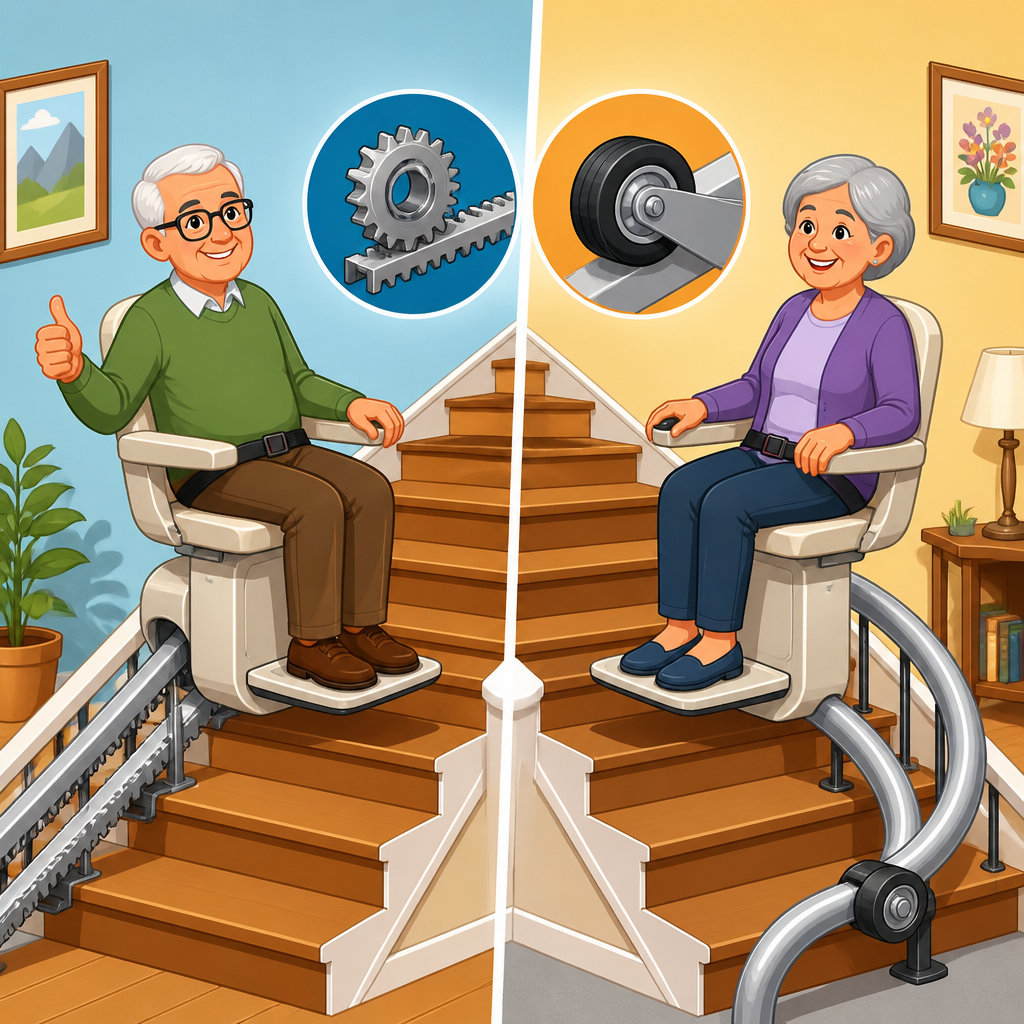
Choosing between rack-and-pinion and friction-drive stair lifts starts with understanding how each system moves the chair, how that affects reliability, and which design best matches the staircase, user needs, and long-term maintenance plan. In the stair lift industry, “drive system” refers to the mechanism that converts motor power into controlled travel up and down the rail. That mechanism determines ride quality, noise, traction, service demands, and how the lift performs when conditions are less than ideal. I have worked with both designs in home assessments, retrofit planning, and service reviews, and the same lesson appears repeatedly: the drive system is not a minor technical detail. It shapes the ownership experience.
A stair lift, also called a chair lift for stairs, is a motorized seat that travels along a rail fixed to stair treads. Most modern units include a battery-powered DC motor, onboard charging, obstruction sensors, a swivel seat, a folding footrest, and call-send controls. The rail, carriage, transmission, and braking system do the heavy mechanical work. Rack-and-pinion models use a geared pinion that engages a toothed rack mounted to the rail. Friction-drive models use powered rollers or wheels pressed against the rail to generate movement through grip. Both systems can be engineered safely, but they solve motion control in different ways, and those differences matter.
This comparison matters because stair lifts are purchased for mobility, independence, and risk reduction. A poor match can create avoidable service calls, discomfort, or shortened equipment life. A good match can provide years of stable daily use with minimal disruption. Homeowners often ask direct questions: Which system is smoother? Which is quieter? Which works better on long staircases, curved stairs, or outdoor installations? Which costs less to maintain? Those are the right questions. This hub article answers them plainly and gives the context needed to evaluate linked topics such as straight versus curved rails, indoor versus outdoor materials, and heavy-duty seat configurations.
At a design level, rack-and-pinion systems dominate much of the residential market because they offer positive mechanical engagement. Friction-drive systems are less common today but still relevant in certain designs and legacy installations. Neither approach is automatically “best.” The correct answer depends on user weight, stair geometry, duty cycle, installation conditions, manufacturer support, and service access in your region. Understanding those variables makes it easier to read specifications critically instead of relying on broad sales claims.
How Rack-and-Pinion and Friction-Drive Systems Work
A rack-and-pinion stair lift uses a motor connected through a gearbox to a small toothed gear called a pinion. That pinion meshes with a toothed strip, or rack, attached to the rail. When the motor turns, the pinion climbs or descends the rack in a controlled, repeatable way. Because the teeth interlock, motion does not depend on surface grip alone. This is why these systems are commonly described as providing positive drive. In practical terms, they maintain consistent travel even if dust, minor moisture, or rail wear would reduce traction in a grip-based design. Many straight stair lifts from established brands use this architecture for exactly that reason.
A friction-drive stair lift uses one or more motor-driven rollers or wheels that press against the rail. The system moves because friction between the drive surface and the rail generates enough traction to pull the carriage. Pressure settings, roller materials, rail finish, and environmental conditions all influence performance. The concept is straightforward and can produce a smooth feel, but it requires careful control of contact pressure and material wear. If traction is reduced, performance can suffer. That does not mean friction-drive units are unsafe by default; it means their engineering priorities differ. Designers compensate with braking systems, motor control logic, and material choices.
The essential comparison is simple: rack-and-pinion creates motion through mechanical engagement of teeth, while friction drive creates motion through controlled grip. That difference affects slippage potential, noise signature, sensitivity to contamination, and service intervals. For homeowners, the value of this distinction is practical, not academic. It explains why one lift may feel more planted on a steep run, why another may need roller inspection sooner, and why installers often prefer one system over the other for complex site conditions.
Performance, Ride Quality, and Daily Use
Ride quality depends on more than the drive system, but the drive system is a major factor. In well-built rack-and-pinion stair lifts, travel tends to feel deliberate and stable, particularly during start-up, ascent on steeper sections, and final leveling at the charge points. The geared engagement gives technicians predictable control over motion profiles. Modern controllers soften acceleration and deceleration, so the older impression that geared lifts always feel abrupt is outdated. When properly installed on sound stair treads with a correctly aligned rail, many users describe the ride as steady rather than harsh.
Friction-drive lifts can feel smooth because the rolling contact can damp some mechanical sensation, especially in systems designed with high-quality rollers and tuned motor control. However, consistency is the key issue. In my experience, the best friction-drive units perform well when the rail is clean, alignment is exact, and wear components are within specification. As those conditions drift, ride feel can change sooner than in a comparable rack-and-pinion design. Users may notice subtle differences before a fault is obvious: slightly more hesitation, a change in motor tone, or reduced confidence on long daily trips.
Noise is another frequent concern. There is no universal rule that one system is always quieter. A rack-and-pinion lift may produce audible gear and carriage noise, while a friction-drive lift may generate roller hum or squeal if pressure or surfaces are not ideal. Installation quality matters enormously. Rail joints, mounting rigidity, carriage alignment, and lubrication practices can matter more than brochure claims. For households sensitive to sound, the right approach is to request a live demonstration of the exact model, not just the drive category, and to ask how the noise profile changes over time with ordinary use.
For daily operation, battery-backed DC systems have improved both designs. Most current residential stair lifts charge at top and bottom stations and can complete multiple trips during a power outage, depending on battery age, user weight, rail length, and temperature. The drive system still influences efficiency, but modern electronics and gear reduction design have narrowed the gap. What users feel day to day is confidence, smooth stopping, and dependable response from the armrest controls. That outcome depends on the full system, though rack-and-pinion often retains an advantage in predictable traction.
Reliability, Safety, and Maintenance Differences
Reliability is where the comparison becomes concrete. Rack-and-pinion systems are generally favored for long-term consistency because the pinion teeth do not rely on friction coefficients remaining within a narrow range. If the rail is properly mounted and the gear train is maintained, the lift continues to track the same path trip after trip. Wear still occurs, of course. Pinions, racks, bearings, and gearboxes are mechanical parts under load. But their wear patterns are usually easier to diagnose and less sensitive to contaminants than the roller-traction relationship in a friction-drive system.
Friction-drive systems rely heavily on the condition of the drive rollers or wheels and the mating rail surface. Over time, those components can glaze, harden, flatten, or lose optimal grip characteristics. Dust, pet hair, residue from cleaning products, or humidity exposure can alter traction. In indoor climate-controlled spaces this may be manageable, but the system remains inherently more dependent on surface condition. That can increase inspection importance. A good service technician will check contact pressure, roller wear, alignment, and braking response rather than assuming the unit will continue operating normally because it still moves.
Both systems incorporate safety features expected under recognized product standards, including seat belts, overspeed protection, obstruction sensors, limit switches, and braking mechanisms. In North America, buyers should look for compliance with applicable ASME A18.1 and certified testing through organizations such as UL or ETL where relevant to the product. These marks do not tell you which drive system is better, but they do indicate that the lift has been evaluated against established safety requirements. Safety also depends on correct installation, proper seat height, transfer space at landings, and user training.
| Comparison Point | Rack-and-Pinion | Friction-Drive |
|---|---|---|
| Motion method | Toothed gear engages fixed rack | Driven rollers grip rail surface |
| Traction sensitivity | Low sensitivity to surface contamination | Higher sensitivity to dust, moisture, and wear |
| Ride consistency over time | Usually very consistent | Can vary as rollers and rail surfaces age |
| Typical service focus | Gear train, alignment, batteries, carriage parts | Roller condition, pressure settings, traction surfaces |
| Common fit | Straight, curved, heavy-use applications | Select models and legacy installations |
Maintenance planning should be part of the buying decision. I usually advise homeowners to ask not only about warranty length but about scheduled service tasks and local parts availability. A less expensive unit can become the costlier choice if specialized rollers, carriage assemblies, or proprietary electronics are difficult to source. Brands with established dealer networks typically support rack-and-pinion models well, which is one reason they remain common in the market. Reliability is not just mechanical design; it is also service ecosystem, documentation quality, and the technician base familiar with the product.
Best Use Cases: Stair Type, Environment, and User Needs
For straight indoor staircases, both systems can work, but rack-and-pinion is usually the safer default recommendation because it handles varied user weights and daily cycles with fewer traction-related variables. It is especially appropriate where the user depends on the lift multiple times per day and cannot tolerate intermittent performance changes. In homes with narrow stairs, the more important factors may be folded width, seat perch options, and rail overrun design, yet the drive mechanism still matters because confidence in travel is central to adoption. A technically capable lift that feels uncertain will not be used comfortably.
On curved staircases, engineering complexity increases because the carriage must maintain stable travel through bends, transitions, and often changing pitch. Many premium curved stair lifts use rack-and-pinion systems because custom rails and geared engagement provide precise control throughout those geometry changes. Friction-drive designs are less common here, in part because maintaining uniform contact conditions through curves is more demanding. When a staircase has intermediate landings, spiral elements, or unusually steep sections, ask specifically how the drive system manages those transitions and whether the manufacturer has a strong installation history on similar stairs.
Outdoor stair lifts face weather, temperature swings, pollen, debris, and moisture. Those conditions tend to favor positive-drive systems with weather-rated components, sealed electronics, and corrosion-resistant rails. Outdoor units often use anodized aluminum, marine-grade vinyl, and protective covers, but no cover fully eliminates contamination. Because friction-drive performance is more sensitive to surface conditions, outdoor suitability deserves especially close scrutiny. If an installer recommends a friction-drive outdoor model, request details on traction material performance in rain, frost, and heat, as well as documented maintenance intervals under local climate conditions.
User profile also changes the recommendation. A heavier user, a taller user needing precise transfer positioning, or a household with two regular riders places different demands on the lift. Bariatric or heavy-duty stair lifts often benefit from the robustness and load management associated with rack-and-pinion configurations, though final suitability depends on certified weight capacity and rail design. For users with Parkinsonian movement, post-stroke transfer limitations, or low trunk stability, smooth starts and secure stopping matter more than marketing labels. In those cases, a field demonstration and occupational-therapy-informed assessment can be more valuable than abstract feature comparisons.
Cost, Installation, and How to Choose the Right System
Initial price is only one part of ownership cost. Straight stair lifts generally cost less than curved units because the rail is standardized rather than custom fabricated. Within either category, drive system influences manufacturing complexity, service frequency, and part replacement patterns. Rack-and-pinion lifts may have slightly different component costs up front, but they often justify that with predictable long-term performance and strong dealer familiarity. Friction-drive units may appear competitive initially, particularly in limited product niches, yet owners should look closely at maintenance history and roller replacement expectations over five to ten years.
Installation quality can outweigh theoretical design advantages. Even an excellent rack-and-pinion lift will perform poorly if the rail is out of alignment, the mounting brackets are improperly spaced, or the charging contacts are poorly positioned. The same is true for friction-drive systems, with even less tolerance for setup errors. Ask whether the installer measures stair pitch, tread dimensions, landing clearance, folded projection, and power access before quoting. Reputable providers conduct a site survey, verify user transfer needs, and explain whether any code, handrail, or doorway issues affect rail placement. That process is a strong indicator of final performance.
When comparing quotes, request answers to six practical questions: What is the rated capacity? What standard governs the product? How many service technicians support this brand locally? What preventive maintenance is recommended? How are batteries and wear parts priced? What happens if the user’s mobility changes and a perch seat, powered swivel, or hinged rail becomes necessary later? Good stair lift selection is modular planning. The drive system is central, but it must fit a realistic picture of current use, foreseeable decline or recovery, and household layout.
The clearest takeaway is that rack-and-pinion stair lifts usually offer the most dependable all-around solution for residential buyers because their positive-drive design supports consistent traction, strong control, and broad manufacturer support. Friction-drive stair lifts can still be viable in certain models and situations, but they demand closer attention to surface condition, wear, and maintenance discipline. For a sub-pillar page on chair lift types and designs, this comparison sets the foundation for understanding related topics such as rail configuration, seating options, outdoor durability, and specialized accessibility features. If you are evaluating stair lift systems now, start with a home assessment, test the exact models available in your area, and compare not just the chair, but the drive system, service network, and long-term ownership path before you buy.
Frequently Asked Questions
What is the difference between a rack-and-pinion stair lift and a friction-drive stair lift?
The main difference is how each system moves the chair along the rail. A rack-and-pinion stair lift uses a geared motor that turns a small drive gear, called a pinion, which meshes with a toothed strip built into or attached to the rail. As the motor turns, the gear climbs the rail in a very controlled, positive-motion way. A friction-drive stair lift, by contrast, relies on pressure and traction. Instead of interlocking teeth, it uses rollers or drive wheels that grip the rail and move the chair through friction.
That mechanical distinction affects nearly everything a homeowner notices in everyday use. Rack-and-pinion systems are generally valued for predictable travel, strong traction, and dependable performance over time because the gear is physically engaged with the rail. Friction-drive systems can offer smooth operation as well, but their performance depends more heavily on maintaining proper contact pressure, clean rail surfaces, and component condition. In practical terms, both systems are designed to safely move users up and down stairs, but they achieve that movement differently, and those differences show up in reliability, service needs, and suitability for certain installations.
Which drive system is generally more reliable for everyday use?
In most residential applications, rack-and-pinion stair lifts are widely considered the more consistently reliable choice, especially for long-term everyday use. The reason is straightforward: the drive gear is mechanically engaged with the rail, so movement does not depend primarily on traction. That makes the system less sensitive to minor changes in surface condition, component wear, or environmental factors that can affect grip. When a stair lift is used multiple times a day, year after year, that positive engagement is a major advantage.
Friction-drive systems can still be reliable when they are properly designed, installed, and maintained, but they typically require closer attention to the condition of the contact surfaces and drive components. Because movement depends on friction between the drive mechanism and the rail, issues such as reduced grip, roller wear, contamination, or loss of proper adjustment can have a more noticeable effect on performance. For some owners, that may not be a problem, especially if the lift is lightly used and regularly serviced. But if the goal is to minimize sensitivity to changing conditions and prioritize predictable operation over the long run, rack-and-pinion systems often come out ahead.
How do ride quality and noise compare between rack-and-pinion and friction-drive stair lifts?
Ride quality and noise can vary by brand, rail design, installation quality, and maintenance condition, but the drive system does influence the overall feel. Rack-and-pinion stair lifts often deliver a stable, deliberate ride because the chair is being advanced through a fixed gear-to-rail connection. Some users describe that movement as confident and controlled. Depending on the model, there may be some audible gear-related sound during travel, but modern units are often engineered to keep noise at a comfortable residential level.
Friction-drive stair lifts are sometimes associated with a smoother or quieter feel in certain designs because there is no gear meshing with a toothed rail in the same way. However, that does not automatically make every friction-drive lift quieter or every rack-and-pinion lift louder. Actual performance depends heavily on engineering quality, the condition of rollers or wheels, how well the rail is aligned, and whether the system is properly maintained. If ride comfort and sound are major priorities, the best approach is to compare specific models in person whenever possible. In general, homeowners should focus less on broad assumptions and more on how a given unit performs under real operating conditions.
Which system requires more maintenance over time?
Both systems need routine inspection and periodic service, but friction-drive stair lifts often demand closer attention to the components that create traction. Because these lifts rely on pressure and grip to move the chair, the condition of rollers, wheels, contact surfaces, and alignment can directly affect operation. If those parts wear unevenly, lose tension, or become dirty, travel quality may decline and service may be needed sooner. In settings where dust, moisture, or temperature variation are present, keeping those contact surfaces in good condition can become especially important.
Rack-and-pinion stair lifts also need maintenance, including lubrication where specified, battery checks, safety sensor testing, and inspection of the gear and rail system. But from a drive-mechanism standpoint, they are often viewed as more forgiving because they do not depend on traction in the same way. That can translate into more predictable performance between service visits. For homeowners comparing long-term ownership costs, the right question is not just which system has fewer moving parts, but which one is more likely to maintain consistent operation with normal residential use. In many cases, the answer favors rack-and-pinion, though actual maintenance needs will still depend on the manufacturer, frequency of use, installation quality, and whether the lift is installed indoors or outdoors.
How do I choose the best stair lift drive system for my staircase and needs?
The best choice depends on a combination of staircase layout, user mobility needs, usage frequency, and your expectations for long-term service. If you want a proven, widely used system with strong traction, dependable everyday operation, and broad compatibility across many residential stair configurations, a rack-and-pinion stair lift is often the leading option. It is especially appealing for households where the lift will be used frequently, where reliability is the top concern, or where minimizing sensitivity to rail conditions is important.
A friction-drive stair lift may still be worth considering in cases where a specific manufacturer’s design offers features that fit the home well, or where the ride characteristics of a particular model appeal to the user. The key is to evaluate the complete package, not just the drive type in isolation. Ask how the unit performs on your exact staircase, what maintenance schedule is recommended, how easy replacement parts are to obtain, what kind of warranty is included, and how experienced the installer is with that system. The most successful stair lift installations come from matching the equipment to the user and the home, rather than assuming one mechanism is automatically best in every situation. A reputable stair lift dealer should be able to explain the pros and cons clearly and recommend the design that offers the safest, most dependable fit for your circumstances.