


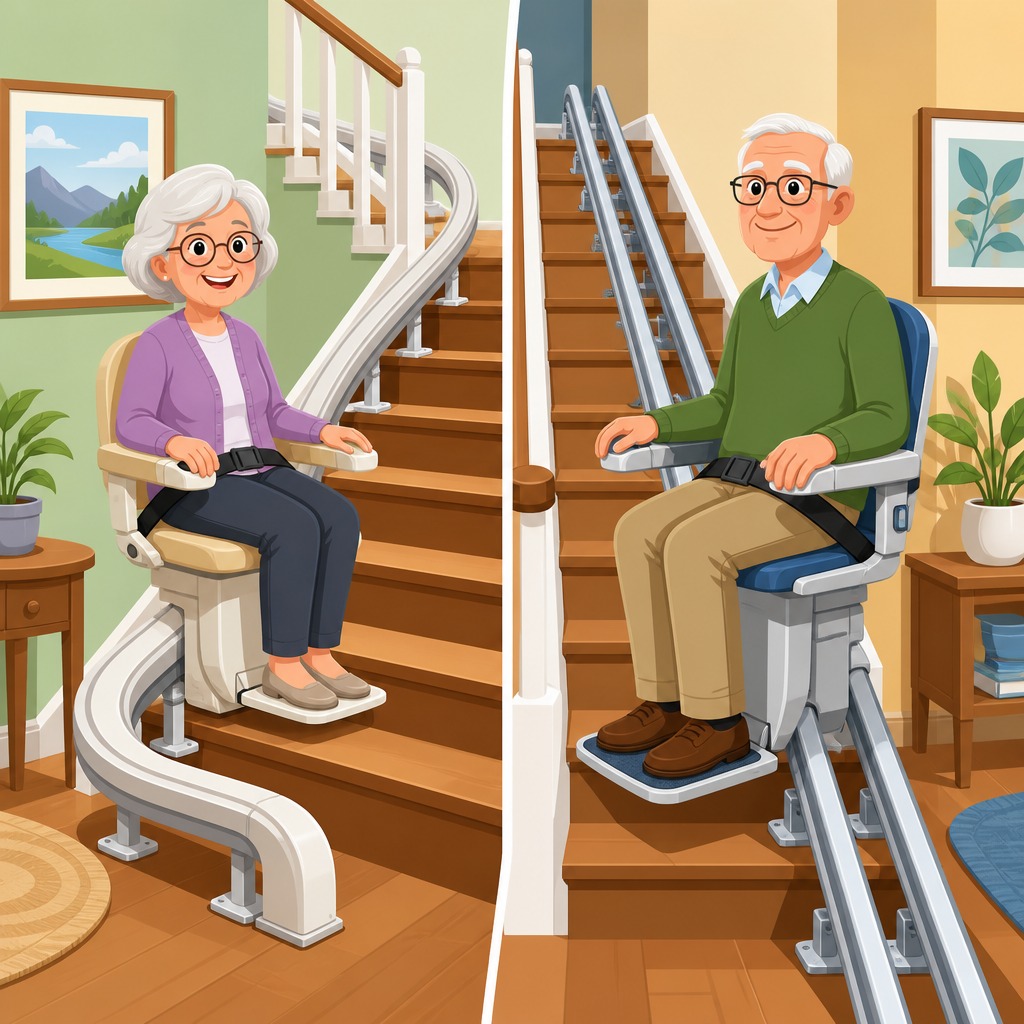
Choosing between a single-rail and twin-rail stair lift starts with understanding how the track supports the chair, how it fits the staircase, and how those design choices affect comfort, installation, maintenance, and long-term value. In stair lift terminology, the rail is the fixed track mounted to the stair treads or, less often, to structural supports beside the stairs. The carriage, motor, gearing, and safety sensors move along that track while the user sits in the seat. A single-rail stair lift uses one primary structural rail, usually compact and visually lighter. A twin-rail stair lift uses two parallel rails or a paired-track system that distributes load differently and often creates a broader support base for the carriage.
This distinction matters because rail design influences nearly every practical buying decision. It affects whether the lift can navigate tight turns, how much space remains for other stair users, how stable the ride feels, what the lift looks like in a hallway, and how easily a technician can service it years later. In my experience reviewing stair lift specifications and installation layouts, homeowners often begin by asking about weight capacity or price, but the rail design is what determines whether a model truly matches the staircase. Straight staircases, curved staircases, narrow stairs, doorways at the top landing, and heavy daily use all place different demands on the system.
For a hub article under chair lift types and designs, the most useful approach is to compare the underlying engineering rather than treat every brand as interchangeable. Single-rail and twin-rail stair lifts are both mature, proven solutions. Neither is automatically better. The right choice depends on staircase geometry, user needs, visual preferences, service expectations, and budget. This guide explains the core design differences, where each system performs best, what tradeoffs buyers should expect, and which questions should shape the next step in evaluating specific models.
How single-rail and twin-rail stair lift designs differ
The simplest way to define the difference is structural. A single-rail stair lift uses one main rail as the carriage pathway and primary support member. That rail may be tubular, extruded aluminum, or a proprietary profile designed to house a rack, cable, or internal drive components. Because the system relies on one dominant track, manufacturers often focus on compactness and a cleaner appearance. This is why many modern straight stair lifts that target standard residential use present a slimmer profile with a folded seat, footrest, and armrests tucked close to the wall.
A twin-rail stair lift uses two rails running in parallel. In many curved stair lifts, the paired rails provide a stable platform for the carriage as it passes through bends, changes in gradient, or parking sections at the top and bottom landings. The dual-rail format can improve torsional stability, meaning the chair is less likely to feel as if it twists relative to the staircase during motion. That does not mean a single-rail lift is unstable; well-designed single-rail systems can be extremely smooth. It means the engineering route to stability is different.
Drive layout also varies. Some single-rail units use a rack-and-pinion system integrated into the rail. Some twin-rail systems place the drive and rollers across the paired tracks, allowing the carriage to maintain contact over a broader base. On curved stairs, this can help when the seat must remain level while the track direction changes. The design differences are most visible when looking at custom curved installations, where twin-rail lifts often resemble a shaped pathway following the inner or outer edge of the staircase with multiple precision bends.
Space, appearance, and fit on the staircase
Many buyers assume the slimmest-looking rail always saves the most space, but the real answer depends on staircase width, fold-up dimensions, overrun sections, and where the user gets on and off. Single-rail stair lifts are frequently chosen for narrow staircases because the rail itself can appear less bulky. On a straight flight in a compact townhouse or bungalow, that visual lightness may make a meaningful difference. When folded, some single-rail lifts leave more apparent walking space, especially if the rail sits close to the wall side and the seat profile is modest.
Twin-rail systems can still work very well in tight homes, particularly when the staircase includes turns or intermediate landings. In those cases, a more complex track may actually improve usability because it can be engineered to park the chair away from a doorway, radiator, or main traffic path. For example, on a staircase that ends directly beside a hallway door, a curved twin-rail layout may carry the seat around the corner to a safer parking position. That is a design advantage, not a drawback, even if the rail itself looks more substantial.
Appearance is subjective, but it matters in lived-in spaces. Single-rail models often suit homeowners who want the least conspicuous look. Twin-rail models can look more technical, yet many premium systems are neatly powder-coated and custom-formed to mirror the staircase. Installers usually recommend evaluating the folded chair depth, the rail projection from the wall, and the landing footprint rather than judging by brochure photos alone. A site survey with measured clearances gives the most accurate picture of everyday fit.
Performance, ride quality, and daily usability
Ride quality depends on more than rail count, but rail design plays a major role in smoothness, noise, and user confidence. A stair lift should start gently, travel at a controlled speed, and stop without jolting. Most reputable residential lifts operate around 0.07 to 0.15 meters per second, though manufacturers vary. In practice, users notice whether the chair feels secure in transitions and whether vibration increases on bends or over longer runs. Twin-rail systems often earn praise on curved staircases because the broader support geometry can produce a settled, well-guided feel through corners.
Single-rail lifts are often excellent on straight stairs, where the travel path is simple and the engineering challenge is lower. On these installations, a compact single-rail model can deliver a very smooth ride with low mechanical noise, especially when the gear train, rollers, and chassis are well matched. I have seen homeowners prefer them not because they are cheaper, but because the boarding position feels intuitive and the rail is easy to live with visually. For a daily-use mobility device, familiarity matters as much as specifications.
Usability also includes seat swivel, call/send controls, remote operation, folding footrests, and safety edges. These features are available on both single-rail and twin-rail designs, but the rail layout can influence how well they function in a specific home. A hinged rail, for instance, may be offered to avoid blocking a doorway at the bottom of a straight staircase. On a curved twin-rail system, the equivalent solution may be a custom park position that removes the obstacle entirely. Good design solves the access problem before the user ever presses the control.
| Comparison Point | Single-Rail Stair Lift | Twin-Rail Stair Lift |
|---|---|---|
| Typical best use | Straight stairs and visually compact installations | Curved stairs, complex landings, and custom routing |
| Rail appearance | Slimmer, simpler profile | Broader, more engineered look |
| Support geometry | One main structural track | Two parallel tracks sharing support duties |
| Ride feel on bends | Depends heavily on model design | Often very stable through turns |
| Customization potential | Usually lower on straight models | Usually higher on curved systems |
| Installation complexity | Generally simpler on standard straight stairs | Higher, especially for custom curved rails |
Installation, customization, and engineering constraints
Installation is where the design differences become most concrete. Straight single-rail lifts are commonly assembled from modular rail sections cut to fit the stair length. This can shorten lead times and simplify replacement in standard homes. A technician measures the staircase pitch, tread depth, obstacles, and power location, then mounts the rail to the treads. Because the rail path is linear, tolerances are easier to manage. Many straight lifts can be installed within a few hours once the unit arrives.
Curved twin-rail lifts are usually bespoke products. The staircase is surveyed using digital measurement tools, photographic references, and sometimes photogrammetry or advanced templating systems. The resulting rail is manufactured to match exact turns, half-landings, or spiral-like changes in direction. This customization is the reason curved lifts cost more and take longer to deliver, but it is also why they solve access problems that a straight lift simply cannot. If a staircase changes direction one or more times, the custom rail geometry is the product.
There are constraints on both sides. A single-rail design may be ideal for a plain stair, yet limited if the top landing requires a wraparound exit. A twin-rail design may handle that route beautifully, but require more planning around banisters, wall projections, and floor space at parking points. Building codes and accessibility best practices also influence design decisions. Although stair lifts in private homes are not the same as platform lifts regulated under commercial accessibility standards, reputable installers still assess safe transfer positions, headroom, trip hazards, and emergency egress.
Weight capacity, durability, and maintenance considerations
Weight capacity is not determined by rail count alone, but the rail architecture contributes to how loads are managed. Many standard residential stair lifts support around 250 to 350 pounds, while heavy-duty models can exceed that. Some heavy-duty designs use wider seats, reinforced chassis components, and extended footrests, and these changes may pair naturally with more robust rail systems. Buyers should focus on the manufacturer’s tested capacity, duty cycle expectations, and staircase suitability instead of assuming twin-rail always means higher capacity.
Durability comes from materials, manufacturing tolerances, drivetrain quality, and service support. Aluminum rails resist corrosion well and are common in residential systems. Steel components may appear in brackets, gear assemblies, or high-load structures. Battery-powered operation is now standard on many stair lifts, with charging points at one or both ends of travel. That means the lift can often continue operating during a power outage for a limited number of trips, provided the batteries are in good condition. Rail design matters here because smooth guidance reduces strain on rollers, motors, and gear interfaces over time.
Maintenance should be practical, predictable, and supported locally. In the field, the systems that age best are usually those with accessible service parts, clear diagnostic procedures, and installers who can still obtain components years later. Straight single-rail lifts may be easier and less expensive to service because of their simpler geometry and wider model availability. Custom curved twin-rail lifts may require brand-specific parts and more specialized adjustment. That is not a reason to avoid them; it is a reason to ask about warranty terms, battery replacement intervals, annual servicing, and response times before purchase.
Cost differences and how to choose the right design
Cost differences between single-rail and twin-rail stair lifts usually reflect customization more than the number of rails. A straight single-rail lift is often the most budget-friendly option because the rail is standardized, installation is faster, and production volumes are higher. A curved twin-rail lift typically costs more because every bend, rise, and parking position must be designed and manufactured for one staircase. In real purchasing decisions, the biggest price driver is usually straight versus curved, not single versus twin in isolation.
To choose correctly, start with the staircase layout. If the stairs are straight, narrow, and uncomplicated, a single-rail model may offer the cleanest and most economical solution. If the stairs turn, split, or end in an awkward landing, a twin-rail curved system may deliver safer boarding and better daily convenience. Next, consider the user. Someone with reduced trunk stability may prioritize the most settled ride possible. Someone sharing the staircase with family may care more about folded clearance and parking position. Someone planning to age in place for many years should evaluate service network strength as seriously as aesthetics.
The best buying process includes an in-home assessment, side-by-side model review, and written answers on capacity, warranty, lead time, and aftercare. Ask the dealer why a specific rail design suits your staircase, what alternatives were ruled out, and how the lift will behave at both landings. Single-rail vs. twin-rail stair lifts is not a style debate. It is an engineering and usability decision that shapes safety, comfort, and independence every day. If you are comparing chair lift types and designs, use this article as your hub, then narrow the search to staircase shape, rider needs, and long-term support before requesting quotes.
Frequently Asked Questions
What is the main design difference between a single-rail and a twin-rail stair lift?
The core difference is in the track system that supports and guides the chair as it travels up and down the staircase. A single-rail stair lift uses one main rail, typically a compact aluminum or steel extrusion, with the carriage traveling along that single support. A twin-rail stair lift uses two parallel rails, which can create a wider track profile and a different method of distributing weight, guiding movement, and handling curves or transitions. In both designs, the rail is fixed to the stair treads in most installations rather than the wall, so the staircase itself carries the load.
From a user’s perspective, both designs are intended to provide safe, smooth travel, but they achieve that in slightly different ways. A single-rail system often emphasizes a cleaner, lower-profile appearance and can look less visually bulky on the staircase. Twin-rail systems are often associated with robust support, especially on custom curved installations, because the two-rail configuration can give manufacturers more flexibility in how they engineer turns, bends, and leveling through complex stair layouts. That does not automatically make one better than the other in every case; it simply means the underlying mechanical design is different.
It is also important to understand that rail design affects more than appearance. It can influence how the carriage is balanced, how the seat rides over joints or transitions, how much space the folded unit occupies, and how the system is installed and serviced. In practical terms, the “best” design depends on the staircase shape, the user’s mobility needs, and the manufacturer’s engineering quality. A well-built single-rail lift can outperform a poorly matched twin-rail model, and the reverse is equally true.
Does a single-rail or twin-rail stair lift take up less space on the staircase?
In many cases, a single-rail stair lift is chosen because it can offer a slimmer visual footprint, especially on straight staircases or in homes where preserving a more open look matters. Since it relies on one main track, it may project less into the stairway than some twin-rail systems. This can be helpful in narrower staircases where every inch counts for other household members walking past the folded chair and footrest. That said, rail count alone does not determine total space usage. The width of the folded seat, armrests, footrest, and the placement of the rail on the treads all play a major role.
Twin-rail systems can sometimes appear larger because of the dual-track layout, but that does not always mean they are impractical for tighter spaces. Some are specifically engineered to hug the edge of the staircase, and on curved stairs they may actually fit the geometry of the staircase very efficiently. The amount of clearance left for pedestrians depends on the staircase width, the number and sharpness of turns, whether the rail parks around a corner, and whether the unit includes a hinged rail or powered folding components.
The most reliable way to judge fit is through a professional site assessment. Installers measure stair width, rise, run, landings, obstructions, door swings, and walking clearance. They also consider where the user gets on and off the chair, because a compact rail is only part of the equation. In short, single-rail designs often have the advantage in visual simplicity and may save space in some situations, but the overall stair lift layout matters more than the number of rails by itself.
Which design offers a smoother and more comfortable ride?
Ride comfort is influenced by several factors, including rail engineering, carriage design, motor quality, transmission system, seat cushioning, speed control, and how the lift handles starts, stops, and turns. Because of that, it is not accurate to say that single-rail is always smoother or that twin-rail is always more stable. A well-manufactured stair lift in either configuration should provide a controlled, steady ride with soft start and soft stop features that reduce jerking and help the user feel secure.
Single-rail stair lifts can feel very refined when the rail is precisely machined and the carriage is engineered to minimize vibration. On straight staircases especially, they often deliver excellent ride quality with minimal visual complexity. Twin-rail stair lifts are sometimes praised for stability on curved staircases because the two-rail system can help the carriage maintain alignment as it moves through bends, changes in angle, and tighter directional transitions. This can be particularly valuable in staircases with multiple landings or complex curves.
Comfort also depends on the user. Someone who is sensitive to motion may care most about smooth cornering and gradual acceleration. Another user may prioritize seat height, swivel operation, armrest support, or how level the chair remains throughout travel. For that reason, a demonstration or test ride is ideal whenever possible. On paper, rail design matters, but real-world comfort comes from the complete system working well together. The safest conclusion is that both single-rail and twin-rail lifts can be very comfortable when properly matched to the staircase and installed by an experienced professional.
Are installation and maintenance different for single-rail and twin-rail stair lifts?
Yes, there can be meaningful differences, although the extent depends on whether the staircase is straight or curved and on the manufacturer’s specific design. Straight stair lifts, whether single-rail or twin-rail, are generally simpler and faster to install because the rail sections are more standardized and the staircase geometry is predictable. Curved stair lifts require custom fabrication, detailed measurements, and more precise fitting, and this is where the distinction between single-rail and twin-rail systems often becomes more noticeable. Some twin-rail designs are widely used in curved applications because they can be engineered around complex corners and landings with strong structural consistency.
Single-rail systems may be somewhat easier to visually integrate and, in some cases, simpler to keep clean because there is only one main track profile. However, maintenance is not just about the number of rails. What matters most is the accessibility of the drivetrain, rollers, charging points, batteries, and diagnostic systems. A high-quality stair lift should be designed for routine service, safety checks, lubrication where applicable, and straightforward replacement of wear components. Battery-powered models in either rail style will still require periodic battery replacement over time, and all lifts should be professionally inspected according to the manufacturer’s guidelines.
Homeowners should also think about long-term service support. A technically excellent rail design is less valuable if parts are hard to obtain or qualified technicians are not readily available in the area. Before choosing between single-rail and twin-rail, ask who will perform service, what the warranty covers, how emergency callouts are handled, and whether maintenance plans are available. In many cases, the reliability of the installer and brand support network has a bigger impact on ownership experience than the rail style alone.
How do I decide whether a single-rail or twin-rail stair lift is the better long-term value?
Long-term value comes from matching the stair lift design to the home and the user’s needs, rather than focusing only on initial price. A single-rail stair lift may offer excellent value if the staircase is straight, space is limited, and the homeowner wants a streamlined appearance with dependable everyday operation. In these situations, the simpler profile can meet mobility needs effectively without adding unnecessary complexity. If the staircase includes curves, intermediate landings, or unusual architectural features, a twin-rail system may deliver better long-term value if its design is better suited to navigating that layout smoothly and safely.
You should also weigh durability, comfort, resale considerations, and future usability. If the user’s mobility needs may change, features such as powered swivel seats, folding rails, seat height options, upgraded safety sensors, and easier transfer positioning may matter more than whether the unit uses one rail or two. Likewise, energy efficiency, charging reliability, battery backup, and the brand’s track record for service life all contribute to value over the years. A lift that costs more upfront but fits the staircase better, requires fewer adjustments, and remains comfortable for daily use may be the smarter investment.
Finally, value should include confidence. The right stair lift should feel secure, operate consistently, and integrate well into the home without creating unnecessary obstacles. The best approach is to compare detailed proposals from reputable providers, review the exact model recommended for the staircase, and ask why that rail design is being suggested. When you evaluate the full picture—fit, safety, comfort, serviceability, and expected lifespan—you are far more likely to choose a stair lift that delivers real long-term benefit, whether it is a single-rail or twin-rail system.