


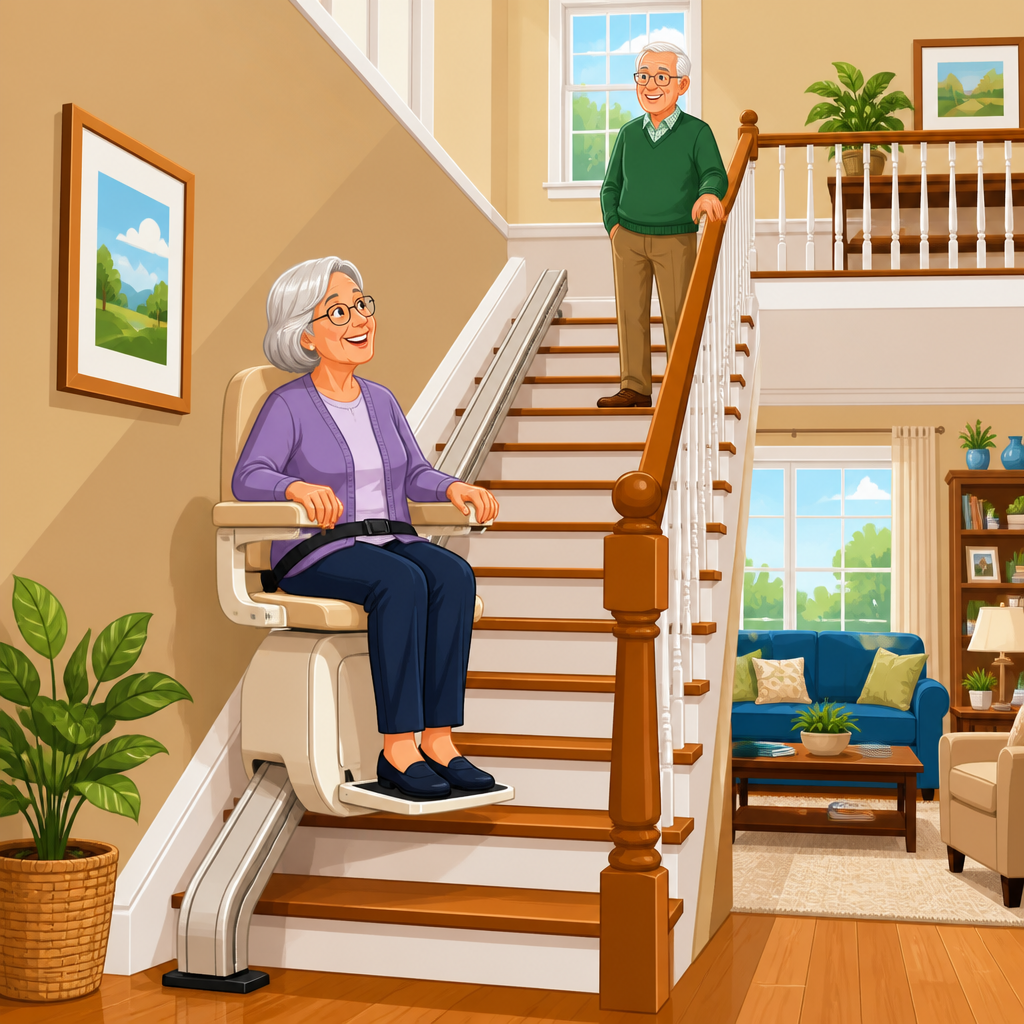
Stair chair lifts for two-story homes give people a practical way to stay safe, independent, and comfortable when stairs become difficult or risky. A stair lift is a motorized seat that travels along a rail fixed to the staircase, carrying the user between floors without requiring climbing, balancing, or assistance. In day-to-day work with mobility equipment, I have seen the same pattern repeatedly: families wait too long, often after a fall, because they assume a move to a single-level home or a major remodel is the only answer. In many cases, it is not. A properly selected stair lift can preserve access to bedrooms, bathrooms, and laundry areas while costing far less than moving or installing a residential elevator.
For buyers comparing options, the key terms matter. A straight stair lift fits a staircase with no turns, landings, or curves. A curved stair lift is custom-built for stairs with bends, intermediate landings, or unusual geometry. Seat height, weight capacity, rail overrun, call/send controls, and battery backup are not sales jargon; they directly affect comfort, safety, and fit. Most modern models run on rechargeable batteries, with a charger positioned at one or both ends of the rail, so the lift keeps working during a typical power outage for multiple trips. Safety sensors stop the chair if it meets an obstruction, and swivel seats help users get on and off away from the stair edge.
This topic matters because falls on stairs are both common and consequential, especially for older adults, people recovering from surgery, and anyone living with arthritis, Parkinson’s disease, stroke aftereffects, neuropathy, or reduced balance. The Centers for Disease Control and Prevention has long documented falls as a leading cause of injury among older adults, and stairs increase both the likelihood and severity of those incidents. In a two-story home, losing confidence on stairs often means giving up part of the house. That can disrupt sleep, hygiene, routines, and caregiver support. A stair chair lift addresses mobility at the specific point where the home no longer matches the resident’s abilities.
As the hub page for stair lifts within chair lift types and designs, this guide covers how stair lifts work, which lift type fits which staircase, what installation involves, what features matter most, how much buyers should expect to pay, and where stair lifts fit among other accessibility options. If you are evaluating products for yourself, a parent, or a client, the right approach is not to start with brand names. Start with the staircase, the user’s body mechanics, and the long-term plan for the home. That sequence leads to better decisions and fewer expensive mistakes.
How stair lifts work in a two-story home
A stair lift system has five primary components: the rail, carriage, motor and transmission, seat assembly, and charging system. The rail mounts to the stair treads, not usually to the wall, which surprises many first-time buyers. That means installation is typically faster and less invasive than expected. The carriage moves along the rail using a geared drive, commonly rack-and-pinion. The seat folds when not in use, and most units include fold-up armrests and footrests to preserve walking space. Call/send controls at each landing let a user bring the chair to their floor or park it away from the main living area.
In a standard two-story home, the lift is usually installed on one staircase connecting the main floor and bedroom level. The user sits, fastens the seat belt, presses a constant-pressure control, and rides up or down at a slow, controlled speed. Modern models generally travel around 15 to 20 feet per minute, prioritizing safety over speed. The seat can swivel at the top landing and lock into position, reducing the need to twist while stepping off. This matters more than many buyers realize; safe transfers, not just travel, are where many incidents happen.
Battery-powered operation is now the norm because it improves reliability and ride quality. During an outage, a charged unit commonly completes numerous trips before recharge is needed. That is a major advantage over older direct-powered designs that stop when household electricity fails. In practice, I advise buyers to ask exactly where the charge points are located. Some lifts charge only when parked at the top or bottom, while others have continuous charging strips. If a family member regularly leaves the chair mid-rail, charging design becomes important.
Straight, curved, and outdoor stair lifts: choosing the right type
The first buying decision is simple: match the lift to the staircase shape. Straight stair lifts are the most common and economical option. They fit one uninterrupted run of stairs and can often be installed within a few hours once measurements are confirmed. Because the rail is standardized, straight lifts are also the category where reconditioned units may make sense for budget-conscious buyers, provided the dealer offers new batteries, a warranty, and local service.
Curved stair lifts are for staircases with turns, pie-shaped steps, split landings, or changes in angle. These systems are built to order after a detailed site survey, often using photo measurement, digital mapping, or templating. The custom rail is why curved lifts cost substantially more and take longer to deliver. The benefit is precise fit and smoother travel through turns. In many two-story homes with decorative staircases near the entry, a curved model is the only workable choice. When specified correctly, it follows the inner or outer edge of the stairs while preserving as much walk space as possible.
Outdoor stair lifts are a separate category designed for porches, decks, garage entries, or exterior steps. They use weather-resistant materials, sealed components, and covers to protect the seat and controls. Buyers sometimes assume an indoor lift can be placed in a garage stairwell or breezeway; that is a mistake unless the manufacturer rates it for that environment. Temperature swings, moisture, and dust shorten the life of indoor equipment used outside its intended conditions.
| Type | Best for | Typical price range | Lead time | Key limitation |
|---|---|---|---|---|
| Straight stair lift | One uninterrupted staircase | $2,500 to $6,000 installed | Days to 2 weeks | Cannot handle turns or intermediate landings |
| Curved stair lift | Turns, landings, spiral or complex stairs | $10,000 to $20,000+ installed | 3 to 8 weeks | Higher cost due to custom rail fabrication |
| Outdoor stair lift | Exterior residential steps | $4,000 to $12,000 installed | 1 to 4 weeks | Requires weather-rated components and maintenance |
These ranges vary by region, rail length, seat style, and dealer support. Brands commonly encountered in the North American market include Bruno, Harmar, Stannah, Savaria, and Access BDD through regional dealers. The best brand is usually the one with strong local installation and service support, not simply the lowest quote.
Measuring the staircase and the user before you buy
Accurate measurement determines whether a stair lift will fit physically and function safely. Dealers measure from the top landing to the bottom landing, stair width, overrun space, headroom, clearance around doors, and any obstructions such as trim, radiators, handrails, or protruding nosings. Most straight lifts require a minimum staircase width around 28 to 30 inches, though exact requirements vary by manufacturer and seat choice. A narrow stair can still work with a compact or perch-style seat, but it needs careful evaluation.
Just as important is fitting the lift to the rider. I always look at hip width, knee bend, torso control, transfer ability, and whether the person uses a cane, walker, or wheelchair at either landing. Someone with limited knee flexion may need a higher seat base or more top landing space for standing. A user with poor trunk stability may benefit from a heavier-duty model with a broader seat and sturdier armrests. If the person cannot safely transfer independently, the right solution may involve caregiver support, transfer aids, or an entirely different accessibility product.
Weight capacity deserves direct attention. Standard residential stair lifts often support 275 to 350 pounds, while heavy-duty models can reach 400 to 600 pounds depending on the configuration. Capacity is not just about motor strength; it affects rail design, seat dimensions, and staircase clearance. Choosing too small a model creates discomfort and real safety concerns. Choosing a larger heavy-duty unit without confirming stair width can create the opposite problem by narrowing the passage for other household members.
Features that matter most for safety, comfort, and daily use
Buyers often focus on price first, but the features that determine satisfaction are usually transfer-related and ergonomic. A powered swivel seat can be worth the cost for users with limited strength or painful joints because it reduces twisting at the top landing. A folding rail, sometimes called a hinged rail, is valuable when the bottom end of the track would otherwise block a hallway, doorway, or traffic path. Powered footrests help users who cannot safely bend down to raise or lower the platform.
Essential safety features should be nonnegotiable. Look for a seat belt, overspeed governor, obstruction sensors on the footrest and carriage, secure seat lock positions, and battery backup. Ask how the lift behaves if it meets an obstacle such as a dropped shoe on the stair. A quality unit should stop immediately and resume only when the obstruction is cleared. Also confirm whether diagnostic displays or fault codes are available. These make service easier and shorten downtime when a problem occurs.
Comfort features matter because stair lifts are used repeatedly, often for years. Seat padding, armrest spacing, ride smoothness, start-stop behavior, and control placement all affect real usability. In evaluations, I watch whether the user can press and hold the toggle comfortably for the full trip. Some people with hand weakness do better with a larger paddle or alternative control arrangement. Upholstery is less important than fit, support, and easy cleaning.
Installation, maintenance, and service expectations
Installation for a straight stair lift is usually straightforward. The technician secures brackets to the treads, mounts the rail, installs the carriage and seat, tests charging, and verifies safety circuits. In a typical home, this can be completed in half a day. Curved installations take longer because the custom rail sections must align precisely. Good installers also train the user and family, covering parking positions, charging habits, seat rotation, and basic troubleshooting.
Maintenance is lighter than many people expect, but not optional. Batteries generally last several years, commonly two to five depending on use and charging habits. The rail should be kept clean, and unusual noises should be checked promptly. Most manufacturers recommend annual service, especially on heavily used lifts. In practice, the quality of after-sale support is one of the biggest differences between dealers. Ask who performs repairs, whether parts are stocked locally, what response time is typical, and whether weekend service is available.
Warranties vary widely. Many dealers offer limited lifetime coverage on major drivetrain components for the original owner, with shorter terms on batteries, electronics, and labor. Read the labor terms closely. A lift with a strong parts warranty but minimal labor coverage can still become expensive if service calls are frequent. If the home is in a rural area, travel charges may apply.
Cost, funding options, and alternatives to compare
For two-story homes, cost planning should include equipment, installation, electrical readiness if needed, and future service. Straight stair lifts usually remain the best value. Curved lifts are a higher investment, but still often cost less than a residential elevator, major first-floor renovation, or assisted living transition. Rental programs exist mainly for straight lifts and are useful after injury or surgery, though long-term rental can exceed purchase cost.
Insurance coverage is limited. Original Medicare generally does not cover stair lifts because they are considered home modifications rather than durable medical equipment under standard rules. Some Medicare Advantage plans, Medicaid waiver programs, veterans’ benefits, workers’ compensation claims, state assistive technology programs, or nonprofit grants may help in specific circumstances. Health savings accounts and flexible spending accounts may also be relevant depending on documentation and plan rules. Buyers should verify every funding source directly before assuming reimbursement.
Alternatives deserve honest comparison. A residential elevator offers wheelchair access and serves multiple users but costs far more and requires significant construction. A home modification creating first-floor living may work, but space is often limited. Ramps solve entry issues, not vertical travel between floors. For a user who can transfer safely and does not need to bring a wheelchair upstairs while seated in it, a stair lift is usually the most efficient solution.
How to choose the right dealer and make a confident purchase
The best buying process starts with an in-home assessment, not a phone quote. A qualified dealer evaluates the staircase, the user, transfer safety, and household traffic patterns. Ask whether the installer is factory-trained, whether permits are required locally, and whether the product meets relevant codes and standards such as ASME A18.1 where applicable. Reputable dealers answer these questions clearly and document measurements and options.
Request a written quote that separates equipment, installation, optional features, warranty coverage, and service terms. Ask what happens if the user’s needs change in a year. Can the seat be modified? Is a heavier-capacity model available on the same stair type? For curved lifts, ask about cancellation terms after rail fabrication begins. Compare at least two dealers when possible, but do not compare on price alone. Fit, service, and reliability matter more than a small upfront difference.
For buyers exploring stair chair lifts for two-story homes, the smartest decision is the one that matches the staircase, the user’s body mechanics, and the household’s long-term needs. Straight, curved, and outdoor stair lifts each solve a distinct access problem. The right model improves safety, reduces fall risk, and keeps essential rooms usable without forcing a move. Focus on accurate measurement, transfer safety, battery-backed reliability, and strong local service. If you are ready to move forward, schedule an in-home assessment and use this hub as your starting point for deeper comparisons across stair lift designs, features, and installation options.
Frequently Asked Questions
How does a stair chair lift work in a two-story home, and what parts are involved?
A stair chair lift is a motorized seat that travels on a rail mounted directly to the staircase, not the wall. In a typical two-story home, the lift carries the rider from one floor to the next using a battery-powered or electric drive system controlled by simple buttons on the armrest or by wall-mounted call/send controls. The main components usually include the rail, the seat, the footrest, safety sensors, a seat belt, the motor, and a charging system that keeps the unit ready for use. Most modern residential stair lifts are battery-operated, which means they can continue working for several trips even during a power outage, provided the batteries are in good condition.
For buyers, the key point is that a stair lift is designed to reduce the physical demands and risks of stair use. Instead of climbing, balancing, or relying on someone else for support, the user sits down, fastens the belt, and rides smoothly between floors. Many models also include swivel seats at the top landing so the rider can get off facing away from the stairs, which improves safety. Fold-up seats, arms, and footrests help keep the staircase usable for other household members when the lift is not in use. In practical terms, a stair chair lift can be one of the simplest and most effective ways to make a two-story home workable again for someone with limited mobility.
Who is a good candidate for a stair chair lift, and when should a family start considering one?
A good candidate for a stair chair lift is someone who can still transfer safely on and off a seated device but has difficulty using stairs because of arthritis, joint pain, poor balance, weakness, shortness of breath, neurological conditions, or recovery from surgery or injury. It is often a strong option for older adults who want to remain in their homes, as well as for people living with progressive mobility changes who are not ready for more extensive solutions such as home elevators or major remodeling. In many cases, the person does not need to be completely unable to use stairs before a lift becomes appropriate. In fact, waiting until stair use becomes dangerous is often what leads to preventable falls and stressful emergency decisions.
Families should start considering a stair lift as soon as the stairs begin affecting daily routines, confidence, or safety. Warning signs include avoiding trips upstairs, using the stairs only when someone else is nearby, pulling heavily on the handrail, pausing often from fatigue, or expressing fear about falling. It is common for people to delay because they assume a move is the only real answer, but that assumption is often wrong. A properly selected stair lift can extend safe independence and allow someone to keep using the full home, including bedrooms and bathrooms on the second floor. Earlier planning also gives buyers more time to compare models, schedule an in-home assessment, and choose the safest setup rather than rushing after an accident.
What should buyers evaluate before choosing a stair lift for a two-story house?
Before buying a stair chair lift, the most important step is to evaluate the staircase itself and the needs of the person who will use it. Buyers should look at whether the stairs are straight or curved, how wide the staircase is, where the rail can start and stop, and whether there is enough safe space at the top and bottom landings for getting on and off the seat. Straight staircases typically use simpler, more affordable lifts, while curved staircases require custom rails and usually cost more. The user’s height, weight, mobility level, and ability to transfer independently also matter, because different models have different seat sizes, weight capacities, and safety features.
It is also wise to consider long-term usability, not just immediate need. Ask whether the seat height is comfortable, whether the controls are easy to operate with limited hand strength, and whether a powered swivel seat or powered footrest would make daily use easier. Noise level, ride smoothness, battery backup, warranty coverage, and service availability should also be part of the decision. Another practical issue is whether multiple household members still need regular access to the stairs. Fold-up designs help preserve walking space, but the layout should still be assessed carefully. The best buyers approach the purchase like a safety investment, not just a piece of equipment, and choose a lift that fits both the home and the user’s likely future needs.
How much do stair chair lifts for two-story homes usually cost, and what affects the price?
The cost of a stair chair lift depends mostly on the shape of the staircase, the lift’s features, and whether the system must be custom built. A straight stair lift is generally the least expensive option because it uses a standard rail and simpler installation. A curved stair lift costs more because the rail must be measured and manufactured specifically for that staircase. Additional features such as higher weight capacity, power folding components, upgraded upholstery, powered swivel seats, and advanced safety options can also raise the price. In some homes, installation complexity, electrical considerations, or unusual landing arrangements may affect total cost as well.
Buyers should also think beyond the initial purchase price. Ask about installation fees, warranty length, battery replacement costs, routine maintenance, and future service calls. In some markets, rental or refurbished units may be available for straight staircases, which can help lower upfront expense in short-term situations. Insurance coverage for stair lifts varies and is often limited, so it is important to verify benefits directly rather than assume the device will be reimbursed. Some families explore financing programs, veterans’ benefits, local aging-in-place grants, or state assistance programs to help manage cost. The smartest way to compare prices is to get a detailed written quote that includes equipment, labor, warranty, and any ongoing service terms, so there are no surprises after installation.
What installation, maintenance, and safety issues should buyers know before making a decision?
Installation for most residential stair chair lifts is faster and less disruptive than many people expect. Because the rail is attached to the stair treads, not the wall, major construction is usually unnecessary. A professional installer will measure the staircase, confirm landing clearances, mount the rail, test the charging points, and make sure the seat, belt, and controls operate correctly. In a straight staircase, installation is often completed in a matter of hours, while custom curved systems take longer because the rail must first be built to match the stairway. Buyers should always use an experienced provider that offers in-home assessment, proper fitting, and hands-on instruction for everyone who will use or assist with the lift.
On the maintenance side, stair lifts are generally reliable, but they are still mechanical devices that need periodic attention. Batteries eventually wear out and require replacement, rails should be kept clean, and moving parts may need inspection or adjustment over time. Regular service helps catch issues before they affect reliability. From a safety standpoint, buyers should look for obstruction sensors, a seat belt, a swivel-and-lock seat, a stable footrest, and easy-to-use controls. It is also important to talk honestly about safe transfers on and off the chair, especially if the user has significant balance problems or cognitive changes. A stair lift is extremely helpful, but it should be part of a broader home safety plan that may also include better lighting, secure handrails, clutter removal, and coordination with a therapist or medical provider when needed.