


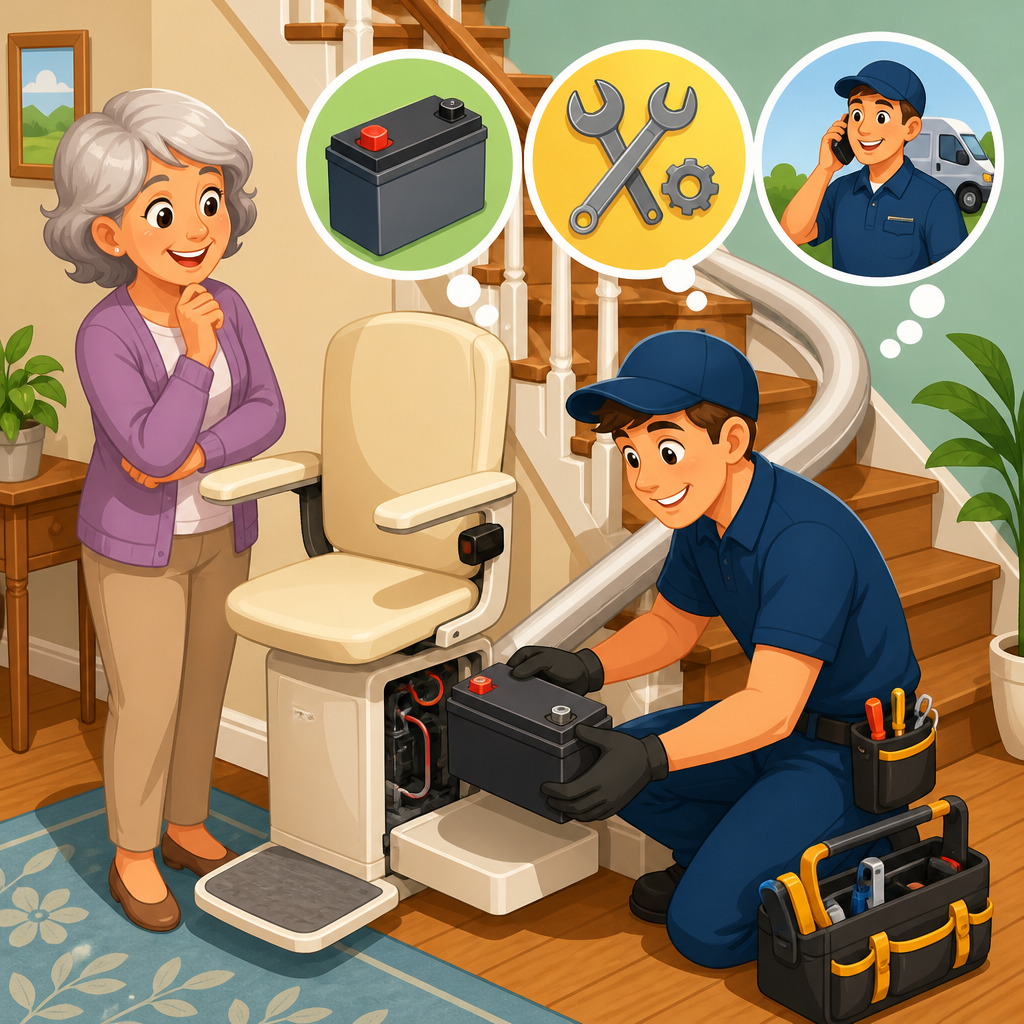
Stair lift battery replacement cost is one of the most common ownership questions I hear from homeowners, caregivers, and facility managers, because batteries are the part most likely to wear out during normal use and one of the easiest components to misunderstand. In practical terms, the battery is the stair lift’s onboard power source, usually sealed lead-acid or, less often, a proprietary pack that stores energy from a charging point at the top or bottom rail. When people ask about cost, they are rarely asking about the battery alone. They usually mean the full bill: parts, labor, diagnostic time, travel, and any service call minimums. That distinction matters, because a battery pair that sells for a modest price can turn into a much larger invoice once installation and troubleshooting are added.
Battery care and replacement sit at the center of stair lift maintenance because a weak battery affects safety, ride quality, reliability, and emergency readiness. A stair lift can still look mechanically sound while slowing down, beeping, stopping short, or failing entirely due to worn batteries. In most modern units, the lift runs on battery power even though it stays plugged into household electricity for charging. That design allows operation during a power outage, but it also means the batteries are consumable parts with a finite cycle life. Based on what I have seen across brands such as Bruno, Stannah, Harmar, Acorn, and Handicare, many batteries last roughly three to five years under normal residential use, though heavy use, poor charging alignment, temperature extremes, and long periods of inactivity can shorten that window.
This article serves as a hub for stair lift battery care and replacement, covering the direct cost of parts, what technicians charge for labor, why service calls vary so much, and how proper charging habits reduce failures. It also explains the warning signs of weak batteries, how different lift designs affect replacement difficulty, what questions to ask a dealer before approving work, and when replacement is not the whole answer. If you are budgeting for maintenance, troubleshooting a beeping unit, or deciding whether to replace batteries now or wait, this guide gives you the facts you need to make an informed decision and avoid paying for the wrong repair.
What stair lift batteries cost and what you are actually paying for
The price homeowners quote to each other often refers only to the battery itself, but a real stair lift battery replacement cost includes several line items. The batteries are usually sold in pairs because most lifts use two 12-volt sealed batteries wired to provide the required system voltage. For many residential models, the parts alone commonly range from about $40 to $180 per battery, or roughly $80 to $360 for the pair, depending on brand requirements, amp-hour rating, terminal style, and whether the dealer uses manufacturer-branded parts. Some premium or proprietary battery assemblies can cost more. If the unit uses standard AGM sealed lead-acid batteries, the raw parts price is typically more predictable than the service price.
Labor is the second major cost. A straightforward replacement on an accessible straight stair lift can take 30 to 60 minutes, but dealers rarely bill only for wrench time. They often include diagnostic checks, charger verification, parking and charging contact inspection, and test rides after installation. In many markets, labor rates land between $100 and $200 per hour, sometimes with a one-hour minimum. Then there is the service call or trip charge, which can add another $90 to $250 depending on local travel distance, emergency timing, and whether the provider is factory-authorized for that brand. When everything is combined, the total bill for a standard residential battery replacement commonly falls between $200 and $600, with some metro areas or proprietary units pushing higher.
There is a valid reason these totals vary so widely. Replacing the batteries without checking the charger, charge strips, limit sensors, and seat or footrest interlocks is bad service. I have seen more than one case where new batteries failed early because the real problem was a dead charger or misaligned charging contacts. In those situations, paying for a proper diagnostic visit saves money. The battery is a wear item, but the charging system determines whether the new set lasts four years or four months.
Factors that raise or lower stair lift battery replacement cost
Several variables influence the final price. Brand is the first. Some manufacturers use common battery sizes that an experienced technician can source easily, while others specify exact replacements, molded connectors, or branded battery packs that narrow your options. Lift type also matters. A straight stair lift generally offers easier access than a custom curved model, where body panels, carriage design, or tighter installation geometry can add labor time. Outdoor stair lifts usually face harsher conditions, so corrosion on terminals or charging contacts may require extra cleaning or replacement.
Usage pattern affects not only battery life but also the likelihood of finding secondary problems. A lift used many times a day by multiple family members wears batteries faster than a lightly used unit in a seasonal home. Infrequent use can also be hard on batteries if the chair is parked away from the charge point, allowing the batteries to sit in a partially discharged state. Age of the unit is another factor. Older lifts may need charge shoes, harness repairs, or updated chargers at the same visit because surrounding parts degrade along with the batteries.
Your location can shift pricing significantly. Dealers in high-cost urban areas tend to charge more for travel and labor than providers in smaller markets. Same-day or after-hours service almost always carries a premium. Warranty status matters as well. Some manufacturers or dealers cover batteries for a limited period, while others treat them as consumables with shorter coverage than major components. Before paying out of pocket, check the original sales paperwork and ask whether your service contract includes battery replacement, annual maintenance inspections, or discounted labor.
Typical cost ranges by service scenario
The easiest way to budget is to look at common scenarios rather than a single advertised number. A homeowner who buys a battery pair over the counter and installs it personally may spend well under $200 if the lift uses standard sealed batteries and no other issue is present. A scheduled replacement by a local dealer on a modern straight stair lift often lands in the $250 to $450 range. If the technician must diagnose intermittent charging, replace a charger, or handle a hard-to-access curved unit, the invoice can move into the $450 to $800 range. Emergency service on a weekend may exceed that.
| Service scenario | Typical parts | Typical labor and trip | Estimated total |
|---|---|---|---|
| DIY replacement with standard batteries | $80 to $200 | $0 | $80 to $200 |
| Scheduled dealer visit, straight lift | $100 to $260 | $150 to $250 | $250 to $510 |
| Dealer visit with diagnostics and charger check | $100 to $320 | $200 to $350 | $300 to $670 |
| Curved or outdoor lift with extra labor | $120 to $360 | $250 to $450 | $370 to $810 |
| Emergency or after-hours service | $100 to $320 | $300 to $600 | $400 to $920 |
These are realistic planning ranges, not fixed national rates, and they assume the problem is limited to batteries or closely related charging components. If the lift also needs a new charger board, a replacement swivel interlock, or repair to a damaged wiring harness, costs increase accordingly. The key point is simple: service conditions drive the total as much as the battery itself.
Warning signs that stair lift batteries need replacement
Weak batteries usually announce themselves before complete failure. The most common signs are repeated beeping, reduced travel speed, stopping midway on the rail, and a chair that runs only a short distance during a household power outage. Some lifts display fault codes, while others rely on audible alerts and indicator lights. If the chair hesitates at the start of travel, struggles under normal rider weight, or loses performance after sitting off the charger, the batteries are prime suspects.
That said, the symptoms are not exclusive to battery wear. I have inspected lifts that beeped because they were not parked fully on the charge contacts, not because the batteries were dead. Dirty charge strips, failed chargers, loose wiring, and misadjusted safety edges can mimic battery trouble. A simple voltage reading without a load is not enough to judge battery health. Proper diagnosis includes verifying float charge voltage, checking loaded voltage drop during operation, confirming charger output, and ensuring the chair actually reaches the charging point. If your dealer replaces batteries without those checks, ask for a more complete evaluation.
Battery care basics that extend life and reduce replacement frequency
Good battery care is straightforward, and it has a direct effect on long-term ownership cost. The most important habit is parking the chair on its charging point every time. Most stair lifts charge continuously when parked correctly, and they are designed for that behavior. Leaving the chair midway on the rail for days drains the batteries and shortens service life. Keep the rail and charging contacts clean according to the manufacturer’s instructions, and do not use harsh cleaners that leave residue. During annual maintenance, a technician should inspect contact points, verify charger output, and test ride performance under load.
Temperature also matters. Excessive heat accelerates battery degradation, while freezing conditions can reduce effective capacity, which is especially relevant for outdoor stair lifts. If the unit is in a vacation property or secondary residence, arrange for periodic checks so it is not left uncharged for long periods. When a lift starts beeping, respond quickly. Deep discharge is hard on sealed lead-acid batteries and can turn a recoverable low-charge situation into a mandatory replacement. Preventive service costs less than emergency failure, especially if the user depends on the stair lift for daily mobility.
DIY versus professional stair lift battery replacement
Some homeowners can replace stair lift batteries themselves, but it is not the right choice for everyone. The case for DIY is strongest when the model uses standard batteries, the manual clearly identifies the procedure, and the person doing the work can safely isolate power, access the carriage, reconnect terminals correctly, and dispose of old batteries through a proper recycling channel. DIY can save the labor and trip charge, which is why some owners search for the battery number and buy a compatible AGM replacement locally.
Professional service is the better option when the user relies on the lift daily, the brand uses proprietary connectors, the carriage is difficult to open, or the symptoms suggest a charging problem rather than simple battery age. A technician can test charger output, inspect contact brushes or charging strips, clear fault codes where applicable, and verify safe operation after installation. There is also risk management to consider. Reversing polarity, pinching a harness, or installing the wrong amp-hour rating can create reliability issues and may affect warranty coverage. In my experience, DIY works best for technically confident owners who are replacing known-worn batteries on a familiar, straightforward unit, not for first-time troubleshooting under pressure.
Questions to ask before approving a battery replacement service call
Before you schedule service, ask what is included in the quoted price. Specifically, confirm whether the estimate covers both batteries, labor, travel, diagnostic time, disposal of old batteries, and a charger test. Ask the provider to identify the exact battery type and whether the replacement is manufacturer-approved. Request the battery date code at installation if possible; sealed batteries can sit on shelves, and fresher stock is preferable. It is also reasonable to ask how long the batteries are warranted and whether the dealer will prorate labor if a battery fails early.
If the lift is older, ask whether the technician will inspect charging contacts, seat and footrest safety switches, and rail alignment during the visit. A slightly higher service fee can be worthwhile if it prevents repeat calls. Finally, ask whether the provider has experience with your specific brand. Stair lift systems are similar in concept but not identical in charger design, diagnostics, or access methods. Brand familiarity often means faster diagnosis and fewer unnecessary parts.
When battery replacement is not enough
New batteries do not fix every no-start or low-power complaint. If a fresh battery pair drains quickly, the charger may be faulty, the outlet may be dead, or the chair may not be reaching the charging station consistently. Worn charge contacts, damaged wiring, or an onboard control issue can interrupt charging even when the indicator appears normal. Mechanical drag can also increase current draw. I have seen lifts with dirty rollers or rail obstructions work the batteries much harder than intended, creating symptoms that looked electrical at first.
That is why battery care and replacement should be treated as part of a broader maintenance plan, not a one-time purchase decision. An annual service visit can catch charging misalignment, corrosion, and control faults before they leave a user stranded. For households where the stair lift is essential for bedroom or bathroom access, proactive replacement near the end of the expected battery life is often smarter than waiting for failure. The cost is easier to schedule, and the risk is lower.
Stair lift battery replacement cost is best understood as a service category, not just a parts price. For most residential owners, the full cost typically reflects a battery pair, labor, and a service call, with total bills commonly ranging from the low hundreds into the mid hundreds depending on the model, dealer, and condition of the charging system. Straight lifts with standard batteries are usually the most affordable to service. Curved, outdoor, older, or proprietary units tend to cost more because access and diagnostics are more involved.
The most important takeaway is that battery life is heavily influenced by care. Park the chair on its charge point, respond quickly to beeping or slow operation, keep contacts clean, and schedule periodic maintenance. Those steps help batteries reach their normal service life and reduce the chance of paying for avoidable emergency calls. When replacement is needed, ask for a complete quote that includes diagnostics, because weak performance can come from the charger or charging contacts just as easily as from old batteries.
If you are building a maintenance plan under the broader Maintenance, Troubleshooting & Safety topic, use this page as your battery care and replacement hub: review your model’s battery type, gather warranty documents, and schedule a professional inspection if the lift shows any warning signs. A timely battery replacement keeps the stair lift dependable, protects mobility at home, and often costs far less than dealing with a preventable breakdown.
Frequently Asked Questions
How much does stair lift battery replacement usually cost?
In most cases, stair lift battery replacement cost includes three separate pieces: the batteries themselves, labor to install them, and any service or trip charge for the technician visit. For standard residential stair lifts that use two sealed lead-acid batteries, homeowners commonly pay somewhere in the low hundreds for the parts, while total installed cost often lands in a broader range once labor and travel are added. The final number depends on the lift brand, battery size, whether the unit uses common SLA batteries or a proprietary battery pack, and how your local dealer structures service calls.
A basic battery-only price may sound affordable at first, but it is important to understand that many companies do not quote batteries in isolation. A technician may need to inspect the charging system, remove covers, test voltage, verify the charger output, and make sure weak performance is actually caused by worn batteries rather than a charging fault. That is why the total invoice can vary noticeably from one service provider to another. In short, if you are budgeting, it is smart to think in terms of total replacement cost rather than just the price of the battery itself.
What affects the price of replacement batteries for a stair lift?
Several factors influence battery price, and the biggest one is compatibility with the specific make and model of stair lift. Many units use widely available sealed lead-acid batteries, which tend to be more economical, but some lifts use branded or proprietary battery packs that cost more because they are model-specific and may only be available through authorized dealers. Battery capacity also matters. Heavier-duty lifts, outdoor lifts, and commercial or high-use applications may require batteries with different specifications, and that can raise the parts cost.
Brand support and age of the lift can also change pricing. If the stair lift is older, replacement parts may be less common or require special ordering. If it is a newer or premium model, the manufacturer may recommend original-equipment batteries rather than generic equivalents. Geography plays a role too. In some markets, local competition keeps service pricing reasonable, while in rural areas or places with fewer stair lift companies, the cost can be higher simply because travel time and availability are different. Finally, if the battery issue is discovered during a broader service visit that includes diagnostics or additional repairs, the total amount due can increase beyond what someone expects from a simple battery swap.
Does labor and the service call usually cost more than the batteries?
It can, depending on the lift and the service company. For many homeowners, the surprise is not the battery price but the added labor and trip charge. A stair lift battery replacement is usually straightforward for a trained technician, but you are still paying for professional diagnosis, safe installation, testing, and travel. If the technician is already onsite for another issue, the labor portion may be modest. If the company is making a dedicated visit just for battery replacement, the service-call fee can become a significant share of the final bill.
This is especially true when a company has a minimum visit charge or when the property is outside its standard service area. Some providers bundle the first hour of labor into the trip fee, while others separate everything into line items. That is why two quotes for the same job can look very different even if the battery cost is nearly identical. The best approach is to ask for a written breakdown of parts, labor, and travel before scheduling service. That makes it easier to compare quotes fairly and avoid confusion about what is actually included.
How often do stair lift batteries need to be replaced, and what shortens their life?
Most stair lift batteries last a few years under normal residential use, but there is no one-size-fits-all replacement interval. Battery life depends heavily on how often the lift is used, whether it stays properly parked on its charging contacts, the temperature of the environment, and the overall health of the charger. A lift used several times a day by one homeowner may go much longer between battery changes than a lift in a busy household, care setting, or small facility where it runs constantly.
The most common reason batteries wear out early is improper charging. Stair lifts are designed to recharge when parked in the correct position, typically at the top or bottom landing. If the chair is routinely left off the charging point, the batteries discharge more deeply and degrade faster. Power outages, a faulty charger, dirty charging contacts, and extreme heat or cold can also reduce lifespan. Another issue is delayed replacement. When batteries become weak, the lift may slow down, beep, or stop unexpectedly, and continuing to use the system in that condition can strain other components. Replacing worn batteries promptly is usually less expensive than waiting until repeated discharge or charging problems lead to more involved service work.
Can I replace stair lift batteries myself, or is professional service the better choice?
Some technically comfortable owners can replace certain stair lift batteries on their own, especially on models that use standard sealed lead-acid batteries with accessible compartments. However, professional service is usually the safer and more reliable option, particularly for people who are not familiar with mobility equipment. Stair lifts are safety devices, not just household appliances, and battery replacement is not simply a matter of swapping one part for another. The system should be powered down correctly, reassembled properly, and tested afterward to confirm safe operation, charging performance, seat functions, and diagnostic indicators.
There is also the issue of accurate diagnosis. A weak or nonworking stair lift does not always mean the batteries are the real problem. The charger, charging contacts, wiring, circuit board, or even user habits can be the underlying cause. If batteries are replaced without solving a charging fault, the new batteries may fail prematurely and the money spent on parts is largely wasted. Professional service also helps ensure the correct battery type, voltage, and terminal configuration are used, which is especially important on brand-specific systems. For most homeowners, caregivers, and facility managers, the value of a proper service call is not just installation convenience—it is confidence that the lift is dependable when someone needs it most.