


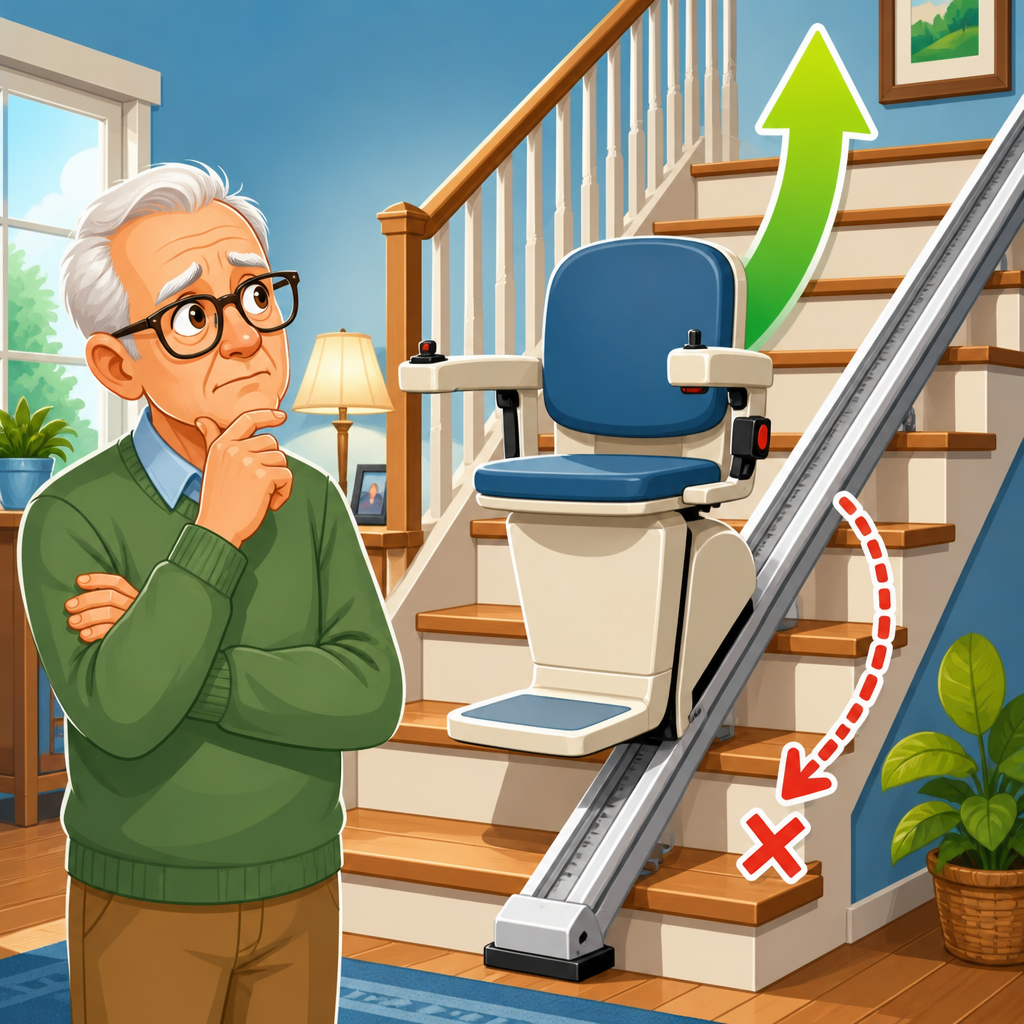
A stair lift that moves up but not down usually points to a problem with charging contacts, seat or footrest safety switches, call-send controls, track obstructions, or a directional fault in the control circuit. I have diagnosed this exact symptom on straight and curved lifts from Bruno, Harmar, Acorn, Stannah, and Handicare, and the pattern is consistent: the lift can still climb because enough power or control logic exists in one direction, while a safety interlock, battery weakness, or switch failure blocks downward travel. For homeowners and caregivers, that matters because a one-direction stair lift can strand a user on the upper floor, interrupt routines, and create a preventable safety risk.
Before troubleshooting, it helps to define the parts involved. The carriage is the motorized unit that travels on the rail. The seat, armrests, and footrest often include interlock switches that must be fully latched before motion is allowed. Most modern stair lifts are battery powered, even when plugged into household electricity, and they charge through contacts placed at one or both ends of the rail. Directional commands come from the armrest controls or wall-mounted call-send stations. If any of those systems loses alignment, power, or continuity, a stair lift may behave normally in one direction and refuse the other.
This article serves as the hub for common issues and fixes within stair lift maintenance, troubleshooting, and safety. Rather than offering a single guess, it organizes the most likely causes in the order I check them in the field. That order matters. Simple issues such as a partially rotated seat, a bumped footrest edge, or dirty charging strips are more common than failed circuit boards. Start with visible and reversible checks, then move toward battery testing, control diagnostics, and service calls. If you maintain a stair lift for an older adult, following a consistent process saves time and reduces unnecessary downtime.
Another reason this topic deserves a detailed guide is that symptoms overlap. A weak battery can mimic a motor problem. A bad down relay can look like an obstruction fault. A call-send remote with a dead battery can make users think the lift itself has failed. The goal is not just to get the lift moving once, but to identify why it stopped and prevent the same fault from returning. When you know which components affect only one direction of travel, troubleshooting becomes more precise and much safer.
Start with safety locks, seat position, and obvious obstructions
The first checks should always involve interlocks and the travel path. On many lifts, the seat swivels and locks for safe entry and exit at the top landing. If the seat is not fully returned to its travel position, the lift may allow limited operation or none at all, depending on the model. I have seen users believe the unit had a major fault when the real issue was a seat left just a few degrees off center after transfer. Push the seat firmly back into its locked travel position and test again.
Next, inspect the footrest and carriage edges. Stair lifts commonly use pressure-sensitive safety edges on the footrest, chassis, or carriage cover. If the lift encountered an object while traveling previously, or if debris is wedged under the footrest, a safety edge can remain activated. Even a loose rug corner, pet toy, dropped sock, or accumulated dust can interfere with the switch. Downward movement is especially vulnerable because the footrest leads the travel path on descent. Clear the stairs, fold and unfold the footrest if applicable, and make sure no edge switch is physically stuck.
Also check armrests, folding hinges, and any manual lowering levers. Some models monitor whether parts are fully deployed. If a hinge is loose or the plastic housing is misaligned, the interlock may fail only in one travel direction because of vibration or weight shift. Listen for beeps or look for status lights. Manufacturers often encode specific faults through audible tones or LED flash patterns, and the owner’s manual can translate those signals into a seat lock fault, footrest fault, overspeed governor trip, or charging problem.
If the stair lift has a key switch, verify that it is fully in the run position. Then test the onboard toggle or rocker control, not just the remote. This isolates whether the issue lies in the carriage or the call-send system. As a basic rule, if the lift runs upward from the seat control but not downward from the seat control, the fault is likely in the down-direction command path, safety circuit, or mechanics rather than the wall station.
Check charging points, batteries, and power supply first
Battery and charging issues are among the most common reasons a stair lift moves up but not down. That sounds backward until you remember how these units use power. The charger maintains the batteries when the carriage is parked at a charging point, often at the top, bottom, or both. If the upper charging contact is dirty or misaligned, the lift may have enough stored energy to travel up but not enough to complete repeated downward starts under load, especially after sitting unused. In other cases, a lift parked at the top may charge correctly there but fail to charge at the bottom, creating intermittent directional problems that seem random.
Start by confirming that the main power outlet feeding the charger is live. Ground-fault outlets can trip, and switched outlets can be turned off accidentally. Then inspect the charger indicator lights if your model has them. Many chargers show power, charging, and fault status. Dirty copper strips, spring-loaded charging brushes, or contact plates are frequent culprits. I clean them with manufacturer-approved methods, usually a dry cloth first and a non-abrasive contact-safe cleaner if allowed. Avoid sanding contacts aggressively because that removes protective plating.
Battery condition matters just as much as charger output. Most stair lifts use sealed lead-acid batteries, commonly 12-volt units in series for a 24-volt system. As they age, internal resistance rises and voltage sags under load. A battery can still appear normal at rest but collapse when asked to start the motor in one direction, particularly downhill if the control board expects regenerative braking or controlled descent torque. Typical battery life is about three to five years, though heat, infrequent use, and chronic undercharging shorten it. If the lift beeps constantly when parked or slows noticeably, battery replacement should move high on the list.
| Check | What to look for | What it may mean |
|---|---|---|
| Wall power | Dead outlet, tripped breaker, unplugged charger | Charger not maintaining batteries |
| Charging contacts | Dirt, corrosion, bent brushes, poor alignment | Lift charges only at one end or not at all |
| Battery behavior | Beeping, slow starts, short travel, weak remote response | Aged or sulfated batteries |
| Charger lights | No light or fault light | Failed charger or supply problem |
If you own a multimeter and the manufacturer permits basic testing, measure charger output and battery voltage under load, not only at rest. A resting pair near nominal voltage can still fail during travel. Because exact values vary by model and chemistry, use the service manual specifications whenever possible. If you do not have those specifications, avoid guesswork and call for service rather than replacing parts blindly.
Test controls, remotes, and direction-specific command faults
When a stair lift goes up but not down, the next category is command input. Directional controls are not always a single switch. The armrest rocker, joystick, or paddle sends a directional signal to the control board, and the wall stations do the same through wired or wireless circuits. A worn contact inside the down side of the armrest switch can fail while the up side still works normally. That is a classic one-direction complaint, especially on older units with heavy daily use.
Begin by testing every available control point. Try the seat control. Then try the top and bottom call-send stations. If downward travel fails from all stations, the issue is likely beyond a single button. If it fails only from one station, replace that remote battery or inspect the wired station for loose terminals. Wireless call-send controls often use coin-cell or AAA batteries that weaken gradually. Users may not notice because the opposite direction still responds from another control location.
Some lifts pair remotes to a receiver board. Loss of pairing, RF interference, or moisture in a wall station can block one command path. On several service visits, I found that a sticky membrane button on the handheld transmitter sent only intermittent down requests. Replacing the remote solved the issue immediately. On wired stations, broken conductors near the terminal block are common because installers or later contractors may pinch the cable behind trim.
If the onboard control itself does not send a down command, the fault may be in the switch assembly, the wiring harness, or the board input. Service technicians typically verify continuity through the switch and confirm whether the controller sees the command. That is more precise than assuming the motor is bad. A directional relay or H-bridge output can also fail on the board, leaving one direction operational and the other dead. Unlike batteries or dirty contacts, board faults usually require model-specific diagnosis and replacement procedures.
Inspect the track, final limits, and mechanical drive components
Rail and drive issues can also stop downward travel while leaving upward travel available. Most stair lifts use a rack-and-pinion or cable drum system with limit switches that define start and stop positions. If a lower final limit switch is damaged, misaligned, or falsely triggered, the controller may interpret the rail as already at the end of travel and refuse any further downward command. I have seen this after impacts during moves, deep cleaning, or footrest collisions with stored items near the bottom landing.
Look closely at the rail for anything unusual: bent rack teeth, loose joints on modular rails, dried grease buildup where the manufacturer specifies lubrication, or obstructions near charge ramps and limit cams. Curved lifts add more potential variables because they include more transitions, joints, and custom bends. If the lift hesitates at the same point every time, mark that location and inspect it carefully. Repeatable location-specific failure usually indicates a rail, rack, cam, or sensor issue rather than a weak battery alone.
The transmission and motor brake deserve attention too. Stair lifts use an electromechanical brake to hold position when stopped. If the brake releases inconsistently, the controller may inhibit travel for safety. Downward travel can expose a marginal brake or gearbox differently because gravity changes the load profile. Likewise, a stripped pinion, worn gearbox, or loose drive coupling may behave differently ascending versus descending. These are not homeowner repair items, but recognizing the pattern helps you give a technician a useful symptom description.
Finally, consider overspeed and slack-cable safety devices where fitted. These components are designed to stop the lift if unsafe motion is detected. A partial trip can leave the unit locked out until manually reset according to manufacturer procedure. Never bypass them. If a safety gear, governor, or cable device has activated, the right response is to determine why, not simply to restore movement.
Know when to stop troubleshooting and call a stair lift technician
Some checks are suitable for owners: verifying power, clearing obstructions, returning the seat to travel position, cleaning approved charging contacts, and replacing remote batteries. Beyond that point, caution is essential. Stair lifts carry people on an incline and rely on redundant safeties. Opening covers, jumping switches, or forcing the carriage can create a fall hazard and may void warranty coverage or service agreements.
Call a qualified stair lift technician if the lift shows a fault code you cannot interpret, runs intermittently, makes grinding noises, stops at the same rail point, beeps continuously after charging checks, or still will not travel downward after the basic steps above. Also call if batteries are older than three years and symptoms suggest voltage drop, or if the unit has not had preventive maintenance recently. A proper service visit usually includes battery load testing, charger verification, rail and rack inspection, safety edge testing, seat switch checks, limit switch alignment, and a controlled ride test under normal operating conditions.
Preventive maintenance reduces repeat failures. In practice, the lifts with the fewest one-direction faults are the ones kept clean, parked correctly on charge, and serviced before batteries age out. Keep the stairs clear, avoid hanging items on the seat or armrests, listen for new noises, and log when batteries were last replaced. If your home has frequent outages, ask your provider whether surge protection or charger replacement intervals should be adjusted. Small habits make a measurable difference in reliability.
The key takeaway is simple: when a stair lift moves up but not down, start with the interlocks, obstructions, and controls you can verify safely, then move quickly to charging and battery health, because those are the most common real-world causes. If the problem persists, direction-specific switch faults, limit devices, or control board issues become more likely and should be handled professionally. Use this guide as your hub for common issues and fixes within stair lift maintenance, troubleshooting, and safety, and schedule service before a minor fault leaves someone stranded when they need the lift most.
Frequently Asked Questions
Why would a stair lift go up normally but refuse to go down?
When a stair lift travels up but not down, that usually means the unit still has enough battery power and drive function to operate in one direction, but something is interrupting the down-direction command or the safety circuit tied to that direction. In real-world service calls, the most common causes are dirty or misaligned charging contacts, a seat swivel lock that is not fully engaged, a footrest or carriage safety edge switch being triggered, a call-send control problem, an obstruction on the rail, or a fault in the directional control circuit. The reason this symptom can seem confusing is that many lifts do not fail in a simple all-or-nothing way. They may still climb because the batteries are strong enough for uphill travel from a charge state, or because the control board is still accepting one directional signal while rejecting the other. That pattern shows up again and again on straight and curved stair lifts from major brands. If the lift consistently stops only when asked to go down, focus first on anything that can block downward travel specifically: parked position, lower charging point alignment, lower call station, final limit sensors, and any safety switch that may be slightly out of adjustment.
What should I check first before assuming the motor or batteries are bad?
Start with the simple, high-probability items before jumping to expensive parts. First, verify that the seat is fully locked in the riding position. A partially rotated seat is one of the most common reasons a lift will not move, and on some models the symptom can appear directional depending on where the carriage is parked. Next, fold and unfold the footrest and make sure nothing is wedged under it or pressing against the safety edges. Many lifts have pressure-sensitive edges on the footrest and carriage that stop motion if they detect an obstacle. After that, inspect the rail for debris, pet hair buildup, dropped objects, or anything contacting the rack or rollers. Then check the charging points where the lift parks. If the contacts are dirty, bent, oxidized, or not lining up correctly, the batteries may charge inconsistently. That matters because a weak battery can produce odd directional behavior before the lift fails completely. Also test both the armrest control and the wall-mounted or wireless call-send controls. If the lift goes down from one control but not another, the issue is likely in the switch, transmitter, or receiver rather than the drive system. These steps can often isolate the fault quickly without unnecessary disassembly.
Can weak batteries cause a stair lift to move up but not down?
Yes, weak or unevenly charged batteries can absolutely contribute to this symptom, even though many people assume battery problems would affect both directions equally. In practice, stair lifts often behave unpredictably when battery voltage drops or when charging is inconsistent. The lift may complete one direction of travel because the batteries still have enough reserve under light or momentary demand, but fail in the other direction because of where it is starting, whether it has just come off a charger, or how the control board responds to low-voltage conditions. A lift parked at a charging station may leave that point and travel one way, then refuse to reverse because battery voltage sags under load or because it is no longer making good charging contact when returned to the stop. That is why battery condition should always be evaluated together with the charging system. Check whether the stair lift is beeping, showing a diagnostic code, or failing to charge reliably at the top or bottom landing. If the contacts are dirty or misaligned, replacing batteries alone may not solve the problem. On the other hand, if the batteries are several years old, swelling, or unable to hold voltage after charging, they may be part of the failure pattern. A proper diagnosis usually includes confirming charger output, battery voltage under load, and consistent contact at both parking points.
How do safety switches and obstruction sensors prevent downward travel?
Stair lifts rely on multiple safety interlocks, and any one of them can stop the unit from moving down if the control system thinks there is a risk. The seat swivel switch is a major one. If the seat is not fully locked forward, most lifts will not run. The footrest and carriage edges are another frequent culprit. These edges are designed to stop travel if they press against an object on the stairs, and sometimes they become overly sensitive, stick mechanically, or remain slightly engaged after a minor bump. On some lifts, the lower final limit or down-direction limit switch can also create a no-down condition if it is out of adjustment or falsely reading that the carriage has reached its safe stopping point. Call-send systems may also be part of the chain, especially if the user is trying to move the lift remotely and one station is not transmitting the down command properly. What matters is that these devices often do their job silently. The lift may not make grinding noises or show obvious damage; it simply refuses to move because the control board sees an open safety circuit. That is why technicians test each switch individually, inspect harness connections, and look for signs of intermittent operation rather than focusing only on the motor or gearbox.
When should I call a stair lift technician, and what should I tell them?
You should call a qualified stair lift technician if the basic checks do not reveal an obvious issue, if the lift is stranded on the stairs, if it shows repeated faults, or if you notice intermittent operation that could worsen unexpectedly. It is especially important to get professional help if the unit moves unpredictably, stops abruptly, or only works from certain controls. When you call, be ready to describe the symptom clearly: whether the lift goes up every time, whether it fails only going down, whether it stops immediately or hums and does nothing, whether the seat swivels and locks properly, and whether the problem happens from both the armrest control and the call-send stations. Also mention any beeping, flashing lights, display codes, recent battery replacement, power outage, cleaning, impact, or track obstruction. That information helps the technician narrow the likely cause before arriving. A good service diagnosis for this symptom usually includes checking charging contact alignment, battery condition, seat and footrest safety switches, remote controls, rail obstructions, and the down-direction control circuit or relay path on the main board. The more specific your description, the faster the repair tends to go, and the less likely you are to pay for unnecessary parts replacement.