


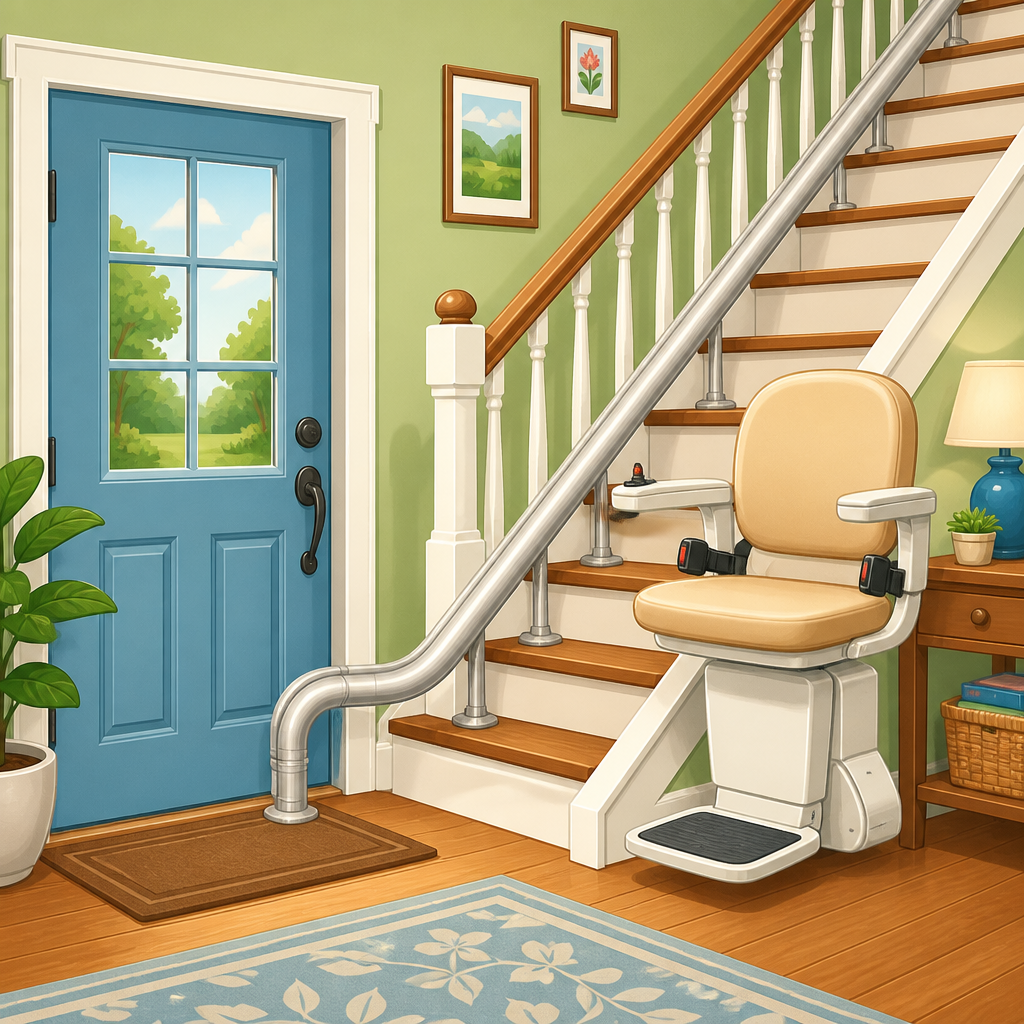
Stair lifts for stairs with a door at the bottom require more than a standard rail, because the track must preserve safe access, clear the door swing, and still deliver a stable ride from the first step to the top landing. In practice, this configuration is one of the most common reasons homeowners need a custom recommendation rather than a basic straight stair lift quote. The issue is simple to define: when a hinged door, entry door, closet door, or hallway door sits directly at the foot of the staircase, a fixed rail can block the opening, create a trip hazard, or leave the user stranded if the chair parks in the wrong place. Choosing the best rail solution means balancing door clearance, transfer safety, staircase width, power reliability, and everyday convenience.
A stair lift is a motorized chair that travels on a rail mounted to the stair treads, not usually to the wall. The rail is the structural pathway that guides the chair, while overruns, hinged sections, parking points, and charging stations determine how the system behaves at the top and bottom. On stairs with a door at the bottom, those details matter as much as lift capacity or seat comfort. I have evaluated many homes where the initial concern was “Will the door still open?” but the real decision involved several linked questions: Can the user get on and off without twisting? Will other family members have enough walking space? What happens during a power outage? Can the rail fold or move automatically? Those are the questions this guide answers.
This article serves as a hub for stair lifts within the broader chair lift types and designs category. It explains the core rail options, when each works best, and the tradeoffs that installers discuss during a site survey. It also helps readers understand where straight stair lifts end, where curved rails become necessary, and why door placement can affect code-minded design decisions even in private homes. If you are comparing models, planning aging-in-place upgrades, or helping a parent remain safely at home, understanding rail solutions for bottom-door stairs will help you avoid costly mistakes and choose a lift that works every day, not just on installation day.
Why a Door at the Bottom Changes Stair Lift Design
A staircase without obstructions is usually the simplest stair lift application: measure the run, confirm width, mount the rail to the steps, and set charge points. Add a door at the bottom, and the geometry changes immediately. The rail may project into the doorway, interfere with the swing arc, reduce required passage space, or place the user too close to the threshold for a safe transfer. That is why reputable dealers begin with door function, not brochure features.
There are several common bottom-door scenarios. The first is a front or back entry door that opens inward toward the staircase. The second is a door across a small hall at the stair base, where any rail extension narrows the passage. The third is a basement, utility, or apartment door adjacent to the first riser. In each case, the installer has to protect three things at once: operation of the door, clear stair use for walking occupants, and a secure boarding position for the rider. If one of those fails, the installation is compromised.
In real homes, even a few inches matter. A standard straight rail often extends beyond the bottom step so the chair can park on a lower overrun, moving the seated user away from the staircase edge. That lower overrun improves safety in many layouts, but it is exactly what can block a door. When that happens, the answer is not automatically “you need a curved lift.” Sometimes a folding rail or a shorter parking arrangement solves the problem at much lower cost. The best solution depends on measurements, user mobility, and how often the door is used.
Best Rail Solutions for Stair Lifts Near Bottom Doors
The best rail solution is the one that preserves door function while giving the rider a safe, repeatable transfer location. In order of frequency, the main options are a hinged rail, a slide track or retracting rail, a straight rail with modified parking, or a custom curved rail that starts beyond the doorway conflict. Installers may also combine solutions, such as a hinge plus a call-send control that keeps the chair parked upstairs.
| Rail solution | Best use case | Main advantage | Main limitation |
|---|---|---|---|
| Manual hinged rail | Straight stairs with occasional door conflict | Lower cost than custom rail | User or caregiver must fold rail section |
| Powered hinged rail | Bottom doorway used daily | Automatic clearance with button control | Higher cost and more components to service |
| Slide track | Hallway or door obstruction at lower landing | Rail footprint changes as chair moves | Available only on selected models |
| Short bottom overrun | Minor clearance issue, capable user | Simple and affordable | Less forgiving transfer position |
| Custom curved rail | Complex geometry or multi-obstruction entry | Precise path around conflicts | Highest price and longer lead time |
A manual hinged rail is a bottom rail section that folds up when the lift is not in use. This works well when the user has enough reach, balance, or caregiver support to operate the hinge safely. In contrast, a powered hinged rail uses a motor to raise and lower the section automatically, usually linked to the arm control or remote. For many households, this is the cleanest answer because the doorway remains usable without manual handling.
A slide track, available from brands such as Handicare on certain straight models, moves part of the rail with the chair so the lower end does not remain extended into the hallway or doorway. This design is especially effective when the issue is not the actual door leaf but the circulation space in front of it. A custom curved rail becomes necessary when the stair base is offset, the first step is tight to a wall return, or the ideal boarding point is not in line with the stair run.
How Installers Decide Between Straight, Hinged, and Curved Rails
During a survey, a trained stair lift specialist measures the stair pitch, overall run, tread depth, nosing profile, lower landing size, and any door swing arcs. They also record user height, weight, transfer side preference, knee flexion, and whether a walker or wheelchair is involved at either landing. Those human factors often decide the rail choice more than the staircase itself.
A straight rail remains the preferred design when the staircase is straight from top to bottom because it is mechanically simpler, faster to install, and easier to service. Straight lifts from Bruno, Harmar, Stannah, Access BDD, and Handicare are widely used because their rails can often be cut or configured on site. But if a fixed lower overrun would block a door, the installer compares two questions: can the obstruction be removed by making the rail movable, or does the rider need a different boarding location entirely? If movement solves it, hinged or slide-track solutions usually win. If location is the issue, a custom curve is the correct answer.
I have seen homeowners assume that a curved rail is always excessive for a bottom-door conflict. Sometimes that is true. However, when the user cannot safely mount the chair on the staircase itself and needs the seat to stop on a flat area beyond the doorway path, a curved start or wraparound lower rail can be the safest design. Cost matters, but transfer safety matters more. A cheaper rail that forces a twisting transfer beside a swinging door is not a successful installation.
Safety, Clearance, and Power Considerations
Safety on a bottom-door stair lift installation depends on more than obstacle sensors. The user should be able to approach the chair, sit, fasten the belt, and rotate or lock the seat without pressure from a closing door or the risk of stepping backward toward the stairs. Most modern lifts include overspeed governors, obstruction sensors on the carriage and footrest, seat belts, and battery operation with charge points at one or both ends. Those features are essential, but they do not compensate for poor layout planning.
Clearance standards vary by product, but many manufacturers prefer around 30 inches or more of staircase width for standard models, with some compact units fitting narrower stairs. The important nuance is that usable width is not just a tape measurement between walls. Handrails, trim, radiator projections, and the open door itself affect true passage space. On stairs with a bottom door, the installer must test both conditions: door open and door closed. In some homes, the rail clears the shut door but prevents the door from opening fully enough for practical entry.
Power also deserves attention. Nearly all modern residential stair lifts are battery powered, with the batteries charging from household electricity through the rail. That means the lift usually keeps working for multiple trips during a power outage, which is important if the door at the bottom is also an exterior egress route. Powered hinges and powered footrests may add convenience, but they introduce more motors and switches. Good brands engineer these reliably, yet every powered feature adds maintenance points. The tradeoff is worth discussing upfront, especially for users who prioritize simplicity.
Brand Features, Costs, and Real-World Buying Factors
Several manufacturers offer workable solutions for stairs with a door at the bottom, but their design philosophies differ. Bruno is known for sturdy straight lifts and dependable dealer support, often favored for straightforward layouts with hinge options. Harmar offers models with folding rails and a broad dealer network. Handicare is frequently shortlisted where a slide track may solve a narrow lower landing. Stannah has a strong reputation for refined ride quality and custom curved work, while Access BDD is recognized for bespoke rail engineering. The right choice often comes down to the local installer’s experience with the exact rail configuration your home needs.
Price varies widely. A straight stair lift typically starts in the lower thousands of dollars, while powered hinge options raise that total. A fully custom curved rail can cost substantially more because the track is built to the staircase template, not pulled from standard stock. Lead times also differ. Straight rails may be installed quickly, sometimes within days if inventory is available. Curved lifts usually require manufacturing time after survey measurements are finalized.
Ownership costs extend beyond the purchase price. Ask about warranty terms for the motor, gearbox, batteries, and rail; typical battery replacement intervals; annual service recommendations; and emergency callout support. Also ask how the lift parks when not in use. In homes with bottom doors, remote call-send controls are especially valuable because they let one user send the chair upstairs, clearing the doorway for everyone else. That small operational detail often has more day-to-day impact than premium upholstery or extra seat padding.
When a Stair Lift Is the Right Solution and When It Is Not
A stair lift is usually the right solution when the user can transfer independently or with minimal assistance, can sit upright safely during travel, and wants to preserve access in a multilevel home without major remodeling. For bottom-door staircases, a properly selected rail can maintain both accessibility and normal use of the doorway. This makes stair lifts one of the most practical aging-in-place products available.
However, they are not universal answers. If the user cannot perform a seated transfer safely, if the staircase is extremely narrow, or if the lower doorway is part of a high-traffic entry that cannot tolerate any rail hardware, alternatives may be better. Those alternatives include a home elevator, a vertical platform lift, relocating essential living space to one level, or using a different entrance route. Occupational therapists and certified aging-in-place specialists can help evaluate these situations in context.
As the hub page for stair lifts under chair lift types and designs, this guide points to the central principle that governs every successful installation: the rail layout determines usability. On stairs with a door at the bottom, that principle becomes even more important because inches of clearance decide whether the lift feels seamless or frustrating. Start with a professional site survey, ask specifically about hinged rails, slide tracks, parking positions, and custom curves, and insist on a solution that protects both safe riding and normal door use. The best stair lift rail solution is the one you can trust every single day. Schedule an in-home assessment, compare at least two detailed proposals, and choose the design that fits your staircase and your routine.
Frequently Asked Questions
Can a stair lift be installed if there is a door directly at the bottom of the stairs?
Yes, in many cases a stair lift can still be installed safely and effectively even when there is a door at the bottom of the staircase. This is actually a very common layout challenge, and it is one of the main reasons a standard straight-rail quote is not always enough. The key issue is not whether a lift can fit on the stairs, but how the rail will interact with the door, the doorway clearance, the walking path, and the user’s safe boarding position.
When a door sits directly at the foot of the stairs, the rail cannot simply end wherever the bottom step ends if that would block the door swing, narrow the hallway, or create a tripping hazard. Instead, the installer evaluates the direction the door opens, the amount of landing space available, whether the rail is mounted on the left or right side, and how the chair will park when not in use. Depending on those measurements, the best solution may be a folding rail, a hinged rail, a short overrun, a parking position higher up the staircase, or a more customized rail configuration.
The most important goal is preserving both accessibility and daily function. You want the stair lift user to get on and off the chair safely, but you also need the door to open properly and the area at the bottom of the stairs to remain practical for everyone else in the home. That is why stairs with a door at the bottom almost always benefit from an in-home assessment rather than a one-size-fits-all recommendation.
What type of rail works best for a stair lift when there is a door at the bottom?
The best rail solution depends on the exact layout, but folding rails and hinged rails are often the most effective options when a door is located at the bottom of the stairs. These rail designs are specifically intended to solve clearance problems at the lower landing. Instead of allowing the rail to extend permanently into the doorway or hallway, the lower section can fold or hinge out of the way when the lift is parked or not in use.
A manual hinged rail must be lifted by hand, while a powered folding or powered hinged rail moves automatically with the press of a control. For many homeowners, a powered option is preferable because it removes the need to bend down or handle the rail physically. This can be especially important for people with balance issues, back pain, limited strength, or reduced flexibility. In a home where the doorway is used frequently, an automatic rail can also make everyday use more convenient and consistent.
In some cases, the best answer is not a folding section but a different parking arrangement. For example, the chair may be parked farther up the staircase so the rail does not interfere with the door area at all. In other homes, a track overrun may help position the rider more safely away from the steps while still maintaining necessary door clearance. The right choice depends on the door’s swing path, the available floor space, and the user’s mobility needs. A reputable stair lift provider should review all of these factors before recommending a specific rail style.
Will a stair lift rail block the door from opening or closing?
It can if the wrong rail design is chosen, which is exactly why this type of installation requires careful planning. A standard rail that extends into the lower landing may interfere with the full swing of the door, prevent it from opening comfortably, or create a bottleneck in a hallway or entry area. In some homes, the rail may even make it difficult to stand safely at the base of the stairs. That is not just inconvenient—it can also undermine the safety benefits the stair lift is supposed to provide.
The good news is that proper rail selection usually prevents this problem. During a professional evaluation, the installer measures how far the door opens, where the hinge is located, how much clearance is needed for foot traffic, and where the chair and user’s feet will sit at the bottom stop point. If necessary, the lower rail can be designed to fold away, stop short of the obstruction, or be repositioned so the doorway remains usable. In some situations, changing the side of the staircase on which the lift is installed can improve door clearance as well.
Homeowners should not assume that a door conflict automatically rules out a stair lift, but they also should not assume every lift can be installed without modification. The difference between a smooth, safe installation and a frustrating one often comes down to these lower-landing details. A door at the bottom of the stairs is one of the clearest signs that rail customization may be necessary.
Is a custom stair lift rail more expensive than a standard straight rail?
Often, yes. A custom rail solution for stairs with a door at the bottom is usually more expensive than the most basic straight stair lift setup because the rail may need additional engineering, added components, or powered features to preserve door access and user safety. For example, a powered hinged rail typically costs more than a fixed rail because it includes extra mechanisms and controls. Even a manual hinged rail can increase the overall price compared with a simple straight track.
That said, the added cost usually reflects a more appropriate and safer installation rather than an unnecessary upgrade. The purpose of the customized lower rail section is to avoid blocking the door, maintain a clear walkway, and create a secure boarding area. If a lower landing problem is ignored just to keep the quote lower, the result may be a lift that is awkward to use or poorly suited to the home. In accessibility equipment, fit and function matter as much as base price.
It is also worth remembering that “custom” does not always mean a fully curved stair lift. Many staircases with a door at the bottom can still use a straight lift platform with a modified lower rail solution. That means the homeowner may be able to solve the doorway issue without moving into the much higher price category associated with a fully curved system. The best way to understand cost is to get a site-specific assessment that looks at the staircase dimensions, door placement, and the user’s transfer needs in real-world conditions.
What should homeowners look for during a stair lift assessment when there is a door at the bottom of the stairs?
Homeowners should expect a detailed assessment that goes beyond basic stair width and length measurements. When a door is located at the bottom of the stairs, the installer should evaluate how the door swings, whether it opens inward or outward, how much space exists between the bottom step and the doorway, and whether the landing provides enough room for safe entry and exit from the chair. The evaluator should also consider nearby walls, trim, handrails, flooring transitions, and traffic flow through the area.
Just as important, the provider should ask about the user’s physical abilities. A person who can stand and pivot comfortably may be able to use a simpler setup than someone who needs a larger transfer area, a powered swivel seat, or a very specific boarding position. The best rail solution is not just about fitting the staircase; it is about matching the equipment to the user’s mobility, strength, balance, and routine. If multiple people will use the staircase daily, that should be part of the planning as well.
A thorough assessment should also include a discussion of convenience and long-term usability. For example, if a folding rail is recommended, homeowners should ask whether it is manual or powered, how it operates during a power outage, where the chair will park, and whether the doorway remains fully usable when the lift is not in motion. An experienced stair lift company should be able to explain why a particular rail solution is recommended and how it solves the bottom-door conflict without compromising safety. If that explanation is vague, it is a sign to ask more questions before moving forward.