


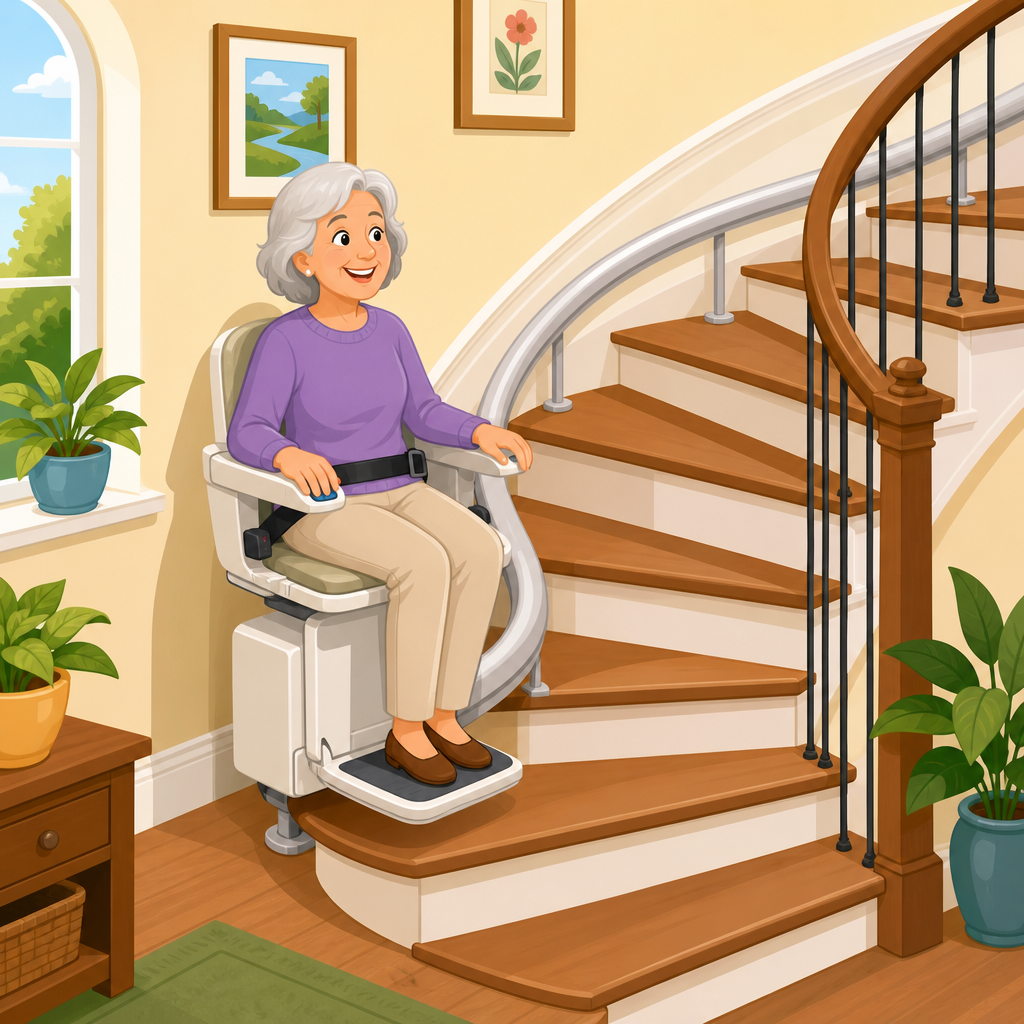
Stair lifts for winder stairs and pie-shaped steps solve one of the hardest accessibility problems in residential design: how to move safely through staircases that change width, direction, and geometry. A standard straight stair lift runs on a simple linear rail, but winding staircases require custom engineering because each tread may taper, the inside and outside travel paths differ, and landings often compress available clearance. In practice, this means buyers must understand more than product brochures. They need to know how curved rails are measured, when a hybrid layout can reduce cost, what building constraints affect installation, and how this subtopic connects to the broader range of chair lift types and designs. As the hub for custom and hybrid designs, this guide explains the terminology, the options, and the decision points that matter most.
Winder stairs are staircases that turn without a full rectangular landing, using triangular or pie-shaped steps to transition direction. Those steps are usually narrower on the inside radius and wider on the outside radius. A stair lift installed on this kind of staircase nearly always uses a curved rail system, although some homes can use a hybrid design that combines short straight sections with custom bends. The distinction matters because straight lifts are faster to manufacture and less expensive, while curved and hybrid lifts are built to the staircase after a detailed survey. The result is a better fit, but also a more involved project with greater variation in price, lead time, and technical requirements.
This matters because winder staircases are common in older homes, townhouses, split-level properties, and compact floor plans where architects needed to save space. They are also exactly the staircases that create the most uncertainty for people planning to age in place or accommodate reduced mobility after surgery, illness, or injury. I have seen homeowners assume that a winder staircase automatically makes a lift impossible, only to learn that a custom rail, a perch seat, or a parking curve at the landing solves the problem cleanly. The opposite can happen too: a staircase may look compatible at first glance, but tight clearances, door swing conflicts, or extremely narrow inside treads can force a different design. Understanding the full custom and hybrid category upfront prevents expensive missteps and helps buyers ask the right questions before an in-home assessment.
How stair lifts work on winder stairs
A stair lift for pie-shaped steps is designed around the travel path, not simply the visible tread edges. During a site survey, a dealer or installer measures the staircase in three dimensions, recording tread depth, rise, stair width, nosing profile, landing size, and obstructions such as radiators, trim, handrails, and nearby doors. On winder stairs, the most important choice is whether the rail will follow the inside curve, the outside curve, or a blended route through the turn. Inside runs often save space and can preserve more walking clearance on the outer side, but the tighter radius may require more precise rail bending and may limit footrest clearance. Outside runs are usually gentler and sometimes provide a smoother ride, but they can project farther into the staircase.
Unlike an elevator, a stair lift does not rely on the wall for primary support. Most models mount to the stair treads through brackets fixed to the steps, which is useful on curved and winding staircases because it avoids the need for major wall reconstruction. The carriage travels along the rail using a geared drive system, typically rack-and-pinion or cable drum depending on the manufacturer, and battery-powered models continue operating during power outages because the charger feeds the batteries at designated points. Reputable curved lift manufacturers such as Handicare, Bruno, Stannah, Harmar, Access BDD, and Platinum all build systems intended for non-standard stairs, but their rail designs, seat options, weight capacities, and parking configurations differ in meaningful ways.
Ride quality depends on geometry. A well-designed curved stair lift must manage speed changes through turns, keep the seat level, and maintain safe clearances at knees, feet, and elbows. That is why custom CAD-based rail production is standard in this segment. Installers typically create a digital model from the survey data, then the rail is fabricated to those dimensions. On difficult winders, engineers may add a start overrun, intermediate park point, or powered swivel at the top to improve transfer safety. These details are not accessories in the casual sense; they are part of how a lift becomes usable on a complicated staircase rather than merely technically installable.
Custom curved versus hybrid stair lift designs
Custom curved designs use a continuously shaped rail made specifically for the staircase. They are the default choice for true winder stairs because they can track complex changes in direction while keeping the chair aligned to the path of travel. This is usually the cleanest solution when the staircase includes multiple pie steps, a quarter turn without a landing, or a compact turn directly into a hallway. The main benefits are precision, smooth operation, and better use of limited space. The tradeoffs are higher cost and manufacturing lead time. Because the rail is bespoke, it cannot usually be returned to stock or repurposed for another staircase.
Hybrid stair lift designs are worth close attention because they are often misunderstood. In this context, hybrid usually means the system combines standardized components with custom sections, or blends straight rail runs and curved transitions to reduce complexity. For example, a staircase with a short straight lower run, a small set of winder steps, and a longer straight upper run may not need a fully complex rail across every inch. A manufacturer may use straighter modular segments and custom bends only where the direction changes. In my experience, this can lower price, shorten production time, and simplify future servicing, provided the staircase geometry allows it. It is especially relevant for homeowners who want a custom solution but need stronger cost control.
| Design type | Best use case | Main advantages | Common limitations |
|---|---|---|---|
| Fully custom curved rail | True winder stairs with multiple pie-shaped steps and tight turns | Exact fit, smoother travel, maximum layout flexibility | Highest cost, longer fabrication time, limited reuse value |
| Hybrid curved-straight system | Stairs with mostly straight runs and one compact winding transition | Lower cost than fully custom, easier component sourcing | Not suitable for every geometry, fewer routing options |
| Modular curved system | Homes needing faster installation on moderately complex turns | Quicker delivery, less bespoke manufacturing | May project more into the staircase, fewer fine adjustments |
Modular curved systems sit between these categories. Some brands use pre-engineered curved sections that can be configured to many stair layouts without fabricating every inch from scratch. These systems can work well on less demanding turns, but they are not universal. On a staircase with unusually narrow inner treads or highly irregular pie-step dimensions, a fully custom rail often fits better and preserves more walking space.
Measurements, clearance, and installation constraints
The most common question homeowners ask is whether their staircase is too narrow. The answer depends on several dimensions, not one. Installers look at total stair width, minimum clear walking width with the seat folded, footrest projection, overhang at landings, and transfer space at the top and bottom. Many manufacturers recommend roughly 30 to 36 inches of staircase width for comfortable installation, but some compact models can work in tighter spaces depending on seat design and rail placement. On pie-shaped steps, the narrow inside edge can be misleading. A staircase that appears wide enough from above may still present footrest conflicts through the turn if the rail hugs the inner radius too tightly.
Landing geometry matters as much as tread shape. Safe use requires enough room to get on and off the seat without twisting awkwardly over the stairs. Powered swivel seats, hinged rails, and parking bends are common solutions. A parking bend curves the rail away from the staircase at the top or bottom landing, allowing the user to dismount on a safer flat surface while also moving the chair out of the main walking path. In homes where a doorway sits directly at the foot of the stairs, a hinged rail can lift the lower end of the track to preserve access. These components are especially valuable on winding stairs because every inch of clearance counts.
Structural support is rarely the limiting factor in a sound residential staircase, since the brackets transfer load into the treads rather than the wall. However, installers still inspect tread condition, substructure stability, and anchoring suitability. They also evaluate electrical access for the charging points, though most battery-operated lifts use a standard household outlet. Local code interpretation can affect expectations around egress width, particularly in multifamily settings or where the staircase serves as a primary path. A qualified dealer should explain these issues clearly rather than dismissing them.
Seat choices, weight capacity, and user-fit details
Not every custom stair lift is custom in the same way. The rail may be bespoke while the chair uses standard seat modules, or the system may include tailored seating features for a specific mobility profile. Seat height, arm width, back shape, and footrest size all influence comfort and safety on winder stairs because curved travel can amplify poor positioning. Users with limited knee flexion may need a higher seat perch. People who cannot bend easily at the hips may benefit from a perch-style seat that supports semi-standing travel on steeper or narrower stairs. Heavy-duty options can increase capacity, but they also demand more clearance, so capacity upgrades on winding staircases must be checked carefully against available space.
Most residential stair lifts support roughly 250 to 400 pounds, while certain premium or heavy-duty models go higher. Capacity is not only a motor issue; it also affects rail loading, carriage size, and seat footprint. I always advise buyers to test the seat with winter clothing, common footwear, and any walking aid they use daily. A stair lift can look spacious in a showroom and feel very different on a tight turn at home. Remote call-send controls are another practical feature because they let one user send the chair away after riding, keeping a hallway or living area less cluttered, then bring it back when needed.
User transfer ability deserves direct attention. If the rider can stand and pivot independently, a standard swivel seat may be enough. If transfers are slow or balance is limited, powered swivel and powered footrest functions reduce fall risk by minimizing awkward reaching and turning. For couples planning ahead, it can make sense to choose these options before they are essential. Retrofitting later is possible on some models but not all, and it may cost more than including them in the original specification.
Cost, timelines, and service expectations
Price varies widely because this category is shaped by customization. In many markets, a straight stair lift may start in the low thousands, while a curved or winder-stair lift often falls into a range closer to $10,000 to $20,000 or more depending on rail complexity, seat features, and installation difficulty. A long staircase with multiple turns, powered options, and challenging parking requirements will land toward the higher end. Refurbished units can reduce cost, but on truly custom winders, only the chair carriage may be reusable; the rail still tends to be new because it must match the staircase exactly.
Timelines are also longer than for straight lifts. After the site survey, the rail design is reviewed, approved, fabricated, finished, shipped, and installed. Lead times of several weeks are common, though modular systems can sometimes move faster. Buyers should ask who handles service after installation, whether parts are stocked locally, and how battery replacement is managed. The long-term ownership experience depends heavily on dealer quality. A beautifully engineered rail is only part of the value; responsive maintenance matters just as much when the lift is a daily mobility device.
As a hub page for custom and hybrid designs, this topic naturally connects to deeper articles on curved stair lifts, modular rail systems, heavy-duty chairs, outdoor custom lifts, hinged rail solutions, perch seats, and reconditioned specialty models. The key lesson is simple: pie-shaped steps do not automatically rule out a stair lift, but they do require a more exact process, better measurement, and product choices matched to both staircase geometry and user ability. If you are comparing chair lift types and designs, start with a professional home assessment, ask specifically about custom and hybrid layouts, and review how the rail, seat, and landing clearances work together before you buy.
Frequently Asked Questions
Can a stair lift be installed on winder stairs or pie-shaped steps?
Yes. Stair lifts can be installed on winder stairs and staircases with pie-shaped steps, but they almost always require a custom curved rail rather than a standard straight-track system. The reason is simple: on a winder staircase, the steps narrow on one side and widen on the other, and the staircase changes direction without a full flat landing. That geometry means the lift cannot follow a simple straight line. Instead, the rail must be designed to match the exact path of travel, account for turning radius, and maintain safe seat positioning throughout the ride.
In most homes, the solution involves a detailed site assessment and precise measurement of every tread, turn, landing, and obstruction. Manufacturers or dealers may use advanced photo measuring tools or digital surveying methods to create a rail that fits the staircase exactly. This is especially important on stairs with tight curves, limited wall clearance, handrails, radiators, door swings, or narrow approach spaces at the top or bottom.
What matters most is not just whether the lift fits the stairs, but whether the rider can get on and off safely. A properly designed system must provide enough room for the user’s knees, feet, and body position through each turn, while also allowing the seat to swivel and lock at a safe transfer point. So while winder stairs are more complex than straight stairs, they are very commonly addressed with custom curved stair lifts when the staircase is structurally suitable.
Why are winder stair lifts more complicated than standard stair lifts?
Winder stair lifts are more complicated because the staircase itself is more complicated. On a straight staircase, the rail follows a uniform angle and consistent tread layout. On winder stairs, the dimensions change as the staircase turns. Each pie-shaped tread may have a different walking line, the inside and outside edges of the steps are not equal, and the available clearance can tighten dramatically in the middle of the turn. Those differences affect nearly every part of the lift design.
The rail must be engineered to move the chair smoothly through changing directions without causing the user to sit too close to a wall, newel post, or opposite balustrade. The seat height, footrest position, carriage orientation, and parking locations all have to be considered in relation to the staircase shape. In some homes, the best travel path is mounted closer to the inside of the turn to save space. In others, the outside of the staircase is the better route because it offers a gentler curve and improved rider comfort. There is no one-size-fits-all answer.
Another layer of complexity is usability. A lift that technically fits the staircase is not enough if it blocks a doorway, intrudes into the landing, or leaves the rider in an awkward transfer position. Installers must also evaluate whether other household members can still use the stairs comfortably when the chair is folded. Because of all these variables, curved stair lifts for winder stairs typically involve custom fabrication, more planning, longer lead times, and higher cost than straight stair lifts.
How is a stair lift measured and customized for pie-shaped steps?
Customization starts with a professional survey of the staircase. For pie-shaped steps, the installer does not simply measure the total stair length from top to bottom. Instead, they map the exact route the lift will travel, including every curve, angle, rise, tread depth, landing transition, and clearance point. Since the width of each step changes across the tread, the measuring process must identify the most appropriate rail line for safe and efficient operation.
During the assessment, the installer will usually evaluate staircase width, headroom, wall projections, bannisters, trim details, handrail placement, door locations, and the amount of open space at both ends of the stairs. They will also review the rider’s physical needs, because seat style, body size, hip-to-knee positioning, and transfer ability can influence the ideal rail configuration. For example, someone who needs a powered swivel seat or a higher seat base may require additional clearance that changes where the rail can be placed.
Once measurements are collected, the rail is manufactured specifically for that staircase. The result is a custom curved track designed to guide the chair smoothly over the winder section while maintaining safe spacing and stable travel speed. Many systems also include tailored start and finish positions, such as a rail overrun that moves the seat away from the stair edge at the top landing. That kind of customization is especially important on winder stairs, where a few inches can make the difference between a safe transfer and a difficult one.
What should homeowners look for when buying a stair lift for a winding staircase?
Homeowners should look well beyond the basic question of price. The most important factors are safety, fit, reliability, and the installer’s experience with curved staircases. A winding staircase with pie-shaped steps demands precise design, so it is essential to work with a provider that regularly handles custom curved installations rather than primarily selling straight lifts. Ask whether the company performs in-home assessments, how the staircase is measured, who manufactures the rail, and whether the installation team is trained specifically on curved systems.
You should also review the lift’s practical features. Key items include a seat belt, obstruction sensors, battery backup, folding footrest, swivel seat, call/send controls, and weight capacity appropriate for the intended user. For tight winder stairs, ask how much space the folded chair will leave for other stair users, whether the rail can be parked away from a busy landing, and whether the unit offers powered options for users who may have limited strength or flexibility. The comfort of the ride through turns is another important point, especially on narrow or sharply angled staircases.
Just as important, ask about service and long-term ownership. Curved stair lifts are specialized products, so response time for maintenance matters. A strong warranty, local service support, and access to replacement parts can make a major difference over time. Homeowners should also request a clear explanation of lead times, because custom rails typically take longer to manufacture than straight models. A reputable provider will explain the tradeoffs plainly and make recommendations based on the actual staircase and user needs, not just on what is easiest to sell.
Are curved stair lifts for winder stairs worth the higher cost?
For many households, yes. Curved stair lifts for winder stairs cost more because they require custom design, specialized manufacturing, and more complex installation, but that additional cost often solves a problem that no standard lift can address. If a homeowner cannot safely use a winding staircase and the alternative is relocating a bedroom, undergoing major remodeling, or moving out of the home, a properly designed stair lift can be a highly practical investment in independence and safety.
The value becomes even clearer when you consider the risks of continued stair use without assistance. Winder stairs and pie-shaped steps are already more challenging than standard stairs because foot placement changes across the turn and the walking path is less forgiving. For someone with reduced balance, limited mobility, joint pain, or fatigue, those conditions can significantly increase fall risk. A custom stair lift reduces the need to navigate that difficult section on foot and provides a controlled, seated ride between levels.
That said, “worth it” depends on matching the system to the user and the home. The right lift should improve daily life, not create frustration. A quality evaluation will weigh the rider’s current mobility, expected future needs, staircase layout, transfer safety, and household traffic patterns. When the design is done correctly and the equipment is well supported, a curved stair lift on a winder staircase is often one of the most effective accessibility upgrades a homeowner can make.