


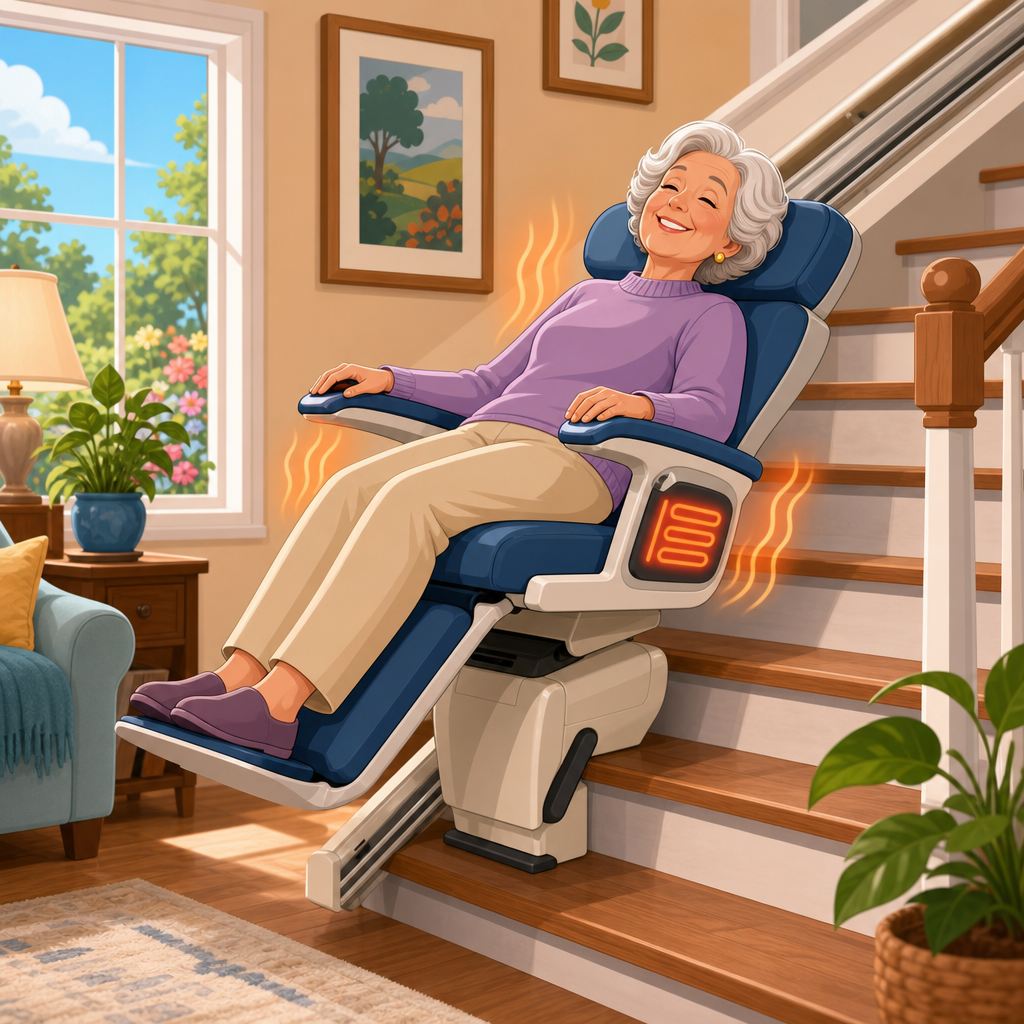
Stair lifts with full recline and heating options sit at the premium end of the accessibility market, combining mobility support with comfort features usually associated with high-end seating. In practical terms, a stair lift is a motorized chair that travels along a rail fixed to a staircase, allowing a user to move between floors without climbing steps. A full recline model offers a backrest and seat angle that can tilt farther than a standard perch, helping users who cannot sit fully upright for long periods. Heating options add gentle warmth through the seat or back, which can reduce stiffness and improve comfort in colder homes. For buyers comparing luxury and premium models, these features are not cosmetic extras; they directly affect daily usability, pain management, and confidence at home.
I have worked with families choosing stair lifts for tight Victorian staircases, wide modern stair runs, and homes where arthritis, spinal conditions, or poor circulation made standard chairs inadequate. The most common mistake I see is treating all stair lifts as interchangeable. They are not. Premium stair lifts differ in seat geometry, motor smoothness, start-and-stop programming, swivel design, upholstery quality, safety sensor coverage, battery backup capacity, and service support. This hub article explains what full recline and heated stair lifts are, who benefits most, how luxury models differ from standard units, and what to evaluate before buying. It also serves as a central guide for the broader luxury and premium models category, helping readers move from broad research to product-level comparisons with clear priorities.
What Full Recline and Heating Options Actually Mean
Full recline on a stair lift does not always mean the same thing across manufacturers, so buyers should ask for exact seat-back and leg-rest adjustment ranges. In premium models, the chair may recline enough to redistribute pressure from the lower spine and hips while still maintaining a safe center of gravity on the rail. Some systems use fixed recline positions, while higher-end versions use multi-position mechanisms with supportive headrests, contoured lumbar padding, and foldable armrests that remain stable when the seat is tilted. Heating usually refers to low-voltage warming elements integrated into the cushion or backrest, controlled by a rocker switch, touch panel, or remote-linked setting. Better systems regulate temperature gradually rather than creating hot spots.
These features matter because many users are not simply looking for transportation up the stairs. They may have osteoarthritis, degenerative disc disease, post-surgical restrictions, muscle spasticity, neuropathy, or circulatory issues that make a rigid chair uncomfortable. In those cases, a premium lift can function as a mobility aid and a therapeutic seating solution during transfer. I often advise buyers to think about the three stages of use: sitting down safely, riding comfortably, and standing up with minimal strain. A heated, reclining chair can improve all three. However, the design has to be engineered around safety. Any reputable premium model will integrate restraint systems, obstruction sensors, overspeed governors, and load-rated components that account for the altered seating position.
Who Should Consider a Luxury Stair Lift
Luxury stair lifts are best suited to users whose comfort requirements are inseparable from mobility needs. That includes older adults who spend much of the day seated and develop stiffness quickly, people with chronic back pain who cannot tolerate a near-vertical chair, and users recovering from hip or spinal procedures who need a more supportive transfer position. Premium models also appeal to buyers planning for long-term aging in place. If a household expects mobility needs to change over several years, it can be more cost-effective to choose a higher-spec lift once rather than replace a basic unit later.
There is also a home-design dimension. In upscale properties, buyers often want a stair lift that blends into the interior rather than looking clinical. Premium manufacturers address that with tailored upholstery, slimmer folded profiles, higher-end rail finishes, powered footrests, and parked-chair options that keep the unit out of the main living sightline. In my experience, aesthetics should never outrank fit and safety, but they do matter because equipment that looks acceptable is more likely to remain installed and used consistently. For households balancing accessibility with resale concerns or formal interiors, luxury models can reduce the psychological barrier to adoption.
Features That Separate Premium Models from Standard Stair Lifts
The jump from standard to premium is not just about extra padding. The engineering differences are significant. Better units use smoother transmission systems, more refined soft-start and soft-stop programming, and superior seat suspension to reduce jarring movement. Rails may be custom-bent more precisely for curved stairs, with tighter tolerances around landings and doorways. Armrests lock more positively, swivel seats rotate with less effort or with powered assistance, and call-send controls respond reliably from either floor. Full recline models also need reinforced seat frames and carefully balanced geometry so the user remains secure through the ride.
Heating systems in premium stair lifts are usually integrated into a broader comfort package. That package may include memory foam layering, breathable upholstery, pressure-distribution contours, and upholstery materials designed to resist wear from repeated transfers. Some brands offer antimicrobial vinyl for care environments, while others use woven fabric or leather-look materials for residential installations. Battery systems are another differentiator. Most modern lifts charge continuously at points on the rail and can complete multiple trips during a power outage, but higher-end models tend to have better battery management and clearer status indicators. Service matters too. A premium chair backed by fast parts availability and trained local technicians is worth more than a feature-rich model with weak support.
| Feature | Standard Stair Lift | Premium Reclining Heated Stair Lift |
|---|---|---|
| Seat position | Mostly upright, limited adjustment | Multi-position recline with enhanced support |
| Comfort package | Basic padding | Contoured cushioning, head and lumbar support |
| Heating | Usually unavailable | Integrated low-voltage seat or back warming |
| Ride quality | Functional start and stop | Softer acceleration and reduced vibration |
| Controls | Manual swivel, basic remotes | Powered options and advanced diagnostics |
| Aesthetic finish | Utility focused | Designer upholstery and refined rail finishes |
Safety, Fit, and Installation Realities
No comfort feature matters if the stair lift is poorly matched to the staircase or the user. The first technical checkpoint is stair geometry. Straight stair lifts fit a single uninterrupted run, while curved stair lifts are custom-made for turns, intermediate landings, or spiral-like changes in direction. Full recline models often need extra clearance behind the user’s shoulders, around knees, and at top or bottom landings. Installers should measure staircase width, overrun space, wall projections, handrail interference, and transfer area clearances. In narrow staircases, a heavily padded reclining chair may fold larger than expected, which can affect other household members using the stairs.
Standards and inspection processes are equally important. Buyers should look for products aligned with recognized stair lift safety standards such as ASME A18.1 in the United States and equivalent conformity expectations in other markets. A quality survey should review user weight, transfer ability, seated posture, hand function, and whether the person can use a seat belt independently. In complex cases, an occupational therapist or physiotherapist may provide valuable input. I strongly recommend an in-home demonstration of seat height, footrest reach, swivel action, and recline range before ordering a custom rail. Returns on bespoke curved systems are often limited, so accuracy at the assessment stage protects both safety and budget.
Luxury Brands, Customization, and Real Buying Questions
Several established manufacturers compete in the premium category, including Stannah, Handicare, Access BDD through its Flow range, Bruno, and Harmar, though available features vary by country and dealer network. Not every brand offers true full recline with heating in every model line, so buyers should verify whether the comfort functions are factory options, dealer-installed accessories, or unavailable on curved rails. Stannah is often recognized for fit, finish, and ride quality. Bruno is well known in North America for robust build quality and dependable dealer support. Access BDD’s Flow line is notable for tight staircase fit and advanced seat positioning on curved installations. Handicare and Harmar can offer strong configurations depending on user weight capacity and local service coverage.
When I help clients compare quotes, I ask the same direct questions. What is the exact weight capacity in the selected configuration? Is the recline adjustable during travel or only while parked? Does the heating function operate on battery power, household current, or both? Can the chair be parked away from the main staircase view? What is included in the warranty for motor, gearbox, batteries, upholstery, and electronics? How quickly can a technician attend if the lift stops working? These questions reveal whether a premium price reflects genuine engineering and support or just upgraded trim. The strongest dealers answer clearly, document everything, and explain limitations before asking for a deposit.
Cost, Ownership, and Long-Term Value
Premium stair lifts cost more because they involve custom manufacturing, enhanced seating systems, and higher service expectations. In broad terms, straight stair lifts often start in the low thousands, while curved luxury stair lifts with custom rails, powered features, premium upholstery, and specialized seating can move substantially higher. Heating and advanced recline add cost, but installation complexity is usually the larger driver. A narrow, winding staircase with difficult landings can require more engineering than the chair itself. Buyers should also budget for electrical readiness if charging points or outlets need adjustment, although most units use standard domestic power supplies.
Long-term value depends on reliability, maintenance, and user satisfaction. Batteries typically require replacement every few years depending on usage, temperature, and charging consistency. Upholstery life varies by material and transfer technique. Annual servicing is advisable even when not required to maintain warranty coverage, because technicians can inspect rollers, charge contacts, seat swivels, harnesses, and safety edges before small issues become failures. Resale value for stair lifts is limited, especially for curved rails made to a specific staircase, so purchase decisions should focus on years of safe use rather than recovery of cost. If the lift keeps a user in a multistory home and delays a move or prevents falls, the value can be substantial.
How This Hub Fits the Luxury and Premium Models Topic
As a hub for luxury and premium stair lift content, this page should guide buyers toward the next level of research. From here, the most useful follow-up topics include brand-specific reviews, straight versus curved premium model comparisons, upholstery and seat material guides, heavy-duty luxury stair lifts, powered swivel and powered footrest roundups, and service-plan evaluations. Buyers who need a full recline and heating package are usually balancing multiple priorities at once: medical comfort, home design, safety, and long-term ownership. A hub article works best when it clarifies those priorities first, then directs readers to narrower comparisons with the right context.
The core takeaway is simple. Stair lifts with full recline and heating options are not niche indulgences; for the right user, they are practical premium mobility systems that improve comfort, consistency, and independence. The best model is the one that fits the staircase precisely, supports the user’s body securely, and is backed by dependable local service. Start by arranging a detailed in-home assessment, ask specific questions about recline range, heating control, safety certification, and warranty coverage, and then compare premium models on evidence rather than appearance alone. That approach leads to a stair lift that feels like part of the home and performs like essential equipment every day.
Frequently Asked Questions
What is a stair lift with full recline and heating, and who is it designed for?
A stair lift with full recline and heating is a premium mobility solution built for people who need more than basic seated transport on the stairs. Like any stair lift, it uses a motorized chair mounted to a rail attached to the staircase, carrying the user safely between floors. What makes this type different is the addition of a deeper reclining seat position and integrated heat in the chair, usually within the seat and sometimes the backrest. These features are intended to improve comfort during use and, in some cases, make the lift more suitable for individuals who struggle to remain in a fully upright posture.
Full recline can be especially helpful for users with reduced core strength, spinal conditions, joint pain, muscle weakness, certain neurological disorders, or post-surgical limitations that make standard seated positions uncomfortable or impractical. The heating function may appeal to those with stiffness, arthritis, poor circulation, or chronic discomfort, although it should be viewed as a comfort feature rather than a medical treatment. In many homes, this combination is chosen not only for function but also for quality of life, because a more supportive and comfortable chair can make daily transfers less stressful and more sustainable over time.
These stair lifts are often considered when a standard model does not adequately support the user’s posture, pressure relief needs, or comfort expectations. They are also relevant for people planning ahead and wanting an accessibility upgrade that feels less institutional and more like high-end seating. That said, suitability depends on the user’s physical condition, the staircase layout, and safe positioning during travel. A professional assessment is the best way to determine whether a fully reclining heated stair lift is appropriate for the intended user and home.
How does the full recline feature improve safety and comfort compared with a standard stair lift seat?
The full recline feature improves comfort by allowing the user to travel in a more supported position rather than being forced into a near-vertical seat angle. For some people, upright sitting increases pain, creates pressure points, causes fatigue, or makes it difficult to keep the head and trunk aligned. A chair that reclines farther can reduce strain on the hips, lower back, neck, and core muscles, making the ride more manageable and more comfortable. This can be particularly valuable for users who need better postural support over even short periods.
From a safety standpoint, the key issue is not simply that the chair reclines, but that it does so within a system engineered to maintain secure travel. Quality models are designed so the user remains properly positioned relative to the seat belt, footrest, armrests, and center of gravity of the chair while moving along the rail. In other words, a full recline stair lift is not just a lounge chair attached to stairs; it is a purpose-built accessibility device that must preserve stability and safe clearance throughout the journey. This is why professional fitting and configuration matter so much.
It is also important to understand that “full recline” can vary by manufacturer. Some models offer a noticeably deeper tilt than standard chairs, while others provide a medical-style positioning system with more advanced support options. The best version for a user depends on body size, transfer ability, head and neck control, and how much angle is actually needed. In many cases, the improvement is less about luxury and more about enabling the user to ride consistently, comfortably, and with less physical stress than a traditional seat would allow.
Are heated stair lift seats safe to use, and do they require special maintenance?
Yes, heated stair lift seats are generally safe when they are part of a professionally manufactured and installed lift from a reputable provider. The heating system is typically low-voltage and built into the chair with controls and safety features designed for everyday residential use. As with any powered accessibility equipment, the safest approach is to choose a model that meets relevant safety standards, is installed by trained technicians, and is used according to the manufacturer’s instructions. A heated seat should feel comfortably warm, not excessively hot, and it should operate consistently without creating discomfort or risk to the user.
There are, however, practical considerations. Users with reduced skin sensitivity, circulation problems, neuropathy, or conditions that affect temperature awareness should ask their doctor and stair lift provider whether a heated seat is advisable. While many people find gentle warmth soothing, anyone who cannot easily detect overheating should be cautious. It is also wise to ask whether the heating function can be adjusted, switched off independently, or set to a preferred level, since comfort needs vary widely.
Maintenance requirements are usually modest, but they should not be ignored. The seat upholstery should be kept clean and dry, and any signs of wear, wiring issues, inconsistent heating, unusual odors, or control malfunctions should be inspected promptly by a qualified service professional. Routine stair lift servicing is still essential, because the heating feature is only one component of a larger system that includes the motor, batteries, rail, charging points, swivel mechanism, seat belt, and safety sensors. In short, heated seats are not high-maintenance, but they do belong within a properly maintained mobility device.
Can a stair lift with full recline and heating be installed on any staircase?
Not every staircase is automatically suitable, but many are. Stair lifts with premium seating features can be installed on a wide range of straight and curved staircases, provided there is enough space for the rail, chair movement, and safe user clearance. The basic shape of the staircase is only one factor. Installers will also look at width, landings, wall proximity, doorways, headroom, obstructions, parking position, and how the chair folds when not in use. Because full recline models may have different seat dimensions and travel clearances than simpler lifts, precise measurement is especially important.
Straight staircases are often easier and less expensive to fit because they use a simpler rail. Curved staircases, staircases with intermediate landings, or complex layouts usually require a custom rail, which can increase cost and lead time. If the user needs a deeper recline angle, the provider must also confirm that the seated position remains safe and practical at all points on the route, including boarding and dismounting areas. In some homes, a power swivel seat, powered footrest, or special transfer arrangement may be recommended to make the lift easier to use.
Even if space is limited, it is still worth arranging a professional home assessment rather than assuming the answer is no. Manufacturers and installers can sometimes offer compact designs, custom seating configurations, or alternative solutions that make installation possible. On the other hand, if the staircase cannot safely accommodate a reclining chair lift, a good provider should say so clearly and discuss other options such as a different stair lift style, a through-floor lift, or a home layout adjustment. The right answer is always the one that balances accessibility, safety, and day-to-day usability.
Are stair lifts with full recline and heating worth the higher cost?
For the right user, they can be absolutely worth the investment. These models sit at the upper end of the market because they combine core mobility technology with upgraded seating, enhanced comfort, and often more advanced customization. If a standard stair lift would technically work but leave the user in pain, poorly supported, or reluctant to use it, then paying more for a full recline and heated seat may lead to much better real-world outcomes. A mobility device only delivers value if the person can and will use it consistently.
The true value often comes from improved comfort, better posture tolerance, easier daily routines, and a stronger ability to remain in the home safely. For users with chronic pain, spinal limitations, stiffness, or difficulty sitting upright, the premium features may make the difference between an acceptable solution and one that genuinely supports independence. Heating can also add a meaningful comfort benefit, especially in colder homes or for users who find warmth helps reduce stiffness before or after transfers. While these features are not medically curative, they can make everyday use significantly more pleasant.
That said, worth depends on need. If the user is comfortable in a standard stair lift seat and does not require a deeper angle or additional warmth, a premium model may be more luxury than necessity. The smartest approach is to compare models based on the user’s actual physical requirements, not just feature lists. Ask for an in-home assessment, trial seating if available, a written breakdown of costs, warranty details, service coverage, and any customization charges. When a full recline heated stair lift is matched to a genuine need, the higher price often reflects meaningful benefits rather than unnecessary extras.