


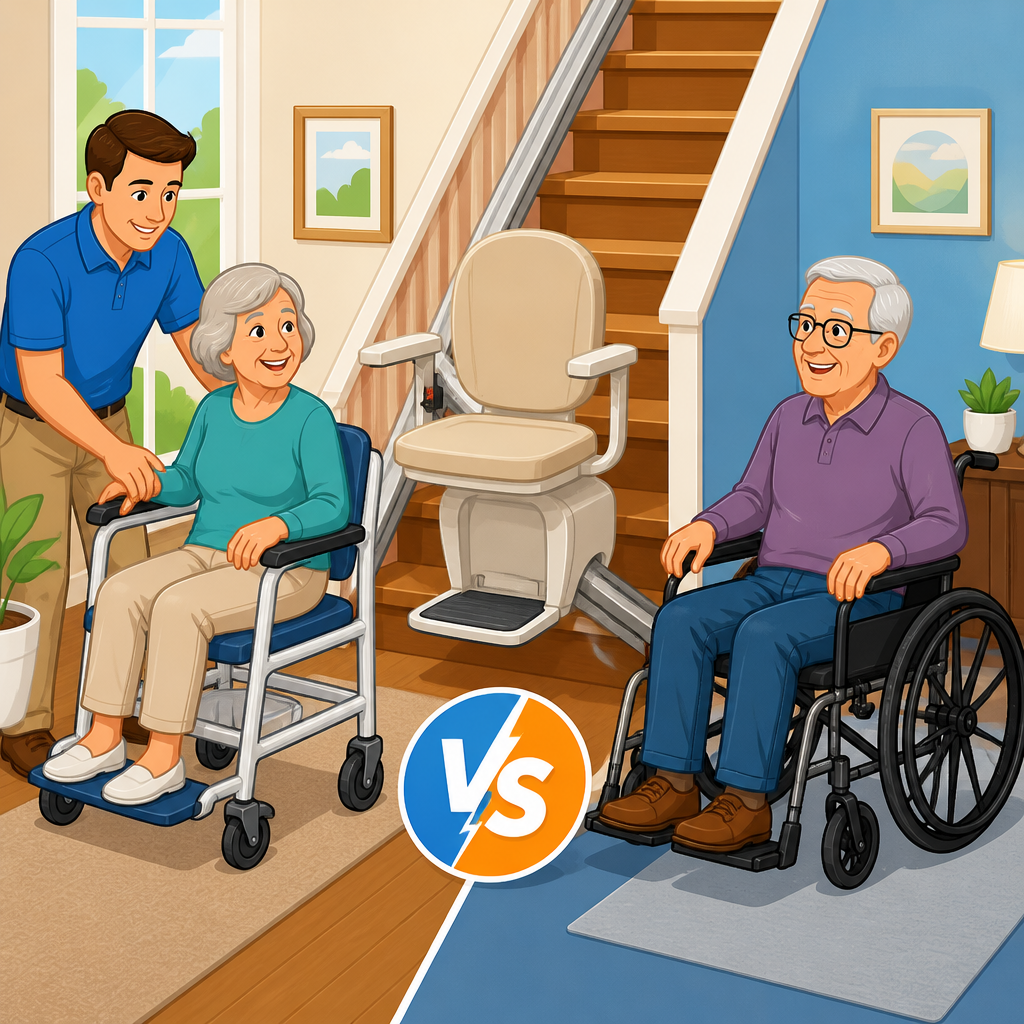
Choosing between transfer chairs and wheelchairs for use with a stair lift is not a small equipment decision; it affects safety, comfort, caregiver workload, home layout, and long-term mobility planning. In the accessibility and mobility solutions field, I have seen families focus on the stair lift first and only later realize that the mobility aid used at the top and bottom landings matters just as much. A stair lift moves a person along the staircase, but the transfer into and out of the seat determines whether the system works smoothly every day or becomes physically risky.
A transfer chair is a lightweight transport device designed to be pushed by a caregiver, usually with four small wheels, compact dimensions, and no self-propelling hand rims. A wheelchair, by contrast, is a broader category that includes standard manual wheelchairs, lightweight manual models, tilt-in-space chairs, transport wheelchairs, and power wheelchairs. When people ask, “Which works better with a stair lift?” the practical answer is that a transfer chair often works better in tight homes and caregiver-assisted routines, while a wheelchair is usually better for independent mobility before and after the lift ride. The right choice depends on the user’s strength, balance, transfer ability, turning space, and whether one device must serve the entire home.
This matters because stair lifts are built around seated transport on a fixed rail, not around carrying a wheelchair itself. Most residential stair lifts have a seat width around 16 to 21 inches, weight capacities commonly between 250 and 400 pounds, and landing requirements that vary by model and by local code. The user typically approaches the stair lift, brakes or stabilizes the mobility device, stands or pivots with assistance, sits on the lift seat, rides, then transfers again at the opposite landing. Every one of those steps creates variables: seat height mismatch, armrest interference, foot placement, caregiver reach, and the storage footprint of the device waiting nearby.
As the hub page for mobility aids and devices within accessibility and mobility solutions, this guide looks beyond a simple product comparison. It explains how transfer chairs and wheelchairs interact with stair lifts, what safety standards and fit issues matter, and how to evaluate related equipment such as walkers, canes, ramps, patient lifts, grab bars, and transfer boards. If you understand the transfer sequence, environmental measurements, and user needs, you can choose a setup that is safer and more sustainable than simply buying the smallest chair you can find.
How stair lifts work with mobility aids in real homes
A stair lift is a motorized chair attached to a rail mounted on the staircase treads or, less commonly, to the wall system depending on design. The user sits on the lift seat, secures the seat belt, places feet on the footrest, and rides up or down. Residential models from established manufacturers such as Bruno, Harmar, Stannah, and Handicare are designed for one seated passenger, not for carrying a full-size wheelchair. That design fact is the starting point for every mobility-aid decision.
In practice, the mobility device supports the user at the boarding and exit points. On a straight staircase with generous landings, a manual wheelchair can be positioned near the lift, locked, and used again after the ride. In a narrow hallway or on a small upper landing, the turning radius of a wheelchair may create a bottleneck, especially if doors swing inward. A transfer chair usually occupies less floor space, is easier for a caregiver to angle into position, and can often be folded for storage when the stair lift is in use. That is why transfer chairs are common in homes where assistance is always available.
The transfer itself is the key event. Safe transfers depend on seat-to-seat height compatibility, stable arm support, non-slip flooring, and enough space for the user’s strongest side to lead if they use a pivot transfer. If the user needs moderate or maximum assistance, a stair lift plus transfer chair setup may still work, but only if the caregiver can manage the person’s weight and movement without twisting on the stairs. For users with poor trunk control, severe Parkinsonian freezing, recent stroke deficits, or advanced multiple sclerosis, a standard stair lift transfer may become too risky without additional supports or a different vertical access solution.
Transfer chairs: best fit, strengths, and limitations
Transfer chairs are often the most practical partner for a stair lift because they are built for short-distance assisted movement in confined spaces. Most weigh far less than standard manual wheelchairs, often around 15 to 35 pounds depending on frame material and options. Their small rear wheels reduce overall width and make doorways, bathrooms, and landings easier to navigate. In homes with older floor plans, that reduced footprint can determine whether the setup works at all.
The main advantage is controllability for caregivers. A transfer chair can usually be brought closer to the stair lift seat, angled more precisely, and moved away quickly once the person is seated on the lift. I have found this especially useful in split-level homes where the upstairs landing is only a few feet deep and a conventional wheelchair blocks circulation. Because transfer chairs often fold easily, they are also simpler to park near a wall without interfering with the stair lift call/send controls.
They do have clear limitations. Transfer chairs are not designed for self-propulsion, so they reduce user independence. Small wheels perform poorly on thresholds, thick carpet, and outdoor surfaces. Postural support is usually basic, and some users feel unstable during longer seated periods. If the chair is too low compared with the stair lift seat, the transfer becomes harder, not easier. Families sometimes buy an inexpensive transport chair online, then discover the fixed footrests hit the stair lift base or the handles leave the caregiver bent awkwardly during every transfer.
Transfer chairs are best for users who can stand briefly, pivot with assistance, or perform a supported lateral transfer, and who already rely on a caregiver in the home. They are less suitable as the only mobility device for someone who needs independent movement all day.
Wheelchairs: when they work better than transfer chairs
Wheelchairs work better with a stair lift when preserving independence matters more than minimizing landing footprint. A manual wheelchair with properly fitted seat depth, seat-to-floor height, rear wheel position, and armrest style can let a user travel throughout the home before and after the lift ride without waiting for assistance to push them. That can be the difference between partial dependence and meaningful autonomy.
Standard manual wheelchairs also offer broader configuration options. Desk-length or removable armrests can improve side transfers. Swing-away or elevating leg rests may help users with edema, orthopedic precautions, or limited knee flexion. Pressure-relieving cushions, lateral supports, and anti-tippers can be selected based on clinical needs. If the person spends several hours a day in the chair, these features are not luxuries; they are part of skin protection, posture management, and energy conservation.
The challenge is space. A typical manual wheelchair can require a turning circle close to 60 inches, and even a lightweight model needs enough clear floor area to approach the stair lift safely. Power wheelchairs create a bigger issue because they are heavier, wider, and harder to reposition manually if they stop in an awkward place. Most homes with residential stair lifts are not designed around power wheelchair maneuvering at both landings. In those cases, the wheelchair may still be clinically necessary, but the stair lift setup may need careful remodeling, offset hinges, threshold changes, or an alternate lift solution.
Wheelchairs are usually the better choice for users with upper-body strength, strong self-management goals, or a need for sustained seated support. They are less efficient in cramped homes where every transfer requires a caregiver to jockey for position.
Head-to-head comparison for stair lift use
| Factor | Transfer Chair | Wheelchair |
|---|---|---|
| Landing space needed | Low; compact and easy to angle | Moderate to high; harder in tight halls |
| User independence | Low; caregiver required | Moderate to high for manual users |
| Ease of transfer to stair lift | Often easier due to compact frame | Good if fitted well and space allows |
| Comfort for long sitting | Limited | Better with cushions and adjustments |
| Outdoor/threshold performance | Poor to fair | Better, especially larger rear wheels |
| Storage near lift | Usually folds and stores easily | Bulkier; power chairs are hardest |
| Caregiver workload | Lower in positioning, higher in pushing | Higher in tight transfers, lower if user self-propels |
| Best use case | Assisted transfers in small homes | Independent daily mobility with enough space |
If the sole question is, “Which works better with a stair lift itself?” transfer chairs usually win because they simplify the transfer zone. If the larger question is, “Which works better for the person’s full daily mobility?” a wheelchair often wins. Good planning weighs both answers instead of treating the stair lift as the only variable.
Safety, fit, and assessment criteria that should drive the decision
The safest choice comes from assessment, not guesswork. Start with measurements: staircase width, top and bottom landing depth, door swing, threshold height, and the clear space needed beside the parked stair lift seat. Then assess the user: transfer method, grip strength, standing tolerance, cognition, vision, continence urgency, and fatigue pattern over the day. A person who transfers well in the morning may be unsafe by evening if weakness or medication timing changes performance.
Seat height alignment matters more than many buyers expect. When the wheelchair or transfer chair seat is significantly lower than the stair lift seat, the user must work uphill during the transfer. When it is too high, sliding and controlled descent become difficult. Armrests should support push-off without blocking movement. Locking brakes must hold on the specific flooring in the home; brakes that seem adequate in a showroom can drift on polished hardwood.
Clinical and industry guidance should inform the decision. Occupational therapists and physical therapists evaluate transfer mechanics, while certified aging-in-place specialists and reputable stair lift dealers assess environmental fit. Manufacturers follow standards such as ASME A18.1 for platform and chair lifts in many jurisdictions, but compliance does not guarantee ease of use for a specific individual. The right question is not merely whether the equipment is approved, but whether the user can transfer safely and repeatedly under real conditions.
How this choice connects to the wider mobility aids and devices category
A stair lift rarely succeeds as a stand-alone fix. In most homes, it becomes part of a mobility ecosystem that may include walkers for short indoor ambulation, canes for supervised balance support, bedside commodes to reduce urgent stair use, gait belts for caregiver-assisted transfers, transfer boards for lateral moves, lift recliners for sit-to-stand assistance, and grab bars at key transition points. If a user relies on a transfer chair at the stair lift, they may still need a rolling walker on one level and a shower chair in the bathroom.
That is why mobility aids and devices should be planned as a coordinated system. For example, a person recovering from hip surgery may use a front-wheeled walker on the main floor, a transfer chair for stair-lift boarding, and raised toilet seating to protect surgical precautions. A progressive neurological condition may start with a cane, shift to a manual wheelchair, and eventually require a power chair and a vertical platform lift instead of repeated stair lift transfers. The equipment path changes as function changes.
The hub approach is useful because buyers often shop by product instead of by task. The better method is to map every daily task: bed to bathroom, recliner to kitchen, front door entry, car transfer, and stair access. Once those tasks are clear, the right mix of devices becomes easier to identify, and costly duplicate purchases become less likely.
When a stair lift is not the best answer
Some users should not be steered toward a stair lift plus chair transfer system at all. If the person cannot safely sit upright unsupported, cannot follow commands consistently, has severe contractures that prevent proper seating on the lift, or requires total-assist transfers, a home elevator, vertical platform lift, ceiling lift, or first-floor living conversion may be the safer strategy. The same is true when a power wheelchair user cannot be transferred off the chair without significant risk.
I have also seen stair lifts fail in households where the device technically fit but the workflow did not. A spouse with back pain could not push the transfer chair safely. An adult child caregiver worked nights and was unavailable when needed. A user with urgent bladder symptoms could not complete the transfer sequence fast enough. These are not minor inconveniences; they are reasons to rethink the whole access plan.
Cost should be considered in lifecycle terms. A transfer chair may be inexpensive, but if it leads to repeated unsafe transfers, emergency calls, or a quick replacement with more supportive equipment, it was not truly economical. Likewise, a custom wheelchair setup may cost more up front but preserve independence and reduce caregiver strain for years.
Transfer chairs and wheelchairs can both work with a stair lift, but they solve different problems. Transfer chairs usually work better with the lift mechanism because they are compact, light, and easy to position on tight landings. Wheelchairs usually work better for the person’s broader mobility needs because they support independence, longer sitting tolerance, and more individualized positioning. The better choice depends on whether the priority is caregiver-managed transfers in limited space or self-directed movement throughout the home.
The most reliable way to decide is to evaluate the transfer sequence, not just the products. Measure the landings. Compare seat heights. Test brake stability on the actual flooring. Consider who will assist, how often the stairs are used, and whether the user’s condition is stable or progressive. Include related mobility aids and devices in the plan, from walkers and grab bars to transfer boards and bathroom equipment, because stair access is only one part of daily function.
If you are selecting equipment for yourself or a family member, arrange an in-home assessment with a qualified stair lift provider and a rehabilitation professional before you buy. That single step will do more to improve safety, comfort, and long-term usability than any online spec sheet.
Frequently Asked Questions
1. Does a transfer chair or a wheelchair usually work better with a stair lift?
In most homes, a transfer chair works more smoothly with a stair lift than a standard wheelchair, but the right answer depends on the user’s strength, balance, caregiver support, and the space available at the top and bottom landings. A stair lift is designed to carry a person while they sit in the lift seat, not while remaining in a wheelchair or transfer chair, so the key issue is what happens before and after the ride. A transfer chair is lighter, narrower, and easier for a caregiver to position close to the stair lift seat, which often makes transfers simpler and safer in tight areas. It can also be easier to store out of the way once the user is seated on the lift.
A wheelchair, however, may still be the better choice if the user relies on it throughout the day for posture support, pressure relief, independent movement, or medical positioning. Many wheelchair users need the stability, arm support, foot support, and custom seating that a transfer chair cannot provide. In those situations, the question is not whether a transfer chair is more convenient, but whether using one would reduce safety or comfort elsewhere in the daily routine. From a practical accessibility standpoint, the best match is the mobility aid that allows secure transfers at both landings without compromising the person’s overall mobility needs in the rest of the home.
2. Why do the top and bottom landings matter so much when choosing between a transfer chair and a wheelchair?
The landing areas are where the most important safety decisions happen. A stair lift may handle the staircase itself, but the user still has to get on and off the stair lift seat, and that transfer takes place at the top and bottom of the stairs. If those spaces are narrow, crowded, or have doors, turns, or carpeting transitions nearby, a full-size wheelchair may be difficult to position close enough for a clean transfer. In contrast, a transfer chair often has a smaller footprint and tighter maneuverability, which can make a major difference in older homes, split-level layouts, or hallways with limited turning radius.
Landing size also affects caregiver body mechanics. If a caregiver has to twist, reach, or work from an awkward angle because the wheelchair cannot line up properly with the stair lift, the transfer becomes more physically demanding and less predictable. Over time, that increases the risk of falls, skin tears, shoulder strain, and caregiver injury. Evaluating the landing areas means looking at seat height alignment, approach angle, footrest clearance, armrest interference, and whether the person can safely pivot or stand briefly during the transfer. This is why stair lift planning should never focus only on the staircase; the surrounding floor space often determines whether a transfer chair or wheelchair is the better functional fit.
3. Is a transfer chair safer than a wheelchair for stair lift transfers?
Not automatically. A transfer chair can be safer in some situations because it is lighter, easier to maneuver, and often simpler to place close to the stair lift seat. For users who can participate in a pivot transfer or who have reliable caregiver assistance, that easier positioning can reduce awkward gaps and improve control during the move. In homes where space is limited, this alone can significantly improve transfer safety. Transfer chairs are also commonly used for short-distance assisted movement, so they can be a practical landing-to-landing solution when the user does not need to self-propel.
That said, a wheelchair may be safer for users who need more trunk support, pressure management, head positioning, or a more stable seated base before and after the stair lift ride. If a person fatigues easily, slides forward in basic seating, or cannot maintain posture during a transfer setup, a transfer chair may actually increase risk despite being easier to push. Safety comes from the overall transfer process, not from the device category alone. The safest option is the one that allows proper alignment with the stair lift, gives the user enough physical support, and matches the caregiver’s ability to assist consistently. In many cases, the best way to determine this is through an in-home assessment by a stair lift provider, occupational therapist, or mobility specialist who can evaluate the user’s transfer pattern in the real environment.
4. When does a wheelchair make more sense than a transfer chair with a stair lift?
A wheelchair usually makes more sense when the user depends on it as their primary mobility system throughout the day and needs features a transfer chair cannot provide. This includes people who self-propel, need anti-tippers, custom cushions, lateral support, elevating leg rests, tilt or recline functions, or medically necessary seating for skin protection and posture. If the individual spends long periods seated and requires consistent support for circulation, alignment, or pain management, switching to a transfer chair just for stair lift access may create new problems even if it simplifies the transfer itself.
A wheelchair is also often the better option when independence is a major goal. A transfer chair typically requires a caregiver to push it, which may be acceptable for short transitions but limiting for someone who is capable of independent mobility on the main floor or upstairs. In long-term planning, it is important to think beyond today’s staircase challenge. If the person’s condition is progressive, investing in a setup that works with their existing wheelchair may make more sense than building a routine around a transfer chair that could become inadequate within months. The decision should account for current function, future needs, seating tolerance, and whether both floors of the home are actually usable with the chosen mobility aid.
5. What should families evaluate before deciding on a transfer chair or wheelchair for use with a stair lift?
Families should evaluate the entire transfer sequence, not just the mobility device itself. Start with the user’s physical abilities: Can they stand briefly, pivot, bear weight, follow cues, or help with repositioning? Then look at caregiver support: Who will assist, how often, and with what level of physical strength or training? Next, assess the home layout in detail, including landing dimensions, doorway widths, flooring changes, turning space, stair lift seat height, and whether the chair can approach from a safe angle. These details determine whether a transfer can be done repeatedly without strain or unnecessary risk.
It is also important to consider comfort, daily practicality, and long-term mobility planning. Ask whether the user will sit in the chair for minutes or hours, whether pressure relief is needed, whether the chair must fit in bathrooms or bedrooms, and whether the person needs independent movement once they reach the other floor. Think about storage as well, especially if the stair lift is near an entryway or hallway. Finally, involve qualified professionals early. A stair lift installer can evaluate the equipment setup, while an occupational therapist or seating specialist can assess transfer mechanics and mobility needs. The best outcome usually comes from treating the stair lift and the mobility aid as one coordinated system rather than two separate purchases.