


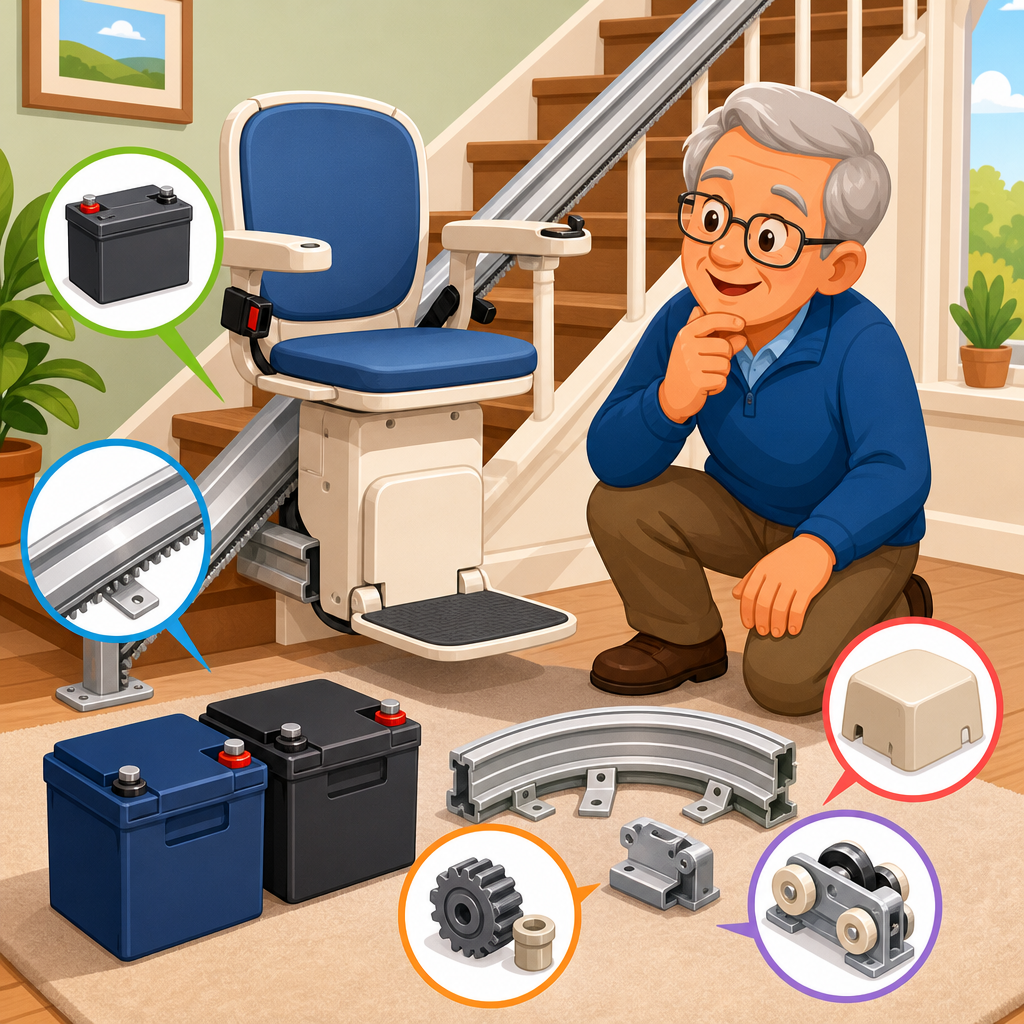
Buying a used stair lift can cut costs dramatically, but the savings only hold if you understand which components wear out fastest and which parts are expensive to replace. In the refurbished mobility market, “used stair lift batteries, rails, and parts” refers to the core mechanical and electrical components that may already have years of service behind them before the unit reaches a second owner. A stair lift itself is a motorized chair that travels along a rail fixed to the stair treads, typically powered by rechargeable batteries that charge at points on the track. When I inspect preowned units, I focus less on upholstery or cosmetic scratches and more on battery age, rail compatibility, carriage wear, charger output, safety circuits, and availability of manufacturer parts, because those factors determine reliability.
This matters for three reasons. First, stair lifts are safety devices, not convenience gadgets. If a battery fails midway on the staircase or a limit switch misreads track position, the user can be stranded or exposed to fall risk. Second, replacement costs vary wildly. A battery pair may be relatively affordable, while a custom curved rail, transmission, or obsolete control board can erase the price advantage of buying used. Third, not every used or refurbished chair lift is equally supportable. Brands such as Bruno, Harmar, Stannah, Handicare, Acorn, and Savaria differ in parts availability, service network strength, rail interchange rules, and long-term support policies. Buyers who know what commonly fails first can ask better questions, compare listings intelligently, and avoid units that are cheap upfront but costly over time.
As a hub article for used and refurbished chair lifts, this guide explains what typically needs replacing first, how to judge the condition of key parts, when a rail can be reused, and why some replacement decisions should only be made by a qualified stair lift technician. It also helps you connect the purchase decision to practical ownership issues: installation standards, battery charging behavior, weight capacity, seat and hinge wear, and whether a donor unit is worth refurbishing at all. If you are shopping the secondary market, reviewing dealer reconditioned models, or comparing a straight stair lift with a curved system, the details below will help you evaluate the true cost of ownership before you commit.
Batteries usually need replacing first because they age even when the lift is rarely used
In most used stair lift evaluations, batteries are the first components I expect to replace. Nearly all modern residential stair lifts run on sealed lead-acid batteries housed in the carriage, not in the seat base or on the wall. The charger feeds those batteries whenever the unit is parked at a charging point, and the lift then uses battery power for travel. This design allows operation during a power outage, but it also means battery health directly affects speed, stopping behavior, beeping faults, and trip capacity.
Battery aging is driven by more than ride count. Time, heat, storage conditions, and chronic undercharging matter just as much. A stair lift that sat unplugged in a garage, was removed from a home, or spent months off its charge points may need batteries immediately, even if the chair looks clean and barely used. In practice, many batteries last around three to five years, though environment and charger performance can shorten that window. Common warning signs include slower travel, audible low-voltage alarms, failure to complete a full trip, and erratic fault codes.
When reviewing a refurbished stair lift listing, ask for the battery installation date, charger voltage output, and whether the unit was load-tested on a full run. “New batteries installed” is meaningful only if the charger is also verified, because a weak charger can damage fresh batteries quickly. Replacing batteries is often the smartest preventive service on a used chair lift, particularly if service history is incomplete.
Rails are durable, but compatibility and condition matter more than appearance
Rails are often misunderstood in the used stair lift market. Buyers assume the rail is a universal track that can be reused across homes, but that is only partly true. Straight rails are far more reusable than curved rails because many straight systems can be cut to length and installed on another staircase if model compatibility is maintained. Curved rails, by contrast, are usually custom fabricated to the original stair geometry, including landings, bends, parking extensions, and overrun dimensions. In most cases, a used curved rail has little value unless it matches the next staircase almost exactly, which is rare.
Condition still matters. A straight rail can be structurally sound yet unsuitable if it has dents, corrosion, stripped mounting points, worn rack teeth, or contamination that affects rollers and drive engagement. During inspections, I look for pitting, misalignment, splice integrity on sectional rails, and any evidence that the lift carriage was run with damaged rollers. Even small defects can create rough travel, noise, accelerated gear wear, or sensor issues. A rail from a humid coastal home may have hidden corrosion that a casual buyer misses.
Also confirm whether the rail includes all brackets, charge strips, end stops, and installation hardware approved for that model. Missing hardware can delay installation or force substitutions that are not recommended by the manufacturer. For straight stair lifts, rail reuse can make financial sense. For curved units, buyers should assume the rail will be the least reusable component unless a dealer confirms a match.
What commonly wears out on a used stair lift
Beyond batteries and rails, several parts tend to drive early service calls on used and refurbished chair lifts. Some are normal wear items. Others fail because of poor storage, heavy use, or outdated electronics. The table below reflects the components I most often discuss with buyers comparing used units.
| Part | What it does | Typical used-market issue | Why it matters |
|---|---|---|---|
| Batteries | Provide operating power to the motor and controls | Capacity loss, sulfation, deep-discharge damage | Can cause mid-travel stops, alarms, and no-run faults |
| Charger | Maintains battery charge at park points | Low output, intermittent charging, failed transformer | Bad chargers destroy good batteries and reduce reliability |
| Seat swivel and lock | Lets user turn safely at landing | Loose detents, latch wear, unsafe engagement | Unsafe transfers increase fall risk at top landing |
| Footrest and safety edges | Detect obstacles and support feet | Broken switches, cracked hinges, wiring fatigue | Compromised obstruction sensing is a major safety problem |
| Call/send controls | Moves lift when user is not seated | Dead remotes, pairing issues, sticky wall stations | Affects convenience and parking at charge points |
| Rollers, gears, or transmission parts | Guide and drive the carriage along the rail | Wear, noise, backlash, uneven travel | Repairs can be costly and may signal deeper wear |
| Control board or diagnostic electronics | Manages safety logic and motor commands | Obsolete boards, moisture damage, fault lockouts | Parts availability can determine whether repair is viable |
The practical lesson is simple: cosmetic condition tells you very little. A chair with fresh upholstery can still need batteries, a charger, remote controls, and a seat lock adjustment before it is dependable.
Chargers, control boards, and safety circuits often decide whether a used lift is worth buying
Electronic parts separate a bargain from a burden. A charger is inexpensive compared with a motor or custom rail, but it has outsized importance because poor charging behavior gradually ruins the battery set. Check whether the stair lift charges continuously wherever it parks or only at designated points, and verify the contacts are clean and aligned. I have seen many “battery problems” that were really dirty charge strips, bent charging tabs, or a failed charger not supplying proper current.
Control boards require closer scrutiny. On older used stair lifts, especially discontinued models, the board may be the hardest part to source. If a seller cannot confirm parts support through the manufacturer or a reputable dealer network, treat the unit cautiously. Some boards can be refurbished by specialist electronics shops, but turnaround time, warranty quality, and firmware compatibility vary. This is one of the most important buying-guide issues in the refurbished chair lift category: a mechanically sound unit can become uneconomical if one proprietary board fails.
Safety circuits deserve the same attention. Stair lifts rely on seat swivel interlocks, footrest edge switches, overspeed governors on some designs, final limit switches, key switches, and diagnostic sensors. These are not optional accessories. Any bypassed interlock, taped switch, or homemade wiring repair is a red flag. A reputable refurbisher will replace damaged harnesses, verify continuity, and document final testing on incline travel, obstruction detection, and landing stop accuracy.
Mechanical wear shows up in the seat, footrest, drivetrain, and hinge assemblies
Many shoppers think “used stair lift parts” means only batteries and rails, but mechanical wear at user touchpoints often appears next. Seat padding and armrests are easy to spot and relatively easy to replace. More important are the seat swivel mechanism, folding hinges, and lock engagement points. At the top landing, the seat should rotate smoothly and lock positively without excessive force. If it wiggles, half-locks, or requires lifting to engage, the transfer may not be safe for a user with weak balance.
Footrests deserve detailed inspection because they combine structure and safety sensing. Cracked footrests, loose hinges, or nonresponsive edge switches are common on hard-used lifts. If the lift does not stop and reverse correctly when the footrest meets an obstruction, it should not be installed until repaired. Wiring fatigue is also common where the footrest folds repeatedly.
Deeper mechanical wear shows up as grinding sounds, jerky starts, uneven speed, or excessive play in the carriage. Depending on the model, that can point to worn rollers, rack engagement issues, gearbox wear, or transmission problems. On refurbished units, ask whether the dealer lubricated only approved points, checked rack condition, and measured drive noise during a full loaded run. Over-lubrication attracts dust and can mask wear temporarily; proper refurbishment is inspection-driven, not cosmetic.
Straight versus curved used stair lifts: what replacement risk looks like in each category
As a hub topic, used and refurbished chair lifts should always be split into straight and curved categories because replacement economics are fundamentally different. Straight stair lifts are simpler to resell, recondition, and reinstall. Their rails are more adaptable, installation is quicker, and parts interchange is often better within the same model line. That makes batteries, seat components, remotes, and charger systems the most common replacement concerns.
Curved stair lifts carry higher replacement risk because the rail is custom, the fit must be exact, and the systems are generally more complex. Even if the chair and carriage are in excellent condition, the original curved rail may be useless for another home. Some dealers refurbish the chair assembly and order a newly manufactured curved rail, which can still save money compared with an entirely new system, but it changes the value calculation completely. In those cases, the “used” portion is really the carriage and seat assembly, not the track package.
For buyers, this means a used straight lift can often be a complete product purchase, while a used curved lift is often a parts-and-platform purchase. If your staircase has turns, intermediate landings, or a parking fold around a doorway, ask whether the quoted system uses any reused curved sections, whether the rail is newly fabricated, and what warranty applies to each component group.
How to inspect a refurbished chair lift before purchase or installation
A proper inspection follows a repeatable checklist. Confirm the exact model number, serial number, manufacturing date, and whether the unit is still supported by the brand. Request service records showing battery replacement date, charger testing, fault history, and any replaced safety switches. Verify the weight capacity matches the intended user and that the seat width, armrest spacing, and footrest dimensions are appropriate for real daily use, not just a showroom demonstration.
Then insist on an operational test. The lift should complete repeated full trips smoothly, park accurately on charge points, and maintain normal speed under load. Test call/send controls from both landings. Fold and unfold the seat, arms, and footrest. Engage the swivel at the top landing and make sure the carriage will not travel when the seat is out of travel position if the design includes that interlock. Listen for unusual clicking, chatter, or grinding.
Finally, ask the questions that reveal long-term support quality: Who installs it? Who services it locally? Are original manufacturer parts used? What labor warranty is included? Is the rail cut and mounted according to the brand’s instructions? The best used stair lift purchase is not simply the cheapest machine. It is the unit with verifiable parts support, a professional installation plan, and the fewest high-risk unknowns.
Used stair lift batteries, rails, and parts do not wear at the same rate, and that is the key to buying wisely. Batteries usually need replacing first because age, storage, and charger condition shorten service life even on lightly used lifts. Rails, especially straight rails, often last much longer, but compatibility and hidden damage matter more than surface appearance. Electronic parts such as chargers, control boards, and safety switches can determine whether a used or refurbished chair lift remains serviceable years from now. Mechanical components at the seat, footrest, and drivetrain also deserve close inspection because they directly affect safety and ride quality.
For anyone researching used and refurbished chair lifts under buying guides and product reviews, the main benefit of this knowledge is cost control without compromising safety. You can separate normal preventive replacements from deal-breaking defects, compare straight and curved systems realistically, and ask dealers the questions that expose weak refurbishment practices. Focus on supportable brands, documented service history, tested charging systems, and professional installation. If you are considering a specific model, use this hub as your starting point, then compare battery age, rail type, parts availability, and warranty terms before you buy.
Frequently Asked Questions
What parts on a used stair lift usually need replacing first?
The first components to look at on a used stair lift are usually the batteries, charger, seat belt, remote controls, and other high-use electrical parts. In most cases, the batteries are the most common early replacement item because they naturally lose capacity over time, even if the lift has not been used heavily. A stair lift may still run with aging batteries, but it can become slower, weaker on inclines, or less reliable during power interruptions. The charger is another important part because if it is not maintaining the batteries correctly, battery failure can happen much sooner.
Beyond the power system, small but critical wear items often show up before major structural parts do. These can include safety sensors, swivel seat mechanisms, armrest switches, footrest hinges, and call/send controls. Upholstery and cosmetic covers may also show visible wear, but those are usually less urgent than anything affecting safe operation. The rail itself typically lasts much longer than the electrical accessories, but the carriage rollers or internal drive components that travel along the rail can wear with age and repeated use.
As a general rule, the most likely “first replacements” are not the biggest pieces you can see, but the parts that cycle constantly every time the lift runs or charges. That is why a buyer should focus less on appearance and more on battery age, charger performance, sensor function, and how smoothly the lift starts, stops, and parks. Those are often the earliest clues that service parts may soon be needed.
How long do used stair lift batteries last, and how can you tell if they are near the end of their life?
Most stair lift batteries last roughly three to five years, although actual lifespan depends on the brand, how often the lift is used, indoor temperature conditions, how well the charger has been working, and whether the lift has been stored for long periods. A used stair lift may already have batteries that are several years old, which means replacement could be needed shortly after installation even if the unit seems functional during a brief demonstration.
Common warning signs of weak stair lift batteries include beeping, reduced speed, short travel before stalling, failure to complete the full trip under load, or a lift that works only when parked correctly on its charging points. In some cases, the chair may seem normal when empty but struggle when someone is riding it. That often points to declining battery capacity rather than a simple cosmetic issue. If the batteries are original, undocumented, or visibly dated, it is smart to treat them as a near-term maintenance cost.
A practical way to assess battery condition is to ask for service records, battery installation dates, and a demonstration that includes multiple trips with a rider on the chair. If records are unavailable, assume some uncertainty. Because battery replacement is one of the most predictable costs with used stair lifts, many buyers choose to replace them proactively after purchase. That can be a wise move, especially for users who depend on the lift every day and cannot risk unreliable performance.
Is the rail on a used stair lift likely to need replacement, or is it usually reusable?
The rail is usually one of the more durable parts of a stair lift, and in many cases it can be reused if it is compatible with the staircase and remains in good physical condition. Straight stair lift rails are generally much easier to reuse than curved rails. A straight rail is simpler, more standardized, and often easier to trim or adapt within manufacturer limits. Curved rails, by contrast, are typically custom-built for a specific staircase layout, with bends and parking positions designed for one home. That makes them much less transferable and often one of the most expensive parts to replace.
Even when a rail appears structurally sound, it still needs careful inspection. Buyers should check for bends, dents, corrosion, mounting damage, loose brackets, abnormal wear along the travel path, and any signs that the carriage does not move smoothly from end to end. A damaged or poorly aligned rail can create operational problems, noisy travel, uneven stopping, or extra strain on the motor and transmission. In other words, a reusable rail is not just one that looks intact; it is one that supports safe, consistent movement under load.
It is also important to think about compatibility, not just condition. A good rail from one model may not work with another chair or carriage, and proprietary manufacturer designs can limit parts interchangeability. So while rails do not usually wear out as quickly as batteries or switches, they can become impractical to reuse if the model is discontinued, custom-made, or missing key mounting hardware. For many used stair lift buyers, the rail is less likely to be the first worn part but more likely to become the first major cost problem if it is the wrong type or cannot be matched properly to the installation.
Which used stair lift parts are most expensive to replace if they fail?
The most expensive stair lift parts to replace are usually the rail, the motor or gearbox assembly, the carriage electronics, and model-specific control boards. Curved rails are often at the top of the list because they are custom-manufactured to fit the exact turns and dimensions of a staircase. Replacing one can significantly reduce or even eliminate the savings of buying used. Straight rails are generally more affordable than curved ones, but they still represent a major component cost if damaged or missing.
The motor and transmission system can also be costly because these parts do the heavy lifting, literally and mechanically. If the lift hesitates, makes grinding noises, slips, jolts, or struggles under normal use, the underlying issue may involve internal drive components rather than a simple battery problem. Electronic boards and diagnostic modules can be expensive as well, especially for older or discontinued models where parts are scarce. In the refurbished mobility market, availability matters just as much as price. A part may not seem expensive in theory, but if it is hard to source, repair timelines and labor costs can increase quickly.
By contrast, items such as batteries, remote controls, seat covers, and some switches are usually more manageable replacement costs, even though they are common wear points. That is why a thorough evaluation should separate routine maintenance items from major system components. If a used stair lift needs only batteries and minor service parts, it may still be a very good value. If it needs a custom rail, a proprietary board, and drivetrain work, the economics can change fast.
How can you inspect a used stair lift before buying to avoid costly replacement surprises?
The best inspection combines visual checks, operational testing, and documentation review. Start by identifying the manufacturer, model, and approximate age of the unit. Then ask whether the lift is straight or curved, whether it has been refurbished already, and whether any parts have been replaced recently. Service records are extremely valuable because they can reveal battery age, past faults, recurring repairs, and whether the unit has been maintained according to manufacturer recommendations.
During the physical inspection, examine the rail, brackets, seat frame, swivel mechanism, footrest, safety edges, and charging contacts. Look for rust, cracks, loose mounting points, frayed wiring, missing covers, and signs of impact damage. Then test the lift through full travel in both directions, ideally with a rider. It should start smoothly, run at a consistent speed, stop accurately, and charge properly at its designated parking points. Test the call/send remotes, seat swivel lock, folding features, seat belt, and obstruction sensors. Any hesitation, beeping, harsh noises, or inconsistent charging should be investigated before purchase.
Finally, confirm whether replacement parts are still available for that exact model. This step is often overlooked, but it is critical. A used stair lift may appear to be a bargain until a failed board, charger, or rail component cannot be sourced easily. If possible, have a qualified stair lift technician inspect the unit before committing. That extra step can help you distinguish between normal wear-and-tear items like batteries and much more serious replacement risks involving the rail, drive system, or electronics. In practical terms, that is the difference between buying a cost-saving mobility solution and buying a repair project.