


What happens at the end of a stair lift rental agreement depends on the contract, the equipment installed, and the user’s mobility needs, but in most cases the process comes down to four options: return the unit, extend the rental, convert to a purchase, or replace it with a different model. For families comparing stair lift rental vs. purchase, the end-of-agreement stage is where total cost, convenience, service obligations, and long-term value become clear. I have worked with households arranging temporary accessibility after surgery, with adult children managing a parent’s changing needs, and with facilities balancing budget limits against safety requirements, and the same question always comes up near the final billing cycle: what exactly happens next? A stair lift rental agreement is the written contract covering use of a stair lift for a fixed or rolling term, usually including installation, maintenance, and removal. Purchase means you own the chair, rail, and core components, though warranties and service plans vary by brand and dealer. This topic matters because the wrong choice can add avoidable fees, leave a staircase unusable for days, or lock a family into paying more than ownership would have cost. Understanding the exit process is also the fastest way to judge whether renting or buying makes better financial sense from the start.
How stair lift rental agreements usually end
Most stair lift rental agreements end in one of three standard ways: scheduled termination, month-to-month continuation, or early cancellation after the minimum term. In practice, many straight stair lift rentals begin with an upfront charge that covers delivery, installation, and initial setup, followed by monthly payments. When the original term ends, the provider typically contacts the renter or the renter gives notice according to the agreement, often seven to thirty days in advance. The company then confirms whether the unit will be removed, kept in place under an extension, or applied toward a purchase if the dealer offers that option.
The biggest factor is whether the lift is on a straight staircase or a curved staircase. Straight stair lifts often use modular rails that can be installed, removed, and reused more easily, which makes rentals common and end-of-term removal relatively predictable. Curved stair lifts are usually custom built to exact stair measurements, so rentals are less common and purchase is often the default recommendation. If a curved unit is rented, the contract may treat the rail differently from the chair assembly because the rail has little resale value once fabricated for one home.
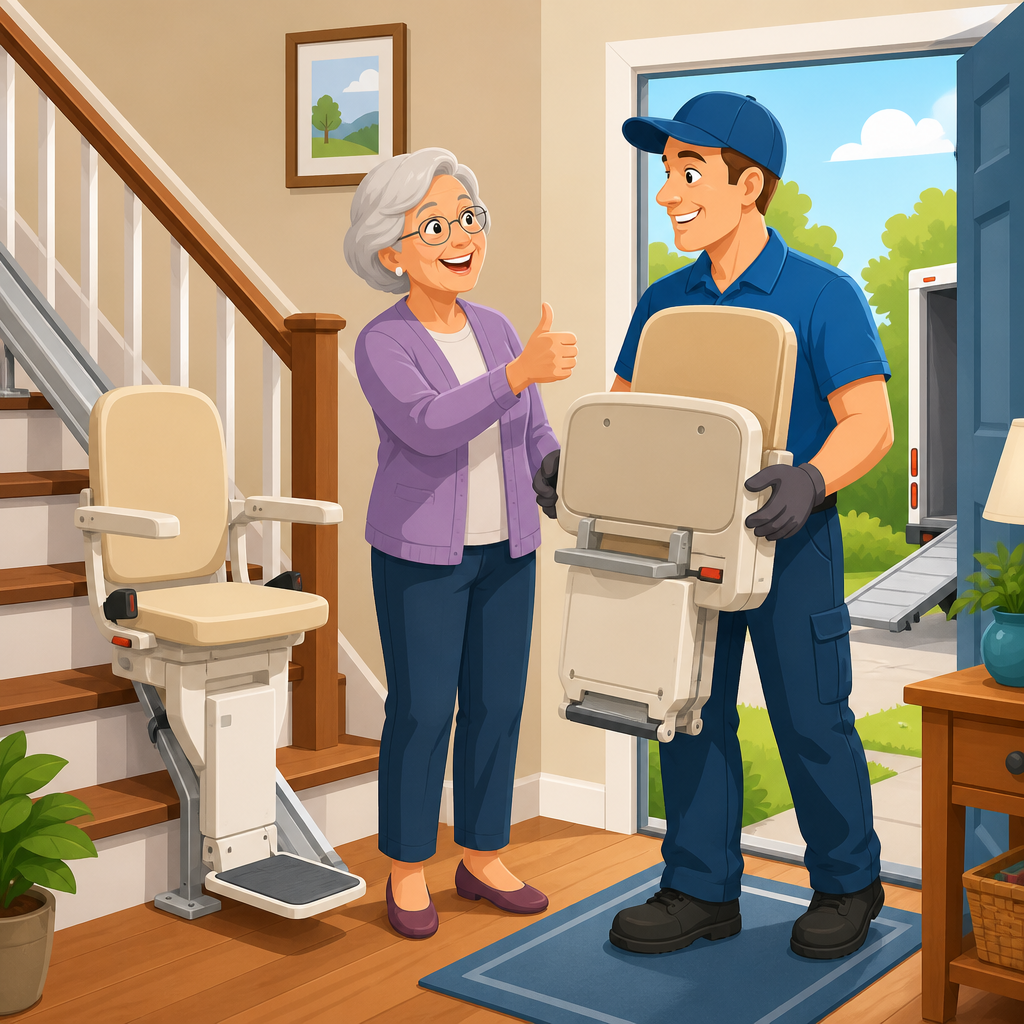
At the end of the agreement, the provider normally inspects the unit for excessive wear, confirms functionality, and schedules removal by trained technicians. Reputable dealers disconnect power safely, take down the rail, patch only minor fastening points if that service is included, and restore the staircase to basic usability. Cosmetic repair, repainting, carpet work, or trim replacement is not always included, so the contract language matters. Families are often surprised that removal timing depends on technician availability, not just the date printed on the contract.
Return, renewal, or buyout: the main end-of-term options
When the rental period ends, most consumers have four realistic paths. Returning the lift is the simplest. This works well when the need was temporary, such as recovery from hip replacement, stroke rehabilitation, or a short-term decline in mobility. Renewal makes sense when the user still needs help but long-term prognosis remains uncertain. A purchase conversion can be financially smart if the lift has already been rented for several months and future use is likely to continue. Replacement with a new unit is less common but important when the original rental no longer fits the user’s condition, home layout, or safety requirements.
| End-of-term option | Best fit | Typical cost effect | Main tradeoff |
|---|---|---|---|
| Return and remove | Temporary recovery or short-term care | Stops monthly payments after removal | User loses immediate stair access support |
| Extend rental | Uncertain timeline or evolving medical need | Continues monthly expense | Total spend can exceed ownership over time |
| Convert to purchase | Need becomes long term | Higher near-term outlay, lower long-run cost | Not every dealer credits prior rental payments |
| Upgrade or replace | Condition, weight, or staircase needs changed | May require new installation charges | More complex coordination and planning |
Buyout terms vary widely. Some companies offer a rent-to-own style arrangement, but many do not. In the companies I have reviewed, the more common model is partial credit of recent rental payments toward a new or refurbished purchase, not full application of every dollar paid. That distinction matters because consumers often assume months of rent automatically build equity in the equipment. They usually do not unless the contract states that clearly.
If the provider allows purchase conversion, ask whether you are buying the existing installed unit, a refurbished unit of the same model, or a brand-new unit with a fresh warranty. Those are materially different offers. A new warranty from a manufacturer such as Bruno, Harmar, Handicare, or Stannah may justify a higher price than simply keeping an older field unit with limited parts coverage.
Rental vs. purchase: the cost comparison families need
The rental vs. purchase decision is really a question of time horizon. Renting usually costs less at the beginning and more over the long run. Buying usually costs more upfront and less if the lift remains in use for enough months or years. For straight stair lifts in the United States, purchase pricing commonly starts around a few thousand dollars for a basic model, with higher totals for powered swivel seats, folding rails, heavy-duty capacity, or outdoor configurations. Rental pricing often includes an installation fee plus a recurring monthly charge. Because dealers set rates regionally, exact amounts differ, but the pattern is consistent.
A useful way to compare options is breakeven timing. If a family expects to need a stair lift for only two or three months after surgery, renting is usually cheaper and avoids ownership responsibilities. If the need extends toward a year or beyond, purchase often becomes more economical, especially when the buyer can use a certified pre-owned straight stair lift. Refurbished units can reduce upfront cost while still providing dealer installation and service support. That option is one of the most overlooked middle grounds between renting and buying new.
Total cost should include more than the monthly number. Add installation, removal, service call coverage, battery replacement policy, warranty length, transferability, and any minimum rental period. I have seen apparently low monthly rates become expensive after adding a high setup fee and a mandatory minimum term. On the purchase side, I have seen buyers overestimate maintenance costs when the dealer actually included the first-year labor and a multiyear drivetrain warranty.
Insurance coverage is another source of confusion. Original Medicare generally does not classify stair lifts as durable medical equipment for routine coverage, so most families pay out of pocket. Medicaid waiver programs, Veterans benefits, state assistive technology programs, long-term care insurance, or nonprofit grants may help in specific cases, but support varies sharply by state, plan, and eligibility. End-of-agreement decisions should therefore be made using real net costs, not assumptions about reimbursement.
What happens during removal and home restoration
Removal is usually straightforward, but it is not invisible. Technicians disconnect the unit from its power supply, remove the chair and carriage, detach the rail from stair treads or wall-mounted brackets depending on the system, and carry components out in sections. Most modern indoor lifts are fixed to the stair treads rather than the wall, which limits structural disruption. After removal, small screw holes may remain in wood treads or under carpet. Good installers explain this before the original installation and again before pickup.
Home restoration standards differ from one dealer to another. Some include basic cleanup and minor patching. Others remove the lift only and leave cosmetic finishing to the homeowner. If the staircase was carpeted, indentations can remain where brackets sat for months. On painted wood stairs, color variation may appear if surrounding surfaces aged differently from covered areas. These are not usually signs of damage, but they matter for household planning, especially when a home sale is approaching.
Timing also matters. If the user has died or moved to assisted living, families often want immediate removal. During busy periods, however, providers may schedule pickup several business days later. Ask whether billing stops on the removal request date, the last day of the notice period, or the actual pickup date. That single clause can change final charges. In my experience, the best companies state this plainly and send written confirmation with the final service date and account status.
When extending a rental makes sense
Extending a stair lift rental is often the right call when a medical condition is still being evaluated. After a fall, joint surgery, cardiac event, or neurological diagnosis, mobility can improve, plateau, or decline unpredictably. A short renewal prevents a rushed purchase while preserving safe home access. This is particularly helpful when a clinician expects functional recovery but cannot guarantee a timeline. It also helps families avoid buying the wrong specification before understanding transfer ability, seat height needs, or weight capacity requirements.
That said, month-to-month extensions can become expensive if no one recalculates the long-term numbers. I advise families to set a review point, often at three months and again at six months, and compare cumulative rental cost against buying a new or refurbished unit. If the household already knows the user intends to age in place and the staircase configuration is stable, continuing to rent indefinitely is rarely the most efficient option for a straight stair lift.
Extensions can also be strategically useful during a housing transition. A renter may keep the lift temporarily while waiting for a first-floor remodel, a home sale, or a move to a barrier-free apartment. In these cases, flexibility is the value being purchased. Paying more over several months can still be rational if it avoids making a permanent equipment decision in the wrong property.
How to decide between renting and buying from the start
The best rental vs. purchase decision starts with five questions. First, how long is the lift likely to be needed? Second, is the staircase straight or curved? Third, is the user’s condition temporary, progressive, or uncertain? Fourth, what cash flow matters more: lower upfront cost or lower lifetime cost? Fifth, will the home remain the long-term residence? These answers usually point clearly toward one path.
Choose rental when the need is temporary, the staircase is straight, immediate installation matters, and preserving cash is a priority. Choose purchase when the need is long term, the staircase is curved, the user plans to remain at home, or monthly rental charges would likely exceed ownership within the expected use period. Also consider household logistics. Owners can keep the equipment available without worrying about notice periods, pickup scheduling, or ongoing rental invoices.
Before signing either type of agreement, request the full pricing sheet, not just the advertised rate. Confirm model name, weight capacity, seat width, battery type, folding dimensions, service response policy, and what happens if the user no longer needs the unit earlier than expected. Ask whether there is a minimum rental period, an early termination charge, and any purchase credit. Good stair lift decisions are made on written terms, not verbal summaries.
Questions to ask before the agreement ends
As the final month approaches, contact the dealer and ask direct questions. What is the notice requirement? What is the exact final billing date? Are there removal fees? Is any cosmetic repair included? Can the contract be extended month to month? Is there a purchase option, and if so, how are prior payments treated? If the lift is no longer the right fit, what alternatives are available? These questions prevent the most common disputes.
For families researching cost and financing options, the core lesson is simple: the end of a stair lift rental agreement is not just an administrative step. It is the point where rental vs. purchase becomes a measurable financial outcome. Renting delivers flexibility, faster lower-commitment access, and a clean exit when mobility needs are short term. Buying delivers lower long-run cost, stronger continuity, and better fit for permanent aging in place, especially for curved stairs or extended use. Review the contract early, compare cumulative costs honestly, and get written answers before the final billing cycle. If you are evaluating stair lift rental vs. purchase now, use the end-of-agreement terms as your decision filter, because they reveal the true cost, convenience, and value of each option.
Frequently Asked Questions
What are the most common options at the end of a stair lift rental agreement?
In most cases, there are four standard paths when a stair lift rental agreement ends: return the unit, extend the rental, convert the rental into a purchase, or replace the current lift with a different model. Which option applies depends on the terms of the contract, the type of stair lift installed, and whether the user’s mobility needs have changed since the rental began. For example, a short-term recovery situation after surgery may point toward removal and return, while an ongoing decline in mobility may make an extension or purchase more practical.
The most important step is to review the original agreement before the end date arrives. Some rental contracts renew month to month, while others require notice before pickup or renewal. There may also be provisions related to minimum rental periods, removal charges, maintenance coverage, and what happens if the equipment was installed on a curved staircase or customized rail system. Families are often surprised to learn that the “end” of the agreement is not just an administrative detail—it is the moment when the true overall value of renting versus buying becomes easiest to evaluate.
What happens if the stair lift is returned at the end of the rental period?
If the stair lift is being returned, the provider usually schedules a removal appointment, disconnects the unit, and takes away the chair, rail, charging components, and related hardware covered under the rental arrangement. In many straightforward installations, especially on straight staircases, removal is relatively routine. However, the timing, cost, and scope of removal can vary from one company to another. Some contracts include removal in the rental price, while others charge a separate fee at the end of the agreement.
It is also important to ask what condition the provider expects the equipment and installation area to be in. Reputable companies understand that normal household use creates minor wear, but they may still inspect for unusual damage or missing components. Families should also ask whether any mounting points, screw holes, or cosmetic marks will be repaired as part of removal. In many homes, the rail is attached to the stairs rather than the wall, which generally limits visible impact, but it is still wise to understand what the home will look like after pickup. A clear end-of-rental checklist can help avoid confusion and make the return process much smoother.
Can a stair lift rental agreement usually be extended if the user still needs it?
Yes, many stair lift rental agreements can be extended, especially when the user’s need continues beyond the original estimate. This is very common in real life. Recovery timelines change, rehabilitation can take longer than expected, and in some cases a temporary mobility challenge becomes a longer-term condition. When that happens, rental providers often offer a month-to-month extension or a revised rental term. The key is to contact the provider before the agreement expires rather than assuming the lift will remain in place automatically.
Before extending, families should compare the additional rental cost against the price of purchasing a unit outright. A short extension may be the most convenient option, but if the lift will likely be needed for many more months, the cumulative rental cost can start to exceed the value of ownership. This is where the rental-versus-purchase decision becomes especially clear. Ask whether service, maintenance, and repairs continue under the extension, whether the monthly price changes, and whether any portion of previous rental payments can be applied toward a future purchase. Those details can significantly affect the long-term financial picture.
Is it possible to convert a stair lift rental into a purchase?
In many cases, yes. Some providers allow renters to convert the existing arrangement into a purchase, either by buying the installed unit if eligible or by applying part of the rental history toward the cost of a new or refurbished stair lift. This can be an excellent middle-ground option for households that initially chose rental because the need was uncertain, but later realized the equipment would be necessary for the foreseeable future. Instead of starting over, conversion can reduce disruption and simplify planning.
That said, conversion terms vary widely. Not every rented unit is available for purchase, particularly if the equipment is part of a rotating rental fleet, uses components not intended for resale in place, or involves a rail system that was priced differently under the rental model. Families should ask for a written breakdown showing the purchase price, installation charges if any, warranty coverage, and future service responsibilities. They should also confirm whether the converted purchase includes the same protections they would receive if buying a stair lift outright from the start. A well-structured conversion can save money and avoid unnecessary removal and reinstallation, but only if the numbers and service terms truly make sense.
What if the user’s mobility needs change and the current stair lift is no longer the right fit?
If the user’s condition has changed, the end of the rental agreement is often the ideal time to reassess whether the current stair lift still meets safety and usability needs. A standard seated stair lift may have worked initially, but the user may now need features such as a powered swivel seat, folding rail, heavier weight capacity, or easier controls. In more significant cases, the person may need a different type of equipment altogether, such as a standing stair lift, a model designed for narrow stairs, or a solution for a curved staircase if they are moving homes or changing living arrangements.
This is why the final stage of a rental agreement should not be treated as a simple billing decision. It is really a care-planning decision. A reputable stair lift company should be willing to reassess the staircase, review the user’s current mobility level, and recommend whether extending, replacing, or purchasing a different model is the safest and most cost-effective choice. Families should think beyond the next month and consider expected changes in strength, balance, transfers, caregiver assistance, and overall home accessibility. When approached this way, the end of the rental agreement becomes an opportunity to make a smarter long-term decision rather than just closing out a contract.