


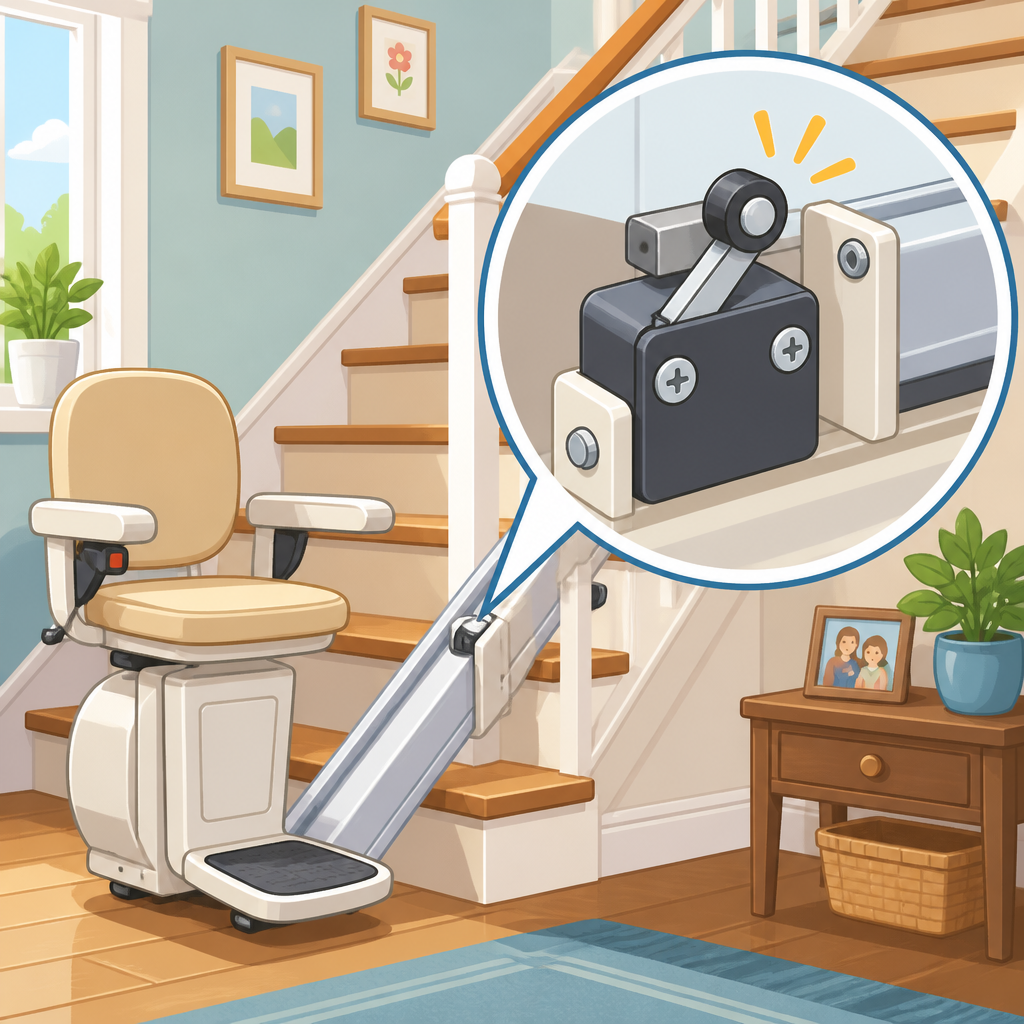
A stair lift final limit switch is the last-stop safety device that cuts power when the carriage reaches a travel boundary, preventing overrun, mechanical damage, and passenger injury. In the field, I explain it as the backup that acts after the normal stopping system, because homeowners understand “backup brake for movement” faster than electrical terminology. The term matters: “limit switch” refers to a sensor that changes circuit state at a set position, while “final” means it sits beyond the routine stop point and intervenes only if primary controls fail or the carriage overshoots. On modern stair lifts, this component works alongside charge contacts, obstruction sensors, seat interlocks, overspeed governors, and braking systems to create layered protection.
Understanding the stair lift final limit switch is important because stair lifts operate on a track with fixed endpoints, minimal clearance, and real users who may have limited mobility, slower reaction time, or balance concerns. A lift that travels past its intended stop can strike the rail end, damage the gearbox, misalign the carriage, or leave a rider stranded between floors. In older homes with narrow staircases, those consequences become more serious because there is less room for safe recovery. Manufacturers such as Bruno, Handicare, Stannah, and Acorn design multiple safeguards specifically because endpoint control is critical to safe use, reliable charging, and code-conscious maintenance.
This article serves as a hub for safety features explained within stair lift maintenance, troubleshooting, and safety. If you are diagnosing a lift that will not move, stops unexpectedly, or fails to charge at the top or bottom landing, the final limit switch is one of the first safety devices to understand, but never the only one. In practice, accurate troubleshooting depends on seeing how endpoint switches interact with the rest of the safety chain. When homeowners know what this switch does, they make better service decisions, recognize warning signs earlier, and avoid bypass attempts that create far greater risk than the original fault.
Most stair lifts use at least two levels of stopping control near each end of the rail. The normal limit or slow-down switch tells the unit to decelerate and stop at the programmed landing position. The final limit switch sits farther along and removes drive power if the carriage goes too far. Some systems also use magnetic sensors, cams, or board-level position logic, but the principle stays the same: independent endpoint protection. That layered design is standard good engineering. Any article about stair lift safety features should start here, because endpoint protection is one of the clearest examples of why redundancy is built into mobility equipment.
How a stair lift final limit switch works
A stair lift final limit switch is usually triggered mechanically or magnetically when the carriage reaches a precise point near the rail end. In many installations I have serviced, a small actuator arm, cam, or strike plate contacts the switch and opens the drive circuit. On other models, a magnet mounted at the rail endpoint changes the state of a reed or Hall-effect sensor. Once activated, the switch tells the control system that travel must stop immediately. Depending on the design, it may interrupt motor power directly, signal the main board to inhibit movement, or both. The key requirement is fail-safe endpoint control, not convenience.
The distinction between a standard limit switch and a final limit switch is practical, not academic. The normal stop is part of routine operation, so it engages every trip. The final limit should almost never activate in normal use. If it does, it indicates overshoot, adjustment drift, control error, worn stopping components, or a problem in the primary limit circuit. That is why technicians treat final limit activation as a diagnostic clue rather than a simple nuisance stop. It often points to another fault upstream, including carriage speed variation, loose cams, board calibration issues, or mechanical wear in the drive train.
Because stair lifts rely on batteries even when plugged into household power, endpoint control also affects charging. Many units charge only when parked at designated contacts near the top or bottom landing. If the carriage overruns or stops short, the batteries may not sit on the charge points correctly. Homeowners then report what sounds like a battery problem when the root cause is positional control. I have seen lifts replace batteries unnecessarily because the actual issue was a bent charge vane, a misadjusted final limit assembly, or contamination on the contact strip. Knowing the switch’s role prevents expensive guesswork.
Why the final limit switch is so important for safety
The final limit switch matters because it protects against low-frequency but high-consequence failures. A stair lift is not like a room elevator with a large hoistway and multiple fixed barriers. It runs in open view, often inches from a wall, landing edge, or floor obstruction. If the carriage travels beyond its intended stopping point, the user can experience a jolt, a twisted seat position at the landing, or difficulty standing safely. In the worst case, overrun can damage structural rail components or create a transfer hazard for a rider stepping off. The final limit switch exists to stop that chain of events.
It also protects the machine itself. Gear racks, pinions, motor assemblies, chassis rollers, and charging hardware are designed around controlled stopping distances. When a carriage hits a hard endpoint without the intended electrical stop, force transfers into components that were not meant to absorb repeated impact. Over time, that can cause rail-end damage, cracked mounts, wiring strain, and intermittent faults that are much harder to diagnose than a simple switch replacement. Good maintenance focuses on preventing secondary damage, and endpoint safety devices do exactly that.
From a liability and duty-of-care standpoint, endpoint protection is fundamental. Mobility equipment is used by older adults, people recovering from surgery, and riders with chronic conditions affecting strength, dexterity, and balance. They need predictable starts and stops. A final limit switch supports that predictability by catching rare failures before they become incidents. In service work, I regard it as one of the components you respect most because it sits quietly in the background until the day another system does not do its job.
Where it fits among other stair lift safety features
The final limit switch is part of a broader safety chain. Seat swivel interlocks prevent travel unless the seat is locked in a riding position. Footrest and carriage obstruction sensors stop the lift if it meets an object on the stairs. Overspeed systems monitor descent speed and engage a brake if speed exceeds specification. Armrest controls often require constant pressure, reducing unintended movement. Battery monitoring circuits warn when voltage drops too low for dependable operation. Each device solves a different risk, and the final limit switch specifically addresses endpoint overtravel.
Because this page is a hub for safety features explained, it helps to compare how these protections differ in purpose and symptoms when they fail.
| Safety feature | Primary purpose | Common failure symptom | Typical service response |
|---|---|---|---|
| Final limit switch | Stops overtravel at rail endpoint | Lift stops near end and will not continue in one direction | Inspect switch, cam, wiring, and stop alignment |
| Normal limit/slow-down switch | Controls routine deceleration and landing stop | Lift stops short, overshoots, or lands roughly | Check adjustment, board input, and actuator position |
| Obstruction sensor | Stops movement when footrest or carriage meets an object | Random stoppage with clear stairway or constant fault tone | Test edges, clean pivots, inspect wiring |
| Seat swivel interlock | Prevents travel unless seat is locked | Power on but no movement after seat rotation | Confirm latch engagement and switch continuity |
| Overspeed governor/brake | Stops uncontrolled descent | Brake trip, fault lockout, or no movement after speed event | Reset or replace per manufacturer procedure |
| Charge contacts | Maintain battery charging at park positions | Beeps, dead batteries, intermittent operation | Clean contacts, verify park position, test charger output |
This comparison shows why troubleshooting by symptom alone can be misleading. A lift that stops at the top landing could involve the final limit switch, the standard limit, the charge position, or even a seat issue if the user rotates the chair before command input. Accurate diagnosis depends on service mode checks, continuity testing, and manufacturer-specific fault logic.
Common problems, warning signs, and causes of failure
Final limit switches are durable, but they do fail. The most common causes I see are mechanical misalignment, worn actuators, pinched or fatigued wiring, moisture intrusion, dirt buildup, and switch contact wear. On outdoor stair lifts, temperature swings and condensation accelerate corrosion and brittle cable jackets. On indoor lifts, carpet fibers, pet hair, and cleaning residues can affect moving parts around the carriage and rail ends. A switch can also appear faulty when the real issue is a loose cam or bracket that no longer strikes it at the correct position.
Typical warning signs include abrupt stopping near the top or bottom, inability to travel in one direction, failure to settle properly onto the charge contacts, unexpected beeping after parking, or the need to “bump” the control repeatedly to get movement. Some lifts log fault codes; others simply refuse travel. If the unit regularly reaches the very end of the track before stopping, that is not normal and should be serviced quickly. Final limits are backups, not routine end stops.
Another nuance is intermittent faults. A switch may test fine while stationary but fail under vibration as the carriage approaches the endpoint. That is why technicians often inspect harness flex points, connector retention, and actuator repeatability under live conditions. Replacing the visible switch without correcting the underlying alignment problem often leads to repeat failure. Good service means finding the reason the safety device had to intervene.
Inspection, testing, and maintenance best practices
Homeowners should limit themselves to observation, cleaning approved exterior surfaces, and reporting symptoms accurately. They should not open covers, bridge switches, or attempt electrical testing. Stair lifts contain moving drive parts, stored electrical energy, and manufacturer-specific safety logic. A bypass that seems harmless can defeat multiple protections at once. The safest homeowner check is to confirm the rail ends are clear, the seat is locked, the footrest is unfolded properly, and the unit is parked where it normally charges.
Professional inspection is more involved. A technician typically verifies landing stop position, switch actuation timing, continuity, wiring integrity, bracket security, and board recognition of the switch state. They also inspect related items: chassis roll, gear mesh, charger contact alignment, battery voltage under load, and any stored fault information. On units with installation setup menus, the engineer may confirm speed and soft-stop values are within specification. Service should always follow the manufacturer manual, because trip logic differs by brand and model.
Preventive maintenance reduces final limit issues. Annual service is a reasonable minimum for most indoor stair lifts, while high-use or outdoor units benefit from more frequent inspection. During maintenance, endpoint assemblies should be cleaned, fasteners checked, and wear patterns documented. If a lift begins stopping harder than usual, that should be investigated before a backup stop becomes a regular event. The benefit of maintenance is not just reliability; it is preserving the safety margins built into the equipment.
Repair, replacement, and when to call for service
If a final limit switch is defective, replacement is usually straightforward for a trained technician but should never be treated as a generic hardware swap. Switch rating, actuator style, mounting geometry, and wiring configuration must match the manufacturer specification. After replacement, the unit needs functional testing in both directions, confirmation of normal stopping before the final limit point, and verification that charging still occurs correctly at the landing. On some models, calibration or setup checks are also required.
Call for service immediately if the lift overshoots its usual stop, hits the rail end, fails to charge at a landing, stops repeatedly near an endpoint, or displays a fault that clears only temporarily. Those are not cosmetic issues. They indicate degraded endpoint control or related safety-chain problems. If your stair lift is older and parts are becoming scarce, ask the provider whether the switch is still supported and whether other age-related safety components should be evaluated at the same visit. A well-diagnosed repair is cheaper and safer than repeated emergency callouts.
The final limit switch is important because it is the last independent protection against overtravel, one of the most critical hazards in stair lift operation. It does not replace normal stopping controls; it backs them up. When homeowners understand that role, they can spot abnormal behavior early, describe symptoms clearly, and avoid risky do-it-yourself fixes. Within the larger topic of stair lift safety features explained, this switch is the clearest example of layered protection working as intended: routine controls manage everyday travel, and a hidden safeguard stands ready if something goes wrong.
The main takeaway is simple. A stair lift is safest when every protective device, from seat interlocks to charge contacts, is functioning together, and the final limit switch is a key part of that chain. If your lift stops oddly at the top or bottom, does not park on charge reliably, or seems to run too far before stopping, schedule qualified service promptly. Review the rest of your stair lift safety features, keep to a regular maintenance plan, and treat endpoint problems as urgent rather than inconvenient. That approach protects the rider, the equipment, and the confidence that makes a stair lift worth owning.
Frequently Asked Questions
What is a stair lift final limit switch?
A stair lift final limit switch is a last-stop safety device that shuts off power when the stair lift carriage reaches the very end of its allowed travel. In simple terms, it is the backup that steps in if the normal stopping system does not stop the unit where it should. A standard stair lift usually has primary controls that tell the chair to slow down and stop at the top or bottom landing. The final limit switch sits beyond those normal stopping points as an added layer of protection. If the carriage keeps moving farther than intended, the final limit switch changes the circuit state and cuts movement before the lift can overrun the rail.
The wording matters because “limit switch” describes the type of device: a switch or sensor that reacts at a preset position. “Final” means it is not the first stopping method. It is the end-of-travel backup. That distinction is important for both homeowners and technicians, because people often confuse the normal stop with the emergency stop function. When I explain it in the field, I often compare it to a backup brake for movement. That is not the formal electrical definition, but it helps people quickly understand its job: it is there to protect the lift, the home, and the passenger if the primary system fails to stop the carriage in time.
Why is the final limit switch so important on a stair lift?
The final limit switch is important because it helps prevent one of the most serious travel-related failures a stair lift can have: overrun at the end of the rail. If a stair lift moves past its intended stopping point, the results can include mechanical damage to the carriage, impact to the rail end or stop assembly, strain on the drive system, and in the worst case, a risk of passenger injury. The final limit switch is designed to interrupt power before that kind of overtravel becomes dangerous.
Its value is not just in stopping movement, but in providing redundancy. Good safety design does not rely on a single sensor or a single command to protect the user. Stair lifts are used by people who may already have mobility or balance limitations, so the margin for error needs to be small. The final limit switch creates a second line of defense when the regular stopping system misses its target due to wear, misadjustment, electrical faults, or control issues. Even if such problems are uncommon, the consequences can be significant enough that this backup protection is essential.
It is also important from a service and reliability standpoint. A functioning final limit switch can prevent a small control problem from turning into a major repair. By cutting power at the travel boundary, it can help spare the motor, gearbox, chassis, end stops, and other components from impact-related damage. In short, it protects people first, and equipment second, which is exactly what a well-designed safety device should do.
How does a stair lift final limit switch work?
At a basic level, the final limit switch is positioned so it is triggered only when the carriage reaches a preset boundary near the end of travel. As the stair lift moves up or down the rail, a cam, actuator, ramp, flag, or physical contact point on the carriage eventually reaches that switch location. When that happens, the switch changes state electrically. That signal is used to interrupt the drive circuit or tell the control system to stop supplying motion power. The result is immediate prevention of further travel in that direction.
What makes it “final” is its placement and purpose. The normal stopping system is intended to stop the lift during routine operation at the proper landing position. The final limit switch is mounted beyond that normal stopping zone, not as part of everyday stopping, but as a protective boundary if the carriage travels too far. On many models, it is wired into the safety chain so that once it opens or trips, drive power is cut until the condition is corrected. Depending on the stair lift design, resetting may involve moving the carriage off the switch, cycling controls, or having a technician inspect the cause.
Although the concept is straightforward, the exact implementation can vary by manufacturer. Some stair lifts use mechanical microswitches. Others may use magnetic or proximity-based sensing as part of a broader control system. Regardless of the technology, the principle stays the same: detect an end-of-travel condition and stop motion before the unit overruns its safe operating range. That simple action is one of the reasons stair lifts can be operated safely in homes every day.
What are the signs of a bad or malfunctioning final limit switch?
A faulty final limit switch can show up in several ways, and not all of them are obvious to a homeowner. One sign is that the stair lift stops unexpectedly near one end of the rail and will not continue in that direction. If the switch is stuck, misaligned, damaged, or electrically open when it should not be, the lift may behave as though it has already reached its travel limit. Another sign is intermittent operation, where the lift works sometimes but cuts out near the top or bottom landing without a clear pattern. That kind of inconsistency can point to a loose connection, worn actuator, or switch that is failing under vibration.
More serious warning signs include the lift not stopping properly where it normally should, bumping or traveling farther than expected, or displaying diagnostic fault codes on models with onboard status indicators. In some cases, a user may hear the motor stop abruptly at the edge of travel, which can mean the final safety device is doing its job because the primary stop did not. That should never be ignored. If the backup had to intervene, the lift needs inspection even if it still seems usable afterward.
Because the final limit switch is a safety component, it is not something to bypass or “temporarily work around.” If there is any suspicion that it is defective, the safest response is to stop using the stair lift until it has been checked by a qualified stair lift technician. Cleaning, adjustment, testing, or replacement may be needed, but those steps should be done according to the manufacturer’s procedures. A malfunctioning final limit switch is not just an inconvenience; it is a signal that the stair lift’s end-of-travel protection may be compromised.
How should homeowners maintain or respond to issues involving a final limit switch?
For homeowners, the best approach is not hands-on repair, but awareness, routine observation, and timely professional service. During normal use, pay attention to how the stair lift stops at each landing. It should stop smoothly and consistently in the same place without drifting, bumping, or overshooting. If the chair begins stopping differently, hesitates near the ends of the rail, or suddenly refuses to travel in one direction, that is worth reporting. These changes may involve the normal limit system, the final limit switch, or related controls, and they should be evaluated before the problem gets worse.
Regular maintenance is especially important because stair lifts operate in a real home environment where dust, pet hair, vibration, wear, and minor rail movement over time can affect performance. During professional service, a technician can inspect the switch alignment, mounting hardware, wiring condition, actuator surfaces, and overall stopping behavior. They can also verify that the primary stopping system and the final limit switch are both functioning correctly and in the proper sequence. That matters, because the final limit switch should be there as a backup, not acting as the routine stopping method.
If a final limit issue is suspected, avoid trying to force the lift to move, avoid opening electrical covers unless you are qualified to do so, and never bypass the safety circuit. The right response is to remove the lift from use and schedule service. Homeowners do not need to master the technical language to make a smart decision. A simple rule works well: if the lift is not stopping where or how it normally should, treat it as a safety concern. That mindset helps prevent equipment damage and protects the person relying on the stair lift every day.