


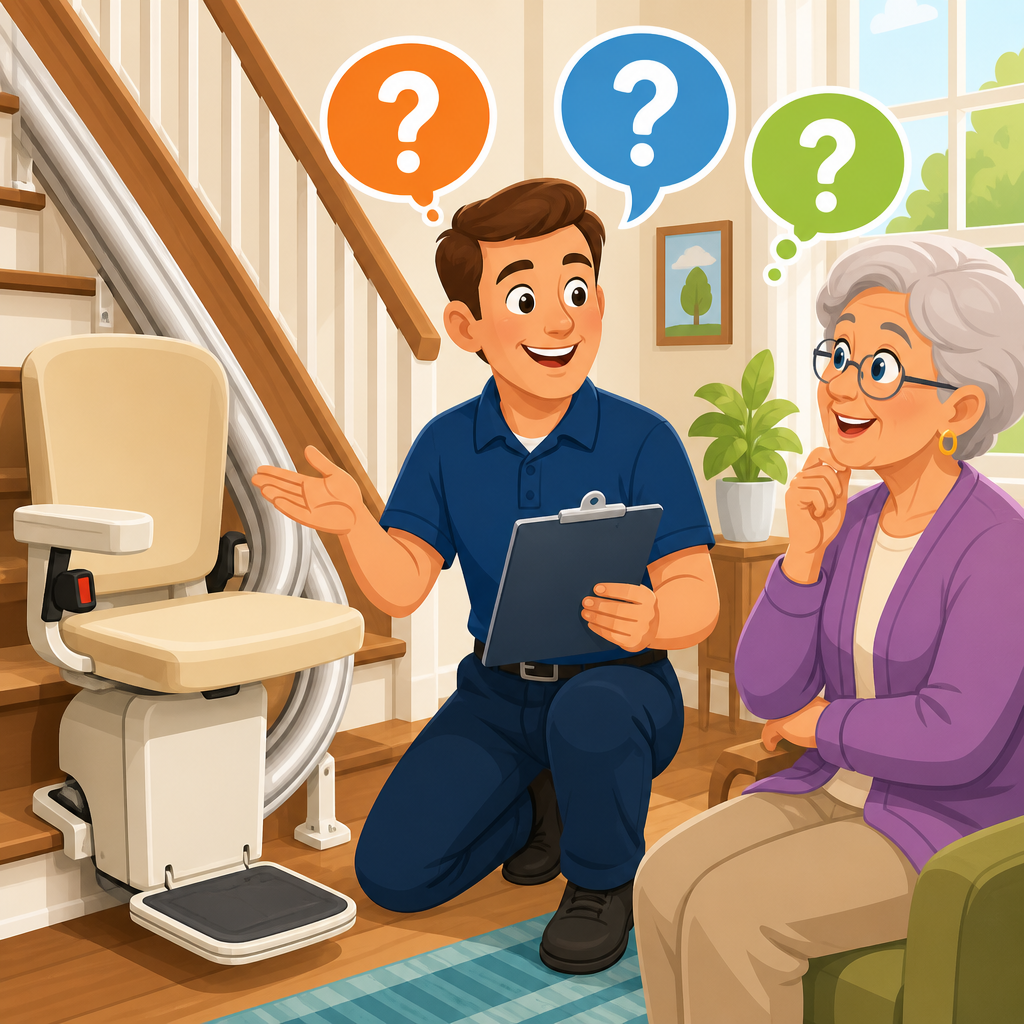
A stair lift inspection is not just a maintenance checkbox; it is the moment when owners, family members, and facility managers can confirm that a critical mobility device is still safe, reliable, and suited to the user’s changing needs. In practical terms, an annual stair lift inspection is a structured review of the rail, carriage, seat, battery, charger, controls, safety sensors, folding components, and mounting points, followed by functional testing under normal operating conditions. I have sat through many of these service visits with technicians and clients, and the difference between a routine inspection and an informed one usually comes down to the questions asked afterward. The right questions reveal wear before it becomes a breakdown, clarify whether repairs are urgent or optional, and help owners plan costs, parts replacement, and future accessibility decisions.
This matters because stair lifts carry people who may already be at higher risk from falls, balance problems, arthritis, or fatigue. A minor issue, such as a weakening battery, a misaligned seat swivel interlock, or debris affecting a footrest sensor, can turn into a no-start condition or unsafe transfer at the top landing. In homes, that can mean missed medications, isolation upstairs, or emergency sleeping arrangements downstairs. In churches, clinics, and multifamily buildings, it can create liability and service disruptions. Asking focused post-inspection questions helps translate a technician’s findings into action. It also creates a written maintenance history that supports warranty claims, resale value, and smarter decisions about repairs versus replacement. If this page is your hub for annual inspections, start here: learn what to ask, why each question matters, and how to turn a yearly visit into a practical safety review.
Ask First: Is the Stair Lift Safe to Use Right Now?
The first and most important question after any stair lift inspection is simple: “Is the lift safe to use today, exactly as it is?” Ask for a direct yes or no answer. If the technician adds conditions such as “safe for now,” “usable but watch it,” or “operational pending parts,” ask what those qualifiers mean in plain language. A stair lift can pass basic travel testing and still have issues that affect safe transfers, reliability, or code-aligned performance. Common examples include a loose armrest, intermittent charger contact, worn geared strip, or a top overrun area that no longer gives the user enough room to dismount comfortably.
Ask the technician to separate findings into three categories: immediate safety issues, near-term reliability issues, and routine wear. That distinction matters. A cracked seat shell, failing seatbelt latch, faulty overspeed governor, or nonfunctioning obstruction sensor belongs in the immediate category and should typically take the lift out of service until corrected. A battery that still tests within range but is trending weak is a near-term reliability issue. Cosmetic trim damage is routine wear. When owners do not force this prioritization, they often hear a long list of technical notes without understanding what truly requires action. Good inspection follow-up begins with operational status, not paperwork.
What Exactly Was Inspected, Tested, and Measured?
Many owners assume “annual inspection” means the same thing across brands and service companies, but it does not. Ask for a component-by-component summary of what was inspected visually, what was tested functionally, and what was measured with tools. On most modern lifts, that should include rail alignment and mounting security, carriage movement, seat swivel locks, footrest and carriage safety edges, call/send stations, arm controls, battery voltage, charging output, final limits, and manual lowering or emergency procedures where applicable. For outdoor units, weather seals, corrosion points, and cover condition should also be reviewed.
I recommend asking, “Did you only test operation, or did you also measure battery and charger performance?” Batteries are a common example of why that distinction matters. A lift may complete several runs during inspection yet still have declining sealed lead-acid batteries that drop under load. A proper technician may use a multimeter or load-testing method rather than relying on casual observation. The same applies to charge points and contacts. If the lift charges intermittently because the parked position is slightly off or the contacts are dirty, the user may not notice until the next day, when the unit is dead on the rail. Detailed questions expose whether the inspection was comprehensive or merely a basic ride test.
What Problems Did You Find, and How Serious Is Each One?
Once the scope is clear, move to findings. Ask for every issue discovered, even if minor, and request a severity ranking. The most useful phrasing is: “Which items affect safety, which affect reliability, and which are preventive recommendations?” This gives you a triage list. It also helps if you later compare estimates from another dealer or discuss the report with family members who were not present. Terms such as “wear noted” or “monitor condition” are too vague on their own; ask what failure would look like if the part worsens.
Examples help. If the technician notes gear rack wear, ask whether the wear is uniform or localized. Uniform wear may simply be age-related; localized wear can point to alignment issues. If they mention the seat swivel is stiff, ask whether lubrication, adjustment, or replacement is indicated. If there is rail movement, ask whether the staircase substrate, mounting feet, or fasteners are involved. Specificity matters because different faults have different urgency, cost, and root causes. A strong annual inspection does not just identify symptoms; it explains the mechanism behind them and the consequence of delaying action.
Which Parts Are Wearing Out, and What Is Their Remaining Service Life?
Owners often ask whether a stair lift is “fine” without asking the more useful question: which parts are approaching the end of service life. Stair lifts do not age evenly. Batteries may need replacement every few years depending on usage and charging consistency, while rails can remain sound for much longer. Hinges, swivel mechanisms, footrest linkages, drive components, and call station batteries can all wear at different rates. Ask the technician to identify consumable or high-wear parts and estimate whether they are likely to last twelve months, six months, or less.
Do not expect a perfect prediction, because usage patterns vary. A unit in a single-user home behaves differently from one in a busy multigenerational household. Still, experienced technicians can usually identify trend lines. Ask whether any wear is normal for the model and age, whether replacement parts are still readily available, and whether repeated repairs on the same assembly suggest larger deterioration. This is especially important for older lifts from discontinued product lines. If a key board, motor gearbox, or diagnostic module has limited availability, the remaining service life of the entire lift may depend less on current condition and more on future parts support.
What Maintenance Should Be Done Now, and What Can Wait?
After annual inspections, people frequently leave with an estimate but no decision framework. Ask the technician to divide recommendations into immediate service, recommended within three months, and optional preventive work. This gives you a usable maintenance schedule rather than a generic list. Some items should be handled during the visit if parts and authorization are available, such as battery replacement, sensor adjustment, or tightening mounting hardware. Others, like replacing cosmetic trim or upgrading a call/send station, may reasonably wait.
The table below is a practical way to interpret common inspection findings and the questions they should trigger.
| Inspection finding | What to ask | Typical urgency | Why it matters |
|---|---|---|---|
| Battery testing weak | Will it fail suddenly or gradually, and should both batteries be replaced together? | High | Low battery voltage causes slow travel, beeping, or complete no-start conditions. |
| Charger output inconsistent | Is the charger bad, or is the parking/contact alignment the real issue? | High | The lift may appear functional now but stop charging between uses. |
| Seat swivel stiff or mislocking | Is this adjustment, lubrication, or a worn interlock component? | High | Unsafe transfers at the landing are a major fall risk. |
| Rail or mounting movement | Are the brackets loose, or is the stair structure itself contributing? | High | Movement can accelerate wear and affect ride stability. |
| Obstruction sensor intermittent | Was the sensor cleaned, tested, and verified under load? | High | A failed safety edge can prevent proper stopping when blocked. |
| Footrest or armrest looseness | Can this be tightened, or is a hinge or fastener worn out? | Medium | Loose user-contact parts reduce confidence and safe positioning. |
| Remote control unreliable | Is it only a battery issue, or is there receiver interference or board trouble? | Low to medium | Call/send problems can strand the lift on the wrong level. |
Are There Safety Features I Should Test Between Annual Inspections?
Yes, and this is one of the most overlooked questions. Annual inspections are essential, but they do not replace regular owner awareness. Ask the technician to show you which user-level checks are appropriate monthly or quarterly. On most lifts, owners can verify that the seat locks firmly into travel position, the seatbelt latches securely, the call/send controls respond consistently, the unit parks and charges correctly, and the footrest and carriage obstruction sensors stop the lift when gently triggered according to manufacturer guidance. You should not open panels or attempt internal adjustments, but you should know how normal operation feels and sounds.
Ask for a demonstration of warning indicators, diagnostic beeps, or display codes specific to your model. Brands differ. A Bruno, Stannah, Harmar, or Handicare lift may signal charging, faults, or seat-position problems differently. If the technician says, “Call us if it starts beeping,” that is not enough. Ask what one beep pattern versus another means, what steps are safe for the user, and when the lift should be taken out of service. This helps prevent a common mistake: continuing to use a lift that is signaling a seat interlock or charging fault because the user assumes it is a nuisance alert.
Is This Stair Lift Still the Right Fit for the User and the Home?
An annual inspection should also cover suitability, not only mechanics. Ask whether the lift still matches the user’s current mobility, weight, transfer ability, and cognitive needs. I have seen lifts that were technically operational but no longer appropriate because the user developed reduced trunk control, needed a powered swivel, or struggled with a narrow seat and arm spacing after a health change. Similarly, a household may have changed. New carpeting, remodeling at the landing, or added furniture can reduce clearances around the rail and affect safe boarding.
Ask about weight capacity and whether the user is comfortably within the rated limit. Ask whether a perch seat, larger seat pad, powered footrest, powered hinge, or alternative control style would improve safety. In some cases, the inspection reveals that the device itself is fine but the transfer environment is not. For example, poor lighting at the top landing, a loose handrail nearby, or clutter near the foot of the stairs may be the real hazard. A good technician should be able to point out these surrounding risk factors even though they are not failures of the lift itself.
What Should I Document, Budget For, and Discuss With My Service Provider?
Before the technician leaves, ask for documentation that is specific enough to be useful later. You want the model and serial number, date of inspection, tests performed, deficiencies found, parts recommended, and any advice about continued use or restricted use. If repairs were declined, note that too. This record becomes your maintenance baseline for next year and helps if warranty questions arise. It also supports continuity when a different technician services the lift later. Vague invoices that say “inspected unit” are not enough for a safety-critical device.
Budget questions are just as important. Ask which recommended repairs are likely one-time fixes and which are recurring wear items. Ask whether the quote includes labor, travel, and follow-up calibration. Ask about lead times for parts, especially batteries, chargers, control boards, and model-specific seat components. If the lift is older, ask directly whether investing in repairs over the next year is sensible or whether replacement planning has started to make more financial sense. That conversation is not sales pressure when grounded in parts availability and reliability history; it is responsible lifecycle planning.
The best questions to ask after a stair lift inspection are the ones that turn technical findings into clear decisions: Is the lift safe now, what exactly was tested, what faults were found, which parts are wearing out, what must be repaired first, what should the owner monitor, and whether the lift still suits the user. Annual inspections work best when they are treated as a safety review, a maintenance planning session, and an accessibility check all at once. That is why this topic belongs at the center of any maintenance, troubleshooting, and safety resource hub. It connects directly to battery care, sensor troubleshooting, rail cleaning, transfer safety, service contracts, and replacement planning.
If you want better reliability from a stair lift, do not end the appointment when the ride test is over. Ask for priorities, timelines, demonstrations, and documentation. Then keep the report, schedule the needed work, and note any changes in how the user rides, transfers, or charges the unit during the year. A stair lift is only as dependable as the maintenance decisions surrounding it. Use each annual inspection to make those decisions with confidence, and if your latest report is unclear, contact your service provider and ask for a line-by-line explanation before the next problem appears.
Frequently Asked Questions
What should I ask the technician about the overall safety of the stair lift after the inspection?
One of the most important questions to ask is, “Based on what you found today, is this stair lift fully safe to use right now?” That wording encourages a clear, direct answer instead of a vague summary. From there, ask the technician to explain the condition of the core safety-related components, including the rail, carriage, seat locking mechanism, swivel seat, seat belt, footrest sensors, obstruction sensors, arm controls, call/send controls, and charging system. If the stair lift includes folding rails, powered hinges, or overrun sections at the top or bottom landing, those parts should also be included in the discussion because they affect safe entry and exit.
You should also ask whether the technician observed any signs of unusual wear, movement at mounting points, alignment issues, intermittent sensor behavior, or reduced stopping accuracy. Even if the lift is technically operational, small changes in ride quality, charging consistency, or seat stability can signal a developing problem. A good follow-up question is, “Did anything pass inspection today but still deserve close monitoring before the next service visit?” That helps separate immediate safety issues from early-stage maintenance concerns.
If the stair lift is used by an older adult, someone with balance limitations, or a person whose mobility has changed since installation, ask whether the current setup still supports safe transfers on and off the seat. Safety is not only about mechanical condition; it is also about how the user interacts with the equipment every day. An authoritative inspection should help you understand whether the lift remains safe in real-world use, not just whether it turned on and moved up and down the stairs.
Are there any repairs, adjustments, or replacement parts that should be handled now rather than later?
After an inspection, it is wise to ask for a prioritized list of recommended work. A useful question is, “What needs immediate attention, what should be scheduled soon, and what can reasonably wait?” This helps you distinguish between urgent repairs and routine maintenance planning. For example, a weak battery, inconsistent charging contact, loose hardware, worn seat swivel mechanism, or deteriorating call/send control may not all carry the same level of urgency, but each can affect reliability and user confidence.
Ask the technician to identify whether any parts are showing wear patterns that commonly lead to breakdowns if left unaddressed. Batteries, chargers, rollers, hinges, safety edges, control switches, and seat components are often worth discussing in detail. If replacement is recommended, ask why, what symptoms support that recommendation, and whether the part is still functioning within manufacturer standards or merely approaching the end of its expected service life. That distinction matters when budgeting and scheduling future work.
It is also smart to ask whether delaying a repair could create additional problems elsewhere in the system. A minor issue in the rail, carriage alignment, charging contacts, or folding footrest mechanism can sometimes accelerate wear in other components. If parts must be ordered, ask how long the stair lift can remain in service, whether any temporary precautions should be followed, and whether the user should limit operation until repairs are completed. These questions turn the inspection into a practical action plan instead of a general maintenance note.
How is the battery and charging system performing, and is the lift likely to remain dependable during everyday use?
The battery and charging system deserve special attention because many stair lift performance complaints begin there. Ask directly, “Is the battery holding a proper charge, and is the charger working as it should?” Also ask whether the charging contacts are clean, aligned, and consistently engaging when the lift is parked. A stair lift may appear to work during testing but still have a charging issue that shows up later as slow operation, beeping, mid-trip hesitation, or failure after repeated use.
You should also ask the technician whether the battery’s age and condition are typical for its service history. Even if the battery has not failed yet, older batteries often become less reliable gradually. Ask whether there are signs of reduced capacity, voltage drop, or charging irregularities that suggest replacement should be planned soon. If the unit is in a home or facility where dependable operation is essential every day, proactive battery replacement may be a better choice than waiting for a failure.
Another helpful question is, “If there were a household power outage today, how well would this lift be expected to perform?” That gives you a clearer picture of backup capability and real-world reliability. If the user depends on the lift for access to sleeping areas, bathrooms, or emergency exits, the ability to operate during an outage is especially important. A thorough answer should help you understand not just whether the battery passed a technical check, but whether the entire charging setup supports dependable daily use between now and the next inspection.
Does the stair lift still fit the user’s current mobility needs and transfer ability?
An inspection is the perfect time to ask a broader question many people overlook: “Is this stair lift still the right solution for the person using it?” A lift can be mechanically sound and still no longer be the best fit if the user’s strength, balance, coordination, posture, or transfer ability has changed. Ask the technician whether the seat height, armrest support, swivel function, footrest position, control placement, and stopping location at each landing still make boarding and exiting safe and comfortable.
If a family member, caregiver, or facility manager has noticed that the user is struggling more with sitting down, fastening the belt, positioning their feet, or standing up at the top landing, bring that up during the post-inspection discussion. These functional changes may indicate a need for adjustments, accessories, training, or in some cases a different lift configuration. For example, powered swivel seats, powered footrests, different seat sizes, rail extensions, or alternative control options may improve safety and independence.
This question is especially important because mobility needs often change gradually. People adapt without realizing that transfers have become less stable or more tiring. Asking the technician to assess user fit in addition to equipment condition can reveal whether the lift continues to support safe daily routines. In an authoritative inspection process, the goal is not merely to confirm that the machine operates, but to confirm that it still works well for the person who depends on it.
What maintenance, testing, and follow-up should be done before the next annual inspection?
Before the visit ends, ask, “What should we do between now and the next inspection to keep the stair lift safe and reliable?” This opens the door to practical guidance that can prevent avoidable service calls. The technician may recommend keeping the rail clean, making sure the lift is parked in a charging position, checking for unusual noises, testing call/send controls periodically, observing sensor response, and reporting any slowing, beeping, rough travel, or seat wobble right away. These simple steps help owners and caregivers catch developing issues early.
You should also ask whether there are any user checks that are safe to perform without tools or disassembly. For example, you may be able to monitor whether the seat locks properly, whether the footrest folds smoothly, whether remotes respond consistently, and whether the lift stops and starts normally. At the same time, ask what should never be handled by the owner, such as electrical work, battery replacement, sensor adjustments, or rail hardware tightening. Knowing that boundary is important for safety and warranty protection.
Finally, ask when follow-up service should be scheduled if minor concerns were found, and whether the unit would benefit from maintenance sooner than the standard annual interval. In a high-use home or a commercial or care setting, yearly inspections may not be enough. A detailed answer should leave you with a clear timeline, a list of warning signs to watch for, and a plan for keeping the stair lift dependable until the next professional review. That is what turns an inspection from a one-time appointment into a long-term safety strategy.