


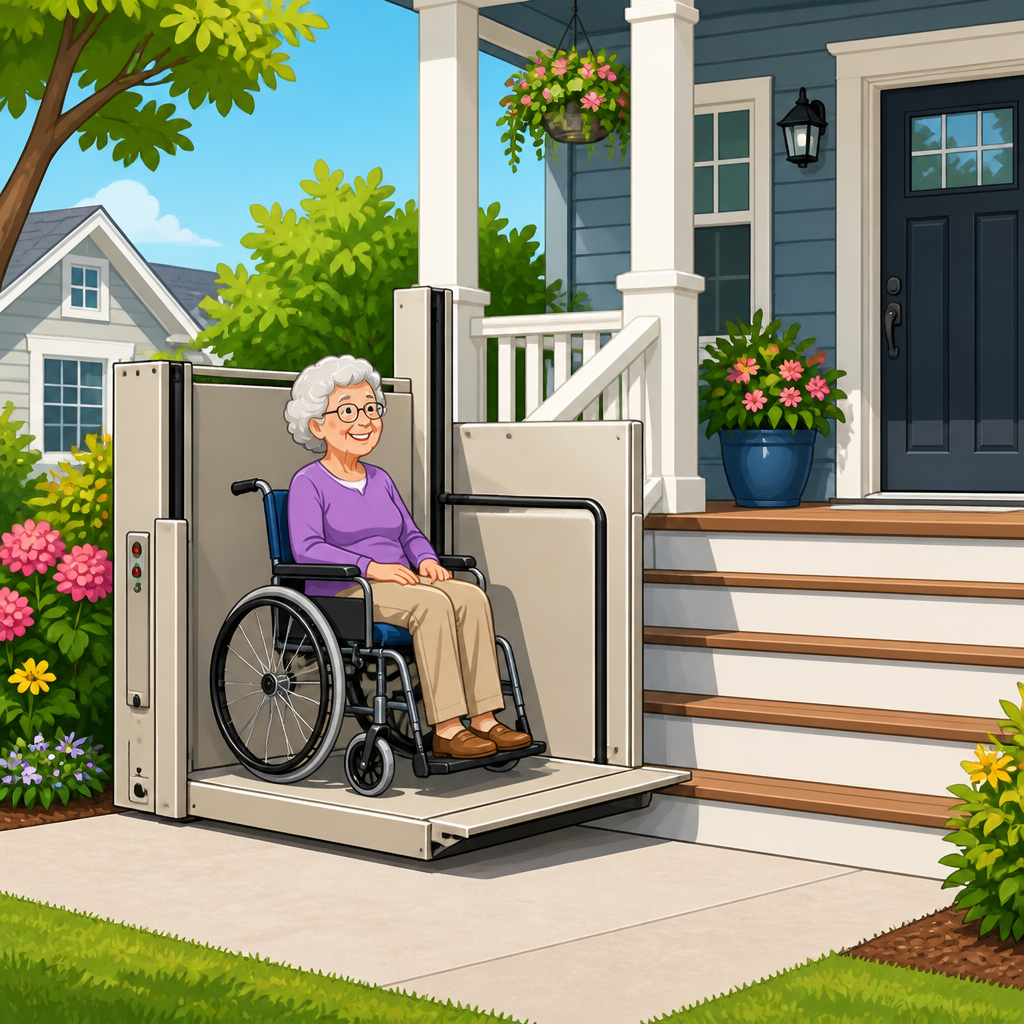
A wheelchair platform lift for porch steps gives homeowners a practical way to overcome a short rise at an entry without rebuilding the entire approach. In residential accessibility, this equipment is usually called a vertical platform lift, or VPL. It raises a person using a wheelchair, scooter, walker, or standing support straight up between two landings. Unlike a stair lift, which carries a seated rider along a rail, a VPL moves a platform vertically and accommodates mobility devices directly. For homes with two to six porch steps, split-level entries, or limited yard space, a VPL is often the most efficient alternative to a long ramp.
I have worked with families comparing ramps, stair lifts, and porch lifts, and the same questions come up every time: Will it fit, is it safe, what does it cost, and will it hold up outdoors? Those are the right questions. A poorly specified lift can create transfer problems, drainage issues, freezing problems, or code complications at the front door. A well-planned VPL, by contrast, restores independent entry, protects caregivers from lifting injuries, and preserves the appearance of the home better than many improvised solutions.
The reason this topic matters is simple: porch steps are one of the most common barriers in aging-in-place projects. A rise of 24 to 60 inches can make a home effectively unusable for someone with reduced mobility. The Americans with Disabilities Act is often referenced in conversations about accessibility, but private homes are not generally required to follow every commercial standard. Even so, ADA dimensional guidance, local building codes, manufacturer instructions, and electrical and foundation requirements all influence residential installations. Homeowners need clear, practical information before choosing a system.
This guide explains how a wheelchair platform lift for porch steps works, when it makes sense, what components matter, how much it typically costs, what installation involves, and how to compare models. It also serves as the hub for the broader vertical platform lift category, so it covers the core concepts that apply to enclosed lifts, open lifts, indoor installations, and higher-travel residential units. If you want the short answer, here it is: a VPL is usually the best choice when the rise is moderate, the user stays in a wheelchair or scooter, and there is not enough room or budget appetite for a compliant ramp or full residential elevator.
What a Vertical Platform Lift Is and When It Is the Right Choice
A vertical platform lift is a powered accessibility device that raises and lowers a guarded platform between levels. At a porch, it normally travels from grade or walkway level to the finished floor height of the entry landing. Standard residential travel ranges commonly start around 28 inches and extend to 72 inches, though some manufacturers offer greater travel with additional enclosures or gate configurations. Most units use a constant-pressure control, meaning the rider presses and holds the button during travel, which improves safety and reduces unintended movement.
A VPL is the right choice when the user needs to remain in a mobility device and the elevation change is too great for a practical ramp. For example, a 30-inch rise requires 30 feet of ramp run at a 1:12 slope, not counting landings, turns, and railings. On a small suburban lot, that footprint can overwhelm the front yard. A porch lift can solve the same access problem in a space roughly the size of the wheelchair plus required clearances. It is also a strong option when a user cannot transfer safely into a stair lift seat, or when multiple users with different devices need the same entrance.
It is not always the best answer. A ramp has no moving parts and remains usable during power outages. A stair lift is often less expensive if the rider can transfer. A full elevator offers greater weather protection and may support more future needs indoors. The important point is fit. If the home has four porch steps, limited side yard, and a wheelchair user who wants independent entry, a vertical platform lift is usually the most practical and dignified solution.
Key Components, Safety Features, and Performance Standards
Every wheelchair platform lift for porch steps includes the same core elements: a drive system, platform, side panels or guard walls, entry and exit gates, user controls, safety sensors, and a power supply. Drive systems vary by brand and may use screw drive, hydraulic power, or winding drum mechanisms. In residential outdoor settings, reliability in temperature swings matters more than theoretical speed. I generally advise homeowners to focus less on drive type marketing and more on weather rating, service support, and the manufacturer’s track record.
Safety features deserve close attention because they determine daily usability as much as compliance. Look for non-skid platform surfaces, obstruction sensors under the platform, gate interlocks that prevent travel unless gates are secured, emergency stop controls, battery lowering or backup options, and adequate guard height. If the upper landing opens directly to a door, verify that the gate swing and door swing do not conflict. Good installers think through these interactions early, because an elegant layout on paper can become awkward once a wheelchair turns toward the threshold.
In the United States, many platform lifts are designed around ASME A18.1, the principal safety standard for platform lifts and stairway chairlifts. Local jurisdictions may also require permits, inspections, and electrical work that align with adopted building codes. Ask specifically whether the proposed installation meets the applicable edition accepted by your authority having jurisdiction. That question instantly separates experienced accessibility contractors from general handymen who have installed only one or two lifts.
| Feature | Why It Matters | What to Ask |
|---|---|---|
| Rated capacity | Determines whether the lift can safely handle the rider and device | Is it 750 pounds or higher for larger power chairs? |
| Platform size | Affects turning, entry angle, and scooter fit | Will my chair fit without clipping the gate? |
| Travel height | Must match finished rise, not rough guesswork | What is the exact floor-to-floor travel range? |
| Weather protection | Outdoor units face rain, snow, and corrosion | Are controls, motors, and finishes rated for exterior use? |
| Battery lowering | Protects access during outages or faults | Can the rider descend if utility power fails? |
| Service network | Repairs are only as good as local support | Who performs warranty service in this ZIP code? |
Space Planning for Porch Steps and Entry Layouts
The most common mistake in VPL planning is measuring only the stair height. The real project begins with the entire approach: sidewalk width, cross slope, porch depth, door clearance, storm door swing, handrail location, and whether the user approaches straight on or at an angle. Most lifts need a stable pad, adequate maneuvering room at top and bottom landings, and clear gate operation. Power wheelchair users often need more space than the minimum brochure dimensions suggest, especially when joystick placement or footplate length increases turning radius.
For porch steps, the installer usually places the lift beside the stair run or perpendicular to the porch edge. Side placement is common because it allows the upper gate to open directly onto the porch landing. Perpendicular placement can work when the porch is shallow, but it may require a larger top landing extension. I have seen projects where homeowners chose the smallest platform to save money, only to discover the user had to make a difficult reverse entry every day. A larger platform or a different orientation would have made the lift far safer and more comfortable.
Site conditions matter outdoors. Water must drain away from the base. In freeze-thaw climates, concrete movement and ice buildup can interfere with lower gates and sensors. If the porch is elevated over a basement stairwell or framed deck, structural attachment details become important. Wood porches may need reinforcement, and older concrete stoops may not provide the anchorage quality a lift requires. Precise field measurements by the dealer, not rough homeowner estimates, should drive the final model and configuration.
Cost, Installation, and Long-Term Ownership
Homeowners usually want a clear number, but VPL pricing depends heavily on travel height, platform size, gate configuration, electrical work, site preparation, and finish options. In many residential markets, a basic outdoor wheelchair platform lift for porch steps may start around the high thousands for the equipment alone, while fully installed projects often land much higher once concrete, permits, and electrical service are included. Complex porches, custom gates, overhead weather covers, and larger capacities push costs upward. If a contractor gives a single price before measuring the site, treat that as a placeholder, not a reliable quote.
Installation typically includes a site visit, shop drawings or layout confirmation, permit application where required, pad or foundation work, dedicated electrical connection, equipment assembly, testing, and final adjustment. Some lifts need 120-volt service while others may require different electrical provisions; the manufacturer specifications govern. The best installations also include user training. Riders should know how to enter, position the chair, operate controls, respond to a fault, and secure the landing area. Caregivers should know manual lowering procedures if the model supports them.
Ownership costs do not end at installation. Like any motorized accessibility device, a VPL needs preventive maintenance. Outdoor units should be inspected for corrosion, debris accumulation, gate alignment, battery condition if equipped, and proper sensor function. Many dealers recommend annual service, though high-use lifts or harsh climates may benefit from more frequent checks. Ask about replacement part lead times before you buy. A lift with slightly lower upfront cost can become more expensive if local technicians are scarce or proprietary parts take weeks to arrive.
Comparing VPLs With Ramps, Stair Lifts, and Home Elevators
Homeowners often compare four solutions for porch access: a ramp, a stair lift, a vertical platform lift, and a residential elevator. Each solves a different problem. A ramp is simplest and often preferred where enough space exists, but length becomes impractical quickly. A stair lift costs less in many cases, yet it requires a safe transfer and leaves the wheelchair parked at another level unless a second device is available. A home elevator is the most comprehensive system, but it is also the most expensive and usually unnecessary for a short porch rise.
The VPL occupies the middle ground. It preserves the rider in the wheelchair, uses a compact footprint, and generally installs faster than major structural reconstruction. That makes it especially valuable for aging-in-place retrofits where immediate access is needed. Consider a homeowner returning from rehab after a stroke, now using a power chair at a house with five front steps and no side-yard room. A ramp may consume the driveway edge, and a stair lift may be unusable due to transfer difficulty. A porch lift can restore front-entry access within weeks rather than months.
There are tradeoffs. Outdoor lifts expose the rider to weather unless a canopy or enclosure is added. Travel is slower than walking a few steps. Some neighborhoods or historic homes require more careful visual integration. Even so, for many families, a properly installed VPL offers the best balance of independence, footprint, and total project cost.
Buying Tips, Common Mistakes, and How to Choose the Right Dealer
The best buying strategy is to start with the user, not the product brochure. Measure the mobility device, note the rider’s transfer ability, hand function, vision, and whether a caregiver will assist. Then evaluate the site and compare at least two qualified proposals. Strong dealers provide exact dimensions, model numbers, rated capacity, scope of site work, permit responsibility, warranty terms, and service response expectations in writing. They should also explain why a given platform size and gate arrangement fits the specific porch layout.
Avoid three common mistakes. First, do not assume every wheelchair fits a standard platform. Power chairs with elevating leg rests or long wheelbases often need more room. Second, do not ignore winter operation. Ask how the unit handles snow, wind-driven rain, and ice around the lower landing. Third, do not treat the electrical and foundation work as afterthoughts. Many delays and cost overruns come from discovering late that the existing porch or circuit cannot support the lift as planned.
Choose a dealer with residential accessibility experience, manufacturer authorization, and a local service presence. Ask for recent projects similar to yours, preferably other porch-step installations rather than commercial jobs. If possible, see one in person. You will learn more from watching a rider enter, operate, and exit a lift than from any glossy brochure. The right dealer will be candid about limitations, recommend a larger platform when needed, and coordinate the details that make the system work safely every day.
A wheelchair platform lift for porch steps is not just a piece of equipment; it is an access strategy that lets a home remain usable as mobility changes. The core advantage of a vertical platform lift is straightforward: it overcomes a short rise while keeping the rider in the wheelchair or scooter, using far less space than a ramp and less structural complexity than an elevator. For many homes, that combination makes independent entry possible without a major remodel.
The most successful projects share the same traits. The rise is measured precisely, the approach and turning space are planned carefully, the platform size matches the actual mobility device, and the installer understands codes, drainage, structural support, and weather exposure. Homeowners who compare options thoughtfully also make better decisions about cost. They know the cheapest quote is rarely the best value if service support is weak or the layout forces awkward daily use. They also understand the tradeoffs: ramps are simple but large, stair lifts need transfers, and elevators solve bigger access needs at much higher cost.
If you are evaluating vertical platform lifts as part of the broader chair lift types and designs landscape, use this page as your starting point. Build a shortlist, request site-specific proposals, and ask each dealer to explain platform size, travel height, power requirements, safety features, and service coverage in plain language. That process will quickly reveal which wheelchair platform lift for porch steps is truly designed for your home, your climate, and your long-term mobility needs.
Frequently Asked Questions
What is a wheelchair platform lift for porch steps, and how is it different from a stair lift or a ramp?
A wheelchair platform lift for porch steps is typically a residential vertical platform lift, often shortened to VPL. Its purpose is to raise a person and their mobility device straight up from one landing to another, making it a practical solution when a front porch, stoop, or short entry staircase creates a barrier. Instead of requiring the user to transfer out of a wheelchair or scooter, the lift carries the person while they remain on the platform. That makes it especially useful for homeowners who want safe, direct access through an existing entrance without a major structural redesign.
The key difference between a VPL and a stair lift is how each system moves and who it serves best. A stair lift carries a seated rider along a rail attached to the stairs, which means the user usually needs to transfer onto the lift seat and may not be able to bring a wheelchair or scooter along. A vertical platform lift moves vertically, not along the stairs, and it is designed to accommodate wheelchairs, power chairs, scooters, walkers, and in some cases a standing passenger with support. For many households, that distinction is critical because it preserves independence and reduces the need for caregiver assistance.
A VPL also differs from a ramp in both footprint and practicality. Ramps are excellent accessibility tools, but they require a great deal of horizontal space, especially when the rise is more than a few steps. For a porch that sits even 24 to 36 inches above grade, a code-compliant ramp can become long, winding, and visually dominant in the front yard. A platform lift solves the same access problem in a much smaller area because it travels vertically. Homeowners often choose a porch lift when the lot is tight, the landscape is difficult to alter, or they want to avoid the cost and disruption of rebuilding walkways, stairs, and railings.
When is a vertical platform lift the right choice for a home entry?
A vertical platform lift is often the right choice when the accessibility challenge is a short rise at the main entry, side door, garage entry, or back porch. If the home has only a few steps leading to a landing, a VPL can provide a straightforward solution without requiring a full addition, a long ramp system, or a complete reworking of the porch. It is especially effective when the user relies on a wheelchair or scooter and needs an option that allows them to stay in their mobility device during the entire entry process.
It is also a strong fit when space is limited. Many homeowners discover that a ramp is technically possible but not practical because it would take up much of the yard, interfere with driveways or sidewalks, or create awkward turns. In those situations, a lift may be the cleaner and more functional option. It can also be a better match for homes where preserving curb appeal matters, since a well-planned platform lift can often be integrated more discreetly than an extended ramp system.
Another factor is the user’s present and future mobility. A VPL can work well for people who use manual wheelchairs, power chairs, scooters, walkers, or other supports, and it may continue to meet needs even if mobility changes over time. That can make it a wise long-term investment for aging in place. Homeowners also appreciate that a porch lift can reduce physical strain on family members and caregivers by eliminating the need to navigate steps manually or assist with difficult transfers. The right choice ultimately depends on the entry height, available space, user needs, local code requirements, and budget, but for many porch-step situations, a residential VPL is one of the most practical and durable solutions available.
What should homeowners consider before buying and installing a porch platform lift?
Before purchasing a porch platform lift, homeowners should start with the basics: rise, available space, user needs, and the condition of the existing entry. The rise is the vertical distance the lift must travel, and that measurement helps determine the correct model and configuration. It is also important to evaluate where the lower and upper landings will be, whether there is enough room to approach and exit safely, and how the lift will interact with doors, railings, columns, and pathways. A good installation is not just about fitting the equipment into a space; it is about creating a safe, comfortable route from arrival point to doorway.
Homeowners should also think carefully about who will use the lift and how. Platform size, weight capacity, control placement, gate configuration, and ease of operation all matter. A device that works well for a manual wheelchair user may need different clearances than one intended for a larger power chair or scooter. If the user has limited hand strength or dexterity, controls and gate systems should be easy to manage. Outdoor use adds another layer of planning, including exposure to rain, snow, heat, and debris, as well as whether a cover, weather-resistant finish, or cold-weather package is appropriate.
Code compliance and professional site evaluation are equally important. Residential vertical platform lifts are regulated equipment, and installation often involves specific requirements related to electrical service, landing dimensions, guardrails, gates, and permits. In some cases, the supporting slab or porch structure may need modification to handle the installation properly. That is why working with an experienced accessibility contractor or lift dealer matters. A qualified professional can assess the site, recommend the right lift type, explain local permitting, and help avoid costly mistakes. Homeowners should also ask about service support, warranty terms, and maintenance expectations, because a lift is not just a purchase—it is a long-term accessibility system that needs to remain reliable year after year.
How much does a wheelchair platform lift for porch steps usually cost?
The cost of a wheelchair platform lift for porch steps can vary widely depending on the lift model, travel height, platform size, site conditions, electrical requirements, and installation complexity. In general, homeowners should think in terms of total project cost rather than the price of the unit alone. A basic residential VPL may seem straightforward, but expenses can increase if the installation requires a new concrete pad, structural modifications to the porch, upgraded electrical service, gate changes, custom enclosures, or permit-related work. As a result, the final investment can differ significantly from one home to another even when the vertical rise is similar.
One of the most important budgeting points is that the equipment itself is only part of the project. Site preparation often plays a major role in the overall cost. For example, if the existing landing is too small, if drainage needs to be corrected, or if the approach path has to be reworked for wheelchair access, those improvements become part of the accessibility solution. Outdoor durability features can also affect price, especially in regions with harsh winters, heavy rainfall, or coastal conditions. Homeowners may also choose optional features for safety, convenience, or aesthetics, which can further influence the final number.
Because pricing depends so much on the site, the best way to get a realistic estimate is through an in-home assessment from a reputable lift provider. A detailed quote should outline equipment, labor, electrical work, permits if applicable, and any recommended site modifications. Homeowners should compare proposals carefully and not focus only on the lowest bid. Reliability, dealer experience, installation quality, and service availability are just as important as upfront cost. A lower-cost lift that is difficult to service or poorly matched to the user’s needs can become far more expensive over time. For most homeowners, the goal should be value, safety, and dependable access—not just the cheapest initial price.
Are porch platform lifts safe, reliable, and suitable for outdoor residential use?
Yes, when properly selected, professionally installed, and regularly maintained, porch platform lifts can be very safe and reliable for outdoor residential use. These lifts are designed with multiple safety features intended to protect the rider during travel and at the landings. Depending on the model, those features may include non-slip platforms, guard panels, entry and exit gates, obstruction sensors, emergency stop controls, backup lowering systems, and constant-pressure controls that require the operator to maintain contact during movement. Together, these features help reduce the risk of accidents and support predictable, controlled operation.
Reliability outdoors depends heavily on choosing equipment built for exterior conditions and making sure it is installed in the right environment. Rain, snow, ice, sunlight, leaves, and temperature swings can all affect performance if the lift is not designed or configured appropriately. For that reason, homeowners should ask specifically about weather resistance, corrosion protection, drainage, and cold-weather operation. In some climates, it may be advisable to add a protective cover or partial enclosure. It is also important to keep the platform and landings clear of debris and to follow the manufacturer’s recommendations for seasonal care.
Long-term safety comes down to maintenance as much as design. Like any mechanical accessibility equipment, a VPL should be inspected and serviced at the intervals recommended by the manufacturer and installer. Homeowners should understand who to call for repairs, what routine upkeep is required, and whether preventive maintenance plans are available. If the lift is a daily-use access point, dependable local service support is especially valuable. With the right product, a code-compliant installation, and consistent maintenance, an outdoor vertical platform lift can be an excellent and dependable way to make porch steps accessible while allowing a homeowner to remain safely and comfortably in their home.