


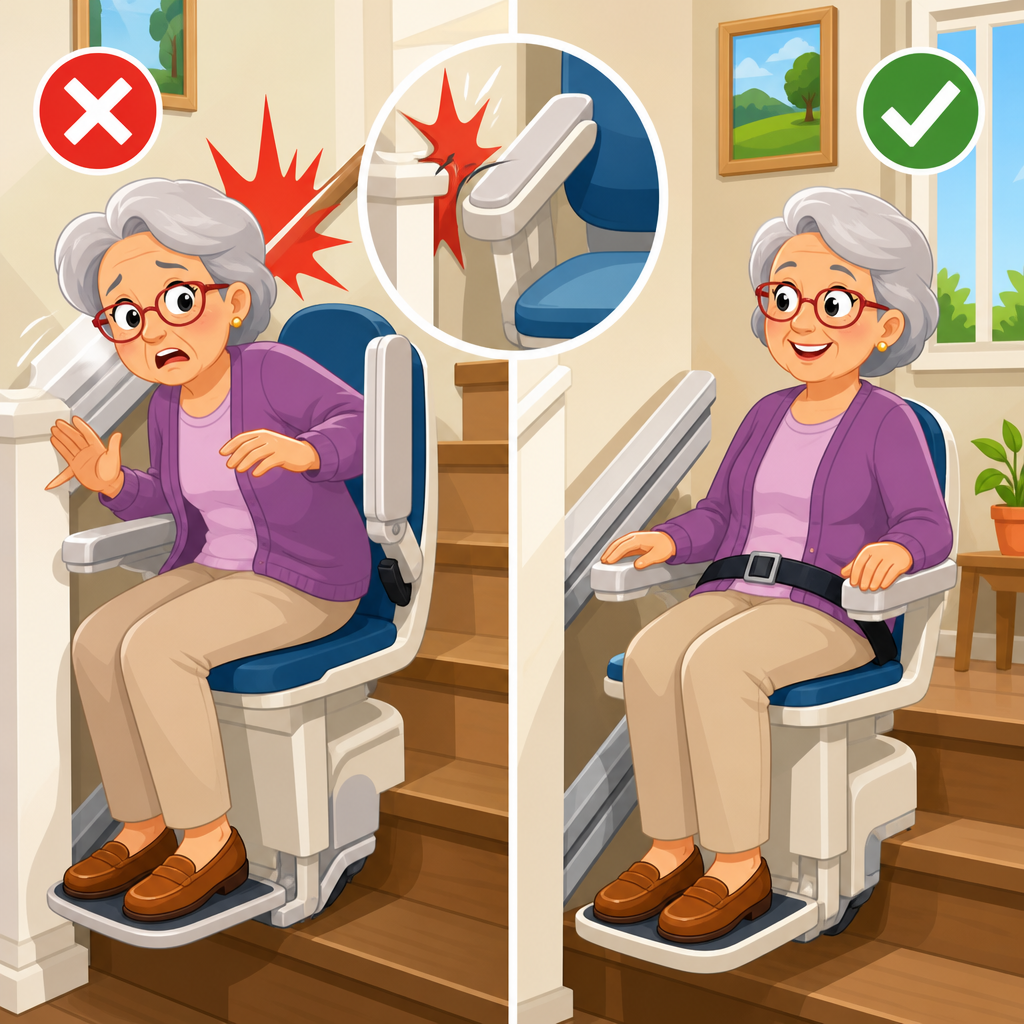
Stair lift armrests are not just places to rest your forearms; they are integral safety components that must be fully lowered before travel because they stabilize the rider, support safe posture, protect against lateral slips, and, on many models, enable key interlocks that allow the lift to run. In the field, I have seen avoidable service calls, nuisance fault codes, and genuinely dangerous riding habits traced back to one simple issue: users starting the chair with one or both armrests raised. For a device designed to carry people with reduced mobility on a staircase, that is a risk no owner, caregiver, or installer should ignore.
To understand why this matters, it helps to define the parts and the function. A stair lift typically includes a seat, backrest, armrests, footrest, swivel mechanism, seat belt, carriage, rail, call-send controls, charging contacts, and a set of safety circuits. The armrests frame the seated space. They give the user leverage while sitting down, create a physical boundary during travel, and often contain operating controls on one side. “Fully lowered” means the armrests are in their normal riding position, down to the manufacturer’s stop, not halfway lowered or loose. On several modern lifts, including many units from Bruno, Handicare, Harmar, and Stannah, correct armrest position is considered part of the intended travel configuration even when an electrical interlock is not obvious to the user.
This topic matters because stair lifts are used by people who may have impaired balance, slower reaction times, reduced grip strength, neuropathy, arthritis, or post-surgical limitations. A healthy adult might compensate instinctively for an awkward seating position, but a stair lift user often cannot. The staircase itself multiplies consequences. A minor shift in posture on level flooring can become a major hazard when the chair is moving over open steps. That is why safety features on stair lifts are designed as a system rather than as isolated accessories.
Safety features explained clearly means looking beyond a checklist. Owners often know about the seat belt and obstruction sensors, yet underestimate subtler protections such as armrest geometry, seat centering, and body containment. Manufacturers engineer these details around standards, including provisions commonly associated with ASME A18.1 and related accessibility and product safety expectations in regulated markets. The principle is straightforward: the rider should be seated squarely, supported on both sides, with feet on the footrest and the seat locked in the correct forward-facing travel position before the lift moves.
How lowered armrests improve rider stability during travel
The most immediate reason stair lift armrests must be fully lowered before travel is rider stability. When both armrests are down, they narrow the usable seat envelope and help keep the torso centered over the seat pan. That matters on every run, but especially at track joints, over start ramps, and during acceleration or deceleration. Even smooth lifts create small but perceptible motion changes. A centered rider tolerates those transitions well. A rider leaning outward because one armrest is raised is more likely to shift unexpectedly.
In practical terms, the armrests act as side supports. They are not a substitute for a seat belt, but they complement it. A lap belt restrains forward or upward movement; armrests reduce side-to-side drift and give the user a bracing surface if they feel uncertain. I have watched new users relax noticeably when both armrests are down because the chair feels defined and secure. When one armrest remains up, many users unconsciously lean toward the lowered side, creating an uneven posture that can become uncomfortable and less stable.
This is especially important on curved stair lifts. Curved systems follow changing geometry and may introduce mild rotational sensations as the carriage negotiates bends. The lift is still operating normally, but the user feels more movement than on a straight rail. Lowered armrests help contain those sensations by giving equal support on both sides. On narrow staircases, they also discourage the rider from letting an elbow protrude outward where it could feel close to a wall or bannister, which increases anxiety and encourages poor posture.
Another overlooked point is fatigue. Many stair lift users have limited core strength. A fully supported riding position reduces the muscular effort needed to remain upright. That lowers the chance of slumping, twisting, or reaching for external support mid-travel. Riding should require almost no active balancing. If the user must stabilize themselves because an armrest is up, the chair is no longer doing its full job.
Why armrests are part of the stair lift safety system
Stair lift safety features work as layers. The seat belt restrains, the swivel lock prevents unsafe travel orientation, footrest sensors stop the lift if it meets an obstruction, overspeed and final limit devices monitor carriage behavior, and batteries keep the lift operating during power outages. Armrests fit into this layered design by helping maintain correct body position and, on certain models, by serving as a condition for normal operation.
Some stair lifts include microswitches or position-sensitive components linked to the armrest assembly, particularly where controls are mounted in the armrest or where folding geometry affects cable routing. If the armrest is not in its proper riding position, the lift may beep, refuse to move, or behave intermittently. Users sometimes interpret this as a battery or charger problem, but a position-related fault can be the real cause. During troubleshooting, armrest position is one of the first things experienced technicians verify.
Even when there is no explicit armrest interlock, manufacturers still expect armrests to be down during travel because the rest of the safety system assumes a correctly seated passenger. The seat belt lies better across the lap when the user is centered. The joystick or rocker switch is easier to operate consistently when the arm supporting it is level. The rider is less likely to twist around to adjust clothing, reach for the rail, or brace against a wall. In other words, lowered armrests reduce the human behaviors that create unsafe moments.
Caregivers benefit from understanding this systems view. If a user reports that the lift “jerks,” “stops randomly,” or “feels scary,” the issue may not be mechanical failure. It may be that they are starting with an armrest up, sitting off-center, or not bringing the seat fully into travel position after boarding. Better habits often solve what sounds like a technical fault.
Common risks when riding with armrests raised
Riding with raised armrests increases several concrete risks. The first is lateral instability. Without a side boundary, the user can drift or lean, particularly if they have hemiparesis, vestibular problems, Parkinsonian rigidity, or general deconditioning. The second is unsafe hand placement. Users with an armrest raised often reach outward toward the wall, staircase, or rail for reassurance. That creates a pinch, scrape, or impact hazard as the chair passes through tight clearances.
The third risk is poor transfer follow-through. If a user leaves an armrest up after sitting down, it usually means they rushed the boarding sequence. In my experience, that often correlates with other missed steps: the feet are not fully on the footrest, the seat belt is not latched, or the seat is not locked after swiveling. One shortcut rarely stays isolated. Safety habits cluster, and so do safety failures.
The fourth risk is control inconsistency. Because many stair lift controls are mounted at the end of an armrest, a raised or partially lowered arm can change wrist angle and encourage awkward thumb pressure on the rocker or toggle. That seems minor, but users with arthritis or tremor need a stable hand position for precise operation. A proper armrest position supports reliable control use.
The fifth risk is damage over time. Repeated travel with a loosely positioned armrest can strain hinges, loosen fasteners, or wear detent mechanisms on models with folding arm assemblies. While the lift should be built robustly, using it outside the intended travel configuration adds avoidable wear and can produce rattles or alignment complaints later.
| Situation | What can go wrong | Why lowering the armrests helps |
|---|---|---|
| One armrest left up | User leans sideways and feels unstable | Creates balanced side support and centers the torso |
| User reaches toward wall or rail | Hand, elbow, or sleeve contacts nearby surfaces | Keeps arms inside the chair profile |
| Seat belt worn loosely | Body shifts despite belt being latched | Improves belt fit by promoting square seating |
| Curved rail travel | Changing motion feels more pronounced | Provides equal bracing points on both sides |
| Transfer completed hastily | Other safety steps are skipped | Reinforces a consistent pre-travel routine |
How armrests interact with other safety features
Armrests make the most sense when viewed alongside every other built-in protection. Start with the seat belt. The belt is essential, but it works best when the user is already sitting fully back in the seat with hips centered. Lowered armrests encourage that position. A user perched near one edge of the seat may still latch the belt, yet the restraint will not manage body movement as effectively as intended.
Next is the swivel seat lock. At the top landing, many lifts allow the seat to rotate for easier dismounting and lock in that position. Before travel, the seat must usually return to its forward riding position and re-lock. Armrests support that transition because users often grip them while rotating and then settle squarely before setting off. If an armrest remains raised, the rider may not complete that reset smoothly, especially if they are anxious or weak.
Footrest safety edges are another example. These sensors stop the lift if the footrest contacts an object on the stairs. That feature prevents crushing hazards, but it does not protect a rider whose body is leaning outward above the footrest line. Lowered armrests help keep the upper body aligned over the base of support, complementing what the obstruction sensors are designed to do below the knees.
Call-send controls, key switches, and diagnostic displays also fit into the picture. In many homes, more than one person uses or moves the lift. A predictable riding setup reduces confusion for everyone. When families standardize on a pre-travel sequence—sit fully back, lower both armrests, lower the footrest if powered, fasten the belt, confirm seat lock, then travel—operation becomes safer and troubleshooting becomes easier.
Finally, consider emergency stopping behavior. If a lift halts because of an obstruction or depleted battery, a user with both armrests down is usually calmer and better supported while waiting for assistance or instructions. Small details matter most when something does not go exactly to plan.
Best practices for users, caregivers, and technicians
The safest stair lift owners treat every trip as a short checklist, not an informal ride. The routine should be simple enough to remember under stress and consistent enough to become automatic. From years of installations and follow-up visits, the most effective instruction is always practical: back fully into the seat, lower both armrests completely, place both feet on the footrest, fasten the seat belt snugly, verify the seat is locked in travel position, and only then press and hold the travel control.
Caregivers should observe actual use rather than relying on verbal confirmation. A user may say they always lower the armrests, yet still leave one half-raised because of shoulder pain, limited reach, or misunderstanding. If that happens, the solution may be training, maintenance, or equipment adaptation. For example, a powered seat or alternative transfer technique may reduce the urge to skip steps. Occupational therapists can also help users practice safer boarding patterns after stroke, joint replacement, or balance decline.
Technicians should inspect armrest hinges, covers, mounting points, and switch function during routine service. Loose armrests are not cosmetic issues. They affect user confidence and may compromise safe posture. If a model uses wiring through the armrest for controls, technicians should check for pinch points, intermittent continuity, and signs of repeated forced folding. Service documentation should note whether the user was instructed again on travel position and safety sequence, because education prevents repeat faults.
Owners should also keep manufacturer manuals accessible and schedule maintenance at the recommended interval, commonly every twelve months or more often in high-use settings. Batteries, charger output, seat swivels, rail cleanliness, and safety edges all deserve attention, but daily habits remain the first line of safety. A well-maintained stair lift can still be used poorly. Lowering the armrests before travel is one of the easiest habits to enforce and one of the most worthwhile.
When raised armrests may be appropriate—and when they are not
Raised armrests do have a legitimate purpose: transfers, cleaning, parking, and space-saving when the lift is folded. At the top or bottom landing, lifting an armrest can create room for the user to sit down, stand up, or pivot more comfortably. In narrow hallways, folded components reduce obstruction when the lift is not occupied. That is normal use.
What raised armrests are not for is occupied travel. The distinction matters because some users become accustomed to leaving one armrest up after boarding, especially if they perceive it as easier for shoulder mobility or winter coat bulk. If comfort is the issue, the answer is not to bypass the intended configuration. The answer is to assess fit, transfer technique, clothing interference, seat width, or the need for a different model or accessory.
There are also model-specific nuances. Heavy-duty stair lifts, perch-style lifts, and outdoor units may have different seat dimensions or armrest shapes. Some users with larger body frames need careful setup to ensure the armrests lower freely without pinching clothing. That setup should be handled by a qualified dealer. The rule remains unchanged: if the lift is moving with a passenger, the armrests should be fully lowered unless the manufacturer explicitly states otherwise in writing, which is uncommon.
The key takeaway is simple. Stair lift armrests must be fully lowered before travel because they are part of safe rider containment, proper posture, and dependable system operation. They work with the seat belt, swivel lock, footrest, and controls to reduce preventable risk on the stairs. Review your lift manual, watch how the chair is actually being used, and make lowering both armrests a non-negotiable step before every ride.
Frequently Asked Questions
Why do stair lift armrests need to be fully lowered before travel?
Stair lift armrests must be fully lowered before travel because they are part of the chair’s safety system, not just a comfort feature. When the armrests are down, they help keep the rider centered in the seat, support a stable upper-body position, and reduce the chance of leaning or sliding sideways while the lift is moving. That matters on any staircase, but especially on narrower stairways, steeper runs, or curved lifts where body position can shift more noticeably during travel.
On many models, lowered armrests also satisfy built-in interlocks or position switches that tell the lift it is safe to operate. If one or both armrests are left raised, the chair may refuse to move, stop unexpectedly, or display a fault code that looks like a mechanical problem when it is really a positioning issue. In day-to-day use, this is one of the most common preventable causes of nuisance service calls. Just as important, riding with an armrest up encourages unsafe habits, such as turning the torso, reaching outward, or failing to sit squarely in the seat. Lowering both armrests before every trip is a simple step that improves safety, reliability, and proper riding posture all at once.
What safety risks can happen if someone rides with one or both armrests raised?
The biggest risk is loss of stability. A stair lift rider should be seated fully back in the chair with feet on the footrest, seat belt fastened if equipped, and both armrests lowered. If an armrest is raised, the rider loses an important side support point. That can make it easier to shift sideways, lean too far, or feel unbalanced during start-up, stopping, or travel around a bend. Even small body movements can matter when someone has limited mobility, reduced core strength, poor balance, or weakness on one side.
There is also a behavioral risk. When an armrest is up, riders are more likely to hold onto the wrong part of the lift, brace themselves awkwardly, or twist their body to compensate. Those habits can increase the chance of a lateral slip, a poor seated position, or a panic response while the chair is moving. In some homes, users raise an armrest to make getting on easier and then forget to lower it before pressing the control. That may lead to a no-run condition on lifts with interlocks, or worse, movement on systems that allow travel without the armrest fully secured. Either way, it is not best practice. Fully lowering both armrests before travel creates a more contained, controlled seating position and helps the rider remain properly aligned throughout the trip.
Do all stair lifts have armrest safety interlocks, or is this only true on some models?
Not every stair lift is designed exactly the same, but many modern units include armrest-related safety features, position switches, or logic that expects the chair to be in a proper travel configuration before movement is allowed. On these models, an armrest that is not fully lowered may prevent operation, trigger a fault indicator, or cause intermittent running issues if the switch is only partially engaged. That is why a chair can appear to have an electrical or mechanical problem when the real issue is simply that one armrest is not down all the way.
Even on models that do not strictly require the armrests to be lowered in order to run, the safety principle still applies. Manufacturer differences do not change the fact that armrests help stabilize the rider and promote safe posture. A good rule is to follow the owner’s manual for the specific make and model, but also to treat fully lowered armrests as standard operating procedure regardless of brand. From a field perspective, this reduces user error, cuts down on avoidable troubleshooting, and reinforces consistent safe use. If there is ever uncertainty about whether your lift has an armrest interlock, a qualified stair lift technician can confirm it quickly during inspection or service.
Why does an armrest issue sometimes lead to service calls or fault codes?
Because the symptoms can mimic a larger problem. If an armrest is not fully lowered, the user may press the control and the lift will not move, may beep, may show an indicator light, or may stop after seeming to start. To the rider, that can feel like a motor failure, a battery problem, or a broken switch. In reality, many of these cases come down to the chair not being in a ready-to-travel state. A slightly raised armrest, a loose-feeling armrest that did not seat completely, or an internal position switch that was not engaged can all produce what looks like a technical fault.
In the field, these are among the most frustrating service visits because the underlying issue is often preventable. The homeowner may report that the lift works sometimes and not others, which can happen when an armrest is lowered inconsistently or only partway. Repeated attempts to run the lift in that condition can create confusion, lead users to assume the unit is unreliable, and increase unnecessary callouts. Before assuming a stair lift needs repair, it is wise to check that the seat is in its travel position, the footrest is clear, the key switch is on if applicable, and both armrests are fully lowered. That quick check often resolves the issue immediately and helps distinguish user-positioning problems from true equipment faults.
What is the best way to make sure armrests are used correctly every time?
The best approach is to build it into a simple, repeatable pre-travel routine. After sitting down, the rider should position themselves fully back in the seat, place both feet securely on the footrest, fasten the seat belt if the lift has one, and lower both armrests completely before pressing the travel control. Caregivers and family members should reinforce the same sequence consistently, especially when helping someone who is new to a stair lift or has memory, balance, or coordination challenges. A routine reduces skipped steps and makes safe operation more automatic.
It also helps to address the reason users leave armrests up in the first place. Sometimes they are trying to make transfers easier, dealing with stiffness in the shoulders, or simply unaware that the armrests serve a safety function. In those cases, a technician can often demonstrate a safer transfer technique, verify that the chair is adjusted properly, and confirm the armrests move smoothly and latch as intended. If an armrest feels loose, does not stay down, or seems difficult to move, that should be inspected promptly rather than worked around. Good habits and properly functioning equipment go together. When riders understand that armrests are there to stabilize the body, help maintain posture, reduce lateral slip risk, and in many cases allow the lift to operate correctly, they are much more likely to use them properly on every trip.