


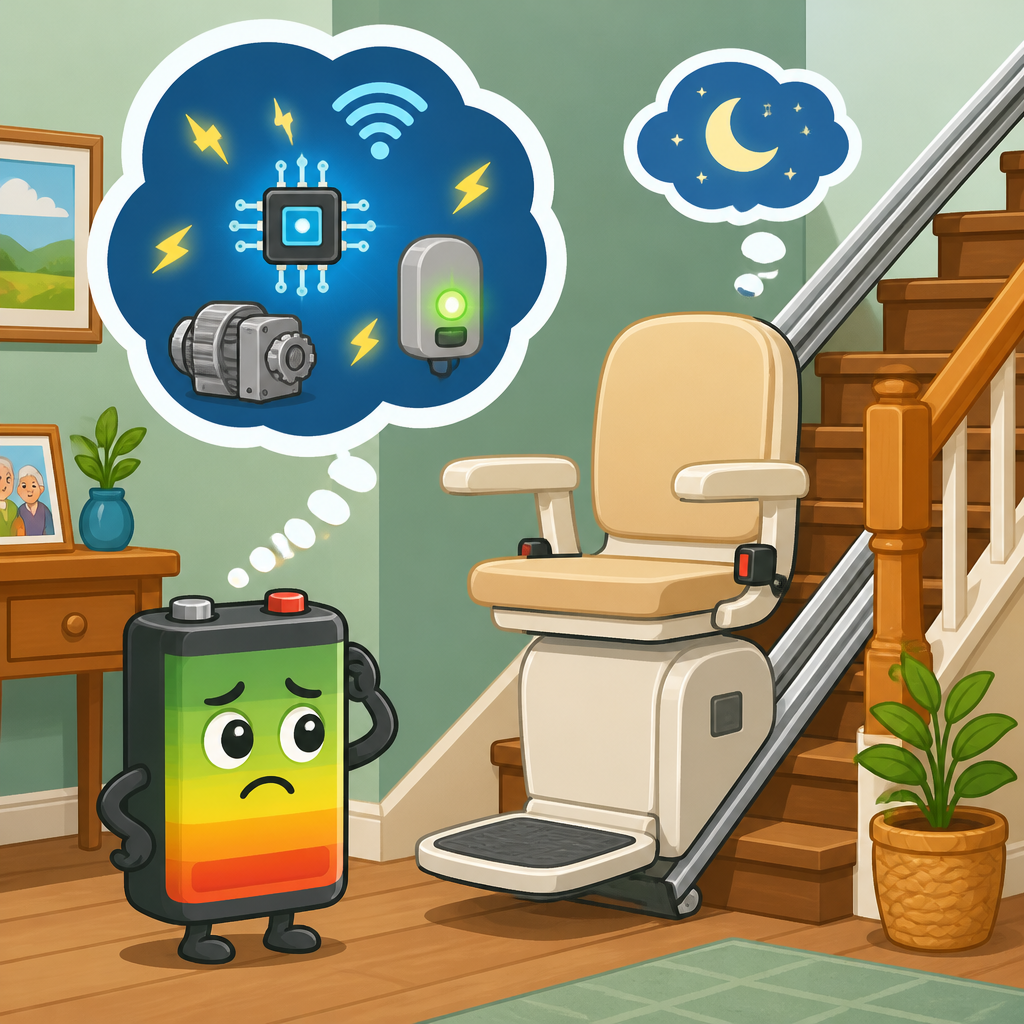
Stair lift batteries can lose charge even when the chair never leaves the rail, and understanding why that happens is the first step toward preventing nuisance beeps, mid-stair stoppages, and premature battery replacement. A stair lift depends on rechargeable batteries housed in the base of the chair or carriage, with power supplied through a charger connected to household electricity and charge points mounted along the track. In normal operation, the batteries run the motor while the charger restores energy whenever the lift is parked in the correct position. That design keeps the lift working during a power outage, but it also means idle time is not the same as zero battery use. Small electrical loads continue in the background, charging can be interrupted by alignment issues, and battery chemistry naturally changes with age.
When homeowners ask why a stair lift battery drains while the lift is not being used, the answer usually comes down to one of five causes: the charger is not supplying current, the chair is not fully parked on the charge contacts, the batteries are sulfated or worn out, the environment is accelerating self-discharge, or another component is drawing more power than it should. I have seen each of these in service calls, often in combination. A lift can sit untouched for days, appear fine, and then suddenly chirp an error tone because the batteries have been slowly dropping below the control board’s minimum voltage threshold. By the time the user notices, the real problem may have been developing for months.
This matters because battery care is one of the most important parts of stair lift maintenance, troubleshooting, and safety. Weak batteries shorten travel distance, reduce lift speed, increase the likelihood of fault codes, and can leave a rider stranded between landings. They also create misleading symptoms. A homeowner may suspect the motor, circuit board, remote, or even the household outlet, when the underlying issue is simply that sealed lead-acid batteries no longer hold a stable charge. This hub article explains how battery drain happens, what signs to watch for, how to test the system logically, and when replacement is the right call. It also serves as a practical guide to the broader topic of battery care and replacement, so you can maintain reliability and make informed service decisions.
How stair lift batteries work when the lift is idle
Most modern stair lifts use two 12-volt sealed lead-acid batteries wired in series to provide 24 volts to the drive system. Common capacities range from 7Ah to 12Ah, although some heavy-duty units use larger batteries. Even when the lift is not moving, the control board, safety circuits, diagnostic indicators, call-send receiver, and in some models powered swivel or powered footrest features can draw a small standby current. On a healthy system with a functioning charger, that standby draw is harmless because the batteries remain on float charge. On a neglected system, the same tiny load becomes significant over days or weeks.
Self-discharge also plays a role. Sealed lead-acid batteries naturally lose a small percentage of charge over time even when disconnected. At room temperature, that rate is modest, but it increases in warmer environments and rises sharply as batteries age. A stair lift installed near a sunny entryway, radiator, or unconditioned stairwell may therefore lose charge faster than the same model in a climate-controlled hallway. Temperature affects charging efficiency too. Cold conditions reduce available capacity, so a battery that seems acceptable in mild weather can behave weakly in winter, especially if charging has already been inconsistent.
Another important point is charge management. Stair lifts do not charge continuously at every point on the rail unless designed with a full-length charging strip. Many use charge contacts only at one or both ends of the track. If the chair stops even slightly off the designated park position, the charger may not reach the batteries. I have seen lifts miss charging because a folded footrest caught on carpet, a user parked half an inch short of the contact point, or dirt built up on the copper strips. The lift looked parked, but electrically it was disconnected and slowly draining.
The most common reasons batteries drain without use
The first and most common reason is loss of incoming power to the charger. The stair lift may be plugged into a switched outlet, a tripped GFCI-protected receptacle, a dead circuit, or an extension lead that has been unplugged during cleaning. Some chargers show a small LED, but many homeowners never check it. If the charger loses AC power, the batteries become the sole source for all standby loads. Depending on battery age and condition, the lift may start beeping within a day or two or may last several weeks before showing trouble.
The second major cause is poor contact at the charge points. Stair lifts rely on spring-loaded brushes, metal tabs, or charging shoes touching fixed contacts on the rail. Oxidation, pet hair, carpet lint, and household dust can reduce conductivity. Misalignment can do the same, especially after repeated bumps at the end of travel or after rail fasteners loosen slightly over time. In practice, intermittent charging is harder to diagnose than total charging failure because the batteries may recover sometimes and drain at other times. Users often report that the lift works perfectly for a week, then starts beeping overnight.
Battery age is the third driver. Most stair lift batteries last about three to five years, though lifespan varies with brand, temperature, user weight, trip frequency, and charging quality. Sealed lead-acid batteries deteriorate through sulfation, plate corrosion, and internal resistance growth. As internal resistance rises, voltage drops more sharply under load and charging becomes less efficient. An old battery can show acceptable resting voltage yet collapse when the motor starts, which is why simple voltage checks do not always tell the whole story. In service work, age alone is often enough to justify replacement if symptoms match and the charger has been verified.
The fourth cause is an abnormal parasitic draw. A failing control board, sticky relay, illuminated display, powered seat function, or aftermarket accessory can consume more standby current than intended. This is less common than charger or battery issues, but it does happen. The fifth cause is charging profile mismatch. Using an incorrect charger, off-brand battery with unsuitable characteristics, or mixed old and new batteries can prevent the system from reaching and holding proper float voltage. Because the two batteries work as a pair, replacing only one often creates imbalance and shortened life for both.
Symptoms that point to battery drain instead of other faults
Battery drain has recognizable patterns. The clearest symptom is an audible low-battery beep when the lift is parked, especially overnight. Another is sluggish performance after the chair has been idle, followed by better operation after sitting on the charge point for several hours. Users may also notice shorter travel range during a household power outage, dimmer status lights, slower powered swivel movement, or a lift that stops near the top where load and angle combine to demand the most current.
Fault behavior under load is another clue. When batteries are weak, the lift may start normally on level rail sections and then cut out partway through travel, particularly on units carrying heavier riders. Safety circuits may interpret the voltage sag as a fault and halt operation. Technicians look for under-load voltage drop because it reveals weakness that resting readings can hide. For many 24-volt systems, a healthy pair should remain well above low-voltage cutoff during travel. If voltage plunges as soon as the motor engages, the batteries are usually at or near end of life.
At the same time, not every nonworking lift has a battery problem. Seat swivels, armrest interlocks, overspeed governors, footrest edges, and final limit switches can all prevent movement. That is why diagnosis should follow a sequence rather than assumptions. Still, when the complaint is “it sits there and loses power,” battery charging remains the first area to inspect.
Practical diagnostic steps homeowners and technicians use
A systematic check prevents wasted parts and repeat service calls. Start by confirming the charger has AC power and any indicator light shows normal operation. Verify the outlet with a lamp or meter, and check nearby GFCI devices because a stair lift outlet is often downstream of a bathroom or garage reset point. Next, park the chair fully at its designated charging position and listen for any confirmation tone if the model provides one. Inspect charge contacts for dirt, discoloration, or bent hardware, and clean only as recommended by the manufacturer, usually with a dry cloth or approved contact cleaner.
Then measure charging voltage and battery voltage if you are qualified to work around electrical equipment. A digital multimeter is the standard tool. Compare readings at rest, on charge, and during travel. Manufacturer service manuals from Bruno, Harmar, Handicare, Stannah, and Acorn provide model-specific expected ranges, and those ranges matter. Generic numbers help, but exact thresholds vary by controller. On several lifts I have serviced, the charger tested normal but the carriage was not actually receiving that voltage because a contact brush had worn short. That kind of fault only becomes obvious when measuring at the battery terminals and charge interface separately.
| Check | What to look for | What it usually means |
|---|---|---|
| Charger LED or meter reading | No light, no output, dead outlet | AC supply problem or failed charger |
| Chair parked on charge point | Stops short, no charge confirmation, beeping | Misalignment or user parking issue |
| Charge contacts | Dust, corrosion, worn brushes, bent tabs | Intermittent or blocked charging |
| Battery age | More than 3 to 5 years old | Likely reduced capacity or sulfation |
| Voltage during travel | Sharp drop under load | Weak batteries or high-resistance connection |
If batteries are more than a few years old, load testing is more informative than open-circuit voltage alone. Some technicians use dedicated battery testers; others evaluate performance through controlled travel tests while monitoring voltage. Also inspect wiring harnesses, fuse holders, and battery terminals for heat discoloration or looseness. High-resistance joints can mimic battery failure because they restrict current flow. Finally, review usage patterns. A lift in a vacation home, for example, may sit off the charger for long periods if left away from its park point, causing repeated deep discharge and fast battery degradation.
Battery care, replacement timing, and long-term prevention
Good battery care starts with parking habits. Always leave the chair at a charging point when not in use, and teach every user in the home to do the same. Keep the rail ends and contact surfaces clean, and do not store items where they can block the chair from reaching its exact park position. If the home loses power often, test the lift after service is restored to confirm charging resumes. During routine maintenance, ask for battery age to be documented on the service sticker or invoice. That single detail makes future troubleshooting faster and more accurate.
Replacement should usually be done as a matched pair using the exact specification recommended by the manufacturer or an approved equivalent with the correct voltage, amp-hour rating, dimensions, and terminal type. Mixing brands or capacities is false economy. In practice, the labor cost to open the carriage often exceeds the price difference between batteries, so replacing both together avoids callbacks and uneven charging behavior. After installation, the charger should be checked, the lift should be run through multiple cycles, and any service counters or fault logs should be reviewed if the model supports diagnostics.
Prevention also means recognizing limits. No battery lasts forever, and no charger can recover a severely sulfated battery that has been left discharged for weeks. If the lift emits repeated low-battery alarms, moves slowly, or is older than the typical battery life window, schedule service before complete failure occurs. Reliable stair lift operation depends on healthy batteries, clean charging contacts, and a verified charger. Treat battery care as core safety maintenance, not an optional upgrade. For anyone responsible for a lift at home, the next step is simple: inspect the charging position today, note the battery age, and plan replacement before a preventable no-start leaves the lift unavailable when it is needed most.
Frequently Asked Questions
Why would a stair lift battery drain if the chair is not being used?
Many homeowners assume a stair lift battery only loses charge when the lift is traveling up or down the stairs, but that is not how the system works. Even when the chair is parked and idle, the lift still depends on a healthy charging setup to keep the batteries topped off. Most stair lifts use rechargeable batteries located inside the chair base or carriage, and those batteries are constantly supplying low-level power to onboard electronics such as control boards, sensors, seat switches, call/send stations, and safety circuits. Under normal conditions, the charger replenishes that small amount of power automatically.
If anything interrupts the charging process, the batteries begin to discharge little by little even though the lift never moves. The most common reasons include the chair not being parked exactly on its charging contacts, a charger that has lost power, dirty or corroded charge points, a tripped outlet or breaker, loose wiring, or aging batteries that no longer hold a full charge. In other words, the issue is often not that the battery is being heavily used, but that it is not being properly recharged while the lift sits still. Over time, that slow drain can trigger warning beeps, cause the unit to stop midway on the stairs, and shorten battery life significantly.
Can parking position affect whether the stair lift battery charges properly?
Yes, parking position is one of the most overlooked causes of battery drain in a stair lift. Most models are designed to charge only when the chair is parked at a specific point on the rail where the charging contacts line up correctly. If the chair stops slightly short of that location or is left at the opposite end of the track where no charger is present, the batteries may not receive any charge at all. To the user, the lift can appear to be parked normally, but electrically it may be sitting just far enough away from the charge points to prevent current from flowing.
This is especially common after a short trip, a power interruption, or a situation where the lift was manually moved or stopped before reaching its usual resting point. Some units have charge strips at both ends of the rail, while others only charge in one or two designated positions. If the stair lift is not returned to one of those exact spots, the batteries continue powering the system without being replenished. That slow but steady discharge often explains why a lift that “was not used much” still ends up with weak batteries. A good habit is to always send or return the chair to its proper charging location and confirm that any charging indicator light, if your model has one, shows that power is being received.
What charging or electrical problems commonly cause stair lift batteries to go flat?
Several electrical issues can prevent a stair lift from maintaining battery charge, even if the lift itself seems fine mechanically. One of the most common causes is a charger that has lost household power. The charger is usually plugged into a wall outlet, and if that outlet is controlled by a switch, protected by a GFCI, or connected to a tripped breaker, charging can stop without being immediately obvious. In some homes, the stair lift outlet may be shared with other devices or located in an area where cords are accidentally unplugged during cleaning or rearranging furniture.
Another frequent problem is dirty, worn, bent, or corroded charging contacts on the rail or carriage. These contact points must make consistent electrical connection whenever the chair is parked. Dust, pet hair, oxidation, or minor misalignment can interfere with that connection enough to stop charging or reduce it to a level that cannot keep up with normal battery draw. Loose wiring between the charger and the rail can also interrupt the flow of electricity. In some cases, the charger itself has failed internally, so even though it is plugged in, it is no longer delivering proper output to the batteries.
Because these problems are often silent, users may not notice anything until the stair lift starts beeping or slowing down. A quick check of the outlet, breaker panel, charger indicator lights, and chair parking position can sometimes reveal the issue. If everything appears normal but the batteries still discharge, a technician should test the charger output and inspect the charge circuit. Catching a charging fault early can prevent unnecessary battery replacement and avoid being stranded on the stairs.
How do old or failing batteries behave differently from healthy stair lift batteries?
As stair lift batteries age, they lose their ability to store and deliver energy efficiently. A healthy battery can accept a full charge, hold that charge while the lift is parked, and provide enough power for multiple trips if household power is interrupted. An older battery may still appear to charge, but in reality it stores less energy and loses it faster. That means the stair lift may work normally for a while, then suddenly begin beeping, moving sluggishly, or stopping after only a few trips. In some cases, the battery voltage drops overnight even though the chair remained parked on the charger the entire time.
This kind of decline is normal over the life of the batteries, but it often gets mistaken for another problem because the lift may still function intermittently. Users might notice that the chair runs more slowly than before, struggles more on longer staircases, or gives low-battery alerts shortly after being used. During a household power outage, failing batteries become especially obvious because they may not provide enough reserve power to operate the lift safely. Heat, age, repeated deep discharges, and charging system issues can all shorten battery life.
Most stair lift batteries do not fail all at once. Instead, they gradually lose capacity until nuisance symptoms become hard to ignore. If the charger and charge points are working correctly but the batteries still cannot stay charged, replacement is usually the most reliable solution. Using the correct battery type and replacing both batteries together, when applicable, helps restore dependable performance and protects the lift’s electrical system.
What can be done to prevent a stair lift battery from draining when the lift is idle?
The best prevention starts with making sure the stair lift is always parked in its designated charging position. That simple step allows the charger to maintain the batteries continuously and is one of the easiest ways to avoid unnecessary drain. It also helps to periodically confirm that the charger has power, especially after storms, breaker trips, outlet resets, or household electrical work. If your unit has a charge light or status indicator, checking it regularly can give early warning that the batteries are not being maintained properly.
Routine cleaning and inspection also make a difference. Charge contacts should be kept free of dust, grime, and corrosion so they can make solid electrical contact. Homeowners should avoid spraying cleaners directly onto electrical components, but gentle maintenance in accordance with the manufacturer’s guidelines can help prevent buildup. If the stair lift begins beeping, hesitates, or seems to lose strength, it is important not to ignore those symptoms. Early service can identify a weak charger, a contact issue, or deteriorating batteries before the lift becomes unreliable.
Regular professional maintenance is one of the smartest long-term strategies. A qualified technician can test battery voltage under load, verify charger output, inspect wiring, clean and align contact points, and replace worn parts before they cause bigger problems. Keeping the lift plugged into a dedicated, reliable outlet and replacing batteries at appropriate intervals also helps preserve performance. In short, preventing idle battery drain comes down to maintaining the charging system, parking the chair correctly, and responding quickly when the first warning signs appear.