


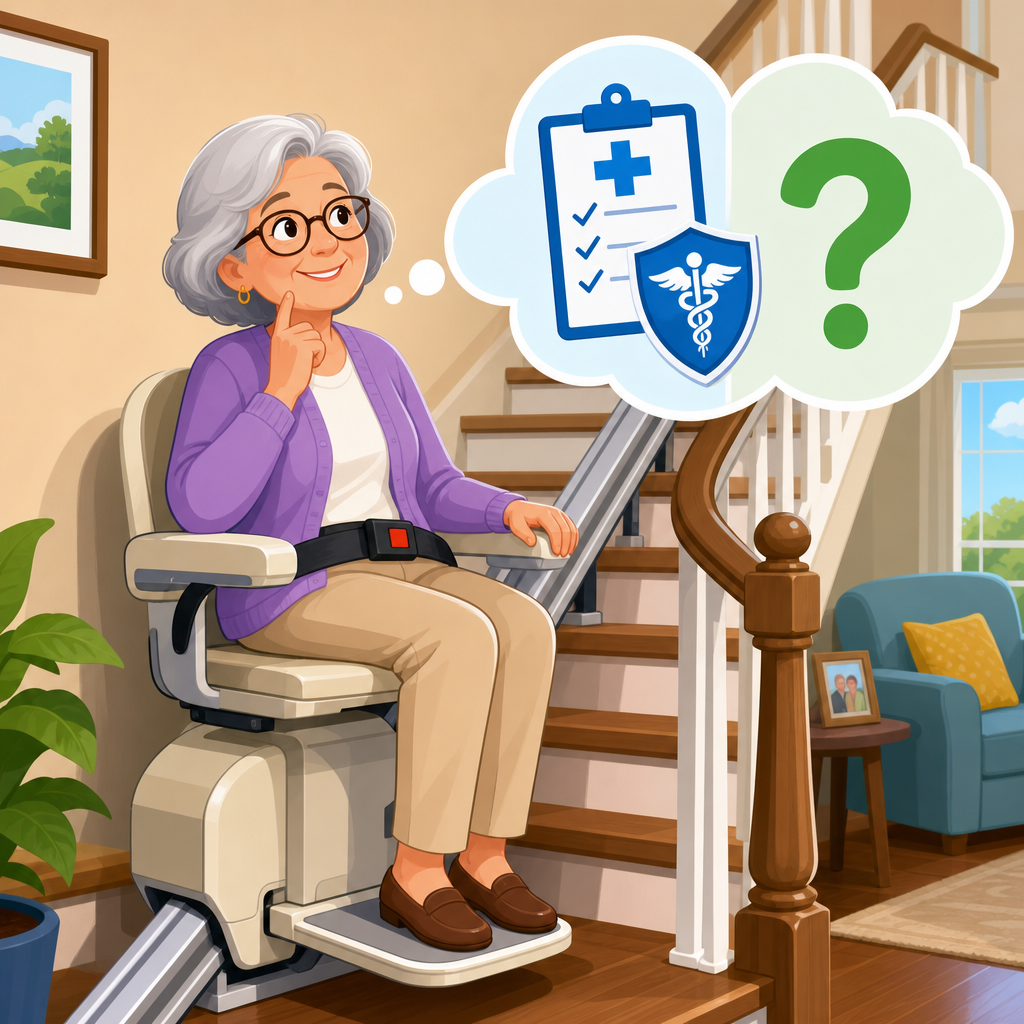
Will Medicare pay for a chair lift? In most cases, original Medicare does not pay for a home stair chair lift, because Medicare usually classifies it as a home modification rather than durable medical equipment. That short answer matters because families often start shopping for mobility solutions during a health crisis, and the difference between a covered medical device and a noncovered convenience item can mean thousands of dollars out of pocket.
A chair lift, sometimes called a stair lift or stair chair, is a motorized seat attached to a rail that carries a person up and down a staircase. It is designed for people who have difficulty climbing stairs because of arthritis, stroke, heart disease, balance problems, neuromuscular conditions, or recovery after surgery. Insurance coverage for chair lifts depends on how a policy defines medical necessity, durable medical equipment, and home accessibility modifications. Those definitions are not interchangeable, and that is where many coverage misunderstandings begin.
I have worked with families comparing estimates, reading Medicare benefit language, and appealing denials for mobility equipment, and one pattern repeats constantly: people assume that if a device clearly helps someone stay safe at home, insurance must cover it. Unfortunately, safety alone is not the coverage test. Medicare and private insurers rely on benefit categories, coding rules, and contract language. A stair lift can prevent falls and support aging in place, yet still be excluded because the policy views the rail, motor, and installation as structural improvements to the home.
This article is the hub for the broader question, does insurance cover chair lifts, with Medicare at the center. It explains what Medicare covers, whether any part of a stair chair might qualify, how Medicare Advantage and Medicaid can differ, what private long-term care insurance may do, and which financing options can close the gap. If you are trying to decide whether to pursue coverage, request a doctor’s order, file an appeal, or compare grants and payment plans, understanding these rules first will save time and help you ask better questions.
Why Original Medicare Usually Does Not Cover a Stair Lift
Original Medicare includes Part A for hospital care and Part B for outpatient and medical services. The part most people ask about here is Part B, because Part B covers certain durable medical equipment when it is medically necessary and prescribed for use in the home. Examples include wheelchairs, walkers, hospital beds, patient lifts, and power scooters when specific criteria are met. Stair lifts generally do not fit into that covered category.
The reason is practical and regulatory. Medicare treats a stair lift as a home modification attached to real property, not as a stand-alone medical device primarily serving a medical purpose. The track is custom installed along the stairs, often anchored into stair treads, and intended to function as part of the home environment. Even though the chair, footrest, motor, and controls are mechanical components, the overall system is usually evaluated as an accessibility improvement rather than durable medical equipment under Part B.
That distinction is consistent with how Medicare approaches many accessibility upgrades. Ramps, widened doorways, roll-in showers, and stair glides may be essential for independent living, but they are not typically covered by original Medicare. In contrast, a patient lift that transfers a person from bed to chair may be covered because it is recognized as durable medical equipment and not considered a permanent home alteration.
For families, the key takeaway is direct: if you are asking, will Medicare pay for a chair lift for stairs in my house, the usual answer is no under original Medicare. You should still verify your exact situation with Medicare or your supplier, but planning as though the full stair lift cost will be your responsibility is generally the safest assumption.
Can Any Part of a Chair Lift Be Covered?
There is one nuance that causes confusion. In limited situations, a small component related to a seat lift mechanism may be covered, but that is not the same thing as a stair lift. Medicare has historically covered certain seat lift mechanisms that help a person stand up from a chair when medically necessary, while excluding the chair itself. A seat lift mechanism is a powered device inside a chair that tilts the user from sitting to standing. It does not move a person up a staircase.
Because the phrases chair lift and seat lift sound similar, people often think Medicare denied the wrong item. In reality, these are different categories with different coverage rules. A lift chair recliner sold in a furniture store may include a covered mechanical component if the beneficiary meets criteria and uses a participating supplier, but the upholstery, frame, and nonmechanical portions are not usually covered. A stair lift mounted on stairs is a separate product and is generally not covered by original Medicare.
That difference matters when talking to suppliers. Ask for the exact product description, billing category, and whether the item is being treated as durable medical equipment, a seat lift mechanism, or a home modification. Vague terms lead to false expectations. A contractor who installs stair chairs may not bill Medicare at all, while a durable medical equipment supplier may handle claims for approved mobility devices.
What Medicare Advantage Plans May Cover
Medicare Advantage plans, also called Part C plans, are offered by private insurers and must cover everything original Medicare covers, but they can also provide supplemental benefits. That flexibility creates the best possibility of some help with chair lifts, although coverage is still far from guaranteed. Some plans offer benefits aimed at people with chronic conditions, home safety risks, or functional limitations. These may include allowances for bathroom safety devices, grab bars, air conditioners for qualifying health conditions, transportation, meal support, or broader home modification benefits.
In practice, I have seen Medicare Advantage plans vary widely. One plan may offer no stair lift assistance at all. Another may provide a limited annual flexible allowance that could be used toward home safety equipment. A third may require case management approval and restrict benefits to members meeting strict clinical criteria, such as repeated falls, inability to access a bedroom or bathroom, or documented risk of institutional placement.
If you have a Medicare Advantage plan, do not rely on the summary sentence in the marketing brochure. Read the Evidence of Coverage and call member services. Ask whether stair lifts, stair glides, or home accessibility modifications are covered; whether prior authorization is required; whether there is a dollar cap; whether a network vendor must perform installation; and whether a physician, occupational therapist, or case manager must document medical necessity. Those details determine whether a benefit is real or merely theoretical.
| Coverage source | Typical treatment of stair lift | What to ask |
|---|---|---|
| Original Medicare Part B | Usually not covered | Is any component billable as durable medical equipment? |
| Medicare Advantage | Sometimes partial coverage or allowance | Are home modifications included, and what are the limits? |
| Medicaid waiver | Often possible if waiver allows home modifications | What functional criteria and waiting lists apply? |
| Private health insurance | Usually excluded, but some exceptions exist | Does the policy cover medically necessary accessibility equipment? |
| Long-term care insurance | May reimburse under home care benefits | Does the contract include home modification language? |
Does Medicaid Cover Chair Lifts?
Medicaid is often more promising than Medicare for chair lift coverage, especially through Home and Community-Based Services waivers. Medicaid is jointly funded by federal and state governments, so benefits differ by state. Many state waiver programs are designed to keep older adults and people with disabilities safely at home rather than in nursing facilities. Because of that goal, some states will cover environmental accessibility adaptations, including stair lifts, when they are necessary for the person to remain in the home.
Coverage is never automatic. States may require an assessment showing that the lift is cost-effective, tied to a care plan, and essential for access to living areas. Some programs will only approve modifications to the primary residence, not a second home. Others limit the dollar amount available per year or over a lifetime. Waiting lists can also be long, especially for waiver slots.
The smartest step is to contact your state Medicaid office, Area Agency on Aging, or local disability resource center and ask specifically about home modification benefits under waiver programs. Request the exact program name, eligibility rules, financial limits, and required documentation. If the stair lift could prevent a nursing home admission, say that clearly. That functional and cost-saving argument often matters more than a general statement that stairs are inconvenient.
How Private Insurance and Long-Term Care Insurance Handle Stair Lifts
Employer health plans, marketplace plans, and individual private insurance policies usually follow logic similar to original Medicare: they cover medically necessary treatment and durable medical equipment, but they often exclude structural home changes. That means standard health insurance rarely pays for a stair lift. Still, there are exceptions. Some union plans, retiree plans, or high-value employer plans include broader rehabilitation or case management benefits that may allow partial reimbursement.
Long-term care insurance is different because it is built around assistance with activities of daily living, cognitive impairment, and services that support care outside an institution. Some policies include benefits for caregiver training, care coordination, or home modifications if they help the insured remain safely at home. Whether a chair lift qualifies depends entirely on the contract language. Older policies are especially variable, and benefit triggers matter.
When reviewing any private policy, look for these phrases: home modifications, environmental accessibility adaptations, alternative plan of care, care management, and durable medical equipment. Then ask for a written coverage determination. Verbal assurances from a call center are not enough when a stair lift may cost several thousand dollars.
What a Stair Lift Costs and Why Financing Matters
A straight stair lift generally costs less than a curved stair lift because the rail is simpler and does not need custom bends. In many markets, a straight model with installation may run roughly $2,500 to $5,500, while a curved model commonly ranges from about $10,000 to $20,000 or more, depending on landings, rail length, weight capacity, seat upgrades, and power options. Outdoor units, heavy-duty models, and complex multi-landing systems can cost even more.
Because original Medicare usually will not pay, financing becomes part of the decision. Reputable stair lift companies may offer monthly payment plans, refurbished units for straight staircases, rental programs for short-term recovery, or buyback options. Families should compare not only the purchase price but also warranty length, battery backup, service response time, transferability, and removal fees. A cheaper installation can become expensive if maintenance is poor or the rail cannot be adapted after a home layout change.
Other funding sources can help. Veterans may qualify for assistance through VA programs, especially if mobility limits are service connected or if home modification grants apply. Nonprofit organizations, state assistive technology programs, disease-specific foundations, and local civic groups sometimes offer grants or low-interest loans. Health savings accounts and flexible spending accounts may also be usable if a clinician documents medical necessity, though tax treatment should be verified.
How to Improve Your Chances of Getting Help With Costs
Even when coverage is unlikely, documentation still matters. Start with a physician or specialist note that explains the diagnosis, functional limitations, fall risk, and why stairs block safe access to essential parts of the home. An occupational therapy home assessment is even stronger because it connects the device to daily function, transfers, endurance, and safety. Good documentation helps with Medicare Advantage requests, Medicaid waivers, long-term care claims, veteran benefits, grants, and tax documentation.
Then gather two or three detailed estimates. Each estimate should list the model, weight capacity, rail type, installation requirements, warranty, and any ongoing maintenance plan. If your staircase is curved or narrow, request a site assessment from an experienced installer, not just a phone quote. Accurate measurements prevent budget surprises and make funding applications more credible.
If a plan denies coverage, appeal promptly and specifically. Reference the policy language, attach clinical records, and explain the cost of not approving the lift, including falls, emergency visits, caregiver strain, and possible institutional care. Appeals do not always succeed, but strong facts outperform emotional requests. I have seen approvals happen only after the second review because the first submission lacked a functional assessment and a clear statement that the bedroom and full bathroom were inaccessible without the lift.
Best Alternatives if Insurance Will Not Cover a Chair Lift
If a stair lift is unaffordable or structurally impossible, consider alternatives. A vertical platform lift may work for wheelchair users but is often expensive and may require permits. A first-floor bedroom conversion can sometimes solve the problem at lower cost. Relocating laundry, adding a half bath, installing grab bars, or using a hospital bed on the main floor may reduce immediate risk. For some people, a ramp and threshold modifications provide more value than investing in stairs at all.
The right answer depends on prognosis, home layout, caregiver support, and long-term plans. A person recovering from knee surgery may benefit from a short-term stair lift rental if available. Someone with progressive Parkinson’s disease may need a broader aging-in-place plan, not just one device. Think in systems, not gadgets.
Medicare usually will not pay for a chair lift, but that does not mean you are out of options. Original Medicare generally excludes stair lifts because they are considered home modifications rather than covered durable medical equipment, while Medicare Advantage, Medicaid waivers, long-term care insurance, veteran programs, and nonprofit funding may offer partial help in the right circumstances. The most effective approach is to confirm your policy details, document medical necessity, compare bids carefully, and pursue every realistic funding source before buying. Start by calling your plan, your state benefits office, and a qualified stair lift installer today so you can match the safest solution to the most affordable path forward.
Frequently Asked Questions
Will Medicare pay for a chair lift in my home?
In most situations, original Medicare will not pay for a chair lift installed on a staircase in your home. Medicare generally views a stair chair lift as a home modification or convenience item rather than durable medical equipment that primarily serves a medical purpose. That distinction is important, because Medicare Part B usually covers medically necessary durable medical equipment such as walkers, wheelchairs, and hospital beds, but it does not typically cover structural changes made to a home. Even if a doctor recommends a stair lift because climbing stairs has become unsafe, original Medicare still usually does not approve payment for the lift itself, the track, or the installation costs. For many families, this comes as a surprise, especially when they are trying to quickly make a home safer after surgery, illness, or a decline in mobility.
Why does Medicare usually deny coverage for stair lifts?
Medicare usually denies coverage for stair lifts because of how it classifies the item. To be covered under Part B, equipment generally must meet Medicare’s definition of durable medical equipment, meaning it can withstand repeated use, serves a medical purpose, is appropriate for use in the home, and is not usually useful to someone who is not sick or injured. A stair lift may seem medical in nature, but Medicare often treats it as a home accessibility improvement rather than a covered medical device. In other words, it is considered part of the home environment instead of a standalone piece of medical equipment. Since installation often involves attaching a rail system to the staircase and modifying the home, Medicare tends to place it in the same broad category as ramps, widened doorways, or bathroom renovations. That is why a medical need alone does not necessarily translate into Medicare coverage for a chair lift.
Does Medicare cover any part of a chair lift, such as the seat or motor?
In some discussions about coverage, people hear that Medicare may cover part of a “seat lift mechanism,” but that is not the same thing as a stair chair lift. A seat lift mechanism is a device that helps a person stand up from a recliner or lift chair, and under limited circumstances Medicare may cover the mechanical lifting component if it is medically necessary and prescribed by a doctor. However, Medicare does not usually cover the chair portion itself, and this benefit does not apply to a stair lift that carries someone up and down a staircase. This confusion is very common because the terms sound similar. If you are asking about a chair lift for stairs, original Medicare usually does not pay for it. If you are asking about a lift chair that helps you rise from a seated position, there may be partial coverage for the mechanism only, assuming Medicare’s requirements are met. It is always wise to verify exactly which device is being discussed before making a purchase.
If Medicare will not pay, what other ways can I get help paying for a chair lift?
If original Medicare does not cover your stair lift, there may still be other avenues worth exploring. Some Medicare Advantage plans may offer supplemental benefits that go beyond original Medicare, although coverage varies by insurer and plan, so you would need to review your evidence of coverage or call the plan directly. Medicaid may help in some states, particularly through Home and Community-Based Services waivers or other programs designed to help people remain safely at home rather than move into institutional care. Veterans and surviving spouses may also have access to assistance through the Department of Veterans Affairs, depending on eligibility and medical need. In addition, some state assistive technology programs, nonprofit organizations, local Area Agencies on Aging, and disease-specific charities may offer grants, low-interest loans, or referrals to community resources. Some chair lift companies also provide financing or refurbished units at a lower price. Because these programs differ widely by location and personal circumstances, the most practical approach is to ask a benefits counselor, aging services agency, or case manager to help you identify every available option before paying entirely out of pocket.
What should I do before buying a stair chair lift?
Before buying a stair chair lift, start by getting a professional assessment of the user’s mobility, balance, strength, and home safety needs. A doctor, physical therapist, or occupational therapist can help determine whether a stair lift is the best option or whether another solution, such as a bedroom move to the first floor, a ramp, a wheelchair, or in-home support services, may be more appropriate. Next, contact Medicare or your Medicare Advantage plan, if applicable, so you understand exactly what is and is not covered. If you are pursuing financial assistance through Medicaid, VA benefits, or a local grant program, check the rules before installation, because some programs require prior approval. It is also smart to get multiple quotes from licensed stair lift providers, ask about warranties, maintenance, battery backup, weight limits, and whether the unit can be customized for a curved staircase. Finally, make sure the installer evaluates the home carefully for safety and fit. Taking these steps can help you avoid buying the wrong equipment, paying more than necessary, or missing a possible funding source.